

A Sub-Zero refrigerator is built for long, dependable service. That’s why owners get worried the moment a Classic refrigerator stops cooling. When the temperature climbs, food spoils quickly, and the problem needs attention right away.
The signs are usually clear: the fridge feels warm, butter goes soft, or the temperature on the control panel doesn’t match what your thermometer shows inside. At that point, most people want one simple answer:
“Why is my Classic refrigerator warm?”
The good news: even though the Classic Series is known for durability, cooling problems still happen — and they usually follow recognizable patterns. In this article we explain the real causes of cooling loss in Sub-Zero Classic units, the model-specific signs worth knowing, the checks you can safely do yourself, and the early warnings that a system is starting to fail. If you’d rather have someone look at it in person, our Sub-Zero refrigerator repair team handles Classic units every week.
First, a quick note on names. “Classic” covers two generations: the legacy Classic (BI) models, built from 2008 to 2022 (BI-30U, BI-36U, BI-36UFD, BI-36S, BI-48S and others), and the current Classic (CL) models made since 2022, such as the CL3650U, CL4250UFD, and CL4850S. Older Sub-Zero built-ins like the 511, 550, 590, and 661 come from the earlier 500 and 600 Series, so we’ll mention them separately.
How to Spot Cooling Issues Early
A failing Sub-Zero rarely fails silently. Before it warms up completely, most Classic models show a pattern:
Classic Fridge Warm but Freezer Cold
One of the most misunderstood symptoms. Classic combination units use Sub-Zero’s dual refrigeration: the refrigerator and freezer have separate cooling systems, and no air is shared between them. So a warm refrigerator next to a cold freezer isn’t a “damper” problem — it points to the refrigerator’s own system: its evaporator fan, frost on its evaporator, its temperature sensor, or its controls. Our guide to one side warm, one side cold goes deeper on this split.
Classic Not Getting Cold — Intermittently
Many owners notice temperature swings long before a complete failure. Sub-Zero calls a swing of about 5°F up or down normal, especially after the door has been open or warm groceries went in. Bigger swings, or swings that keep coming back, are worth a closer look.
BI-36 Not Cooling Properly
On the BI-36 over-and-under, French door, and side-by-side models, this usually shows up as uneven shelf temperatures or a compartment that never reaches its setpoint.
BI-48 Not Cooling or Cooling Unevenly
The BI-48 side-by-side holds a lot of food, and it’s often opened many times a day in a busy household. Uneven cooling here is a common reason for a service call, and the first suspects are airflow, frost, and the condenser.
CL3650 Refrigerator Warm
On the newer Classic models, a warm refrigerator section can come from a blocked condenser, a fan or sensor problem, or a control issue. Because these units are younger, a warranty check is worth doing before any repair.
CL4250 Not Cold Enough
Often linked to restricted airflow at the condenser or a compressor that isn’t keeping up.
CL4850 Cooling Failure
On a large side-by-side, a cooling problem tends to grow quickly if it’s ignored.
These symptoms are your refrigerator’s early warnings — signals that one or more systems can no longer hold temperature the way a Classic should.
The Hidden World Behind the Stainless Steel: Actual Causes of Cooling Failure
Every refrigerator looks simple from the outside. Inside, a Sub-Zero Classic is a carefully planned system of coils, sensors, fans, sealed refrigerant lines, separate refrigerator and freezer systems, and electronic controls. Sub-Zero itself lists the usual causes of a warm refrigerator: a fan that isn’t working properly, a temperature sensor or control problem, a compressor, evaporator, or condenser issue, and a problem with the door seal.
Below are the problems we find most often in Classic units.
1. Dirty Condenser Coils: The Most Common Cause of Cooling Decline
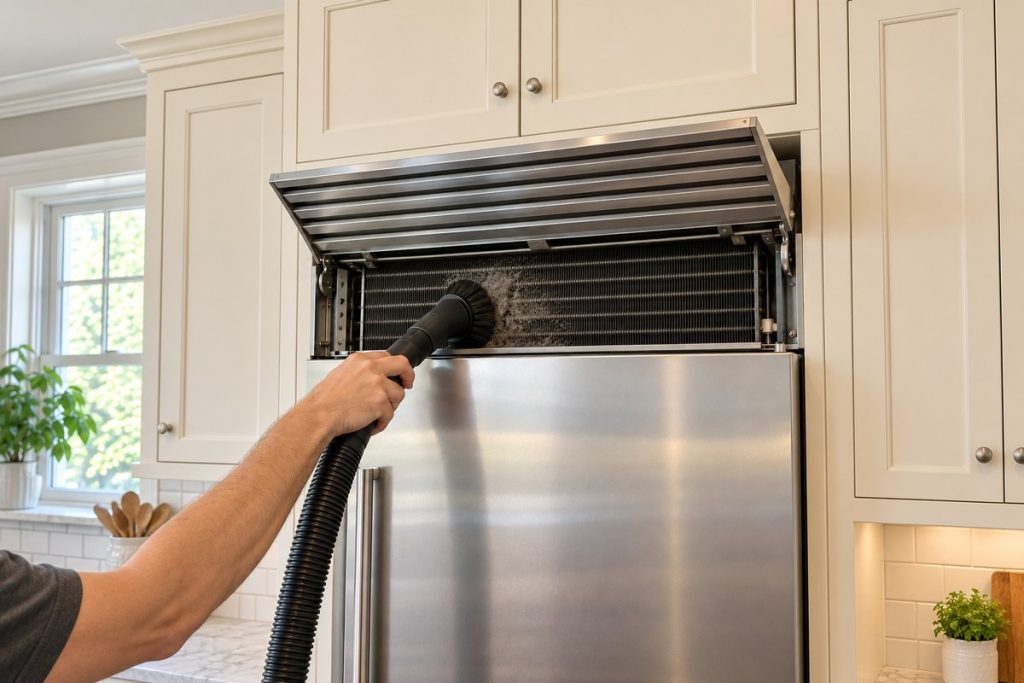
Pollen, dust, pet hair, and lint all end up on the condenser, where they form a mat that blocks the airflow the condenser needs to release heat. On Classic (BI) models, the condenser sits at the top of the unit, behind the flip-up grille. Many Classic units even remind you: a flashing “Vacuum Condenser” or “Service” message on the control panel is a cue to clean it.
When the condenser is dirty, problems follow one after another:
- the compressor runs longer and hotter
- the refrigerant can’t shed heat efficiently
- the system loses cooling capacity
- temperatures rise
- major parts are put under strain
Left long enough, a dirty condenser can lead to compressor damage, one of the most serious outcomes. The cause is simple, but the consequences can be expensive if it’s ignored. Sub-Zero recommends cleaning the condenser every six to twelve months.
2. Temperature Sensor and Control Problems: The “Brain Fog” of a Classic
When owners search “how to troubleshoot a Classic that’s not cooling,” control problems come up quickly — and for good reason. Classic units rely on electronic temperature sensors (thermistors) and a control board to decide when to cool.
Failures can look like:
- the unit thinks it’s colder than it is
- warm compartments even though the fans are running
- cooling that comes and goes
- cycling on and off too often
- zones that are far apart from their settings
On a legacy Classic (BI), the control panel will often tell you directly: EE on the display with the service wrench flashing means a faulty temperature sensor — EE on the left for the freezer, on the right for the refrigerator. There’s no homeowner fix for this one; note the code and call for service. A faulty sensor doesn’t sound dramatic, but it can throw off the whole cooling system.

3. Compressor Problems: When the Heart Stops Pumping Cold
The compressor is the heart of your refrigerator. When it weakens or fails, the signs are hard to miss:
- the refrigerator is warm and the freezer is struggling too
- very long run times
- clicking or humming without much cooling
- sudden warm zones
- temperatures rising no matter the setting
On older Sub-Zero built-ins — the 511, 550, 590, and 661, which come from the 500 and 600 Series — compressor wear is a common finding simply because of their age. A stressed compressor often traces back to:
- a heavily blocked condenser
- a refrigerant leak or restriction
- control problems that keep it running
- a hot room or a poorly ventilated installation
- age
Once the compressor is involved, the do-it-yourself options are over: compressor and sealed-system work must be done by EPA 608 certified technicians. Our guide to Sub-Zero compressor noise explains which compressor sounds are normal and which aren’t.
What You Can Safely Check Yourself
Important safety note: Only do the checks below. Don’t remove panels, touch wiring, or try to work on the compressor or refrigerant lines, and never chip ice or melt it with heat. Anything beyond these checks should be done by a qualified appliance technician.
These steps follow Sub-Zero’s own troubleshooting for a warm refrigerator:
- Check the settings. On an electronic control panel, Sub-Zero recommends 38°F for the refrigerator and 0°F for the freezer. After any change, allow 24 hours for the unit to reach the new setting.
- Check the doors. Make sure nothing is keeping a door from closing all the way, and turn on the door ajar alarm if your model has one.
- Look at the door gasket. A torn or flattened seal lets warm air in. Sub-Zero recommends that a technician replace a damaged gasket.
- Give new groceries time. A big load of warm food raises temperatures for several hours.
- Clean the condenser if it hasn’t been cleaned in the last six months. Press Power on the control panel to turn the unit off, lift the grille, and use a soft brush attachment on a vacuum — no chemical cleaners.
- Know the 48-degree rule. If the refrigerator is above 48°F at a 38°F setting, or the freezer is above 10°F at 0°F, Sub-Zero says cleaning the condenser alone is unlikely to fix it. Clean it anyway — and schedule service.
- Wrench flashing and an alarm, but temperatures are fine? Sub-Zero suggests turning off the home circuit breaker to the unit for 30 seconds, then back on, and watching how it runs.
Why Classic Cooling Problems Need More Than a “Quick Fix”
Every so often we meet someone who tried their own repair after searching “Classic not cooling fix” or “fixing a warm Classic fridge.” The effort is understandable, but Sub-Zero systems, especially the Classic Series, need a level of precision that can’t be improvised.
Here’s why:
- The sealed refrigeration system may only be opened by EPA 608 certified technicians with the proper equipment.
- Diagnosis means reading the control’s error codes and testing sensors, fans, and the compressor — not just guessing.
- The refrigerant charge must be exact; even a small error affects cooling.
- Sub-Zero evaporators and airflow are built specifically for each model.
- Many failures are internal and not visible from the outside.
Whether it’s a legacy Classic (BI), a newer Classic (CL), or an older 500 or 600 Series unit, every generation has its own patterns. If your unit is a BI-30 or BI-36, our BI-30 and BI-36 problems guide covers the age-related issues we see most.
Hot, Humid Summers Make Cooling Problems Worse — Here’s Why
Sub-Zero designs its indoor refrigerators to run in a room between 60°F and 90°F. The warmer the room, the more the unit runs to stay cold. And Sub-Zero notes that units in humid homes without climate control can see the drain pan fill quickly or excess frost build up.
Around Atlanta that adds up:
- Pollen season clogs condenser fins faster.
- Summer heat keeps compressors running longer.
- Dust buildup speeds up wear.
- Built-in installations rely on an open grille for airflow, so anything blocking it hurts cooling.
- Garages, porches, and rooms without air conditioning push a unit outside its design range.
That’s why owners here see Classic units warm up, the refrigerator side go warm while the freezer stays cold, and compressor strain more often than in cooler, cleaner-air regions.
Your Sub-Zero Needs Expert Hands — Not Guesswork
If your Classic is warming up, don’t wait for it to get worse. Sub-Zero systems rarely fix themselves; more often, one problem leads to the next. A proper diagnosis now usually keeps the repair smaller.

Restore the Cold, and Your Confidence
A Classic refrigerator that won’t cool isn’t just a mechanical issue — it’s a disruption to your home, your meals, and your routine. The Classic Series is built like few other appliances, but even the best systems need expert care. Whether you’re dealing with a small temperature swing or a full cooling failure, the right diagnosis gets your refrigerator back to holding temperature — and gives you back your peace of mind.
Is your Sub-Zero Classic warm right now? Schedule Sub-Zero refrigerator repair with PRO Appliance Repair — same- or next-day service across most of metro Atlanta. Our insured, background-checked, EPA 608 certified technicians use genuine OEM parts and back the repair with our workmanship warranty — up to 12 months on Sub-Zero.
FAQ
Why is my Classic refrigerator warm?
The most common causes are a dirty condenser, a fan problem, frost on the evaporator, a faulty temperature sensor or control, a door that isn’t sealing, or a compressor or sealed-system problem. Start with the settings, the doors, and the condenser; if it’s still warm after 24 hours, schedule service.
What causes a Classic fridge to be warm while the freezer stays cold?
Classic combination units have separate refrigerator and freezer systems, so the problem is in the refrigerator’s own system — usually its evaporator fan, frost on its evaporator, its temperature sensor, or its controls. It isn’t a shared damper, because there isn’t one.
How do I troubleshoot a Classic that’s not cooling?
Check the setpoint (38°F refrigerator, 0°F freezer) and wait 24 hours after any change, make sure the doors close and the gaskets are intact, and clean the condenser behind the top grille if it’s been more than six months. If the refrigerator is above 48°F or the freezer above 10°F, schedule service.
Can a dirty condenser really cause major failures?
Yes. A blocked condenser makes the compressor run longer and hotter, and Sub-Zero warns that not cleaning it can lead to temperature loss or mechanical damage. It’s the most preventable cause on this list.
What does EE on my Classic display mean?
On a legacy Classic (BI), EE with the service wrench flashing means a faulty temperature sensor — on the left for the freezer, on the right for the refrigerator. There’s no homeowner fix; write down the code and the current temperatures and call for service.
Do you service older Sub-Zero models and the newer Classic (CL) too?
Yes. We work on legacy Classic (BI) models, current Classic (CL) models, and older 500 and 600 Series built-ins, in 30- to 48-inch configurations.
PRO Appliance Repair is an independent repair company and is not affiliated with, sponsored by, or endorsed by Sub-Zero Group, Inc. Brand and model names are used only to identify the appliances this page is about and remain the trademarks of their respective owners.