

You open the refrigerator and the lettuce has a crust of ice on it. Then you pull the freezer drawer, and it’s not quite as cold as it should be — or it won’t slide back in without a shove. On a panel-ready Sub-Zero that’s supposed to disappear into your cabinetry, that kind of fussiness is the last thing you expect.
It’s frustrating. It’s also, more often than not, fixable — and sometimes the fix is something you can do yourself in a few minutes.
Sub-Zero’s Designer over-and-under refrigerators — the integrated, panel-ready models with the refrigerator on top and a freezer drawer below — are known for their clean look and dependable cooling. Still, after a few years in a busy Atlanta kitchen, a familiar set of complaints shows up: uneven temperatures, a freezer drawer running warm, a drawer that won’t close smoothly, frost where it shouldn’t be, and alarms that go off when everything looks shut.
This guide walks through what typically causes these problems, why they show up, what you can safely check, and when it’s time for a technician. If you’d rather have someone look at it in person, our Sub-Zero refrigerator repair team works on Designer and Classic over-and-under models across metro Atlanta.
A quick note on models. Sub-Zero’s Designer over-and-under line includes the older IT models and the current DET models; the Classic line has its own over-and-under models, such as the BI-30U and BI-36U (legacy) and the CL3650U (current). If your unit is 42 or 48 inches wide with two tall doors, it’s a side-by-side, and our guide to Sub-Zero side-by-side zones out of balance is the one you want.
Temperature Balance Problems: What’s Behind Them
Inside every Sub-Zero over-and-under are two separate cooling systems — one for the refrigerator, one for the freezer — each with its own temperature setting. Sub-Zero presets them at 38°F (3°C) for the refrigerator and 0°F (−18°C) for the freezer.
When something drifts, owners notice the classic signs of imbalance:
- Food freezing in the refrigerator section
- A freezer drawer running warm
- Humidity shifting — condensation or dry spots
- Frost forming where it shouldn’t
- Door or drawer alarms going off seemingly at random
A small swing is normal: Sub-Zero says a fluctuation of about 5°F is expected, especially after a lot of door openings or a big grocery run. Anything more than that usually comes from one of the following.
Aging Sensors & Drift
Each compartment has a temperature sensor (a thermistor — a small probe that reads air temperature) telling the control when to cool. If a sensor reads wrong, the control responds to the wrong number: the display can look perfect while the food says otherwise.
Why It’s Not a Shared-Air Problem
You’ll sometimes read that a “stuck air damper” throws the zones out of balance. On Sub-Zero models with dual refrigeration, the refrigerator and freezer have individual systems, and air isn’t shared between the compartments. So when one side drifts, look at that side’s own parts — its sensor, its fan, its door or drawer seal — not a damper between them.
Weak Evaporator Fans
The evaporator is the cold coil hidden behind the back panel; its fan pushes that cold air through the compartment. When the fan slows down or stops, cold air can’t circulate evenly — one shelf freezes while another runs warm.
Drawer Misalignment Affecting Airflow
A freezer drawer that isn’t fully closed or sealed lets warm, humid air in. That air turns to frost, the frost chokes airflow, and the freezer starts losing ground. On panel-ready Designer models, a custom panel that’s out of alignment is one of the causes Sub-Zero names for a freezer drawer that won’t close.
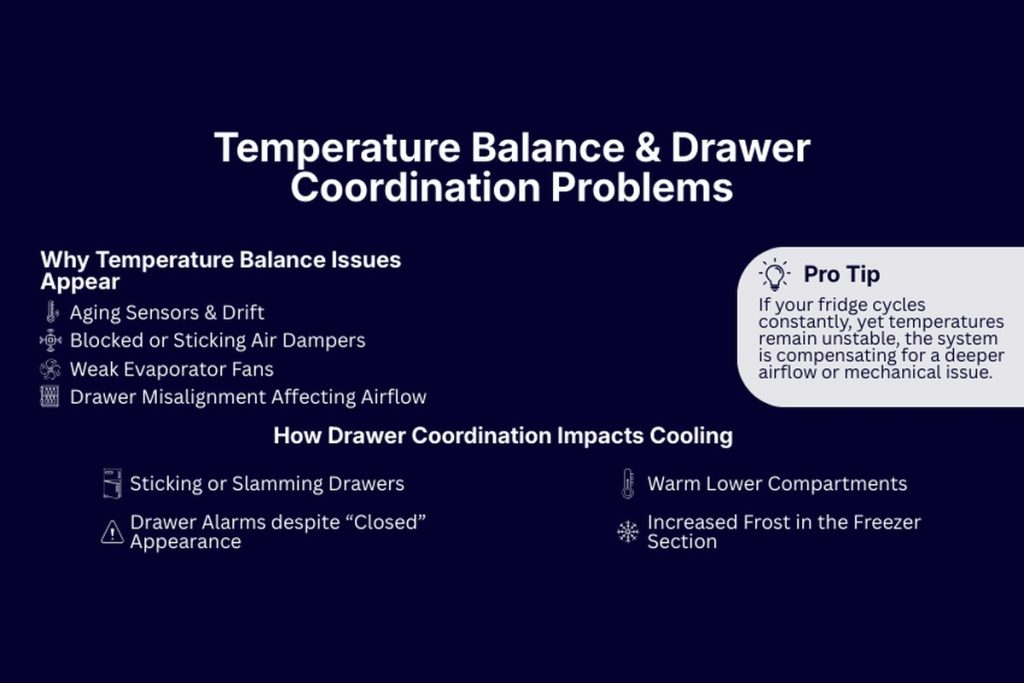
How Drawer Coordination Impacts Cooling
On an over-and-under, the freezer drawer and its baskets do more than hold food. When the drawer closes fully, it seals the freezer. When it doesn’t, the freezer pays for it. Even minor problems lead to:
- Sticking or slamming drawers
- Drawer alarms despite a “closed” appearance
- A warm freezer compartment
- Increased frost in the freezer section
Sub-Zero lists what usually keeps a freezer drawer from closing:
- Food blocking the upper basket or the drawer. One bag of frozen vegetables standing up at the back is enough.
- A custom panel out of alignment on Designer (IT) and overlay models.
- The ice maker’s sensing arm in the lower position, which keeps the upper basket from sliding back. Gently lift the arm to the up position, and make sure it lowers back into the ice bin as you slide the basket back.
- Ice frozen over the drawer slides. That needs defrosting, not chipping.
- A basket installed backwards — on some models it’s possible to put it in the wrong way around.
Heavy, uneven loading and plain wear can also take a toll on the slides over time. A slide that squeaks needs replacing, per Sub-Zero — lubricating it isn’t an option because the inside of the unit is so cold.
Struggling with a drawer that won’t close or a freezer that won’t hold temperature? Book Sub-Zero refrigerator repair and tell us your model when you call.
Homeowner Troubleshooting Steps
Safety first. Before cleaning the condenser, turn power off at the control and wear gloves — the fins are sharp. Don’t chip at ice with a knife or screwdriver. Don’t adjust the custom panel or the leveling legs yourself; Sub-Zero leaves leveling to an installer or service technician. If you smell burning or see damaged wiring, unplug the unit and leave it unplugged.
Here are safe, user-friendly checks you can do yourself, in the right order:
- Clear the path. Remove anything blocking the upper basket or the freezer drawer, and make sure nothing in the refrigerator is pressed against the back wall.
- Check the ice maker arm. If it’s down, gently lift it up, then confirm it lowers back into the bin as you slide the upper basket back.
- Reseat the baskets. Take them out and put them back in, checking that they’re facing the right way.
- Look for ice on the slides. If there is ice, it needs defrosting. On Designer (IT, IC) models with electronic controls, Sub-Zero describes a setting that turns off just one section so its ice can melt; follow your manual for it, keep a towel handy for dripping water, and empty the drain pan if needed (your manual shows where it is).
- Clean the drawer gasket. Mild soap, warm water, a soft cloth. Test: close a dollar bill in the drawer at several points — if it slides out with no resistance, the seal isn’t holding.
- Clean the condenser if it’s been more than 6 months. Sub-Zero recommends every 6 to 12 months, more often with pets; use a soft brush and vacuum, don’t bend the fins, and skip chemical cleaners.
- Check the settings. Make sure both temperatures are where they should be — 38°F and 0°F are Sub-Zero’s presets.
Then give it 24 hours. If the issue comes back, it’s time for a professional diagnosis.
Why Professional Repair Matters
Integrated Sub-Zero units hide a lot. Many airflow and sensor problems are invisible without removing panels or running tests that need the right tools. That’s where we come in. Our EPA 608 certified (a federal certification for handling refrigerant), insured, background-checked technicians handle:
- Temperature imbalance between the refrigerator and freezer
- Temperature sensor testing and replacement
- Evaporator and condenser fan repairs
- Drawer slide replacement and drawer alignment
- Door and drawer gasket replacement
- Sealed-system diagnosis when it really is the cooling system
We’ll tell you straight if a part doesn’t need replacing — so you’re not paying for guesses.
The Bottom Line
Your Sub-Zero Designer over-and-under is engineered for precision, but even high-end appliances need attention as they age. Some drawer and temperature problems really are a stray bag of peas, an ice maker arm, or a basket put in backwards. Others — a failing sensor, a slowing fan, a worn slide — only get worse with time.
Start with the checks above. If the imbalance or the drawer trouble keeps coming back, don’t wait for the freezer to lose a full load of food.
Ready to get it fixed? Schedule Sub-Zero refrigerator repair with PRO Appliance Repair — same- or next-day service across most of metro Atlanta. We use genuine OEM parts (made by the original manufacturer) and back the repair with our workmanship warranty — up to 12 months on Sub-Zero. For drawer sounds specifically, see our guide to Sub-Zero drawer noise.
FAQ
Why is my Sub-Zero over-and-under freezer drawer running warm?
Most often, the drawer isn’t sealing: food blocking the basket, the ice maker arm keeping the upper basket from sliding back, ice on the slides, or a custom panel out of alignment on Designer models. A slowing evaporator fan or a sensor reading wrong are the other usual suspects. Work through the checks above, then give it 24 hours.
What causes the refrigerator and freezer to drift out of balance over time?
Because each compartment has its own cooling system, imbalance usually comes from the drifting side: a sensor, a fan, a seal, or frost choking airflow. A dirty condenser can drag both down. It’s not a stuck damper between compartments — on dual-refrigeration models, the air isn’t shared.
Can I fix a sticking freezer drawer myself?
Partly. Clearing obstructions, lifting the ice maker arm, reseating baskets the right way around, and cleaning the gasket are all fine. Adjusting the custom panel, leveling the unit, and replacing slides are jobs for a technician — forcing them usually makes things worse.
Why does my over-and-under keep beeping even though the drawer looks closed?
Usually the drawer isn’t fully closed or sealed, even if it looks it. Check for food at the back, the ice maker arm, a basket sitting off its rails, or ice on the slides. If the alarm continues with everything clear, have a technician check the drawer alignment and the door switch.
Can I defrost just the freezer on a Designer model?
On Designer (IT, IC) models with electronic controls, Sub-Zero describes a setting that turns off just the freezer section so its ice can melt. Follow your manual’s steps exactly, catch dripping water, and empty the drain pan as needed. In normal operation, though, a Sub-Zero shouldn’t need manual defrosting — if ice keeps coming back, something else needs fixing.
How quickly should I deal with a temperature imbalance?
Soon. A small swing of about 5°F is normal, but a refrigerator holding above 40°F is outside the FDA’s guideline for safe food storage, and a freezer that keeps warming will spoil a full load of groceries. Running out of balance also makes the cooling system work harder. Early attention usually keeps the repair simple.
PRO Appliance Repair is an independent repair company and is not affiliated with, sponsored by, or endorsed by Sub-Zero Group, Inc. Brand and model names are used only to identify the appliances this page is about and remain the trademarks of their respective owners.