
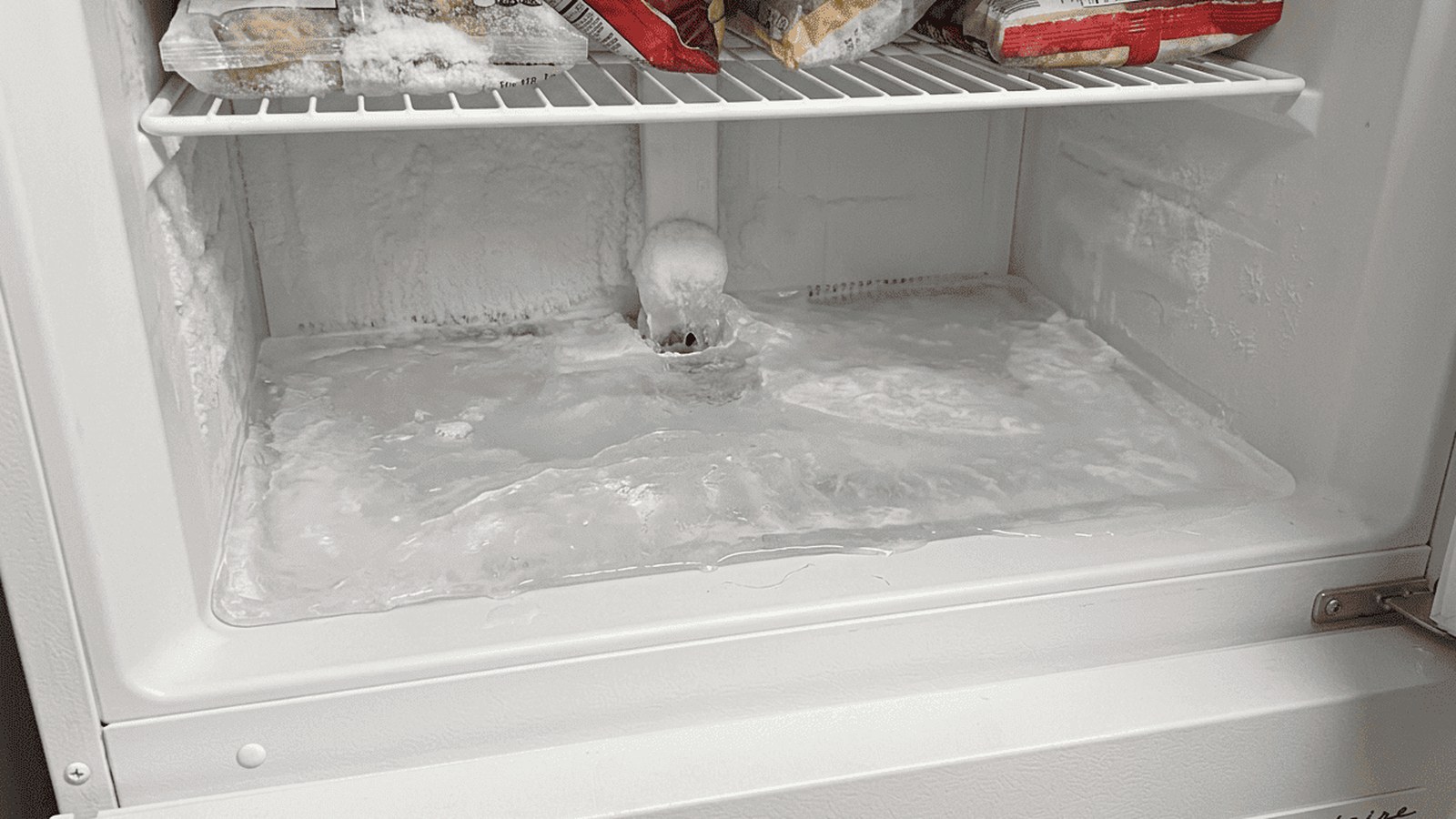
A puddle under the crisper drawers. A sheet of ice on the freezer floor. A damp spot on the kitchen floor that’s back the next morning, no matter how many times you wipe it. If your Frigidaire refrigerator is leaking water, the leak is not random and it will not fix itself. Water inside or under the unit almost always traces back to a blocked drainage path, excess frost buildup, a supply line problem, or humidity getting in.
We see this constantly across Frigidaire French-door, side-by-side, and bottom-freezer models, including the FRFS2823AS and FGHB2868TF. The refrigerator usually still cools properly. That’s what confuses homeowners. The appliance seems to work, but water appears under drawers, inside the freezer, or on the kitchen floor.
In our experience, most cases of leaking water come from
- a clogged defrost drain,
- a frozen drain line,
- a restricted duckbill grommet,
- evaporator coils ice buildup,
- drain pan overflow,
- a damaged water line,
- or a worn door seal.
Each failure leaves a different pattern. Where the water collects tells us what is happening inside the system.
From our guide, you will learn how the defrost drain is designed to work, why it becomes restricted, how moisture turns into repeated leaks, and how to tell whether the issue is internal drainage or an external water line. By the end, you will understand what causes the leak, how serious it is, and whether it requires immediate professional repair.
First, the good news: not every drop of water is a leak. Frigidaire’s own Use & Care Guides say water collecting in the bottom of a crisper drawer is normal, that internal sweating increases in humid weather, and that moisture on the outside or between the doors should disappear when humidity drops. We’ll show you how to tell normal moisture from a real leak.
Water on the floor right now? Our Frigidaire refrigerator repair team will trace the leak to its source and fix it so it doesn’t come back.
The Defrost Drain System: How It Works and Where It Fails
Every modern Frigidaire refrigerator is built to manage moisture internally. Water inside the appliance is not abnormal. Uncontrolled water is.
Here’s what happens during normal operation.
Moisture in the air freezes onto the evaporator coils during cooling cycles. That frost buildup is expected. On a regular schedule, the unit enters a defrost cycle. A heater warms the evaporator coils, melting the accumulated frost. The meltwater flows downward into the defrost drain opening located beneath the evaporator assembly.
From there, water travels through a drain tube, often referred to simply as the defrost drain line, and exits near the compressor compartment. It empties into a drain pan. Heat from the compressor and condenser area evaporates the water. Frigidaire’s guides even mention it: you may hear water dripping into the drain pan during defrost, and a hiss or sizzle as drops hit the defrost heater. Both are normal.
- When this path is clear, you never see the water.
- When it’s not, leaking water begins.
What Is a Clogged Defrost Drain
A clogged defrost drain is the most common cause of internal refrigerator leaks.
Debris builds slowly inside the drain opening. Food particles, packaging fragments, mold growth, and mineral deposits accumulate over time. Once the opening narrows, meltwater backs up during the defrost cycle.
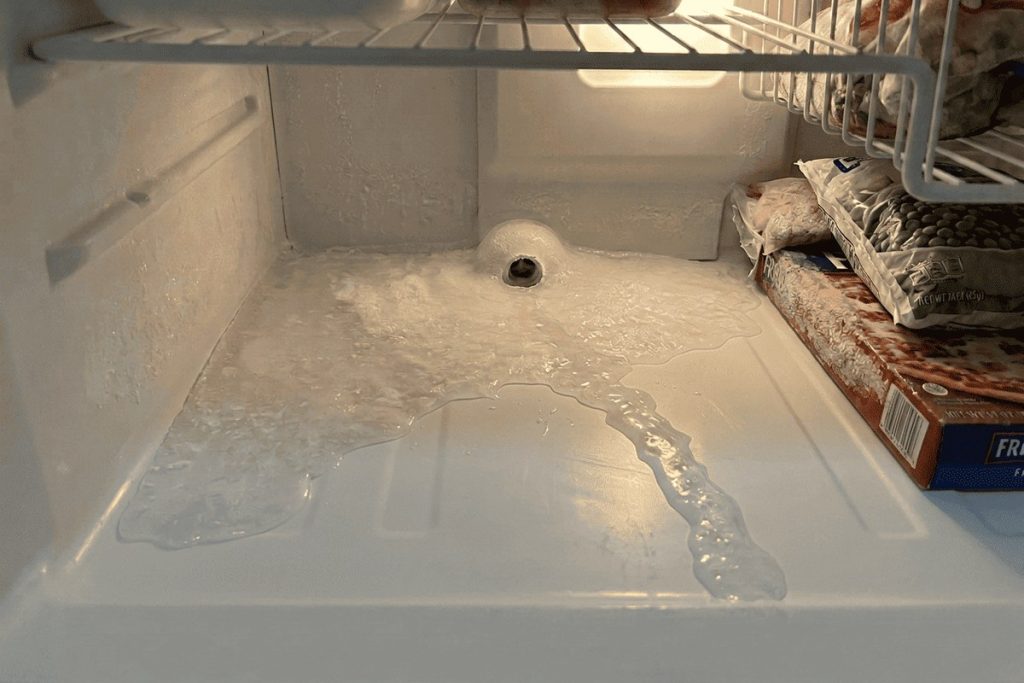
That water has only one place to go: forward into the freezer floor or down into the refrigerator section.
This often shows up as water collecting under the crisper drawers, on the shelf below them or on the cabinet floor. Customers clean it, assume it was a spill, and then it returns days later. (Water inside the drawer itself is a different story; see the pattern guide below.)
That repeat pattern is classic clogged defrost drain behavior.
The key point: clearing surface water does nothing. The restriction remains inside the drain path.
Same puddle, again and again? That’s a drain that needs clearing from the inside. Book Frigidaire leak repair and we’ll clear the restriction properly.
Frozen Drain Line: Why It Refreezes
A frozen drain line is related but slightly different.
When the defrost drain is partially blocked, a small amount of water may pass through while the rest remains near the evaporator area. That standing water refreezes once the cooling cycle resumes.
Over time, ice builds inside the drain tube itself. Eventually, the line becomes fully frozen.
When that happens, each defrost cycle produces more water that cannot exit. The freezer floor fills with ice. As ice thickens, it begins spilling forward.
In FRFS2823AS and FGHB2868TF models, we frequently see thick sheets of ice forming under the lower freezer drawer. Once the ice melts slightly, leaking water appears outside the unit.
Simply thawing the visible ice does not permanently solve a frozen drain line. If the root restriction remains, the problem repeats.
The Duckbill Grommet: Small Part, Big Problem
At the bottom of many refrigerator drain tubes sits a small rubber fitting called a duckbill grommet.
Its purpose is simple: allow water to exit while preventing warm air and debris from traveling upward into the drain tube.
Over time, that rubber can harden, collapse, or collect sediment. When it narrows, water flow slows. Instead of draining freely, meltwater backs up.
This backup contributes to both clogged defrost drain conditions and frozen drain line formation.
We have replaced plenty of these small drain valves on units where no other part was faulty. Once removed or cleaned, drainage returned to normal. It’s a small part creating large leaks.
Evaporator Coils Ice Buildup and Drain Overload
Sometimes the drainage system itself is not the original problem.
Excess evaporator coils ice buildup can overwhelm the drain path.
When airflow becomes restricted or humidity increases due to a worn door seal, frost accumulates more heavily on the evaporator coils. During defrost, that heavier frost melts into a larger volume of water.
If the defrost drain is even partially restricted, the extra meltwater cannot clear quickly enough. It overflows.
In this scenario, leaking water is a secondary symptom. The underlying issue may involve airflow imbalance or sealing failure.
This is why proper diagnosis matters. Clearing a drain without addressing evaporator coils ice buildup only delays recurrence.
Drain Pan Overflow: The External Indicator
Once water exits the drain tube, it enters the drain pan beneath the refrigerator.
Under normal conditions, this pan never fills completely. Heat from the compressor and condenser fan area evaporates the water gradually.
Drain pan overflow happens when:
- Excess water accumulates too quickly
- The pan is misaligned
- The refrigerator is not level
- Evaporation is insufficient
If you see leaking water beneath the appliance and the interior appears dry, drain pan overflow becomes likely.
This is more common in high-humidity environments or when multiple drainage issues combine.
How the Pattern of Water Tells the Story
Leak location is the first thing our technicians look at. It tells us most of the story.
- Water under the produce drawers: a clogged defrost drain
- Ice sheet under the freezer basket: a frozen drain line
- Water dripping from the rear bottom: drain pan overflow
- Water near the supply connection: a water line issue
- Moisture along the door frame: a door seal problem
Each pattern narrows the cause without guessing.
Why These Problems Appear
Drain-related failures are progressive.
A small restriction becomes a full clog. A partially frozen drain line becomes solid ice. A hardened duckbill grommet closes further. Excess evaporator coils ice buildup increases meltwater volume.
Left without attention, these conditions can lead to:
- Interior liner warping
- Electrical exposure
- Mold growth
- Flooring damage
External Leak Sources: Water Line, Door Seal, and Pressure-Driven Moisture
Not every case of leaking water comes from the defrost drain. Once we rule out internal drainage restriction, we look at external water supply and air infiltration.
These failures behave differently. The water pattern is different. The repair approach is different.
Damp floor behind the fridge? Let our Frigidaire technicians check the water line and fittings before the damage spreads.
Water Line Leaks: Slow Drips That Go Unnoticed
Many Frigidaire units, including bottom-freezer models like the FRFS2823AS, are connected to a household water line for the ice maker and dispenser.
That water line typically runs:
- From the wall supply valve
- Into the rear inlet valve
- Through internal tubing
- Toward the ice maker assembly
A compromised water line does not usually create large puddles immediately. It creates slow seepage.
In field cases, we often see:
- Damp flooring directly behind the refrigerator
- Mineral buildup around the inlet valve
- Dripping only during ice production cycles
The reason is pressure.
The water line is only under active pressure when the inlet valve opens. If a fitting is loose or a tube has developed a micro-crack, water escapes during those few seconds.
Homeowners often misinterpret this as intermittent leaking water. It’s not intermittent. It’s pressure-triggered. Frigidaire’s own installation checklist asks for no water leaks at any connection, rechecked 24 hours after installation. Frigidaire also warns that plastic supply tubing greatly increases the potential for leaks and recommends copper or stainless-steel braided tubing.
On side-by-side models, tubing that passes near the door hinge can fatigue over time from door movement. When that happens, leaks appear near the bottom hinge rather than the rear wall.
The diagnostic clue: interior compartments remain dry. The leak is external and supply-related.
Internal Water Line Routing Failures
Inside the cabinet, tubing runs through insulated channels to reach the dispenser or ice maker.
If insulation shifts or the line rubs against cabinet framing, friction wear may occur over years.
In one bottom-freezer case, we found a pinhole leak in the internal water line where it passed through the freezer door hinge channel. The leak only appeared when the door was opened and the line flexed.
The symptom was leaking water near the front lower corner. No drain restriction was present.
Water line failures often require panel access, not just tightening a rear fitting.
Door Seal Failure: The Hidden Moisture Multiplier
A worn door seal does not leak water directly. It creates the conditions for internal overload.
When the door seal fails to close tightly, warm air enters continuously. Warm air carries humidity. That humidity freezes onto the evaporator coils.
More frost means more meltwater during the defrost cycle.
If the defrost drain is already partially restricted, that extra volume pushes it into overflow.
In larger units with tall, heavy doors, door seal compression loss is common after years of use. Frigidaire’s installation checklist calls for doors that seal completely to the cabinet on all sides.
Field indicators of door seal contribution:
- Condensation near the door frame
- Frost accumulation near the evaporator housing
- Water collecting after heavy door use
Replacing a worn door seal often reduces evaporator coils ice buildup and stabilizes moisture control.
On French-door models, there’s one more part to know: the flipper mullion, the hinged strip on the left door that the right door seals against. Frigidaire’s guides list it as a cause of moisture inside the cabinet, and its adjustment is described in the installation section of the manual.
Ignoring it leads to recurring clogged defrost drain conditions.
Pressure Imbalance and Drain Flow Disruption
Refrigerators rely on gravity and slight pressure differences to move defrost water downward.
If the refrigerator is not level, water may pool instead of draining properly. Frigidaire’s checklists call for a refrigerator that’s level side to side, with the front slightly higher than the back.
In more than one case we’ve seen, a forward tilt of just a few degrees caused water to remain near the drain opening instead of flowing freely.
Over time, sediment accumulates. That sediment becomes the beginning of a clogged defrost drain.
Level alignment is not cosmetic. It affects drainage path efficiency.
Combined Failures: Where Diagnosis Gets Complicated
Some of the most persistent leaking water cases involve multiple contributing factors.
Example case:
FRFS2823AS unit. Our customer reported ice under the freezer basket and water on the floor weekly.
Inspection revealed:
- Partially frozen drain line
- Hardened duckbill grommet restricting flow
- Minor door seal compression loss
Each issue alone might not have caused visible leaking water. Combined, they overwhelmed the system.
Drain cleared. Grommet replaced. Door seal adjusted.
Leak resolved permanently.
That layered diagnosis is why repeated DIY thawing often fails. Only the visible symptom gets addressed.
Drain Pan Overflow Under High Humidity Conditions
Drain pan overflow is less common than a clogged defrost drain, but we see it in specific conditions, especially during peak summer humidity in Atlanta.
Frigidaire says it plainly: the rate of frost buildup and internal sweating increases in humid weather. When indoor humidity rises, refrigerators work harder to remove moisture from the air inside the compartments. More humidity means more frost forming on the evaporator coils. During the defrost cycle, that heavier frost load melts into a larger volume of water. Under normal airflow conditions, this increased meltwater still evaporates from the drain pan without issue.
The problem begins when condenser airflow is restricted.
The condenser fan is responsible for moving warm air across the compressor area and the drain pan. That airflow accelerates evaporation. If the underside of the refrigerator is coated in dust, lint, or pet hair, the condenser fan cannot move air efficiently. Heat builds up around the compressor, and evaporation slows.
When evaporation slows but meltwater volume increases, the drain pan can fill faster than it dries. At that point, water begins dripping from the base of the appliance.
We frequently see this pattern in homes with pets. Hair and dust accumulate heavily around the condenser fan housing. Once airflow is restored and the area is cleaned thoroughly, evaporation returns to normal and the leaking water stops — without any repair to the defrost drain itself.
Pattern Recognition for DIY Attempts
When we approach leaking water complaints, we classify by pattern:
Interior pooling under drawers: likely a clogged defrost drain or frozen drain line.
Ice forming before leaking: a frozen drain line with evaporator coils ice buildup.
Rear-bottom dripping: drain pan overflow or a water line fitting issue.
Front-corner leak near the hinge: water line fatigue or routing wear.
Moisture near the door frame: a door seal letting humidity in.
Water inside the crisper drawer itself: often normal. Frigidaire says to dry produce before storing it and, on models with a humidity control, to move it to a lower setting.
Each pattern narrows the mechanical cause before parts are removed.
Why Some Frigidaire Leaks Keep Coming Back
One of the most frustrating situations for homeowners is when leaking water returns weeks after the refrigerator was fixed. The ice melted. The visible blockage was cleared. The floor was dried. Everything looked normal until the puddle came back.
When that happens, the original repair addressed the symptom, not the mechanism behind it.
To understand why leaks repeat, we have to look deeper at how the defrost system actually operates and what influences meltwater volume.
Defrost Cycle Timing and Meltwater Volume
During normal cooling operation, frost accumulates on the evaporator coils. The control board triggers a defrost cycle at scheduled intervals. A heater warms the coils, melting accumulated frost. Meltwater drains downward through the defrost drain.
The amount of water produced during each cycle depends on two factors:
- How much frost accumulated.
- How long the defrost heater runs.
If airflow is partially restricted or a door seal allows excess humidity inside, frost builds up more heavily than intended. When the defrost heater activates, it melts a larger mass of ice. That produces a higher volume of water in a short period.
If the defrost drain is even slightly restricted, that surge overwhelms the drain opening.
Clearing a clogged defrost drain without correcting excessive frost accumulation guarantees recurrence.
Airflow Restriction and Evaporator Coils Ice Buildup
Air must move freely across the evaporator coils. When airflow is reduced — due to blocked vents, overloaded shelves, or fan performance issues — frost accumulates unevenly.
Uneven evaporator coils ice buildup creates concentrated meltwater flow during defrost. Instead of gradual drainage, the system experiences periodic overload.
On bottom-freezer units like the FGHB2868TF, we’ve seen food packaging block internal vents. The result was localized frost accumulation near the lower evaporator section. When defrost occurred, water exceeded drain capacity and leaked forward.
The refrigerator was not defective. The airflow path was compromised.
This is why leak diagnosis sometimes includes inspecting vent pathways, not just the drain line.
Temperature Sensor Influence on Defrost Duration
Many modern refrigerators use temperature sensors to help end the defrost cycle. If a sensor reads slightly off due to age or calibration drift, the defrost heater may run longer than necessary.
Longer heater operation melts more frost than usual. More meltwater enters the defrost drain at once.
A partially restricted drain that once handled normal volume now becomes insufficient.
We have seen this pattern in older units where defrost timing drifted gradually over years. The drain line was not fully blocked, but it could not handle the increased output.
When evaluating recurrent leaking water, we do not stop at clearing the drain. We confirm that defrost operation is within specification.
The Frozen Drain Line Cycle
A frozen drain line often appears solved after manual thawing. The freezer floor looks clear. The water stops.
If sediment or debris remains inside the defrost drain tube, water cannot flow freely. During defrost, some water drains. Some remains. That residual moisture refreezes as soon as cooling resumes.
Each cycle adds another thin layer of ice inside the tube. Over time, the drain narrows again.
Without clearing the entire tube length and verifying the duckbill grommet opening at the base, a frozen drain line almost always repeats.
We have opened drain assemblies where only the top inch had been cleared during earlier repair attempts. The lower tube remained partially obstructed.
Door Seal Compression Loss and Humidity Load
A worn door seal does not drip water directly, but it changes the internal moisture balance.
When warm air leaks into the cabinet, humidity increases. That humidity freezes onto the evaporator coils. Increased frost means increased meltwater during defrost.
Even a healthy defrost drain can be overwhelmed by excessive moisture load.
In models with larger freezer compartments, we often find slight door seal compression loss near the lower corners. It may not be visible, but it is enough to increase humidity infiltration.
Replacing or reseating the door seal reduces evaporator coils ice buildup and stabilizes drainage volume.
Ignoring it leads to repeat leaking water cases.
Drain Tube Misalignment After Service
Another overlooked cause involves service misalignment.
If the refrigerator has been moved for flooring, cleaning, or previous repair, the drain tube at the rear may shift. If the duckbill grommet is not seated properly into the drain pan area, water may drip outside the pan rather than into it.
This presents as drain pan overflow, but the pan itself is not full. The tube is simply misdirected.
We have corrected multiple leaking water complaints by repositioning the drain tube to align properly with the pan opening.
It is a simple oversight that causes persistent leaks.
Leveling and Gravity Flow
Drainage relies on gravity. If the refrigerator tilts forward slightly, water may pool near the defrost drain opening rather than flowing downward.
Pooling increases sediment accumulation at the drain entrance. That sediment becomes the beginning of a clogged defrost drain.
In older homes with uneven flooring, we often adjust the leveling as part of leak correction. Leveling takes tools and means moving a heavy appliance, so we don’t list it among owner checks.
This is not cosmetic. It ensures proper gravitational flow through the defrost drain.
Mechanical Nuances: What Happens If Leaks Are Ignored
Leaking water may begin as a small inconvenience. Over time, repeated moisture exposure creates secondary damage.
We’ve seen cases involving:
- Interior liner distortion from repeated freeze-thaw pooling.
- Mold growth beneath crisper drawers.
- Electrical connector corrosion in the lower cabinet.
- Hardwood floor swelling beneath the appliance.
Drain-related issues are rarely catastrophic in the beginning. They become costly when ignored.
Diagnostic Mapping: Matching Symptom to Failure
Below is a structured mapping based on field patterns.
| Symptom | Most Likely Cause | Secondary Checks |
|---|---|---|
| Water under crisper drawers | Clogged defrost drain | Frozen drain line |
| Water inside a crisper drawer | Normal humidity from produce | Humidity control setting |
| Ice sheet under freezer basket | Frozen drain line | Evaporator coils ice buildup |
| Water dripping at rear base | Drain pan overflow | Drain tube alignment |
| Damp near hinge | Water line fatigue | Door seal compression |
| Condensation along frame | Door seal or flipper mullion | Humidity load |
Pattern recognition shortens repair time and prevents part replacement guesswork.
How We Approach a Frigidaire Leaking Water Case
When a customer calls about leaking water, we don’t start by pulling panels. We start by mapping the pattern.
First, we identify where the water appears. Under drawers? On the freezer floor? Behind the unit? Near the hinge?
Next, we determine whether the leak follows a defrost cycle, an ice production cycle, or appears continuously.
Then we verify three systems:
- Drainage path integrity — defrost drain, frozen drain line, duckbill grommet.
- Moisture load — evaporator coils ice buildup, door seal compression, airflow balance.
- External supply — water line routing, inlet valve connections, drain pan alignment.
Only after isolating the category do we correct the failure point.
That process prevents repeat leaks. Clearing ice without opening the drain tube is incomplete. Replacing a water line without checking pressure cycling is incomplete. Adjusting a door seal without inspecting frost accumulation is incomplete.
Water does not appear without cause. We track it back to origin.
What You Can Safely Check Yourself
Safety first: don’t remove panels or the kick plate, don’t touch wiring, and don’t loosen water fittings. Keep water away from outlets. If water reaches anything electrical, unplug the refrigerator by the plug, not the cord, and call a technician.
Without tools, you can:
- Note exactly where the water appears: inside a drawer, under the drawers, on the freezer floor, behind the unit, or near a hinge.
- Dry your produce before storing it, and on models with a crisper humidity control, try a lower setting.
- Check that every door closes and seals on all sides, and that nothing inside keeps a door from closing.
- Look (don’t reach) behind the refrigerator for damp flooring or mineral crust around the water connection.
- Keep the area around the base clear of dust and pet hair so the drain pan can evaporate.
When Leaking Water Requires Immediate Attention
Not every puddle is urgent. Some are manageable if addressed quickly. Others require immediate repair.
Schedule service without delay if:
- Water reaches electrical components beneath the unit.
- Ice continues forming repeatedly under the freezer basket.
- The floor beneath the refrigerator feels soft or warped.
- The drain pan fills faster than it evaporates.
- The leak worsens over a short period.
Drain-related leaks rarely correct themselves. If the pattern is repeating, the restriction is still present.
Why Proper Repair Matters
Melting visible ice, wiping up water, or tightening an obvious fitting may reduce visible leaking water temporarily, but they do not eliminate sediment inside the defrost drain, clear the entire frozen drain line, or correct airflow and humidity imbalance.
We check the whole system: the full drain tube, the drain valve at its end, the water line, the door seals, leveling, and condenser airflow. When the full system is evaluated, the leak does not return.
Our EPA 608 certified, background-checked technicians bring 15+ years in the field and genuine OEM parts, and our repairs carry a warranty of up to six months. We’re an independent repair company, not affiliated with Frigidaire.
Final Thoughts
A Frigidaire leaking water is not a mystery problem. It is a moisture management failure.
In most cases, the cause is a clogged defrost drain or frozen drain line. In others, it may involve a restricted duckbill grommet, evaporator coils ice buildup, drain pan overflow, a compromised water line, or a worn door seal.
The pattern of water tells the story.
Correct diagnosis prevents repeated service, protects flooring, and preserves the appliance.
If your refrigerator is leaking water, don’t wait for it to get worse. Water always travels farther than you expect. Ready to stop the puddles? Book Frigidaire refrigerator repair in Atlanta and across Georgia. Same- or next-day service is available most days.
Frequently Asked Questions
Why is my Frigidaire leaking water but still cooling properly?
Most leaks are drainage-related. A clogged defrost drain or frozen drain line allows defrost meltwater to escape into the cabinet or onto the floor while cooling remains unaffected.
How do I know if it’s a clogged defrost drain?
Water under the crisper drawers or ice forming on the freezer floor are strong indicators of a clogged defrost drain or restricted drain path. Water inside a crisper drawer, though, is often just humidity from the produce; Frigidaire calls that normal.
What is a duckbill grommet and why does it cause leaks?
The duckbill grommet sits at the bottom of the drain tube and allows water to exit. If it hardens or clogs, water backs up and contributes to leaking water inside the unit.
Can a door seal cause leaking water?
Yes. A worn door seal allows humid air inside. Increased humidity leads to evaporator coils ice buildup and heavier defrost meltwater, which can overwhelm the defrost drain.
Why does the leak return after I melt the ice?
Melting ice does not remove sediment inside the drain tube. If the defrost drain remains partially restricted, the frozen drain line will return.
Is drain pan overflow serious?
Drain pan overflow can indicate excessive meltwater or poor evaporation due to restricted condenser airflow. If left uncorrected, it may contribute to compressor stress.