
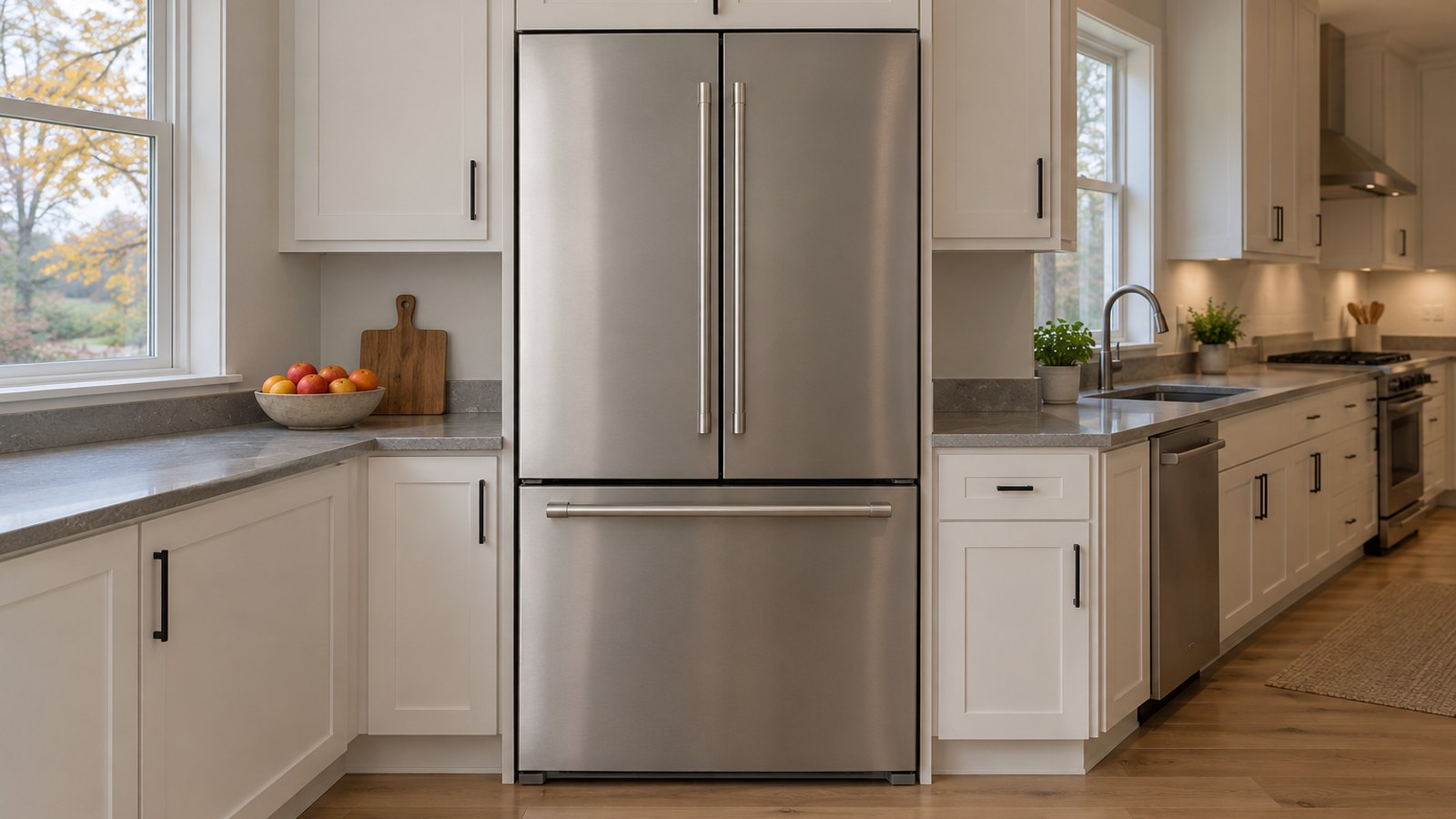
You reach for the milk and it’s cool, not cold. The freezer drawer still feels icy, the display looks normal — yet the Bosch you picked for its clean lines and quiet hum isn’t keeping up. Or the ice bin is empty, or there’s a damp spot by the toe kick. Frustrating, especially on a refrigerator that probably came with a remodel.
The reassuring part: most Bosch 800 Series problems trace back to a short list — airflow, door sealing, the water path, a mode or setting, or installation. A warm fresh-food section may be airflow, not a sealed-system failure. Noise may be a fan hitting frost, not a dying compressor.
In this guide: what you’re seeing → what it usually means → the safe checks → the signs that shouldn’t wait → the warranty gaps after year one. Prefer a diagnosis right away? Our Bosch refrigerator repair team works on these units across metro Atlanta.
Quick Answer: What Usually Goes Wrong With a Bosch 800 Series Refrigerator?
| What you notice | What it may point to | Safe first check |
|---|---|---|
| Fresh-food section warm | Airflow, damper, fan, sensor, defrost, door seal | Move food off the vents |
| Freezer warm too | Compressor start, controls, fan, sealed system, power | Confirm power and settings |
| No ice | Filter, water supply, fill tube, freezer temperature | Make sure the ice maker is on |
| Slow dispenser | Filter, water pressure, valve, frozen line | Check filter seating |
| Water underneath | Water connection, valve, filter housing, defrost drain | Look — don’t touch the line |
| Buzzing or grinding | Fan hitting frost, compressor, valve, ice maker | Note where and when |
| GFCI trips | Moisture, compressor start, wiring, outlet | Stop resetting it |
| Cracked glass | Impact, thermal shock, frame pressure | Stop using it |
Technician tip: the symptom is often one step away from the failed system — check before replacing, and you won’t pay for parts you don’t need.
Safety first: only attempt the checks in this guide. Don’t remove panels, touch wiring or reach into a grille while the unit runs — beyond these checks, it’s a technician’s job. Don’t touch water fittings or hoses; the line stays under house pressure. The one exception: for a damaged or leaking appliance, Bosch’s safety instructions say to unplug it or switch off its breaker and turn off the water. Burning smell or water at the outlet? Skip the checks and call.
Know Your Bosch 800 Series Refrigerator Before Troubleshooting
The 800 Series is a family, not one machine. Most homes have a 36-inch French door bottom-mount; there’s also a glass-door version with a Refreshment Center. VitaFresh, Home Connect, AirFresh, MultiAirFlow, dual compressors and an interior water dispenser vary by model.
So the model number matters. Bosch lists the B36CL80ENS at 72 × 35 5/8 × 27 13/16 inches, with a 72 × 36 × 25-inch cutout, VitaFresh Pro, Home Connect, an interior filtered dispenser and dual compressors. The B36CT81ENS is the same size with different features.
Before calling, write down: the E-Nr. (product number) and FD (production number) from the rating label — Bosch’s manual says service needs both — plus the symptom, real temperatures, any alert, and what changed recently.
Bosch 800 Series Refrigerator Not Cooling Properly
Cooling problems are our most urgent calls — once food warms, there’s a real clock. And a Bosch that isn’t cooling may still have lights and fan noise: awake, while one part has quietly quit.
What may be happening
The evaporator fan (it pushes air across the cooling coil) is weak or stopped. Frost blocks airflow. A sensor misreads the cabinet, or the damper — a flap that meters cold air — sticks. Worn gaskets let humid air in. Or the compressor, its start components or the sealed system needs diagnosis.
Atlanta heat matters: a hot kitchen or a tight enclosure leaves less margin, and Bosch’s manual warns against covering the external ventilation openings.
Safe checks before you call
- Doors and vents. Make sure every door closes fully and food sits off the vents and the back wall.
- Settings. Bosch recommends 37°F (3°C) for the refrigerator and 0°F (−18°C) for the freezer. Vacation and eco modes hold the fresh-food side at 43°F (6°C) on purpose — make sure neither is on.
- Frost. A thin layer on the refrigerator’s back wall is normal; Bosch says that wall defrosts automatically. The freezer is NoFrost, so heavy frost there is a real clue.
- App. Check Home Connect for alerts.
Lights on, no cooling at all? Bosch’s manual lists demo mode as one cause — switch it off exactly as your edition describes.
Call right away if it stays warm past the recovery time (Bosch says a restarted unit needs several hours), both compartments are warming, or you hear repeated clicking or start attempts.
Fresh-Food Section Warm, Freezer Still Cold
One of the most common 800 Series complaints. The freezer feels fine, so the fridge seems almost fine — then the fresh-food side keeps drifting up.
Often the system still makes cold; it just isn’t reaching the fresh-food section. Likely causes: the evaporator fan, a blocked air channel, a damper, a defrost failure, a sensor, a leaking gasket, or food packed against the vents. On dual-compressor models, the fresh-food side has its own cooling circuit too. Bosch says MultiAirFlow keeps temperatures consistent “from drawer to door” — frost, a dead fan or a poor seal breaks that.
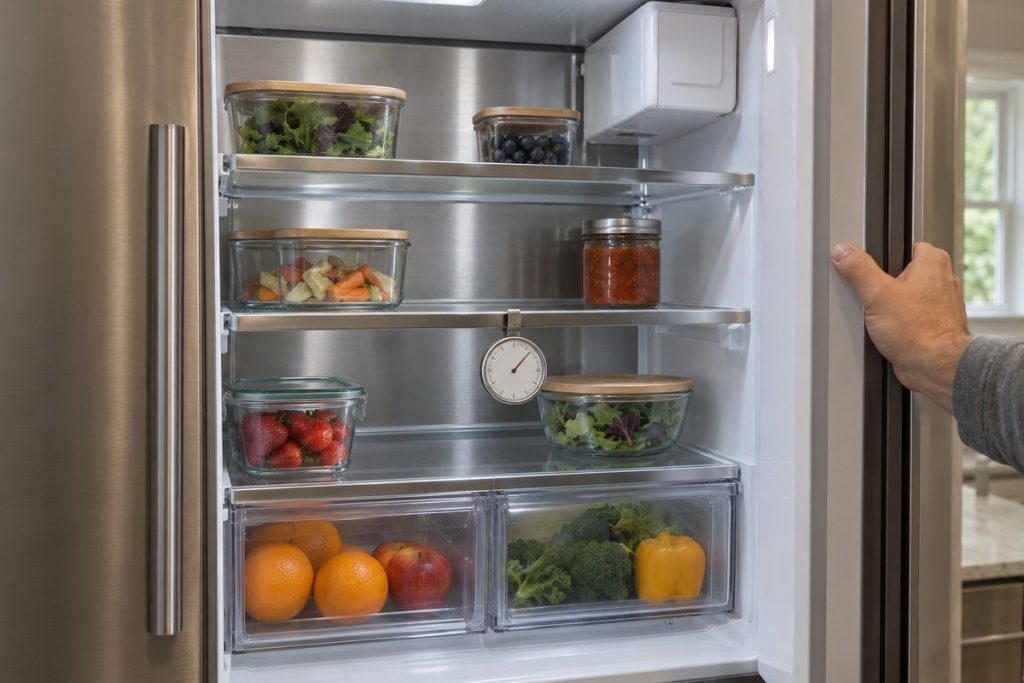
Quick test: a thermometer in each compartment, doors closed for several hours. Freezer normal, fridge warm? → Airflow and sensing go to the top of the list.
Freezer Not Freezing or Ice Cream Soft
Soft ice cream. Bendy frozen vegetables. Clumped ice. The freezer isn’t cold enough to trust.
Check: the drawer closes completely with no packaging behind it, there’s no frost at the gasket, and ice production didn’t change at the same time. Don’t judge right after a big load — Bosch suggests switching on Super freezing beforehand, and rechecking after several hours if the temperature alarm sounds.
Still can’t hold temperature? Schedule service — a freezer problem can become a full cooling problem fast. And per Bosch, don’t refreeze thawed food unless it’s been cooked.
Bosch 800 Series Refrigerator Making Loud Noise
Every refrigerator makes noise. Bosch’s manual lists humming, bubbling, buzzing, gargling, clicking, crackling and rumbling as normal. The question is whether a sound is new, sharp, repetitive — or arriving with a performance problem.
| Sound | Possible source | Why it matters |
|---|---|---|
| Grinding or scraping | Fan blade hitting frost | Often comes with warming |
| Constant loud buzzing | Compressor, valve, fan | Brief is normal; constant isn’t |
| Repeated clicking | Compressor start attempts, relay | Diagnose if temperatures rise |
| New rattling | Loose panel, item touching the cabinet | Often simple |
| Thump | Water valve or house pressure | Tied to ice or dispenser use |
Try Bosch’s easy checks first: bottles touching, wobbly bins, a refrigerator that isn’t level or touches the cabinets. Grinding isn’t on Bosch’s normal list. Tip: record a short video of the sound for the technician.
Ice Maker Not Making Ice
Ice needs two systems at once: a cold enough freezer and water arriving on time. Designs vary — Bosch’s faster QuickIce Pro appears on some Bosch French door models, not every 800 Series — but the diagnostic path is the same.
Common causes: an overdue or poorly seated filter, low water pressure (Bosch calls for at least 29 psi), a kinked line, a frozen fill tube, the inlet valve, a warm freezer, a door switch, or the ice maker module.
Checks, in this order:
- Ice maker on? Vacation and Sabbath modes switch ice production off.
- Just installed? Bosch says the first batch takes about four hours after the freezer reaches temperature — discard ice from the first 24 hours.
- Clear the bin. Objects in it can block the fill level sensor.
- Replace an overdue filter. Weak dispenser flow too? → Think water path.
Spot a kinked hose? Leave it for the technician — Bosch warns never to pull on the water hose at the back.
Read the symptom: cycles but stays dry → water path, valve or fill tube. Never cycles → temperature, switch or module. Small, hollow cubes → supply or filter restriction.
Water Dispenser Slow, No Water, or Strange Taste
Many 800 Series models hide the filtered dispenser inside the fresh-food section. Clean front — but the water still depends on the filter, valve, tubing and your home’s supply.
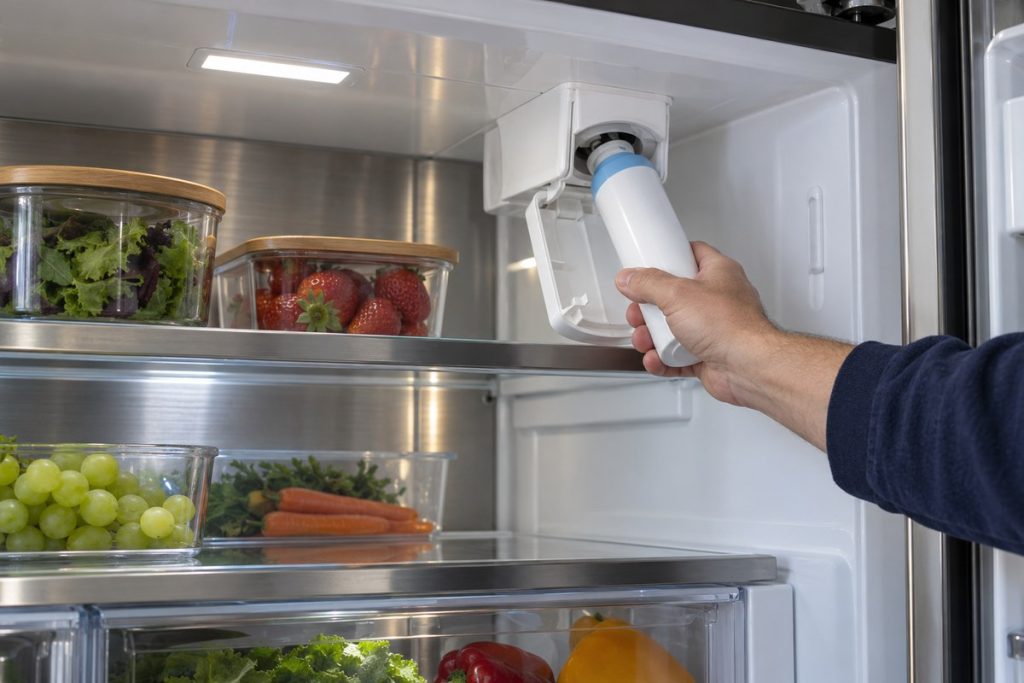
A slow dispenser often follows a filter change: not fully seated, the wrong type, air in the system, or low pressure. Strong before, weak after? → Start with the filter.
Checklist:
- Use the correct Bosch filter, installed exactly as your manual shows — it’s under pressure, so remove it with care.
- After a change, Bosch says to dispense water for five minutes and discard it.
- Dripping dispenser? The manual’s answer is air in the system — keep dispensing until it clears.
Bosch calls for a new filter every six months, when “change filter” lights up, or sooner if output drops. Odd taste? It can be the filter, stale ice or food odors — and Bosch says to flush the system after five days without dispensing.
Water Leaking Under or Inside the Refrigerator
Move fast on leaks. In Atlanta homes, we often see owners discover one only after the hardwood starts to cup or the base cabinet smells damp.
Common sources: the water connection or hose (the first cause Bosch’s manual names), a poorly seated filter or cracked housing, the inlet valve, a blocked defrost drain, the ice maker fill tube, condensation, or drain pan overflow.
Right away: wipe up standing water. Don’t pull the refrigerator out — a loaded 36-inch unit is heavy and the hose is attached at the back. Still leaking, or water near the outlet? Follow Bosch’s instruction: unplug it or switch off its breaker, and turn off the water. Photograph everything for warranty or insurance.
Frost, Condensation, or Sweating Around Doors and Drawers
It starts small: condensation on a drawer, frost near the freezer gasket, droplets along the mullion rail — the flip-out strip where the French doors meet. Then the cabinet smells damp. Atlanta humidity exposes a tired gasket fast.
Possible causes: a door not closing fully, packaging blocking a drawer, a dirty or damaged gasket, misalignment, a mullion rail that doesn’t fold, frequent openings on humid days, or a defrost issue. Bosch’s rule for the rail: never open it by hand — if it’s flipped out, rotate it closed before shutting the door.
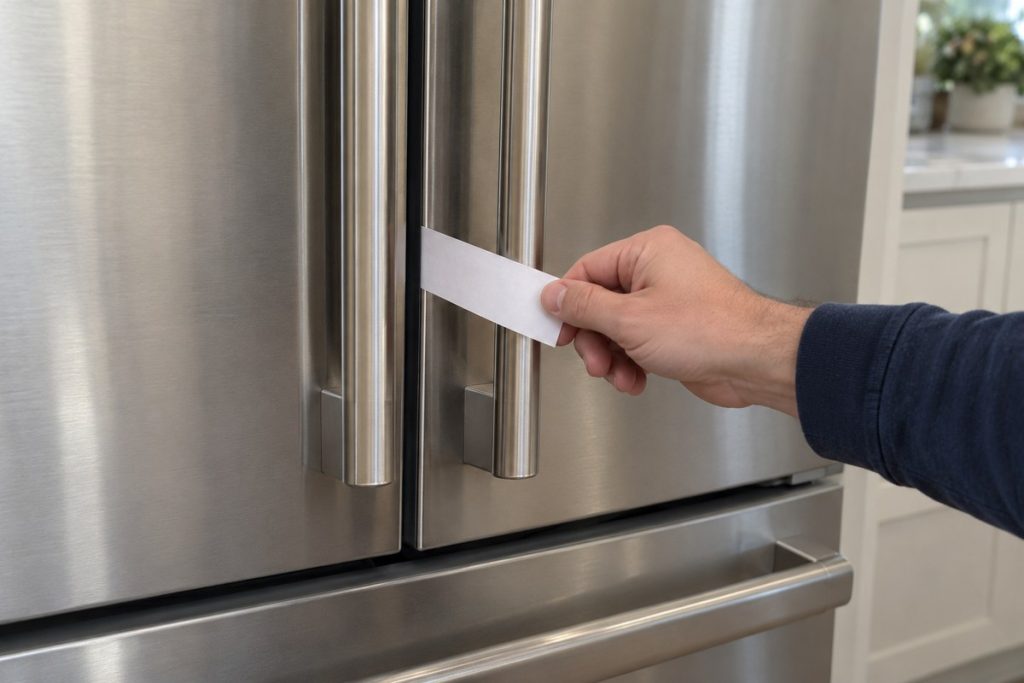
The dollar-bill test: close the door on a bill. Slides out with almost no resistance in several spots? The gasket or alignment needs attention. Not a diagnosis — a free clue.
VitaFresh Drawer Problems and Food Spoiling Too Fast
On VitaFresh Pro models, Bosch says the drawers keep food fresh up to 3x longer than a Bosch without VitaFresh, by balancing temperature and humidity — results vary by food. So when produce wilts early, the drawer gets blamed. Often unfairly.
Before blaming it: check it’s fully seated, confirm the food setting, keep bags off the vents, don’t store produce wet, and track the real temperature.
Spoiling all over the refrigerator? Then it’s not the drawer — drift, airflow, sealing or humidity is affecting the whole cabinet.
Home Connect Alerts, Display Issues, and Control Confusion
Home Connect lets you monitor and control many 800 Series models remotely, and some send a door-ajar notification to your phone. Useful — until the app reports a problem the refrigerator doesn’t seem to have. Sometimes it’s a brief door opening; sometimes it’s a real cooling or control issue. Don’t panic over one alert. Don’t ignore repeats.
How to handle alerts: check real temperatures, ask whether a door was open or groceries just loaded, make sure the app isn’t showing stale data, and screenshot repeats for the technician.
“E” or “d” on the display, or an unresponsive panel? Bosch’s manual says “E” or “d” means the electronics detected a fault. Write it down, then do Bosch’s reset once: switch off, disconnect at the plug or breaker, reconnect after five minutes. Back again? Call.
GFCI Tripping Issues With Bosch 800 Series Refrigerators
Refrigerator circuits can have GFCI protection too — the outlet with “test” and “reset” buttons — especially in garages, basements and remodeled kitchens. If your Bosch trips one, don’t make resetting it a routine.
The cause can be the outlet, moisture, a compressor start, a fan motor, wiring, a control board, or another load on the circuit. Note: does it trip at startup or after ice or water use? What else shares the circuit?
Important: never bypass the protection, and skip the extension cord — Bosch’s manual rules out extension cords and power strips. Repeated trips need a professional.
Glass Panel Shattering, Cracked Shelves, and Glass-Door Concerns
Depending on the model, an 800 Series may have glass shelves, glass covers or glass doors. “Glass panel shattering” covers a broken shelf, a cracked crisper cover, a damaged door panel, or a hairline crack that spreads.
Common contributors: heavy bottles, an overloaded shelf, a hot pot on cold glass, glass not seated after cleaning, a misaligned door pressing on a panel.
Stop using damaged glass: remove food carefully and keep kids and pets away. If the crack looks stress-related, have the supports checked too — or the new glass can crack the same way.
Door Alignment, Gasket Wear, and Cabinet Fit
These refrigerators often go into design-driven kitchens with near-flush openings and tight panels, so installation quality matters more. Out of level or rubbing a cabinet? Door problems become temperature problems, then spoiled food.
Signs: a door that needs an extra push, a rail that doesn’t fold smoothly, gasket gaps, frost near one corner, a cabinet that rocks when doors open.
Bosch’s manual says to level the appliance with a bubble level and the screw feet; in a tight opening, that’s a job for the installer or a technician. A perfect-looking installation can still be mechanically wrong.
Bosch 800 Series Reliability Concerns
An honest take avoids two extremes: every complaint means the product is bad, or premium appliances never fail.
In our experience, most 800 Series concerns land in a few buckets: water and ice, airflow, sensors, sealing, installation — and expectations. A premium Bosch is supposed to be quiet, so a fault feels bigger.
Usually normal: brief fan or compressor sounds, short recovery after groceries, ice maker noises, thin frost on the fridge’s back wall.
Not normal: food warming overnight, repeated temperature alerts, water underneath, repeated GFCI trips, grinding, freezer frost that returns.
Warranty Coverage Gaps Homeowners Should Know
Here’s where owners get caught off guard. Bosch’s warranty page lists a one-year limited warranty on refrigerators — entire appliance, parts and labor. The written warranty for the B36CL models counts those 365 days from the original delivery date and gives cosmetic defects like scratches and dents just 30 days.
Built-in refrigerators get more: parts-only coverage on the entire appliance in year two, on electronics in years three through five, and lifetime parts-only coverage against rust-through on stainless-steel doors. Exact terms are in the manual or warranty supplement.
The gaps: repairs after year one, parts-only periods without labor, leaks blamed on installation, cosmetic flaws found after 30 days, and a refrigerator that came with the house without paperwork.
Worth knowing: Bosch’s written warranty says a repair shop not affiliated with Bosch, or third-party parts, won’t by themselves void it — though Bosch takes no responsibility for damage from repairs outside its own service network. Inside year one, contact Bosch first.
Keep: the receipt or closing documents, the E-Nr. and FD numbers, photos, alert screenshots, installation paperwork and past repair invoices.
Out of warranty, or want a second opinion? We’ll tell you straight whether the repair makes sense — same- or next-day, most days.
Before You Call: A Safe 10-Minute Refrigerator Check
| Check | What it tells you |
|---|---|
| Thermometer readings | The display setting isn’t the real temperature |
| Door closure and gaskets | Many cooling complaints start with warm air getting in |
| Food off the vents | Blocked airflow mimics a mechanical failure |
| Frost pattern | Separates airflow, defrost and sealing issues |
Stop and call now if both compartments are warming, the GFCI trips more than once, water reaches an outlet, you smell burning, or it clicks repeatedly without cooling.
When Bosch 800 Series Refrigerator Repair Makes Sense
Repair usually makes sense when the refrigerator is in good shape, parts are available, and the failure isn’t part of a pattern. Replacement may make more sense with repeated major failures, serious sealed-system trouble, unavailable parts, or a repair approaching the value of a new refrigerator.
Nobody should make that call from the doorway — it comes after a real diagnosis. And if a part doesn’t actually need replacing, we’ll tell you.
What you get with us: 15+ years in appliance repair, including years of hands-on work on Bosch refrigerators · EPA 608 certified, background-checked technicians · genuine OEM parts · a repair warranty covering our work for up to six months, separate from any Bosch warranty.
Bosch 800 Series Refrigerator Repair in Atlanta & Georgia
PRO Appliance Repair is a family-owned team servicing Bosch 800 Series refrigerators across metro Atlanta and nearby Georgia communities, where summer heat and humidity put real strain on seals and cooling systems. Book a visit from our Bosch refrigerator repair page and have your E-Nr. and FD numbers handy.
Final Word
A Bosch 800 Series is built to be noticed for its design and forgotten in daily use. When it starts warming food, leaking or getting loud, it deserves a careful diagnosis — not part-swapping. Do the safe checks, but don’t wait on a warming refrigerator or water near an outlet.
Ready to get it fixed? Our team can take it from here — we’ll fix the source, not just the symptom, and stand behind the work.
Frequently Asked Questions
1. Why is my Bosch 800 Series refrigerator not cooling?
Usually airflow, sealing or a setting comes before a major part: blocked vents, a door not closing, vacation or eco mode (both hold the fridge at 43°F / 6°C), frost or a fan. Freezer cold, fridge warm? Think airflow. No recovery after several hours? Schedule service.
2. Why did my Bosch ice maker stop making ice?
Start free: is the ice maker on, is vacation or Sabbath mode active, is something in the bin blocking the fill level sensor? Then the usual suspects: an overdue filter, low water pressure, a frozen fill tube, the inlet valve or a warm freezer. Slow dispenser too? Start with the water path.
3. My Bosch refrigerator is leaking. What should I do first?
Wipe up the water and don’t pull the refrigerator out. If it keeps leaking, Bosch’s safety instructions say to unplug it or switch off its breaker and turn off the water. Then take photos and call. Usual sources: the water connection, filter, inlet valve, fill tube and defrost drain.
4. Are Bosch 800 Series refrigerators reliable?
They’re premium refrigerators with strong food-preservation features, but not problem-free. Most concerns we see involve installation, airflow, the water and ice system or door sealing — and a proper installation prevents a lot of them.
5. Does the Bosch warranty cover my refrigerator repair?
For a defect within 365 days of original delivery, Bosch’s limited warranty covers the entire appliance, parts and labor. Built-in models add parts-only coverage later, without labor. Terms depend on your model and warranty supplement — inside year one, contact Bosch first.
6. How soon can you come fix my Bosch 800 Series in Atlanta?
Usually same- or next-day across metro Atlanta. Have the E-Nr. and FD numbers ready and describe the symptom when you book — our EPA 608 certified, background-checked technician will know what to look for.
Disclaimer: PRO Appliance Repair is an independent repair company and is not affiliated with or endorsed by BSH Home Appliances Corporation or Robert Bosch GmbH. All trademarks belong to their respective owners.