
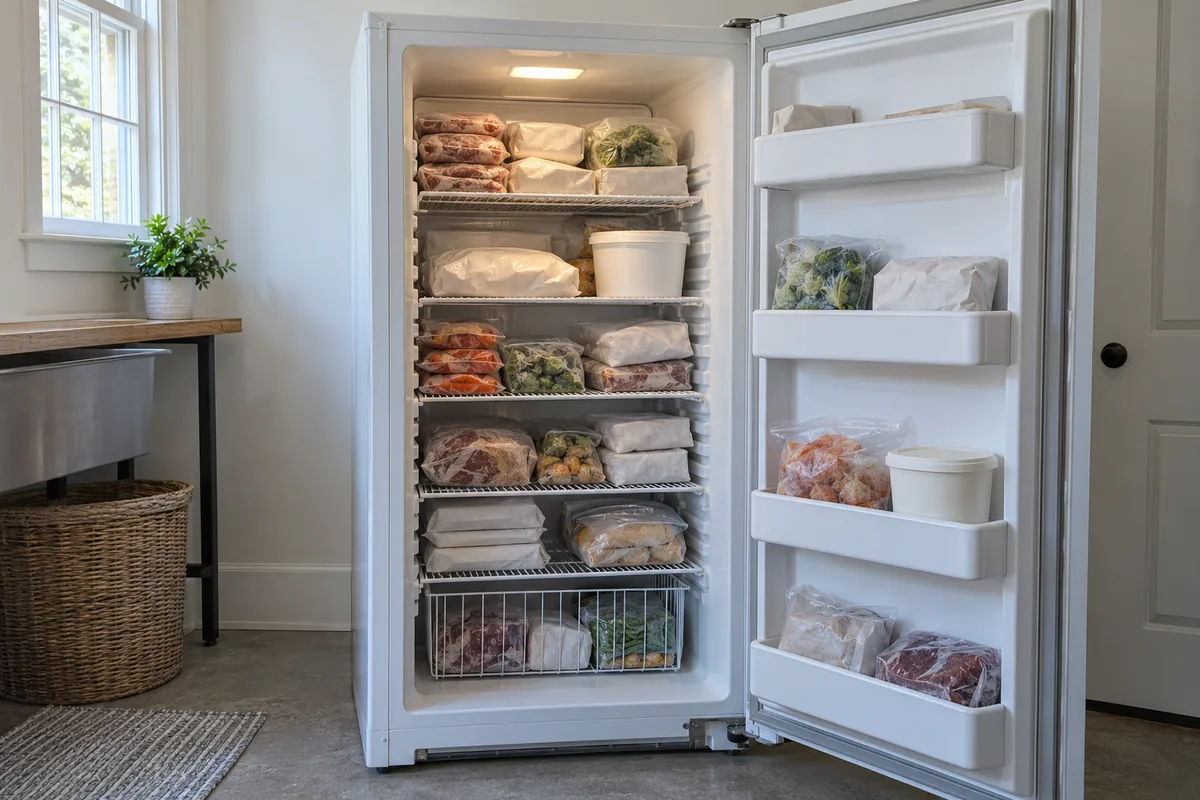
A GE freezer that runs too warm usually shows it in small ways first: soft ice cream, packages that no longer feel solid, ice crystals on food, or a High Temp light on the door of an upright model. Often the cause is something an owner can check without tools: the setting, a door or lid that does not close, a recent load of warm food, or the room around the freezer.
This guide sets out what GE Appliances’ owner’s manuals list for a freezer that is too warm, separately for GE upright and chest freezers and for the freezer section of a GE refrigerator, with their settings and waiting times. If the freezer stays warm after the checks, arrange repair for your GE freezer.
What this guide is based on
GE information on this page is summarized from GE Appliances’ published materials as read in October 2026: manuals for FUF14, FUF17 and FUF21 upright freezers, FCM5 and FCM7 chest freezers, older food freezers, and two families of GE refrigerators, plus model support pages and support articles. Your own manual takes precedence.
Which GE freezer you have
A standalone GE freezer and the freezer section of a GE refrigerator follow different manuals, settings and waiting times. The model number is on a label; your Owner’s Manual says where.
| Type and example models | How the temperature is set | Starting setting in the manual |
|---|---|---|
| Frost-free upright freezers: FUF14DLRWW, FUF17SMRWW, FUF21SMRWW | Electronic control on the door, with a temperature display | Default setting of 0°F |
| Manual defrost chest freezers: FCM5 and FCM7 (for example, FCM7SKWW) | Control from Min to Max (coldest) | Set at 4 |
| Freezer section of French-door refrigerators GFE28GYNFS (GE) and PYE22KYNFS (GE Profile) | Freezer pad on the control panel | Preset at 0°F, shown as recommended |
| Freezer section of GNE27JYMFS, covered by a bottom-freezer refrigerator manual | Depends on the control style | Preset at 0°F on controls with a number |
Before you arrange repair for your GE appliance, write down the model and serial numbers.
Signs of a warm freezer in GE's manuals
The FUF manual’s chart lists “freezer temperature too warm” and “foods defrosting”; for the second, its first cause is a High Temp alarm with a flashing display after a power outage. Alarm Reset silences the alarm, but High Temp stays on until the set temperature returns. The bottom-freezer refrigerator manual lists frost or ice crystals on frozen food, and notes that frost inside a package is normal.
Some warmth is normal: the FUF manual says the outside walls can be as much as 30°F warmer than the room while the compressor moves heat out of the cabinet.
Check the temperature setting first
The FUF and bottom-freezer manuals list a control set too warm among the causes. On FUF uprights, the control on the door shows the set temperature, with a default of 0°F; the chart says to turn it to a colder setting and allow several hours for the temperature to stabilize.
On FCM5 and FCM7 chest freezers, the control runs from Min to Max, the coldest. The manual says to start at 4, adjust one step at a time, and allow several hours after each step. Turning the control to OFF stops cooling but not power, and the Power-On Light (on some models) glows even then, so a lit light does not prove the freezer is cooling. Its chart lists a control at OFF as a cause of foods defrosting: move it to a temperature setting.
In GE refrigerators, the French-door manual presets the freezer at 0°F and the refrigerator at 37°F, and shows 0°F as recommended. For a compartment that is too warm, the bottom-freezer manual says to set the control one step colder. Do not keep turning it colder every hour; each manual gives a waiting time.
How long GE says to wait
A freezer that has just been started, reconnected or loaded needs time to reach its setting.
| Situation | Upright (FUF manual) | Chest (FCM5 and FCM7 manual) | Refrigerator freezer section |
|---|---|---|---|
| First start | At least four hours before adding food | At least 4 hours before adding food | 24 hours to stabilize at the preset |
| Setting change | Several hours | Several hours per one-step adjustment | Not stated separately |
| After being disconnected | 4 hours to cool down completely | Not stated in the chart | 24 hours after an extended power outage |
| Warm food or a long door opening | After hot food or water: until it reaches its selected temperature | Not stated in the chart | 24 hours to stabilize (bottom-freezer manual) |
If the freezer is still warm after its manual’s time, with the door closed and the setting checked, move on to the checks below.
Door, lid and gasket
A door left open appears in every warm-freezer row of these charts: check whether a package is holding the door, or the chest lid, open. Too frequent or too long openings come next: open the door or lid less often.
The FUF manual adds two rows. A door that will not fully close by itself may need its legs adjusted; this page leaves that installation step to a technician. Moisture on the outside of the cabinet can mean the door is not seating properly.
For refrigerators, the bottom-freezer manual names a door gasket on the hinge side sticking or folding over, and the FUF manual describes treating the hinge-side gaskets after cleaning them. This page does not repeat either step: it leaves cleaning or treating a gasket by your model’s procedure, and cutting, pulling or replacing one, to a technician. Owners can look along the seal and pick out by hand any loose crumbs or debris caught in it.

Warm food, loading and location
The FUF manual says to let hot foods cool to room temperature before freezing them. Overloading forces the compressor to run longer, and foods that freeze too slowly may lose quality or spoil. Do not let packages extend past the front of the shelves and take out what you need at one time.
Location matters as much. The same manual places the freezer in the coolest area of the room, away from heat-producing appliances, heating ducts and direct sunlight, and says not to install it where the temperature goes below 0°F or above 110°F, because it will not maintain proper temperatures.
Both the FUF and the FCM5 and FCM7 manuals call for 3 inches (76 mm) on top, back and sides for air circulation; too little space appears in their charts as a cause of a freezer that runs too long.
GE upright freezer temperature too warm: frost and defrosting
The FUF uprights are no-frost models. Their manual says the owner never has to defrost them, because they are preset at the factory to defrost themselves. For heavy frost, it names a door left open, too frequent or too long openings, and periods of high humidity.
The FCM5 and FCM7 chests are manual defrost models. Their manual says that in most climates defrosting is needed only about twice a year, and that no more than 1/2 inch (13 mm) of frost should build up. This page does not repeat its defrosting steps, which switch cooling off and use tools; follow your manual exactly or leave defrosting to a technician. Under its fire-or-explosion warning, the manual says not to use an ice pick or any metal or sharp-edged instrument, which may puncture the liner and then the flammable refrigerant tubing behind it, or any electrical device to defrost. Anything involving refrigerant or its tubing is for a qualified technician.
GE freezer warm but refrigerator cold
When only the freezer section of a GE refrigerator is warm, the bottom-freezer manual’s row for either compartment applies: a control not set cold enough, warm weather or frequent door openings, or a door left open. Set the control one step colder and check for a package holding the door.
The French-door manual lists “not cooling” with one cause, the cooling system turned off, and refers to its controls section; on one control style, the display then reads OF. Both refrigerator manuals call the reverse case, freezer cooling and refrigerator not, normal after plug-in or an extended power outage, with 24 hours to settle.
None of the GE refrigerator documents read for this page gives owners a cause for a freezer section that stays warm after these checks and the 24 hours. That diagnosis belongs to a technician; see repair for your GE refrigerator.
What to check safely
If you smell burning, see smoke or sparks, or find water near an outlet, skip these checks, keep away, and call for help. Otherwise:
- Read the display or control: the setting, High Temp, a flashing display, or OF.
- Close the door or lid; make sure no package holds it open.
- Check the setting: 0°F for FUF uprights and refrigerator freezers; 4 to start on chest models.
- Check the power: plug fully in, seen without moving the unit; breaker not tripped (look only: if it has tripped, do not switch it, arrange service).
- Check the space: about 3 inches around, no heat source nearby.
- Give it time as the table above shows, and check whether the food is still frozen.
Only attempt the checks above. Do not remove any panel or cover or access any wiring, and never reach behind or into a grille while the unit is running. These appliances run on a live household circuit, and any work beyond the checks above belongs to a qualified appliance technician. On appliances connected to a water line, do not open or close supply valves or touch fittings, housings, or filters — the line stays under house pressure even while the appliance is off, so leave that work to a qualified appliance technician. The only exception is a step your own Owner’s Manual and Installation Instructions itself gives owners, outside its installation steps, that needs no tool and does not switch the appliance or its cooling off, done exactly as written.
GE freezer not cold enough: where owner checks end
Arrange service when the freezer stays warm after the checks and its manual’s waiting time, when food is thawing, or when frost keeps building on a no-frost model. The FUF manual says repairs must be performed by a qualified service professional.
GE’s support article on upright and chest freezers that do not cool starts with a control turned to OFF. Its other causes are a technician’s work: a broken temperature or defrost control, a defect in the relay or the guardette (GE’s names for these parts), open internal wiring, or a compressor that does not run. These are possibilities, not a ranking or a list of what any visit includes.
Condenser coil cleaning is not an owner check here. None of these manuals gives owners a coil cleaning step, and GE’s refrigerator noise article says most refrigerators made in 2001 or later have condenser coils in a location that does not require cleaning. For other makes, see freezer repair or refrigerator repair.

Check the warranty before any repair
As GE Appliances’ limited warranty read in the owner’s manuals on its support site in October 2026, for products bought for home use in the U.S., the FUF manual covers any part of the freezer that fails due to a defect in materials or workmanship for one year from the date of original purchase, and the FCM5 and FCM7 manual gives the same one-year term. Both also give free labor to replace the defective part in that year, but the FCM5 and FCM7 manual gives it only if GE Appliances chooses to service the unit, and lets GE Appliances replace the unit instead. Both list loss of food due to spoilage among what GE Appliances will not cover, and both say warranty service comes from service centers or technicians GE Appliances designates; that describes GE Appliances’ service, not PRO Appliance Repair.
Coverage, periods, and conditions can differ by model, purchase and installation date, and use, and can change over time. Check your own warranty document or contact the warrantor it names before booking any repair; this page does not tell you whether your unit is covered.
Frequently Asked Questions
What temperature should a GE freezer be set to?
The FUF upright manual gives a default setting of 0°F, and GE’s French-door refrigerator manual presets the freezer at 0°F and shows it as recommended. Chest models in the FCM5 and FCM7 manual use a Min to Max control, and the manual says to start at 4. Your own Owner’s Manual is the final word for your model.
Why is my GE freezer warm but the refrigerator cold?
The bottom-freezer manual lists the same causes for either compartment: a control not set cold enough, warm weather, frequent door openings, or a door held open by a package. It says to set the control one step colder. If the freezer section still stays warm, the GE documents read for this page give owners no further step; arrange a technician’s diagnosis.
How long does a GE freezer take to get cold?
The FUF upright manual says to let the freezer run at least four hours before placing food inside and that it needs 4 hours to cool down completely after being disconnected. The chest freezer manual also gives 4 hours before food. GE’s refrigerator manuals allow 24 hours for the temperature to stabilize after the refrigerator is first plugged in.
Can I put a GE upright freezer in the garage?
GE’s support pages show “Garage Ready” in the product titles of FUF14DLRWW, FUF17SMRWW and FUF21SMRWW; that is GE’s product wording, not a promise from this page about your garage. The FUF manual says not to install the freezer where the temperature will go below 0°F or above 110°F, because it will not maintain proper temperatures, and to allow 3 inches on top, back and sides for air circulation.
Should I clean the condenser coils on a warm GE freezer?
Not as an owner check. The upright and chest freezer manuals in this guide give owners no coil cleaning step. For refrigerators, GE’s noise article says most made in 2001 or later have their coils where they do not need cleaning. Any work behind a cover or grille belongs to a qualified appliance technician.
GE freezer still too warm?
If the freezer stays warm after the checks, arrange a technician’s diagnosis.
We are PRO Appliance Repair, a family-owned, insured company with more than 15 years of experience. Our technicians are EPA 608 certified (a federal refrigerant-handling certification, not a manufacturer certification) and background-checked, and repairs are made with genuine parts. We offer same-day or next-day service.
Our own repair warranty (up to 6 months) covers the work we perform. It is separate from any warranty on your GE appliance, which it neither replaces nor extends. We are an independent repair company, not affiliated with GE Appliances.
Check the areas we serve, then book a repair for your GE freezer.
PRO Appliance Repair is an independent repair company and is not affiliated with, sponsored by, endorsed by, or authorized by Haier US Appliance Solutions, Inc. d/b/a GE Appliances or the GE brand. Brand names, model names, and product-line names are used only to identify the appliances this page is about. Information about GE appliances on this page is summarized from GE Appliances’ published materials and is not provided or approved by the GE brand or its owner. All trademarks belong to their respective owners.