
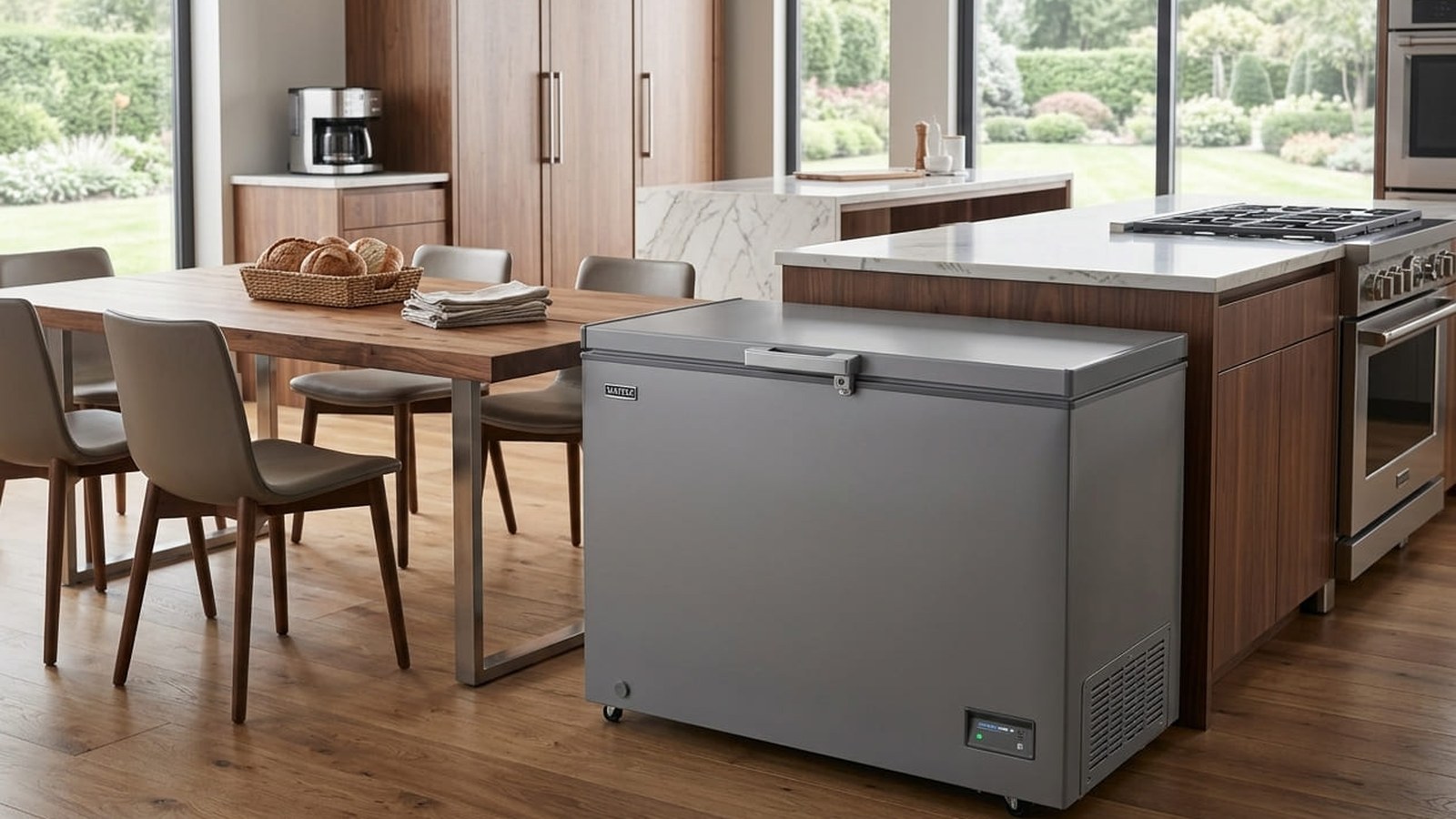
Finding a puddle under your freezer stops you cold. First thought: something’s seriously wrong. Second thought: how much is this going to cost? Here’s the thing — water leaks in Maytag standalone freezers almost always trace back to one of a handful of known causes, and most of them are fixable without a major repair bill.
Before anything else, one fact that changes the whole troubleshooting picture: most standalone freezers have no water supply line. Unlike a refrigerator with an ice maker or a water dispenser, a typical Maytag upright or chest freezer isn’t connected to your home’s plumbing at all. (If yours does have a water line hooked up, that’s a different path — Maytag’s help site has a separate page about leaks from behind the freezer at the supply hose and valve.) For everyone else, every drop on that floor came from one place — frost or ice that melted inside the unit and ended up somewhere it shouldn’t.
That single distinction narrows the list dramatically. You’re not dealing with a burst line. You’re dealing with the defrost water’s path, a door seal that’s letting in too much warm air, or simple condensation. All of those are diagnosable. Most are fixable.
This guide walks through the five real causes of water leaks in Maytag standalone freezers — frost-free uprights and manual-defrost chest freezers — with clear guidance on what you can check yourself and when it’s time for a technician.
Water on the floor right now? Our Maytag freezer repair team will find where it’s coming from and stop it.
Where Does the Water Come From? Understanding Freezer Moisture
To understand why your freezer is leaking, it helps to know how water is supposed to move through the system — because every freezer produces moisture inside, by design.
Maytag’s upright freezer user guide explains it simply. A frost-free freezer never needs defrosting by hand. Moisture in the air settles as frost on the cooling coil, the coil periodically warms up, the frost melts, and the water runs into a drain pan located behind the base grille, where it evaporates. Under normal conditions, you never see a drop.
Maytag even lists it as normal: you may hear water dripping into the drain pan during the defrost cycle. And in very humid weather, the guide says the water in the pan may take longer to evaporate.
Manual-defrost chest freezers work differently. There’s no automatic defrost — frost builds on the inside walls and has to be removed by hand from time to time, following the chest freezer’s own guide.
When any part of either system breaks down — a blocked drain, a damaged or out-of-place pan, a failing defrost part, or a door or lid seal letting in humid air — water ends up on your floor instead of where it belongs. The five causes below cover the realistic scenarios.
The 5 Real Causes of Water Leaks in Maytag Standalone Freezers
Cause 1 — Clogged or Frozen Defrost Drain
This is one of the most frequent causes of water leaks in frost-free Maytag upright freezers.
During each defrost cycle, meltwater flows toward a small drain opening at the bottom of the evaporator area. If that drain gets blocked — by ice, food debris, or mineral buildup — the water has nowhere to go. It backs up, pools on the freezer floor, and either refreezes into a sheet of ice or overflows and leaks out the bottom of the unit.
Signs pointing to a clogged defrost drain:
- A sheet of ice forming on the freezer floor (not on the walls).
- Water pooling inside the freezer at the bottom.
- Water leaking from the front or bottom of the unit, often after a defrost cycle.
The drain sits behind interior panels, next to the evaporator coils. Clearing it properly is a technician’s job — see “What a Technician Does” below.

Cause 2 — Cracked, Shifted, or Overflowing Drain Pan
Even when the drain works perfectly, the water still has to go somewhere — the drain pan behind the base grille. Normally, the water evaporates before it builds up. But a few things can go wrong:
- Cracked pan: a hairline crack lets water seep straight onto the floor. It may be small enough that you only notice when the pan fills.
- Shifted pan: if the pan has moved out of position (common after moving the unit), the water misses it.
- Overflowing pan: if far more frost is melting than normal — often because a bad door seal lets in warm air — the pan fills faster than it can dry. High humidity slows evaporation too.
What you can check: in good room light, see whether the water collects right at the front base, under the grille. Don’t pull the grille or the pan — the pan sits near working parts at the base of the unit. Note what you see for the technician. A cracked pan needs replacing; it can’t be reliably patched.
Cause 3 — Faulty Door Gasket Causing Condensation and Excess Frost
A worn or damaged door gasket doesn’t just cause temperature problems — it feeds water leaks directly. When the seal is compromised, warm, humid air enters constantly. That moisture freezes on the coils and inside surfaces, creating far more frost than the defrost system is meant to handle. The result: more meltwater per defrost cycle than the drain and pan can manage.
There’s a second effect too: moisture on the outside of the cabinet. Maytag’s help site says a minimum amount of condensation is normal, especially during higher humidity — and that you can avoid excess moisture by keeping door openings to a minimum and making sure nothing keeps the gaskets from sealing. Water that drips down the sides and pools on the floor is easy to mistake for an internal leak.
Maytag adds a few more easy things to look at: shelves or baskets out of position on some models can let moisture and air in and cause heavy frost. And where the freezer sits matters — Maytag says not to install it where the temperature drops below 40°F (5°C), to leave 3 inches of space on the top and sides and 1 inch at the back, and to keep it away from an oven, radiator, or other heat source. As general knowledge, a humid garage or basement adds moisture of its own.
If you’re seeing water on the floor along with frost that seems heavier than usual, the gasket is a strong suspect. Maytag’s help site describes a simple test: close the door on a sheet of paper in several spots — if it slides out with no resistance, the seal isn’t holding.
Cause 4 — Defrost System Malfunction (Heater, Control, or Thermostat)
In frost-free uprights, the automatic defrost system relies on a defrost heater, a control that decides when to defrost, and a defrost thermostat. When one fails, the defrost cycle either doesn’t run at all — or runs too long.
- Heater stuck on: melts more ice than normal, so the extra meltwater overwhelms the drain and leaks.
- Control failure: defrost cycles become irregular — too frequent or not frequent enough.
- Thermostat failure: doesn’t shut the heater off at the right temperature — the same result as a stuck heater.
Telltale pattern: the freezer alternates between heavy frost and puddles of water. That back-and-forth is a classic sign of a defrost cycle that isn’t working right.
This isn’t a DIY repair. Finding which part failed means testing parts behind panels, right next to the evaporator coils. It’s a job for a technician.
Cause 5 — Excessive Frost in Manual-Defrost Chest Freezers
For chest freezer owners, the leak picture is different. There’s no automatic defrost to fail — but frost still builds up, and if it isn’t managed, it creates its own water problem.
When frost is allowed to build up thick, the eventual manual defrost produces a lot of meltwater in a short time. If the unit isn’t set up to drain properly, or there aren’t enough towels down, water ends up on the floor.
Contributing factors:
- Opening the lid often (each opening brings in warm, humid air).
- Leaving the lid slightly open — even briefly.
- A worn lid gasket that lets air in between defrosts.
Prevention is straightforward: defrost on the schedule your chest freezer’s guide recommends, keep lid openings short, and keep the gasket in good condition.
Quick Reference — 5 Causes at a Glance
| # | Cause | Freezer Type | What you can do |
|---|---|---|---|
| 1 | Clogged or frozen defrost drain | Frost-free upright | Note ice on the floor; call a technician |
| 2 | Cracked, shifted, or overflowing drain pan | Frost-free upright | Note where water collects; call a technician |
| 3 | Faulty door gasket, condensation | Both types | Check the seal, door openings, and placement |
| 4 | Defrost system part failure | Frost-free upright | Call a technician |
| 5 | Excessive frost / defrost technique | Manual-defrost chest | Defrost on schedule, prevention |
What a Technician Does to Clear a Maytag Freezer Defrost Drain
Since a blocked defrost drain is one of the most common leak causes in frost-free Maytag uprights, here’s what the fix actually involves — and why we don’t recommend doing it yourself.
You’ll find online guides telling owners to unplug the freezer, unscrew the back interior panel, melt the ice with a hair dryer, and flush the drain with a turkey baster. We don’t recommend that. It means removing panels next to the evaporator coils and wiring, using a heat source inside a wet freezer, and risking a punctured coil or a cracked liner. Maytag’s own guide gives owners no steps for reaching the drain or the pan. And Maytag warns against harsh cleaners such as bleach on plastic parts, liners, and gaskets — so pouring chemicals down the drain is out too.
What a technician does instead:
- Protects your food and the unit — power off safely and food moved to coolers.
- Opens the evaporator area the right way for your model, without cracking the liner.
- Clears the ice and debris from the drain opening and the drain tube along its whole length — not just the top inch.
- Checks the drain pan for cracks, position, and overflow signs.
- Tests the defrost system — heater, control, and thermostat — so the drain doesn’t freeze over again.
- Checks the door seal, since a leaky gasket is often what overloads the drain in the first place.
- Confirms the water reaches the pan before putting everything back together.
If the drain was the only problem, the leak stops for good. If it keeps freezing, the defrost system or the seal is the real cause — and that’s what we fix next.
Rather skip the guesswork entirely? Our Maytag freezer technicians handle leak repair across Atlanta and Georgia, with same- or next-day service available most days.
Frost-Free vs. Manual-Defrost Freezers — Why Leak Causes Differ
Not sure which type you have? Here’s the short version.
Frost-free upright freezers run automatic defrost cycles with a built-in heater, control, and thermostat. You never defrost them by hand. The trade-off: more parts that can fail. When a frost-free model leaks, it almost always traces back to the drain path or one of those defrost parts.
Manual-defrost chest freezers have no automatic defrost at all — no heater, no defrost control. Frost builds naturally and you remove it yourself. Leaks in these models are rarely caused by a failed part. They come from frost management — defrosting too rarely, the technique, or a lid seal that lets in too much moisture.
| Frost-Free Upright | Manual-Defrost Chest | |
|---|---|---|
| Defrost system parts | Yes — can fail | None |
| Defrost drain | Yes — can clog | Usually not present |
| Drain pan | Yes, behind the base grille | Usually not present |
| Leak cause | Drain, pan, or a defrost part | Frost overflow or gasket |
| Owner’s role | Look and report | Defrost on schedule, prevent |
Knowing which kind you have cuts the troubleshooting list in half before you even open the door.
How to Prevent Your Maytag Freezer from Leaking Again
Safety first: stick to looking and simple habits. Don’t remove panels, pull the base grille, or reach behind the unit.
For Frost-Free Upright Freezers
- Keep the door seal in good shape. A tight seal means less frost, which means less meltwater per cycle. Keep it clean the way your user guide describes — and skip bleach and other harsh cleaners, which Maytag warns against on gaskets.
- Keep door openings short. Maytag’s own advice for excess moisture.
- Don’t block the air vents with packages. Maytag says covered vents can cause temperature and moisture problems.
- Mind the spot. Proper clearances, no heat source nearby, and a room that doesn’t drop below 40°F.
For Manual-Defrost Chest Freezers
- Defrost on schedule — the longer you wait, the more water you’ll have to manage.
- Lay towels down before you start, not after the water is already on the floor.
- Never chip ice with sharp objects — a screwdriver or ice pick can puncture the cooling coils, a far more serious problem than a water leak.
- Location matters — in a humid garage or basement, frost builds faster, so plan your defrosts accordingly.
Conclusion
Water on the floor under a Maytag freezer looks alarming. In practice, it almost always comes down to one of five causes — and for most standalone freezers, none of them involve your home’s plumbing. Every drop traces back to frost and ice that melted and ended up somewhere it shouldn’t.
In a frost-free upright, the drain path is the first suspect — and clearing it properly is a technician’s job. From there, the drain pan, the door gasket, and the defrost system cover the rest. For chest freezers, the answer is almost always frost management — defrost on schedule, keep the lid seal tight, and the problem stays under control.
Act on it early. A small leak that gets ignored turns into a compressor running around the clock, food cycling through partial thaws, and a bigger repair down the road. A Maytag freezer leaking water is a solvable problem — not a reason to replace the unit.
When in doubt, a professional diagnosis saves you time and guesswork. Our EPA 608 certified, background-checked technicians bring 15+ years in the field and genuine OEM parts, and our repairs carry a warranty of up to six months. We’re an independent repair company, not affiliated with Maytag. Ready to stop the puddles? Book Maytag freezer repair in Atlanta today.
Frequently Asked Questions
I found a sheet of ice at the bottom of my Maytag upright freezer, and now there’s water on the floor. Are these related?
Very likely. An ice sheet on the floor of the freezer usually forms when defrost water can’t drain and refreezes. As it grows, it can melt and overflow out the front or bottom. The drain needs to be cleared from the inside, and the defrost system checked so it doesn’t happen again — a job for a technician.
I hear water dripping inside my Maytag freezer. Is that a leak?
Not by itself. Maytag lists water dripping into the drain pan during the defrost cycle as normal. It’s only a problem if water shows up on the floor or ice builds on the freezer floor.
Can I use bleach to clean my Maytag freezer’s defrost drain?
No. Maytag’s user guide warns against harsh cleaners such as bleach on plastic parts, interior liners, and gaskets. And bleach won’t clear an ice or debris clog anyway. If the drain is blocked, have a technician clear it mechanically.
My Maytag freezer is in the garage and leaks more in the summer. Why?
Hot, humid air gets in every time the door opens — and through any weak spot in the gasket. That means heavier frost and more meltwater per defrost than normal. Maytag also says the pan water may take longer to evaporate in high humidity. Check the seal, keep openings short, and check your guide for the room conditions your model is built for.
I hear a gurgling noise and then see water leaking from my Maytag upright freezer. What’s happening?
Gurgling can be water trying to get through a partially blocked defrost drain. When the drain can’t keep up, water backs up and finds another way out — usually at the front base of the unit. Once the blockage is cleared and water flows freely to the pan, both the noise and the leak should stop.
After a power outage, my Maytag freezer has water inside it. Is this a leak?
No — it’s not a mechanical leak. With the power off, the inside warmed up and frost melted. Wipe out the standing water before it refreezes, and let the freezer get back to temperature. The bigger question after an outage is food safety — check the USDA guidance on what’s safe to keep after a thaw.