

You open your Sub-Zero French-door refrigerator in the morning and the milk is lukewarm. Again. There’s a white line of frost along the top of the doors, the unit seems to run all day, and you’re starting to wonder what that’s doing to the power bill. It’s maddening on a refrigerator built to hold temperature like a vault — but take heart: on these units, the culprit is very often a door gasket, and that’s one of the most straightforward repairs a Sub-Zero can need.
The door seal — the gasket — is one of the most common reasons a French-door Sub-Zero stops cooling properly up top and starts building frost around the doors. Two doors means two long gaskets that have to meet each other and the cabinet perfectly, every single time you close them.
In this post we’ll walk you through the signs, why the upper doors take the beating on BI-36UFD, BI-42UFD, and the newer Classic CL3650UFD and CL4250UFD, what to rule out before you blame the seal, the free checks you can do yourself, and when it’s time for a technician. If you’re seeing warm shelves or frost right now, our Sub-Zero refrigerator repair team handles gasket problems every week.
The Tell-Tale Signs Your French Door Isn’t Sealing Right
Here’s what our technicians typically find when they diagnose a French-door Sub-Zero with a seal problem:
- Warm fridge up top — the milk and produce shelves noticeably warmer than they should be, even though the freezer drawer below is still ice-cold. On a Sub-Zero with dual refrigeration, the refrigerator and freezer have separate systems, so one side can struggle while the other is fine.
- Frost around the doors — that white “beard” of ice along the top section and around the door edges.
- The compressor almost never shuts off — a door that isn’t sealing lets humid Georgia air pour in, and the unit runs constantly trying to keep up.
- Gasket wear — the seal feels hard, cracked, or sticky instead of soft and springy. Look for tears, warping, or discoloration — especially where hands grab the door.
- The dollar-bill test fails — close a dollar bill in the door; if you can pull it out with no tug at some spot, the seal isn’t doing its job there.
- Condensation or water inside the top of the fridge — warm, moist air meeting cold surfaces.
What’s at stake: in Georgia’s heat and humidity, a door that leaks air makes the whole system work harder. Catch it early and you save food, energy, and wear on the compressor. Ignore it, and a gasket problem can turn into frost, condensation, and a much bigger repair.

Why the Upper Doors Take the Biggest Beating
Sub-Zero is straightforward about gasket wear: gasket life varies with use. Heavy use shortens it, and sticky residue or spills left on the gasket lead to premature wear or cracking. On a French-door refrigerator, the upper doors are the ones that get opened dozens of times a day — for milk, leftovers, a snack, a drink — so their gaskets see the most flexing, the most fingerprints, and the most spills.
Add a few things that are specific to French doors:
- Two doors have to meet. The gaskets seal against the cabinet and against each other’s closing point, so a small sag, a slightly misaligned door, or a jar pushed against one door shows up as a leak.
- Doors that get slammed. Every hard slam — kids, a busy dinner rush — works the gasket and the hinges.
- Humidity. Warm, damp air finds any gap and turns into frost on the cold surfaces right behind it.
BI-Series (Classic, formerly Built-In) French Door Models: 36″ and 42″
The Classic (BI) line was made from 2008 until 2022, with the BI-36UFD added in 2012 and the BI-36UFDID (with an internal dispenser) in 2016. Many of these are now well into their second decade of daily use, and the upper gaskets are a common wear point.
- BI-36UFD and BI-36UFDID — the typical call is “the top half isn’t cold, and there’s frost across the center.” With age, the gasket hardens, develops hairline cracks, and stops pulling tight against the cabinet.
- BI-42UFD — same story on the wider 42-inch model. A gasket that cracks along the top or sides, or stops pulling tight, means warm upper shelves and ice where you don’t want it.
On these units, our technicians see the same wear again and again: cracked folds, rubber that’s gone stiff, and seals that no longer pull flat against the frame. Once the seal stops closing tight, the refrigerator breathes warm Georgia air all day long.
Classic (CL) French Door Models: CL3650UFD and CL4250UFD
The newer Classic (CL) French-door refrigerators use the same basic principle: upper doors with long gaskets that need to seal evenly. They’re younger units, so gasket wear is less common — but the same habits wear them out: heavy daily use, spills left to dry on the seal, and hard slams. If a newer CL unit shows frost along the top doors, check what’s keeping the door from closing before anything else.
Hearing the door-ajar chime more often than you used to? On Classic units, a chime sounds if a door has been open for more than 60 seconds. If it goes off when you’re sure the door is shut, something is keeping it from closing fully — worth a closer look.
Rule These Out Before You Blame the Seal
Frost and a warm upper section don’t always mean a bad gasket. Sub-Zero’s own troubleshooting for ice on the back wall or floor of a refrigerator lists several causes: a faulty door gasket, air leaking into the unit, an air circulation issue, a sealed system issue, or a clogged drain tube. So before you order a new gasket, rule out the free stuff — in the right order:
- Something keeping the door from closing. A tall bottle, a pan handle, a crisper not pushed all the way in. Sub-Zero’s first step is to remove anything preventing a proper seal and verify the door closes all the way.
- Temperature settings. Sub-Zero recommends 38°F (3°C) in the refrigerator and 0°F (−18°C) in the freezer.
- A dirty condenser. Sub-Zero suggests cleaning it if it hasn’t been done in the last six months — and says it can take up to 24 hours for the unit to respond afterward.
- The drain. If there’s ice, food debris, or standing water in the drain trough along the back wall, the drain tube may be clogged. That causes frost and water too — and it isn’t a gasket problem.
- Overfilling and wet produce. Too much food blocks airflow, and a lot of moisture-producing or wet produce can cause condensation all on its own. If a door was left open for a while, condensation inside is normal; keep the door closed and it clears.
If all of that checks out and the frost lines up with the door edges, the gasket moves to the top of the list.
What You Can Safely Check and Do Yourself
Important safety note: Only attempt the checks below. Do not remove any panel or cover, and do not try to adjust door hinges or leveling legs — on a built-in, those are an installer’s or technician’s job. Work beyond the breaker and these checks should be done only by a qualified appliance technician.
- Do the dollar-bill test. Close a bill in the door at several points all the way around — top, sides, bottom, and where the two doors meet. If it slides out with zero resistance anywhere, note the spot. Takes two minutes.
- Inspect the gasket. Sub-Zero is clear: if the gasket is ripped, torn, or cracked, it should be replaced. Look closely at the top corners and the area where hands grab the door.
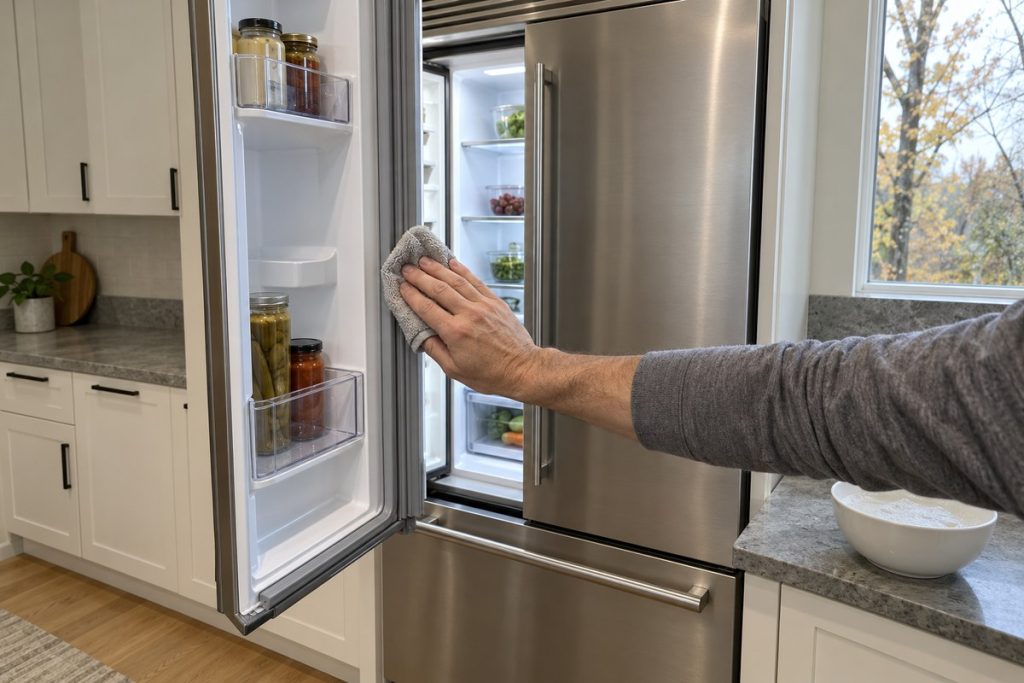
- Clean it properly. Use a soft cloth with mild detergent and water; a paste of water and baking soda handles tough stains. Skip vinegar, isopropyl, and rubbing alcohol — Sub-Zero warns they may damage some plastic parts. If moisture is seeping from the gasket, Sub-Zero says to clean and dry it thoroughly.
- Watch how the doors close. Do both doors swing shut evenly and sit flush? Does one door hang lower than the other? A door that sags can’t seal no matter how new the gasket is — and that calls for an adjustment by a technician, not a new seal.
Why not replace the gasket yourself? It’s tempting — on many Sub-Zero models the gasket has a dart at the back that presses into a channel in the door, with no screws. But Sub-Zero recommends that a service technician complete any door or drawer gasket replacement. A gasket that isn’t seated evenly all the way around, especially at the top corners, leaks just like the old one did — and a door that’s slightly out of alignment will wear out the new seal fast.
Spent time on this and the dollar bill still slides out? You’ve done the hard part — now let us finish the job. We’ll replace the gasket, check how the doors hang, and make sure the seal is even all the way around.

Simple Habits That Save the Seal
A few small habits make a big difference to how long a gasket lasts:
- Keep the gasket clean. Wipe it with mild detergent and water as part of your regular kitchen cleanup. Sub-Zero specifically ties sticky residue and spills on the gasket to premature wear and cracking.
- Close the doors gently. No slamming. Every hard slam works the top section and the hinges a little more.
- Mind the door bins. Overloaded door shelves add weight that can make a door sag over time.
- Keep the condenser clean every six to twelve months, so the unit isn’t working overtime while you sort out a seal.
- Don’t ignore the chime. If the door-ajar alarm sounds, find out what’s holding the door open.
Takes a minute here and there — and it heads off a lot of French-door seal problems before they start.
The Bottom Line
On a French-door Sub-Zero, a warm upper section with frost along the door edges very often comes down to the gasket — and once the free causes are ruled out, a new, properly seated seal and a check of how the doors hang usually solves it. If the seal checks out fine, the next suspects are airflow, the drain, or the sealed system, and those are worth a proper diagnosis rather than guesswork.
Seeing frost or warm shelves right now? Schedule Sub-Zero refrigerator repair with PRO Appliance Repair — same- or next-day service across most of metro Atlanta. Our EPA 608 certified, background-checked technicians use genuine OEM parts and back the repair with our workmanship warranty — up to 12 months on Sub-Zero. Have a side-by-side instead? See our guide to Sub-Zero side-by-side door seals. Older unit with more than one issue? Our article on Sub-Zero BI-30 and BI-36 problems covers how Classic models age.
FAQ
My BI-36UFD has frost only across the top door edge and the rest looks fine. Is it definitely the gasket?
Very often, yes — frost that lines up with the door edge points to warm air getting in there. But rule out the free causes first: something keeping the door from closing, the temperature settings, a dirty condenser, and the drain. If those check out and the dollar bill slides out at that spot, the gasket is the likely fix.
Can I replace the CL4250UFD door gasket myself, or should I call a technician?
Sub-Zero recommends that a service technician replace door and drawer gaskets. The gasket has to seat evenly all the way around — especially at the top corners — and the door has to hang straight for it to seal. A seal that’s slightly off will leak just like the old one. Cleaning and inspecting it yourself is perfectly fine.
I just had the gasket replaced on my CL3650UFD and the top is still a few degrees warm. What now?
Give it time first: after a door has been open for a repair, it can take several hours for temperatures to settle. If it’s still warm the next day, the two usual culprits are a gasket not fully seated at the corners or a door slightly out of alignment. If the seal is good, look at airflow, the drain, or the condenser next.
How often should I replace the French door gasket on a Sub-Zero?
There’s no fixed schedule. Sub-Zero says gasket life varies with use — heavy use shortens it, and spills or sticky residue left on the seal speed up wear. Replace it when it’s ripped, torn, or cracked, or when the dollar-bill test fails after cleaning. Keeping it clean and closing the doors gently helps it last.
Can I use vinegar or alcohol to clean my Sub-Zero door gasket?
No. Sub-Zero recommends a soft cloth with mild detergent and water, and a water and baking soda paste for tough stains. Vinegar, isopropyl, and rubbing alcohol can damage some plastic parts. Dry the gasket after cleaning, especially if you’ve noticed moisture seeping from it.
Why is there condensation inside my Sub-Zero after I left the door open?
That’s normal. When a door stays open for a while, warm, humid air gets in and condenses on the shelves, drawers, or inside of a glass door — and in a warm climate like ours, it’s easier to notice. Keep the door closed and it clears on its own. If it keeps coming back with the door shut, check the gasket.
PRO Appliance Repair is an independent repair company and is not affiliated with, sponsored by, or endorsed by Sub-Zero Group, Inc. Brand and model names are used only to identify the appliances this page is about and remain the trademarks of their respective owners.