

It’s late, the kitchen lights are off, and your Sub-Zero PRO is making a sound you’re suddenly not sure about. A whine. A whoosh. A click that seems louder than yesterday. On a refrigerator that big and that expensive, every new noise gets your attention — and that’s a good instinct. The reassuring part: most of what a PRO does out loud is completely normal, and the sounds that aren’t usually announce themselves early.
Walk into any high-end Atlanta kitchen with a Sub-Zero PRO and the first thing you notice (after all that stainless steel) is the presence of the thing. The PRO line — the 648PRO and 648PROG, and the current PRO3650, PRO3650G, PRO4850, and PRO4850G — is built big: separate refrigeration systems for the refrigerator and freezer, multiple fans, and heavy-duty construction. They’re designed for kitchens that work hard, and a machine like that has a voice.
Most days that voice is just background:
- a low hum when a compressor runs;
- a soft whoosh from the fans;
- the occasional click of a relay or control.
Totally normal for a refrigerator holding three temperature zones steady around the clock.
But sometimes the soundtrack changes. The hum gets louder, a rattle shows up, or a grind appears that wasn’t there last month. That’s when homeowners call us asking the same question: “Is my PRO supposed to sound like this?” Short answer: sometimes yes, sometimes no.
In this guide we’ll separate the normal from the warning signs — walk through the free checks you can do yourself — and show you where DIY stops. If you’d rather have someone listen to it in person, our Sub-Zero refrigerator repair team works on PRO units every week.
PRO Operating Noise: The Baseline
The Sub-Zero PRO is basically a serious kitchen workhorse wearing a tuxedo. Bigger cabinet, more cooling capacity, more moving air — so you may notice it more than your neighbor’s standard French-door fridge. Sub-Zero itself says it’s normal to hear fans and motors, that noises can seem more pronounced in an open-concept home or at night, and that it doesn’t publish decibel ratings for its products. Here are the main sounds you’ll hear on any given day:
| Sound Type | What It Is | What It Sounds Like | When You’ll Hear It |
|---|---|---|---|
| Compressor running | The refrigerator or freezer compressor cycling | A low hum; on variable-speed models, a higher whine at startup that settles | Whenever that section needs cooling |
| Evaporator fans | Fans moving cold air inside each section | A steady whoosh | While that section is cooling |
| Condenser fan | The fan pulling air over the condenser behind the top grille | A moderate whir | When a compressor runs |
| Relays, controls, and defrost | Electronic controls switching; water dripping near the defrost heater | A short click, or a sizzle or crackle | Short, random bursts |
That’s the baseline soundtrack of every PRO we service.
Normal Noise
These sounds are expected and nothing to worry about:
- A high-pitched whine for the first few minutes. The PRO3650 and PRO4850 use variable-speed compressors. Sub-Zero says a variable-speed compressor always starts at high speed, then slows down after about five minutes — and on high speed it may make a high-pitched whine. That’s normal, and replacing the compressor with another variable-speed compressor won’t make it go away.
- A low, steady hum you mostly notice at night. That’s a compressor doing its job — and on a PRO, the refrigerator and freezer each have their own system, so sometimes two are running at once.
- A whoosh from the fans that runs longer after you restock. New groceries or a long door opening mean more cooling — and more fan time.
- Sizzling or crackling now and then. Sub-Zero notes that defrost cycles are normal, and moisture on or near a defrost heater can sizzle. On the 648PRO, the freezer uses an adaptive defrost that runs as needed rather than on a fixed clock.
- Occasional gurgle or hiss. Refrigerant flow and drain water make these sounds, and Sub-Zero considers them normal operation.
- A thump when the ice maker’s water valve shuts. Ice maker and water valve noises are typically heard every 2–3 hours, more often if you use Max Ice.
Our technicians tell customers: if the noise level hasn’t changed and the temperatures are holding at 38°F (3°C) in the refrigerator and 0°F (−18°C) in the freezer — Sub-Zero’s recommended settings — you’re hearing a healthy PRO.
When Noise Indicates Problems
When the soundtrack suddenly gets louder, changes pitch, or shows up at odd times, that’s the red flag. Sub-Zero’s own guidance: a noise that’s new, louder, or more pronounced over time — or one that comes with warmer temperatures — deserves attention. Here’s what those sounds often point to:
- Grinding or scraping from the top machinery area — a condenser fan dragging on debris or a failing fan motor.
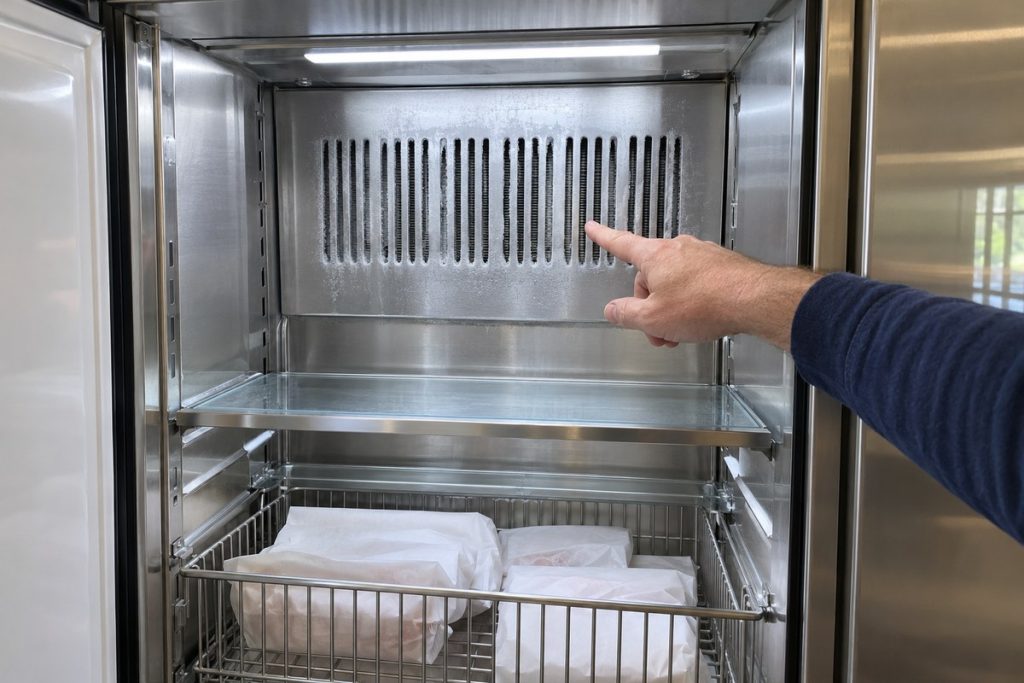
- Scraping, ticking, or thumping inside the freezer — an evaporator fan hitting ice or food packaging. Sub-Zero lists ice on the fan and overfilling as common causes.
- A whine that never settles — unlike the normal five-minute startup whine, a whine that stays high and the unit that never stops running often points to a dirty condenser making the compressor work too hard.
- Constant buzzing that never stops — a struggling start component or a loose connection.
- New banging, knocking, or heavy vibration — loose hardware, a loose grille, or worn compressor mounts.
- Repeated clicking with no cooling — the compressor trying and failing to start. That’s a “call now” sound.
If the noise is brand-new or noticeably louder than last month, treat it as an early warning. The PRO is tough, but ignoring a failing fan motor or an iced fan usually ends in a PRO that isn’t cooling.
Hearing a new grind or rattle? Don’t wait for warm food — a quick diagnosis now is almost always the smaller repair.
What You Can Check Yourself vs. When to Call a Professional
Plenty of noise changes on a PRO come from something simple, and the first few checks cost nothing. Work through them in order.
Important safety note: Only attempt the checks below. Do not remove any panel or cover beyond the top grille your use and care guide tells you to lift, do not access any wiring, and never reach into the grille while the unit is running. A PRO is heavy and anchored to the cabinetry — never pull it out of its opening. Work beyond the breaker and these checks should be done only by a qualified appliance technician.
Do These Yourself
| Noise Symptom | What to Check |
|---|---|
| Noise inside the cabinet | Sub-Zero’s door test: open all doors and see if it stops. Close only the refrigerator door — if the noise starts, it’s the refrigerator fan. Close only the freezer door — if it starts there, it’s the freezer fan. Still there with every door open? It’s in the machinery area up top. |
| Ticking or scraping inside the freezer | Make sure food packaging isn’t pushed into the fan, and that the freezer isn’t overfilled. |
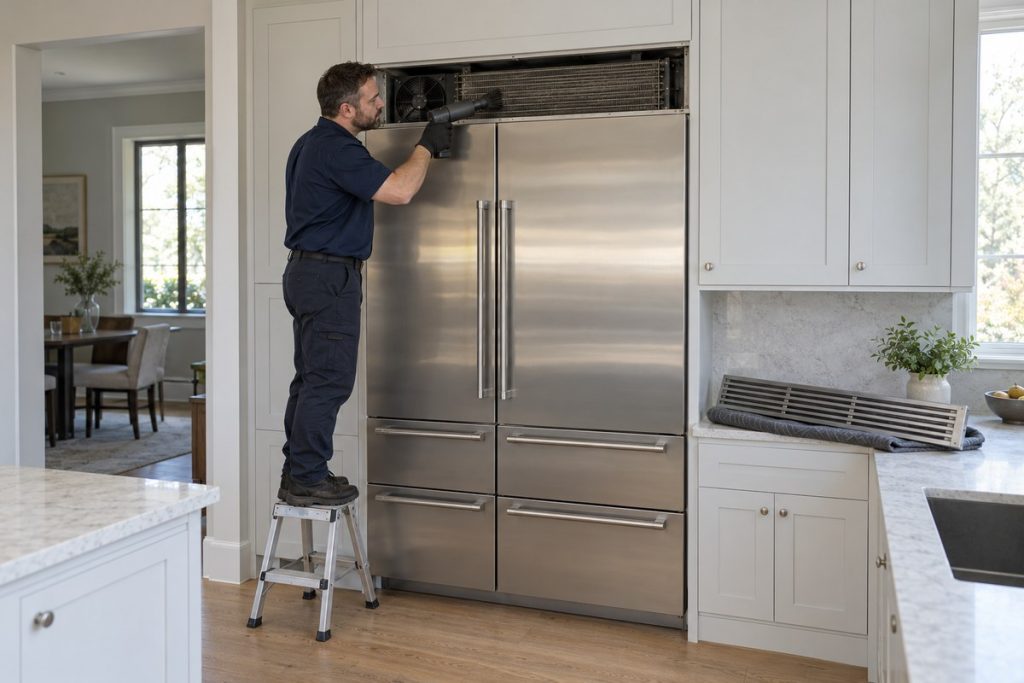
| A whine or hum that never settles, or the unit running constantly | Clean the condenser. On the PRO 48, Sub-Zero’s routine is: turn the unit off at the control panel, lift and rotate the grille above the doors to expose the condenser, and clean it with a soft brush vacuum attachment. Do it every six to twelve months. |
| Rattle from the top of the unit | Make sure the grille assembly is properly attached — Sub-Zero’s first check for grille vibration on the 648PRO. |
| Floor-shaking hum after a remodel | Don’t level it yourself — Sub-Zero directs leveling to an installer or service technician. Mention the remodel when you call. |
Do those checks and a fair share of “it’s suddenly loud” complaints sort themselves out. One more tip: Sub-Zero says it can take up to 24 hours for temperatures to settle after a condenser cleaning, so judge the result the next day.
Spent an evening on this and it’s still noisy? You’ve done the hard part — now let us finish the job.
Stop DIY Here – Call a Technician
If the noise is still there after the easy checks — or you hear any of these — it’s time to bring in someone with the right tools and genuine parts:
- Grinding or metal-on-metal screech that isn’t ice — a failing condenser or evaporator fan motor.
- Constant electrical buzzing — a start relay or other start component near the compressor.
- Loud knocking or banging from the machinery area — loose compressor mounts or hardware, or internal compressor wear.
- Any new noise paired with warm spots or a section that isn’t getting cold — a defrost problem, a fan failure, or a sealed-system issue.
- Frost building around a fan, or a 648PRO with ice building up on the evaporator — that needs a diagnosis, not a home defrost.
Those repairs involve refrigerant handling, the machinery compartment, and parts that have to be matched to your exact model. Trying to shortcut them usually turns a small repair into a big one.
Conclusion
The Sub-Zero PRO is built to sound like what it is: a serious machine doing serious work. Most of the hum, whoosh, and clicking is exactly what it should be — including that high-pitched whine for a few minutes after the compressor starts on a PRO3650 or PRO4850. But when the hum turns into a grind, the whoosh becomes a scrape, or you suddenly have warm spots along with the racket, it’s the refrigerator asking for help.
Catch it early with the quick checks above and you may solve it yourself. Ignore it, and a small annoyance can snowball into spoiled food and a much bigger repair. For a closer look at sounds that come from the compressor itself, see our guide to Sub-Zero compressor noise.
Is your 648PRO, PRO3650, or PRO4850 making new or angry sounds right now? Don’t wait for the weekend groceries to warm up. Schedule Sub-Zero refrigerator repair with PRO Appliance Repair — same- or next-day service across most of metro Atlanta. Our EPA 608 certified, background-checked technicians use genuine OEM parts and back the repair with our workmanship warranty — up to 12 months on Sub-Zero.
FAQ
My 648PRO started making a loud grinding noise from the top last week. Is it about to die?
Usually not. A new grind from the machinery area is often a condenser fan dragging on dust or debris, or a fan motor bearing wearing out. Clean the condenser behind the grille first and make sure the grille assembly is firmly attached. If the grind stays, have a technician check the fan motor before it fails and the unit starts warming up.
My PRO3650 has a constant electrical buzzing that never stops. What’s wrong?
A buzz that never stops often points to a start relay or another start component near the compressor, or a loose electrical connection. That’s a technician job — don’t open the machinery area yourself. Don’t let it run that way for long, either: a compressor that struggles to start again and again is under real stress.
I hear a high-pitched whine when the compressor starts. Is that normal?
On the PRO3650 and PRO4850, yes. Sub-Zero says variable-speed compressors always start at high speed and slow down after about five minutes, and the high-speed whine is normal. What isn’t normal is a whine that never settles while the unit runs nonstop — that often means a dirty condenser, so clean it and watch temperatures over the next day.
My PRO4850 is suddenly very quiet and the freezer is warming up. That’s bad, right?
Yes — on these units, silence plus rising temperatures is worse than noise. If you can’t hear a compressor or the condenser fan and the freezer is warming, a compressor may not be starting, or a fan may have stopped. Check that the breaker is on and the controls are on, then call for service.
The fridge is loud again even after I cleaned the condenser. What now?
Give it 24 hours first — Sub-Zero says temperatures can take that long to settle after cleaning. If the noise returns quickly and temperatures start climbing, the cause is usually beyond the condenser: an iced or failing fan, a defrost problem, or a sealed-system issue. That’s a diagnosis for a technician, not more cleaning.
Is my Sub-Zero PRO supposed to be louder than a regular refrigerator?
It can be more noticeable. A PRO has separate refrigeration systems, multiple fans, and a large cabinet, so you’ll hear fans and compressors run. Sub-Zero notes that open-concept kitchens and quiet nights make sounds stand out more. What matters is change: a sound that’s new, louder, or paired with warmer temperatures deserves a check.
PRO Appliance Repair is an independent repair company and is not affiliated with, sponsored by, or endorsed by Sub-Zero Group, Inc. Brand and model names are used only to identify the appliances this page is about and remain the trademarks of their respective owners.