
That clicking from behind your Maytag refrigerator — the one that repeats every few minutes and then goes quiet — is hard to ignore once you’ve noticed it. Is it the compressor dying? Is the food about to go warm? Should you be doing something right now?
Take a breath. Not every click is bad news. Maytag’s own guides list several clicks, hums, and long run times as perfectly normal. But one particular pattern — a click, silence, another click, and a refrigerator that’s slowly warming — is the compressor circuit trying to start and failing. That one deserves attention fast, because every failed start is hard on the compressor, and a small, quick repair can turn into a big one if it’s left for days.
In this guide we’ll walk through the sounds Maytag calls normal, then the patterns that aren’t: a compressor that won’t start, a compressor that’s locked, a compressor that short-cycles, and the control board that often gets blamed first. We’ll finish with what’s realistic for you to check and what belongs to a technician. If you’d rather have someone look at it in person, our Maytag refrigerator repair team works across metro Atlanta.
First, the Sounds Maytag Calls Normal
Before you assume the worst, know what a healthy Maytag sounds like. In Maytag’s French door bottom-mount Use & Care Guides, these are listed as normal:
- Running longer than you expect. Maytag says it’s normal for the high-efficiency compressor to run for extended periods at varying speeds, using only the energy it needs.
- Pulsating or whirring as the fans and compressor adjust.
- Rapid, repetitive clicking as a valve switches cooling between the refrigerator and the freezer.
- Buzzing and clicking when the water valve opens and closes to dispense water or fill the ice maker (if the refrigerator is connected to a water line).
- Popping from the walls contracting and expanding, especially during the first cool-down.
- Hissing, dripping, sizzling, or gurgling from refrigerant flow, oil in the compressor, or defrost water running to the drain pan.
- Creaking, cracking, or a clatter as the ice maker ejects cubes and they drop into the bin.
So if the refrigerator is cold and the sounds match this list, relax. The patterns below are different: they come with a refrigerator that’s warming, or a compressor that never seems to run.
The Click That Means the Compressor Won’t Start
The pattern: a click every few minutes, then silence. The compressor never settles into running. The refrigerator slowly loses its cold.
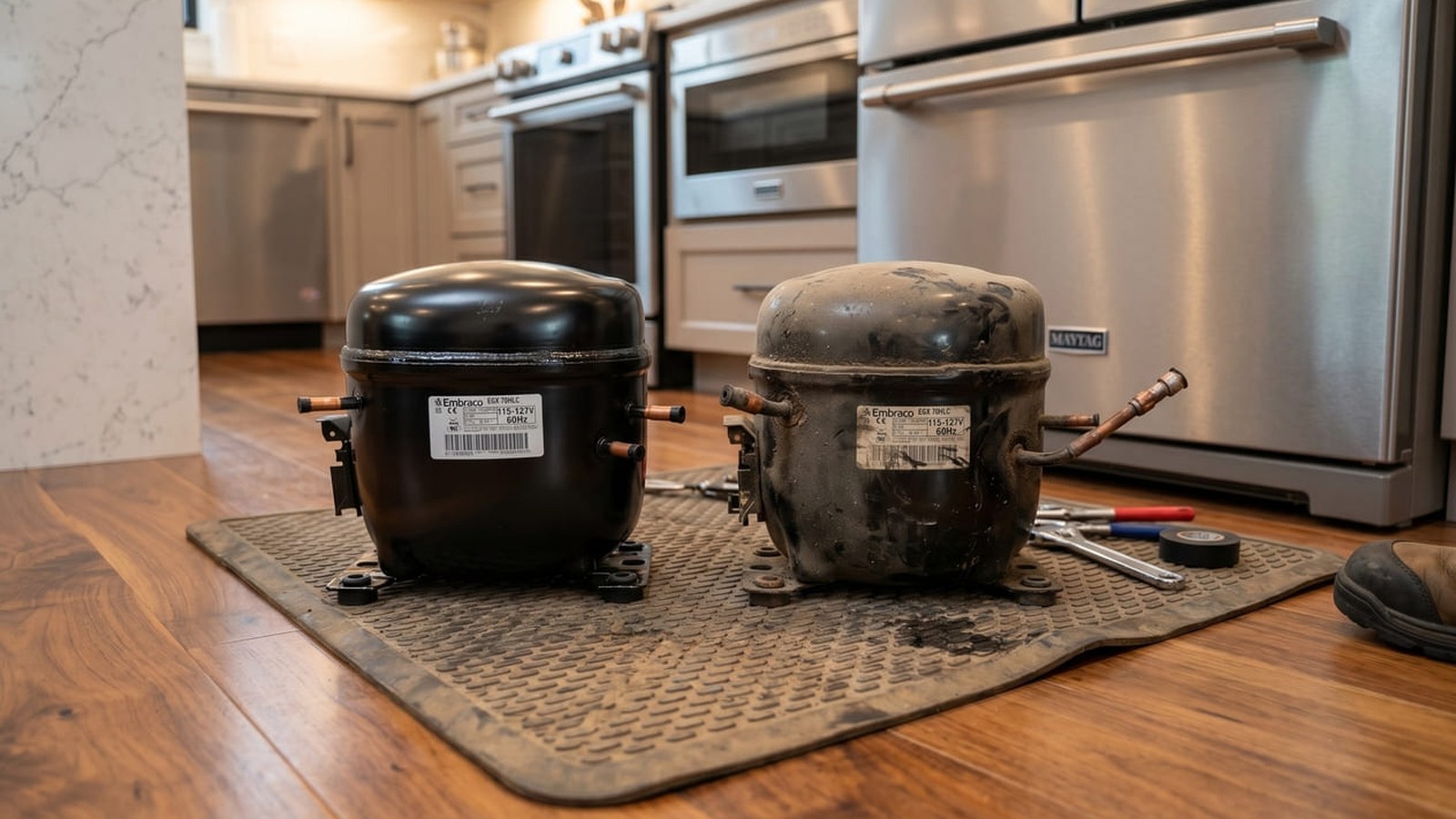
That rhythm is the compressor’s start circuit trying and failing. The start relay is a small part plugged onto the side of the compressor. Its job is narrow and critical: it gives the compressor motor an extra push for the split second it needs to get started, then drops out. When the relay fails, the compressor never gets going. It draws current, the thermal overload protector trips to keep it from overheating, and you hear the silence while it resets. Then the cycle repeats.
You’ll find advice online telling owners to pull the relay off the compressor and shake it, or test it with a multimeter. We don’t recommend it. The relay sits behind a rear panel on a live household circuit, right on the compressor terminals — that’s technician work. What you can do is notice the pattern, write it down, and call before the clicking runs for days.
What a technician tests: the start relay and the overload protector, the power actually reaching the compressor, and the compressor motor itself. If the start components are the problem, it’s usually a quick repair. If they test fine and the clicking continues, the compressor is the next suspect.
The Locked Compressor — When the Motor Can’t Turn
The pattern: a distinct hum for a few seconds, then a click or thud and silence. The refrigerator doesn’t cool.
A locked compressor is mechanically seized — the parts inside have stopped turning. The motor gets power and tries to turn. It can’t, and the overload trips to protect it.
Telling the Two Apart
These two failures can sound alike, but there are differences you can listen for:
| What you notice | Start component problem | Locked compressor |
|---|---|---|
| Sound | A brief click, then silence | A noticeable hum for a few seconds, then a click or thud |
| Rhythm | Repeats every few minutes | Repeats, with the hum each time |
| Vibration | Little or none | A faint vibration during the hum |
| After the start parts are replaced | The problem goes away | The clicking and humming continue |
Only a technician can confirm which one it is. A locked compressor can’t be fixed with a part swap from the outside: it means opening the sealed refrigerant system, recovering the refrigerant, replacing the compressor, and recharging the system. That work requires EPA 608 certified (a federal certification for handling refrigerant) technicians and recovery equipment — it’s regulated, not a formality.
Warranty note: Maytag’s French door bottom-mount guides print a limited warranty of one year on parts and labor from the date of purchase, and then, in the second through tenth years, a replacement compressor specified by Maytag — the compressor only, with labor not included. Terms depend on your model, your guide, and how the refrigerator was installed and maintained, so check your own document before you book a repair.
Short-Cycling — The Compressor Runs but Can’t Keep Up
The pattern: the compressor starts and stops too often. The refrigerator seems to run constantly but never quite gets cold enough.
Remember that Maytag calls long run times normal. Short-cycling is different: the compressor shuts off before it finishes a cooling cycle, again and again. Three causes produce this same pattern.
1. A Dirty Condenser or a Hot Room
The condenser releases heat from the refrigerant into the room. Coat it with dust and pet hair, and the heat can’t escape; the compressor runs hotter and trips out early. Maytag’s guide says there’s no need for routine condenser cleaning in normal home conditions — but if the home is particularly greasy or dusty, or there’s a lot of pet traffic, it should be cleaned every 2 to 3 months.
Room temperature matters too. Maytag’s guide says the refrigerator is meant for a location between 55°F (13°C) and 110°F (43°C), with 60°F to 90°F (15°C to 32°C) the preferred range for best performance. A summer garage in Atlanta can push well past that — and keep it away from an oven or other heat source.
How to check: look at the base grille at the front. If it’s packed with dust, Maytag’s guide shows owners how to clean the condenser: unplug the refrigerator, remove the base grille, vacuum the grille and the front of the condenser with a soft brush, then put the grille back and plug it in. Give it 24 hours and watch whether the cycling settles.
2. Refrigerant Loss in the Sealed System
A refrigerant leak lowers the pressure in the system, and the compressor can’t do its job. It runs, trips, and runs again while the refrigerator warms. Confirming it takes a technician with gauges — and repairing it is sealed-system work for EPA 608 certified technicians.
3. A Defrost Problem That Looks Like a Compressor Problem
If the automatic defrost isn’t working, frost builds on the evaporator coil — the cold coil hidden behind the back panel inside. Airflow drops, the compressor works harder, and the whole thing looks like a compressor failure. It isn’t. This is one of the most commonly misdiagnosed patterns, and it’s exactly why a proper diagnosis comes before any compressor work. Frost on the back wall inside the freezer, or a refrigerator that cools well for a few days after being off and then fades again, are both clues worth mentioning when you call.
Clicking or short-cycling and the refrigerator is warming? Book Maytag refrigerator repair — same- or next-day service across most of metro Atlanta. Move the most perishable food to a cooler in the meantime.
The Control Board — Rarely the Cause, Often the Guess
The electronic control coordinates every compressor start, defrost cycle, and fan command. It can fail. When it does, the symptoms are usually broader than one sound — erratic fans, display errors, and unpredictable cooling all at the same time.
And remember that Maytag lists a single click from relays and control boards, plus rapid repetitive clicking from the valve that switches cooling between compartments, as normal. A board that’s actually failing usually shows itself in more than one way.
The right diagnostic order — the one a technician follows:
- Test the start components first. They’re the most common cause when the compressor won’t start.
- Confirm that power is actually reaching the compressor.
- Only then evaluate the control board — with a test of its outputs, not a guess.
Control boards are model-specific. A board ordered by description rather than the exact part number for your model is a common, frustrating mistake. That’s one more reason to let the diagnosis come first.
What You Can Do vs. What a Technician Does
Safety first. Don’t remove the rear panel, and don’t touch the compressor, its start components, or any wiring — they’re on a live circuit. Don’t touch the water supply valve or the water line. If you smell burning or see smoke, unplug the refrigerator if you can do so safely, keep away, and call for help.
| Issue | You | Technician | Why |
|---|---|---|---|
| Matching the sound to Maytag’s normal list | Yes | Free, and it settles many worries | |
| Cleaning the condenser behind the base grille (dusty homes, pets) | Yes, following Maytag’s guide | Maytag gives owners these steps | |
| Checking the room temperature and clearance | Yes | Too hot a room makes any compressor struggle | |
| Testing the start relay and overload | Yes | Behind a panel, on the compressor terminals | |
| Locked compressor | Yes | Sealed-system work for EPA 608 certified technicians | |
| Refrigerant leak | Yes | Gauges, recovery equipment, EPA 608 certification | |
| Defrost problem | Yes | Behind the evaporator panel | |
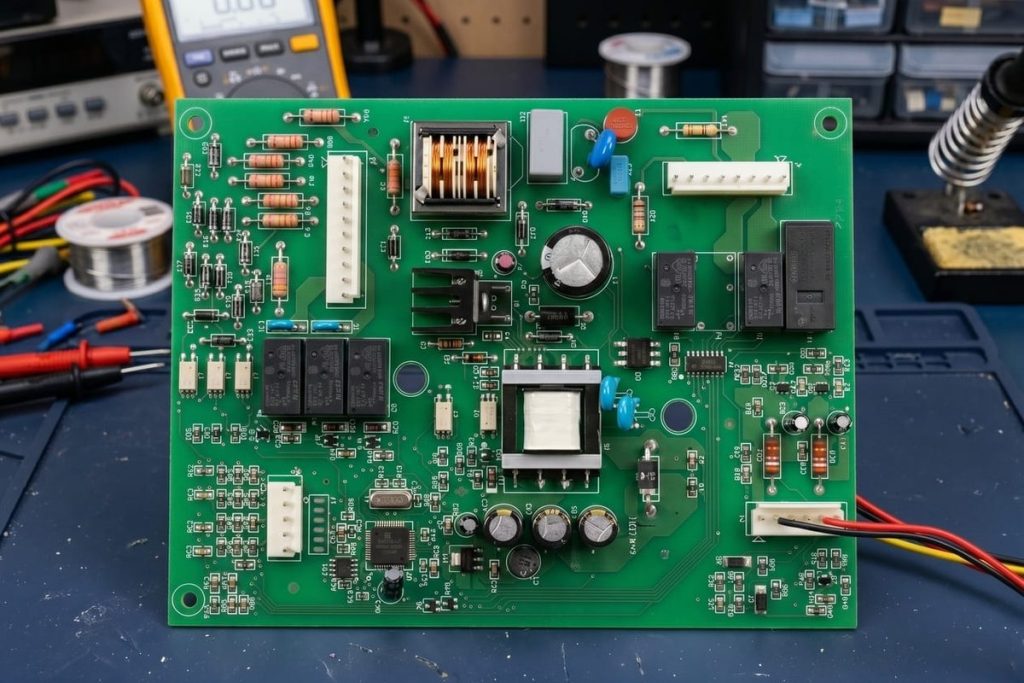
| Control board | Yes | Needs output testing and the exact part number |
Three levels sum up where Maytag compressor problems sit:
- Start components: usually a quick, contained repair — if it’s caught early.
- A locked compressor or a refrigerant leak: sealed-system work, legally and practically a technician’s job.
- A dirty condenser or a hot room: preventable, and often the cheapest fix of all.
For a refrigerator that’s still young and inside Maytag’s compressor warranty window, repairing a failed compressor often makes sense. For an older unit with several aging parts, replacement may be the better path. A technician who has actually diagnosed the unit can walk you through that comparison honestly. Our technicians are insured and background-checked, and we use genuine OEM parts (made by the original manufacturer).
Conclusion
Maytag compressor problems follow a clear decision tree, and the sound tells you where to start:
- Long run times, a single click, rapid repetitive clicking, buzzing as the ice maker fills — all on Maytag’s normal list.
- A click every few minutes, no cooling — start components. Call a technician.
- A short hum, then a thud, no cooling — possibly a locked compressor. Professional diagnosis.
- Short-cycling, dusty grille — clean the condenser per Maytag’s guide and watch for 24 hours.
- Short-cycling, clean condenser — sealed system (the compressor, the refrigerant, and the tubing between them) or defrost. A technician needs to find which.
- Erratic symptoms and display errors — possibly the control board, but start components get tested first.
Don’t let a no-cooling click run for days. Catching it early is what keeps a small repair small. Amana is a sister brand with similar compressor patterns — our guide to Amana refrigerator compressor problems goes through them too.
Maytag clicking, humming, or warming? Schedule Maytag refrigerator repair with PRO Appliance Repair — same- or next-day service across most of metro Atlanta, backed by our workmanship warranty of up to six months.
FAQ
How urgent is a Maytag compressor clicking sound — can I wait a few days?
It depends on whether the refrigerator is still cold. Clicks on Maytag’s normal list, with a cold refrigerator, are nothing to worry about. A click every few minutes and a refrigerator that’s warming is different: every failed start is hard on the compressor. Move perishable food to a cooler and book a diagnosis within a day or two.
Does Maytag’s 10-year compressor warranty cover labor?
Not according to Maytag’s French door bottom-mount Use & Care Guides. They print one year of parts and labor, then, in the second through tenth years, a replacement compressor only — labor not included — when the refrigerator was installed, operated, and maintained according to the instructions. Check your own guide; terms can differ by model.
Can a dirty condenser actually cause compressor problems?
Over time, yes. When the condenser can’t release heat, the compressor runs hotter and longer, and it can trip out early. Maytag says routine cleaning isn’t needed in normal homes, but in dusty or greasy homes, or with a lot of pet traffic, the condenser should be cleaned every 2 to 3 months.
My Maytag runs almost constantly. Is the compressor failing?
Not necessarily. Maytag says it’s normal for the high-efficiency compressor to run for extended periods at varying speeds. If the refrigerator is cold, that’s simply how it’s designed. If it runs constantly and isn’t cooling, that points to the sealed system, a defrost problem, or a condenser that can’t breathe — have it checked.
Could a defrost problem be mistaken for a compressor failure?
Yes, and it happens a lot. Frost building on the evaporator coil cuts airflow, so the refrigerator warms even though the compressor runs. Frost on the back wall inside the freezer is a clue. A technician can tell the two apart before anyone replaces a compressor that didn’t need replacing.
Is a Maytag compressor replacement worth it, or should I replace the refrigerator?
It depends on the refrigerator’s age, its condition, and whether the compressor is still inside Maytag’s warranty window. A younger unit in good shape is often worth repairing; an older one with several aging parts may not be. Ask for an honest comparison after a real diagnosis — not before.
PRO Appliance Repair is an independent repair company and is not affiliated with, sponsored by, or endorsed by Whirlpool Corporation or the Maytag brand. Brand and model names are used only to identify the appliances this page is about and remain the trademarks of their respective owners.