
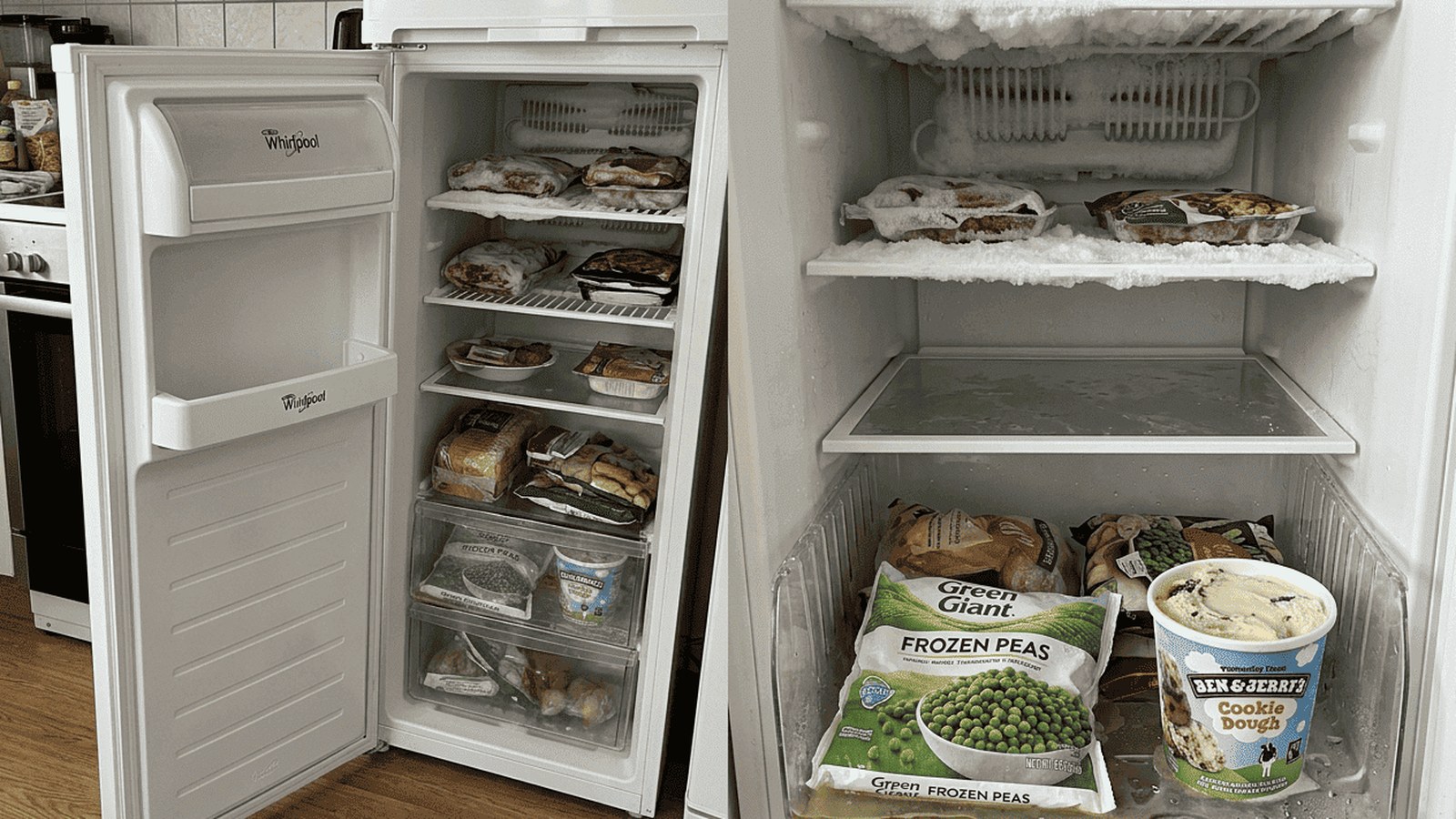
You reach for a bag of frozen berries and it gives under your fingers. Yesterday it was rock-solid. A Whirlpool freezer that can’t stay cold creates uncertainty fast: food frozen one day, soft the next, maybe an alarm that comes and goes. Most people turn the dial, unplug the unit, or wait.
It rarely does.
Whirlpool freezers warm up for specific reasons. Some come down to how and where the unit is installed or set. Others point to airflow, defrost, or parts that no setting can correct. The tricky part: very different causes produce very similar symptoms.
This guide clears that up: how a Whirlpool freezer is meant to hold temperature, the free checks first, and the point where it’s time for a technician. Rather hand it off now? Our freezer repair team comes out same- or next-day on most days across metro Atlanta.
Before you check anything: Unplug the unit or switch off its power before you clean the condenser or reach behind the base grille — Whirlpool’s own cleaning steps start that way. Never chip or pry at frost with a knife or other tool; Whirlpool says not to use mechanical devices to defrost. Moving a freezer or refrigerator takes two or more people. And if food sat warm for a while, check it before you trust it.
What “Too Warm” Means Inside a Whirlpool Freezer
A Whirlpool freezer is built to hold near 0°F (−18°C). Whirlpool’s upright freezer help page says the mid-setting is designed to keep it “at or near 0°F,” and its French door refrigerator pages list 0°F as the recommended freezer setting. Short swings are normal after door openings or a big grocery run — Whirlpool says a large amount of food warms the freezer, and it “can take several hours” to stabilize. What defines a problem is recovery.
When recovery slows or stops, the freezer is failing.
An alarm is one of the clearest signs, on models that have one. Whirlpool’s upright freezer alarm page says it sounds when the freezer gets 10°F or more above normal for your selected setting. On refrigerators with a Power Outage indicator, the display tells you the power was off and the freezer temperature rose. Food may still look frozen, but repeated thawing and refreezing hurts quality and strains the cooling system.
What makes it deceptive: the appliance keeps running. The compressor cycles, the fans hum, and nothing looks urgent.
How Whirlpool Freezers Control Temperature
Cold is produced in one spot — the evaporator coils behind the rear freezer panel — and distributed from there, so airflow and feedback matter as much as the cold itself. The system depends on:
- The evaporator fan, which moves cold air into the compartment
- The temperature sensor, often a thermistor, which reports conditions inside
- The control board, which decides how long the compressor and fans run
- The defrost system, which keeps the evaporator surface clear
On refrigerators, there’s one more link. Whirlpool’s side-by-side help page says most units use a shared cooling system: cold air is generated in the freezer and pushed into the fresh food section through vents. When one element slips, the freezer keeps running while gradually losing cooling — which is why most failures feel slow rather than sudden.
Environmental Conditions That Push Freezer Performance Out of Range
Before any internal failure, look at the room.
Whirlpool’s refrigerator help pages start with the garage question and a 55°F to 110°F room range; its stand-alone upright and chest freezer pages list 40°F to 110°F. Outside that range, cooling changes — and a Georgia garage in July is a tough place for any appliance.
In a cold room, the refrigerator may not run long enough to keep the freezer cold. Compressor cycles shorten, and the freezer drifts warm. Whirlpool’s top-freezer page says some models come with a “garage-ready” setting for rooms between 55°F and 38°F, but not every model has it, and it doesn’t override every limit.
Heat causes problems too. Whirlpool says to keep a freezer away from an oven or other heat source, allow at least 3 inches of air space at the top and sides of an upright freezer and about 2 inches behind it, and to vacuum the condenser coils behind the base grille when they’re dusty. Environmental stress rarely causes instant failure; it eats the margin until something else pushes the freezer past the limit.
Not sure whether it’s the room or the freezer? Our technicians can settle that before food is lost.
When Controls Work Against Cooling
Modern Whirlpool refrigerators rely on electronic controls, and those let cooling be switched off in ways that aren’t obvious. Whirlpool’s help page for a too-warm refrigerator asks it directly: “Is the cooling function turned On?” With cooling off, the lights work and the display responds — but nothing gets cold. Whirlpool’s own cleaning steps have you turn cooling off, so it’s easy to forget to turn it back on.
Temperature selection matters too. For an upright freezer that’s running but too warm, Whirlpool says to try a lower setting and to wait at least 24 hours between adjustments. A freezer that seems broken may simply be following its setting.
Airflow Inside the Freezer and Why It Matters
One of the most common mechanical causes of a warm Whirlpool freezer is restricted airflow inside it.
Cold air has to reach every corner. Whirlpool’s upright freezer manual explains the path: cool air enters from the freezer wall, moves down, and recirculates through the vent near the bottom — “Do not block any of these vents with food packages.” Its side-by-side page adds that items crowded against the back and side walls block the vents and create “warm spots.”
It usually happens by accident — a turkey shoved against the back wall. Cold air pools where it’s made, food near the door softens first, and readings mislead because the sensor sees cold in one spot.
While you’re there, check the door. Whirlpool’s dollar-bill test: close the door on a bill and pull — you should feel tension. Packages, a basket out of place, or a freezer that isn’t level can keep it from sealing. If the problem returns after you clear space, airflow is restricted somewhere you can’t see.
Defrost Failures and Ice Where It Should Not Be
When airflow is clear but cooling still declines, the defrost system comes next.
Frost-free Whirlpool freezers rely on automatic defrost cycles to keep ice off the evaporator coils. When that system fails, frost builds gradually. Over time, iced-over coils choke airflow and cut cooling output.
Many owners notice that unplugging the refrigerator brings the cold back for a while. Others try a manual defrost. Both melt the ice; neither fixes the failure that caused it.
Defrost problems progress steadily: thicker ice, weaker airflow, faster temperature climbs.
The Evaporator Fan and Circulation Loss
The evaporator fan moves cold air through the freezer. Without it, the cold stays trapped at the coils.
Fan failure is often partial — the fan slows, binds now and then, or stops only sometimes — so the swings feel random.
Because so many Whirlpool refrigerators share cold air from the freezer, a fan problem often shows up in both compartments — a warm freezer and fresh food warming at the same time. A change in fan noise is often the first warning.
Sensor and Control Board Failures
Temperature control depends on accurate information. When the thermistor sends wrong readings, the freezer can’t respond correctly.
A faulty sensor may report colder conditions than are real. The control board shortens cooling cycles, and the freezer warms without an immediate alarm.
Control board failures are less predictable: missed defrost cycles, wrong fan timing, cooling that shuts down without warning. Resets won’t fix them, and replacing parts without a diagnosis often means money spent on the wrong part.
How the Problem Appears by Refrigerator Type
What to check first depends on the design, and Whirlpool’s help pages differ by type:
| Type | What Whirlpool’s help pages point to |
|---|---|
| French door (bottom freezer) | Recommended settings of 37°F for the refrigerator and 0°F for the freezer; for a warm freezer section, allow 24 hours after installation, check the door seal, leftover packaging and bins |
| Side-by-side | Nearly the same checks; cold air is made in the freezer and pushed into the fresh food side |
| Top freezer | An airflow control on the back wall of the freezer sets how much air flows between compartments; some models have a garage-ready setting |
| Stand-alone upright or chest | Room between 40°F and 110°F, air space around the cabinet, a temperature alarm on some upright models |
What Happens If the Issue Is Ignored
A Whirlpool freezer running too warm doesn’t settle down on its own. As temperatures rise:
- Food quality deteriorates
- Freezer burn increases
- Ice production slows
- Components run under prolonged strain
What starts as an airflow or sensor issue can turn into a much bigger repair if ignored.
When Professional Repair Is the Right Call
Call a technician when:
- Temperature alarms keep coming back
- The freezer can’t hold safe temperatures
- Frost builds up again quickly after it’s cleared
- Cooling improves briefly, then fails again
At that point, the issue is mechanical or electronic, not a setting.
Whirlpool Freezer Repair
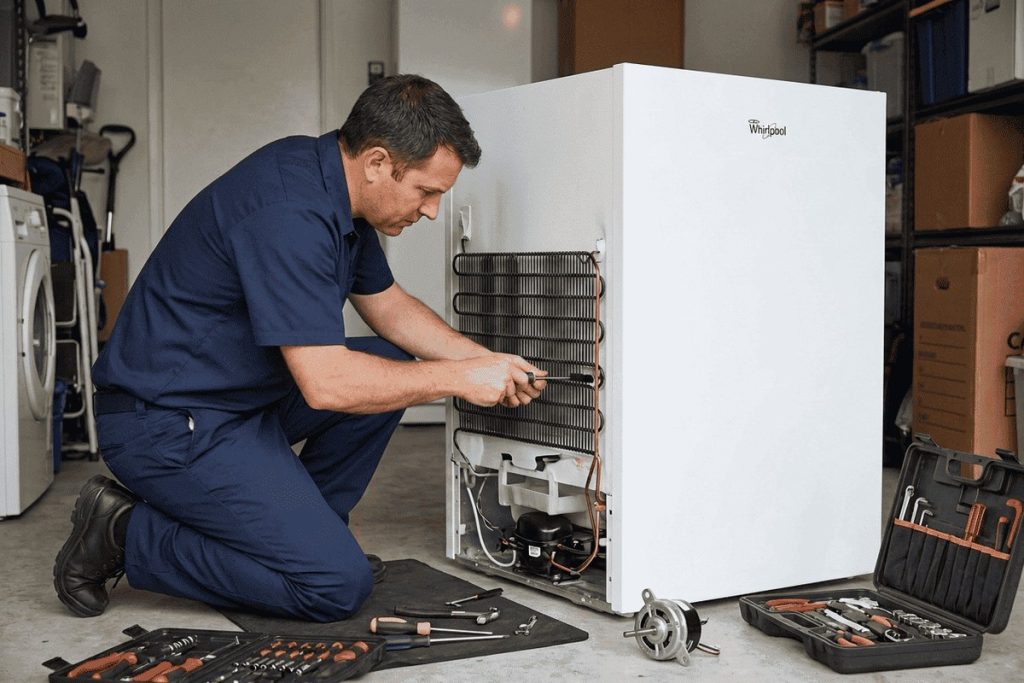
PRO Appliance Repair services Whirlpool French door, side-by-side, bottom-freezer and stand-alone freezers across metro Atlanta, same- or next-day on most days. We’re family-owned and insured; our EPA 608 certified, background-checked technicians use genuine OEM parts, and our workmanship is covered for up to six months. Book freezer repair with PRO Appliance Repair. Seeing an error code instead? Start with our guide to the Whirlpool freezer E2 error.
The Final Thoughts
Freezers rarely announce their problems. They drift out of balance one small change at a time.
When a Whirlpool freezer no longer holds cold the way it used to, attention matters more than adjustment. Small problems are easier to fix early. Same problem on a different brand? Our Kenmore freezer too warm guide walks through it.
FAQ
Why is my Whirlpool freezer running but still too warm?
Usually it’s not the compressor but airflow, temperature feedback, or defrost: cold air is produced but not distributed, or the board reacts to a bad sensor reading. Check the vents, the door and the setting first.
Can blocked air vents really cause freezer temperature problems?
Yes. Whirlpool says not to block the vents with food packages, because restricted airflow causes temperature and moisture problems. Cold air gets trapped near the back, so food near the door and upper shelves softens first.
What does a temperature alarm on a Whirlpool freezer mean?
On upright freezers that have one, Whirlpool says it sounds when the freezer gets 10°F or more above normal for the selected setting. Food may look frozen, but quality is already suffering. Check the door, vents and room; call if it returns.
Does the garage-ready setting prevent freezer temperature issues?
It helps some models in cooler rooms — Whirlpool’s top-freezer page ties it to rooms between 55°F and 38°F — but not every model has it, and it doesn’t remove every risk. Whirlpool’s refrigerator pages still start from a 55°F to 110°F room.
How long should I wait after changing the temperature setting?
At least 24 hours, per Whirlpool’s upright freezer page, then recheck with a thermometer. A big load of unfrozen food also takes several hours to stabilize, so give it time before deciding something’s broken.
When should I stop adjusting settings and call for repair?
If cooling is on, the vents are clear, the door seals, and it still can’t hold temperature, more adjustments won’t help. Returning alarms, frost that comes back, or fixes that fade after a reset point to the fan, thermistor, defrost system or control board — a technician’s diagnosis.
PRO Appliance Repair is an independent repair company and is not affiliated with, sponsored by, or endorsed by Whirlpool Corporation. Brand and model names are used only to identify the appliances this page is about and remain the trademarks of their respective owners.