
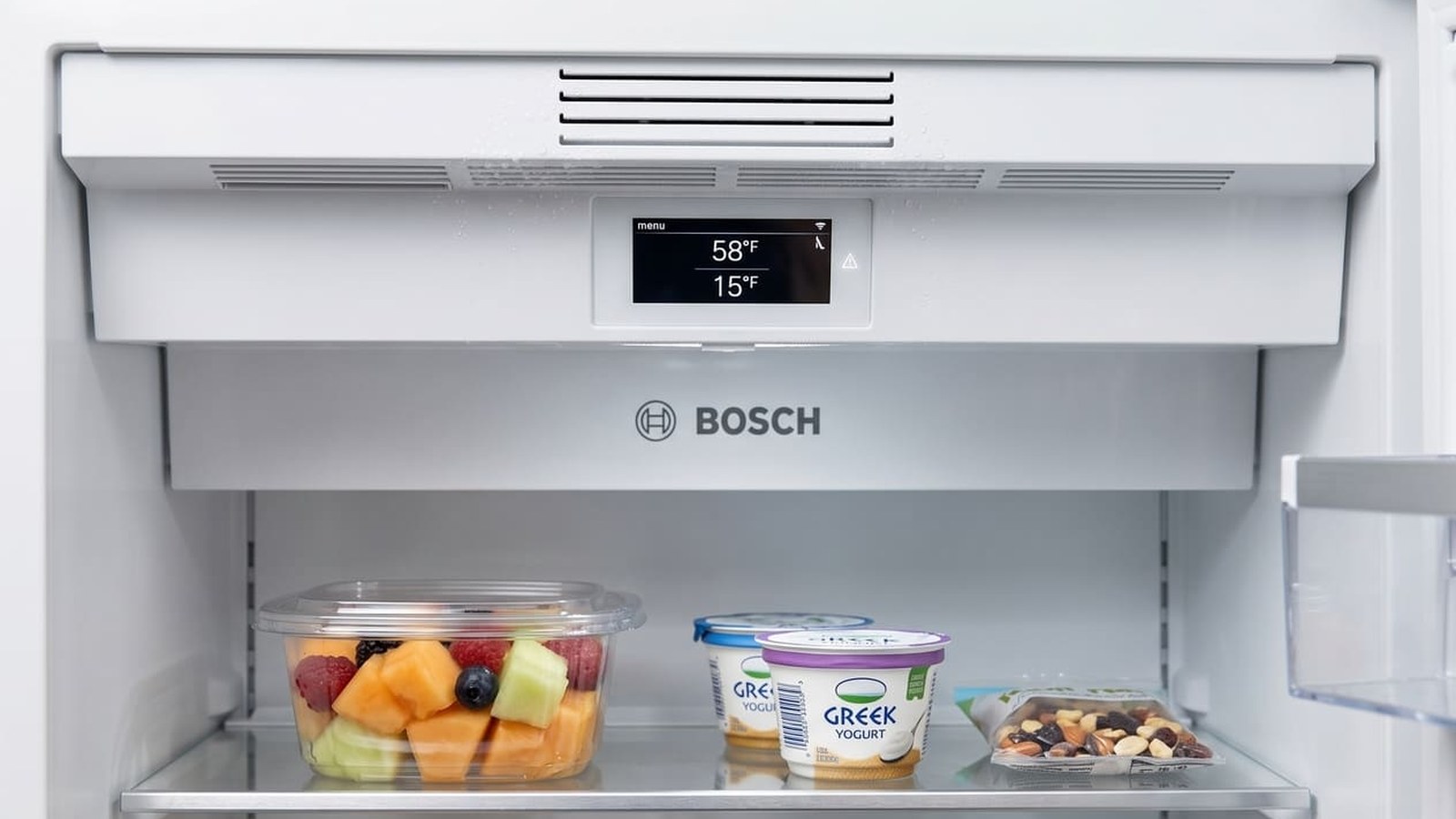
A Bosch fridge can power up like everything is fine and still miss the job it was built for: keeping food cold.
A Bosch fridge can show a normal display, run its fan, and still leave both compartments warmer than they should be after the unit has had time to run. So the diagnosis has to be precise.
A warm Bosch doesn’t automatically mean a dead compressor. It can be:
- a setting, such as a demo or showroom mode,
- blocked ventilation openings or a heat source nearby,
- a control or electronics issue,
- a bad start signal to the compressor,
- a refrigerant restriction,
- a sealed-system leak,
- or a compressor that is running but no longer pumping well.
From the kitchen, those problems can look nearly identical. On the repair bill, they are very different.
This guide follows Bosch’s own Use and Care Manuals for the B36 French door refrigerators (B36CL, B36CT, and B36.D families) and the older B26FT operating instructions. We check the cooling command, the electronics, compressor behavior, sealed-system performance, and temperature recovery before recommending parts. If you’d rather have someone test it, our Bosch refrigerator repair team handles these calls across metro Atlanta.
That is especially important when someone has already quoted a compressor replacement. A major repair should never start with “probably.” It should start with proof.
What We Check First
The compressor gets blamed fast when a Bosch fridge runs warm. Sometimes that is fair.
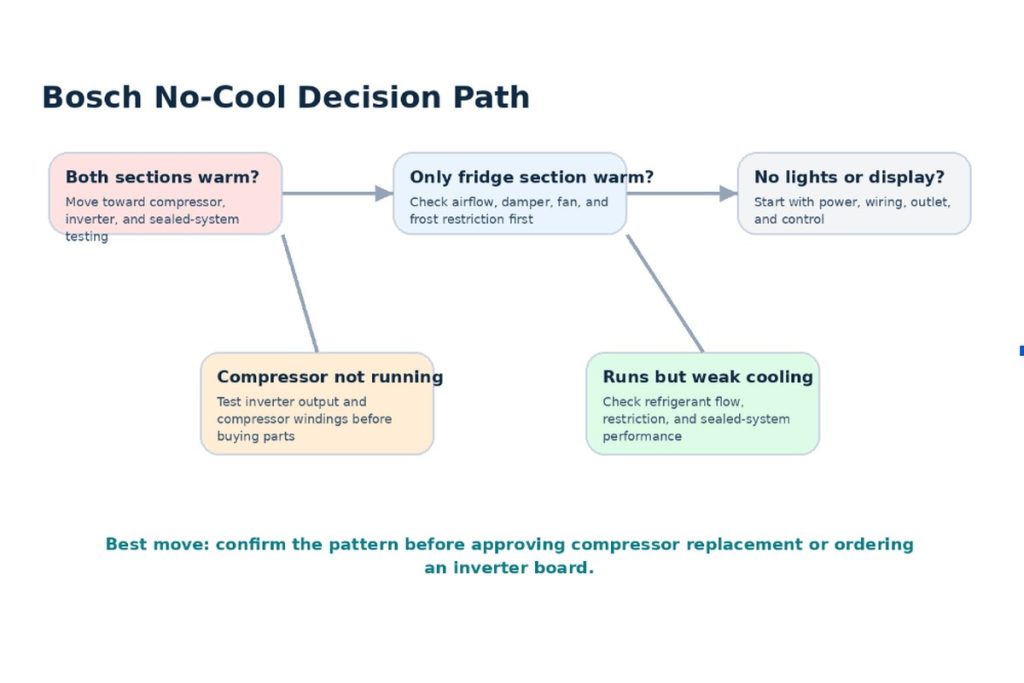
Before anyone talks about sealed-system repair or a compressor quote, look at the cooling pattern. Is the freezer still close to range while the refrigerator section runs warm? Or are both compartments losing temperature together?
That split shows us where to start.
| What you notice | What it points toward | Why it changes the repair |
|---|---|---|
| Freezer is still cold, but the refrigerator section runs warm | Airflow, a fan, blocked vents, frost buildup | Cold air may exist, but it is not reaching the fresh-food section properly |
| Freezer and refrigerator are both warm, display and lights on | Demo or showroom mode first; then compressor, start, or sealed-system fault | Bosch lists a demo mode as the first cause of “not cooling, the displays and lighting are lit” |
| Lights and display are off | Outlet, power supply, wiring, main control | This starts as a power issue, not a compressor issue |
| Refrigerator runs for long stretches | Often normal on modern Bosch units; if cooling is weak too — low refrigerant, weak compressor, restriction | The system may be working hard without moving heat out effectively |
A fan sound doesn’t mean the compressor is healthy. A warm cabinet doesn’t prove the compressor is dead. On Bosch French door refrigerators, the settings, controls, compressor, and sealed system need to be checked in the right order.
Bosch’s newer manuals make one point that saves a lot of worry. If the refrigeration unit is switching on more frequently and for longer, Bosch says: “Not a fault. Modern refrigeration machines switch on more frequently and have different power levels to cool more efficiently.” The same table lists everyday reasons for longer runs — the appliance “has been opened frequently,” or “External ventilation openings are covered up.”
Quick homeowner check before approving major parts
- ☐ Both compartments are warming, measured with a thermometer.
- ☐ The display and lights still work.
- ☐ You’ve ruled out a demo or showroom mode (see your manual).
- ☐ Ventilation openings aren’t covered, and the fridge isn’t next to a heat source.
- ☐ The refrigerator runs for long stretches with no real temperature drop.
- ☐ The display shows “E” or “d,” or a code you can photograph.
- ☐ Food is already moving into unsafe temperatures.
A technician can check the compressor circuit, the electronics, sealed-system behavior, and temperature recovery before you pay for the wrong repair.
Fan Noise and a Lit Display Don’t Clear the Compressor
A Bosch with a running fan and a lit display can still have a serious cooling problem. Those signs only show you the refrigerator has power and some components are active. They don’t explain whether the compressor is starting, whether the electronics are driving it correctly, or whether refrigerant is moving through the sealed system.
That is the part homeowners often miss, and it is why Bosch compressor problems get misread so easily.
Bosch also lists the sounds a healthy unit makes. The newer manuals say: “The appliance hums, bubbles, buzzes, gargles, clicks, crackles or rumbles,” and explain: “Not a fault. A motor is running, e.g. refrigerating unit, fan. Refrigerant is flowing through the pipes.” The older B26FT instructions describe humming as the refrigerating unit and the fan running, and bubbling or gurgling as refrigerant flowing through the tubing. So a hum by itself isn’t a warning sign. What matters is whether the hum comes with cooling.
From the kitchen, a fan problem, an electronics issue, a weak compressor, and a sealed-system restriction can all look oddly similar: the refrigerator runs, the cabinet stays warm, and every reset buys either nothing or a very short break. From a service standpoint, those are completely different repairs.
| What you notice | What it can mean |
|---|---|
| Fans run, but both sections stay warm | Demo/showroom mode, or a compressor, electronics, or sealed-system fault |
| Compressor clicks or hums, then stops | Start failure, overload, electronics, or a locked compressor |
| Compressor area gets very hot while cooling stays weak | Compressor may be struggling under load |
| Compressor stays quiet while fans run | Compressor not running — control, electronics, or wiring fault |
| Refrigerator runs for hours with poor cooling | Weak compressor, low refrigerant, restriction, or sealed-system problem |
If both compartments stay warm after the refrigerator has had time to run, the compressor circuit needs proper testing. The repair could be an electronics board. It could be wiring or control. It could be sealed-system repair. It could be the compressor itself.
The expensive mistake is choosing one before testing the others.
Warm Cabinet, Soft Freezer, Long Runtime
Bosch compressor trouble usually shows up as a pattern.
The refrigerator runs longer than it used to. The freezer stops keeping food firm. The fresh-food section climbs above 40°F. A reset helps for a little while, then the same problem comes back. The compressor area may click, hum, run hot, or stay quiet when it should be working.
Kitchen conditions can blur the picture. Summer heat, tight cabinetry, heavy grocery loads, and frequent door openings all make a refrigerator work harder. Bosch’s manuals list those same causes and the fixes: install the appliance “as far away as possible from heating elements, cookers and other heat sources,” avoid prolonged direct sunlight, open the door “as briefly as necessary,” and let hot food cool before storing it. The older B36CL instructions add that after a large amount of fresh food has been loaded, you should wait at least 2 hours. That part is normal. What isn’t normal is a Bosch that keeps running and still can’t pull both sections back into range.
| Symptom | Why it deserves attention |
|---|---|
| Both sections warm up | The issue is bigger than a fridge-only airflow problem |
| Fans run, but cooling does not return | Settings first, then compressor, electronics, or sealed system |
| Freezer food softens | The unit is not holding its coldest zone; the freezer temperature alarm may sound |
| Clicking or humming near the compressor | The compressor may be trying and failing to start |
| Compressor area gets very hot | Load, start failure, or mechanical trouble may be involved |
| Reset changes nothing | The issue is deeper than the control panel |
A Bosch that warms after a big grocery load deserves a little time. A Bosch that stays warm after hours of running needs a technician.
Compressor or Electronics: Why They Must Be Tested Together
Modern Bosch refrigerators don’t run the compressor as a simple on-off motor. Bosch’s own words are that modern refrigeration machines “have different power levels” — the electronics decide how the compressor starts and how hard it runs.
That setup is efficient. It is also one reason Bosch no-cool calls get misdiagnosed.
A failed electronics board can leave a good compressor sitting silent. A locked compressor can make good electronics look guilty. A wiring or control issue can keep both from doing useful work. If the refrigerator is warm and the compressor-not-running complaint keeps coming back, the compressor and its electronics need to be tested together.
Guessing which one failed first is how a repair bill grows.
| What a technician compares | What it shows |
|---|---|
| Power reaching the compressor-control side | Whether the electronics are getting what they need |
| The electronics’ attempt to start the compressor | Whether the board is calling for cooling |
| Compressor windings | Whether the compressor has an electrical failure |
| Ground fault check | Whether the compressor is shorted |
| Current behavior | Whether the compressor is locked or the drive output is weak |
| Full model and production number from the rating plate | Whether the replacement part is actually compatible |
Part compatibility is especially important on Bosch refrigerators. A board can plug in and still be wrong for the compressor, production revision, or control setup. Model families can have different electronics across production runs, so a connector that fits isn’t enough. A technician checks the full rating plate before ordering parts.
Bosch’s manuals also describe an appliance self-test “which displays faults that can be eliminated by your customer service,” and the newer tables list an “E” or “d” on the temperature display as “The electronics have detected a fault.” If you see one of those, photograph it — it helps the technician — but don’t start the self-test or key sequences unless you’re following your own manual exactly.
If the electronics are bad, replacing the compressor will not help. If the compressor is seized, replacing the board will not save it. A clean test keeps one failed part from turning into two purchased parts.
Sealed System Repair Is a Different Level of Work
Once the compressor itself is confirmed bad, the job moves into sealed-system territory.
That means the refrigeration circuit has to be opened. The failed compressor comes out. The correct replacement goes in. The filter drier is usually replaced. Lines are brazed. The system gets checked for leaks, pulled into vacuum, and charged by exact weight.
This is not the same repair category as a fan motor, gasket, or shelf part. Bosch’s B36CL instructions explain why: “The tubes of the refrigeration circuit contain a small quantity of an environmentally friendly but flammable refrigerant (R600a).” The newer manuals warn: “Do not damage the tubes of the refrigerant circuit or the insulation,” and if you suspect damaged tubes, keep open flames and sparks away, unplug the appliance or switch off the breaker, and call for service.
A proper sealed-system repair needs the right tools, the right refrigerant process, and a diagnosis that justifies opening the system in the first place. If the old compressor failed because of a restriction, contamination, or refrigerant leak, swapping the compressor alone may leave the original problem in place.
What a proper sealed-system repair includes
- ☐ Confirming the compressor is truly the failed part.
- ☐ Checking for leaks, restrictions, or contamination.
- ☐ Removing the failed compressor.
- ☐ Installing the correct replacement compressor.
- ☐ Replacing the filter drier when needed.
- ☐ Brazing connections correctly.
- ☐ Pressure-testing the system.
- ☐ Pulling a proper vacuum.
- ☐ Charging refrigerant by the exact weight on the rating plate.
- ☐ Verifying current draw, heat transfer, and temperature recovery.
Small refrigerant charges leave very little room for sloppy work. A small error in the charge can change performance. A poor vacuum can shorten the life of the new compressor. A missed restriction can make a fresh repair fail early.
Sealed-system work should only start when the diagnosis supports it: the electrical side, the electronics, compressor response, and cooling performance first. Refrigerant handling requires an EPA 608 certified technician.
If another quote says “probably the compressor,” ask what was tested. A major repair deserves more than a hunch.
Bosch B26FT70SNS: What the Older Instructions Say
The Bosch B26FT70SNS French door bottom-mount refrigerator comes up in compressor conversations because the symptoms can point in more than one direction.
Owners usually describe a familiar no-cool pattern: the refrigerator powers on, fans run, the cabinet warms, and the compressor is either silent, hot, or trying to start without success. Some of these are true compressor failures. Some trace back to the electronics. Others involve leaks or restrictions that get mislabeled as compressor trouble.
Bosch’s operating instructions for the B26FT family add two details worth knowing. First: “After installing the appliance, wait at least 8 hours before plugging in the appliance. The oil in the compressor may have flowed into the refrigeration system during transport.” If a B26FT was just moved or installed and plugged in right away, mention that to the technician. Second, the instructions list “Humming – refrigerating unit is running” as a normal sound.
The full rating plate matters as well as the production number and the refrigerant type. The installed compressor and electronics pairing also matter. A part that looks close can still be wrong.
| Owner question | What a technician verifies |
|---|---|
| Can I match the compressor by appearance? | No. Match by model, production number, refrigerant, electrical specs, and approved substitution |
| Do I need the board too? | Only if testing points there |
| Can I use a similar compressor? | Not without confirmed compatibility |
| Why did the new part not start? | Wrong revision, failed electronics, wiring issue, locked compressor, or sealed-system fault |
This is the kind of repair where speed can get expensive. Buying a compressor or board from a parts listing before testing the unit can leave you with a warm refrigerator and an expensive box on the counter.
A technician checks the compressor-and-electronics combination on site. If the compressor is bad, you get the sealed-system repair explained. If the electronics are the problem, you hear that before you pay for compressor work. If the refrigerator isn’t worth the investment, you should hear that too.
How a Technician Diagnoses Bosch Compressor Problems
A good Bosch compressor diagnosis follows a sequence. Skip the sequence and the repair can go sideways fast.
It starts with three questions:
- Is the refrigerator calling for cooling — and is it not in a demo or showroom mode?
- Is the compressor circuit getting the electrical input it needs?
- If the electrical side checks out, is the sealed system moving refrigerant and transferring heat?
That order keeps the repair honest.
If the board is not calling for cooling, the compressor may never get a chance to start. If the electronics receive power but send no useful output, the compressor may be innocent. If the compressor starts but cooling stays weak, the sealed system moves higher on the list.
Checklist: what a technician checks on a Bosch no-cool call
- ☐ Incoming power to the refrigerator.
- ☐ Settings and modes, including demo or showroom mode.
- ☐ Board command for cooling.
- ☐ Electronics input and output behavior.
- ☐ Compressor winding resistance.
- ☐ Ground fault check.
- ☐ Compressor shell temperature.
- ☐ Condenser fan operation and ventilation openings.
- ☐ Frost pattern or lack of frost.
- ☐ Startup and running current.
- ☐ Heat transfer across the condenser loop.
- ☐ Temperature drop during operation.
- ☐ Full model and production number before parts are ordered.
A weak compressor can fool people because it technically runs. You may hear it and even feel vibration. The cabinet still stays warm — the refrigerator can run almost nonstop while the fresh-food section sits in the mid-40s or higher and the freezer never pulls near range.
That’s the point where the cooling system needs testing.
When DIY Won’t Help
Plenty of refrigerator fixes are reasonable for a capable homeowner. Shelves, bins, and door closure can be fair territory. Bosch’s own lists cover those: an appliance that isn’t level, fittings that wobble or stick, bottles or containers that touch.
Compressor and sealed-system work sit in a different category.
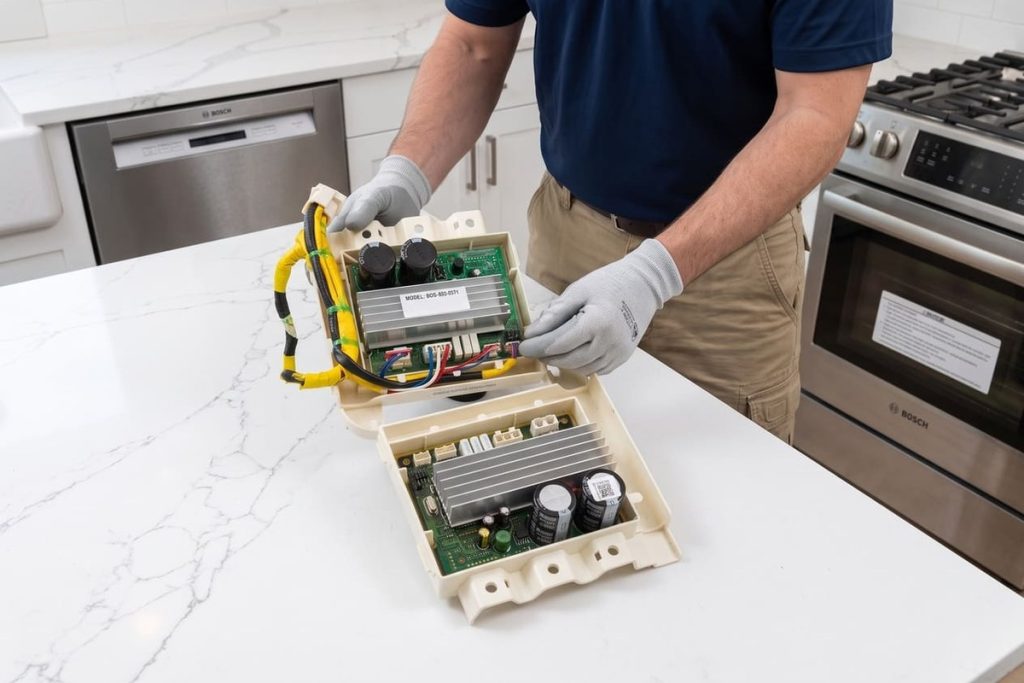
Once refrigerant, electronics testing, compressor windings, brazing, vacuum, or exact charging enters the job, DIY stops being a bargain. One wrong part can waste a lot of money. One poor sealed-system repair can ruin a new compressor. One missed electronics issue can make a compressor replacement look like it failed.
Hand the job off if:
- ☐ Both compartments are warm while fans still run, and the settings are ruled out.
- ☐ You suspect a compressor or electronics failure.
- ☐ The compressor clicks, hums, overheats, or stays silent.
- ☐ Refrigerant work may be involved.
- ☐ You are about to order expensive parts based on a guess.
- ☐ The compressor-not-running issue keeps returning after resets.
- ☐ The freezer and fresh-food section keep warming together.
A service call can be cheaper than experimenting. A refrigerator running hard all day while barely cooling can burn time, food, and patience. Tight cabinetry can add heat stress, but it does not change the repair order. The unit still needs proper testing before sealed-system parts are approved.
Repair or Replace: How to Decide on Compressor Work
Nobody likes hearing a major refrigerator repair quote. With Bosch compressor work, the job covers the compressor, sealed-system labor, the filter drier, refrigerant handling, brazing, vacuum, charging, testing, and often a return visit if the part has to be ordered.
The better question is not whether the quote is high. The failure must be proven, and then you decide whether your Bosch unit is worth repairing.
That answer depends on the model, age, cabinet condition, access, part availability, and whether the issue is truly the compressor or something around it. A built-in or tightly fitted unit usually takes longer to reach.
A compressor repair can make sense on a Bosch with a clean cabinet, strong door seals, and good parts availability. It makes less sense on an older refrigerator that already has failing electronics, damaged seals, noisy fans, rust, or other expensive problems waiting in line.
| Repair usually makes sense when | Replacement is often better when |
|---|---|
| The refrigerator is otherwise in good condition | The refrigerator is older and already showing other failures |
| The cabinet, doors, shelves, and seals are still in good shape | Compressor, electronics, and sealed-system issues stack together |
| The compressor or sealed-system failure has been confirmed | Parts are delayed with no clear arrival date |
| Parts are available within a reasonable time | Cabinet, door seals, or interior condition are already poor |
| Replacement would cost much more than repair | The unit has a history of repeat cooling or electronics problems |
Check your warranty paperwork too. Bosch’s limited warranty statements tie coverage to the original purchase or delivery date and to service providers Bosch approves; read the statement that came with your model before any repair.
A good technician gives homeowners the straight version. Some Bosch refrigerators are worth saving. Some are not. Nobody should push compressor work just because they can do it.
What Slows Down Bosch Compressor Repair
Same- or next-day service is realistic for many problems. Compressor repair is different.
Diagnosis may happen the same day. Full sealed-system repair depends on the exact model, part availability, refrigerant procedure, and whether the refrigerator has to be pulled from a tight cabinet opening.
The biggest delay is usually parts. Some Bosch electronics boards are easy to source. Some compressors and sealed-system parts are not. A technician may identify the failure on the first visit, but the actual repair can become a return-trip job if the compressor or board has to be ordered.
That is normal for this category.
| Factor | What it means for turnaround |
|---|---|
| Part is in local stock | Repair may move faster |
| Part ships from a regional warehouse | Adds several days |
| Built-in refrigerator access | Longer appointment window |
| Sealed-system job required | Usually not a quick in-and-out visit |
| Model and production number check needed | Prevents wrong-part ordering |
Good sealed-system work can’t be rushed. Brazing, vacuum, charging, and temperature verification need time.
What to expect on a compressor complaint
- ☐ First visit for diagnosis.
- ☐ Full model and production number check.
- ☐ Compressor, electronics, and sealed-system testing.
- ☐ Parts sourcing and availability check.
- ☐ Repair quote and repair-versus-replacement discussion.
- ☐ Return visit for sealed-system work if approved.
- ☐ Temperature recovery check after the repair.
If the issue turns out to be a setting, control, fan, or wiring problem and the part is available, the repair may move quickly. If it is compressor work, the first goal is a clean diagnosis so you do not wait on the wrong part.
What to Do Right Now if Your Bosch Refrigerator Is Warm
If your Bosch is warm today, protect the food first.
Use a thermometer if you have one. Check both compartments. Keep the doors closed as much as possible. Move high-risk food if the fresh-food section is above 40°F. If frozen food starts to soften, move it to another freezer or a cooler.
Don’t keep resetting the refrigerator every hour. Power-cycling can make the pattern harder to diagnose, and it won’t fix failed electronics, a locked compressor, a refrigerant leak, or a sealed-system restriction.
Fast action checklist
- ☐ Check the actual temperature with a thermometer.
- ☐ Keep the doors closed.
- ☐ Move perishable food if temperatures are unsafe.
- ☐ Stop loading new groceries into the refrigerator.
- ☐ Avoid repeated unplugging and resets.
- ☐ Note what the display shows — a demo/showroom indication, “E,” “d,” or an alarm.
- ☐ Listen for clicking, humming, or silence near the compressor.
- ☐ Note whether fans are running.
- ☐ Call for diagnosis if both sections stay warm.
If both sections are warm and the fans still run, random part swapping no longer makes sense.
- Don’t start with the board because it is cheaper.
- Don’t start with the compressor because someone online said so.
That is how homeowners end up buying both.
Call right away if:
- ☐ Both compartments are warming.
- ☐ The light and display still work, and no demo mode is on.
- ☐ Fans run, but cooling does not return.
- ☐ The compressor clicks, hums, overheats, or stays silent.
- ☐ You smell something unusual near the unit — Bosch says to keep flames and sparks away and unplug it if you suspect damaged refrigerant tubes.
What Happens After You Call
A compressor complaint can sound intimidating, especially when the refrigerator still has power. Here is the simple version of the steps after you book service.
✓ Step 1: We confirm the symptom. We check whether one section is warm or both sections are losing temperature. That first detail shows whether to start with airflow or move closer to compressor, electronics, and sealed-system testing.
✓ Step 2: We rule out the basics. Power, display behavior and modes, fans, airflow, ventilation openings, door closure, cabinet installation, and temperature readings all help narrow the repair path.
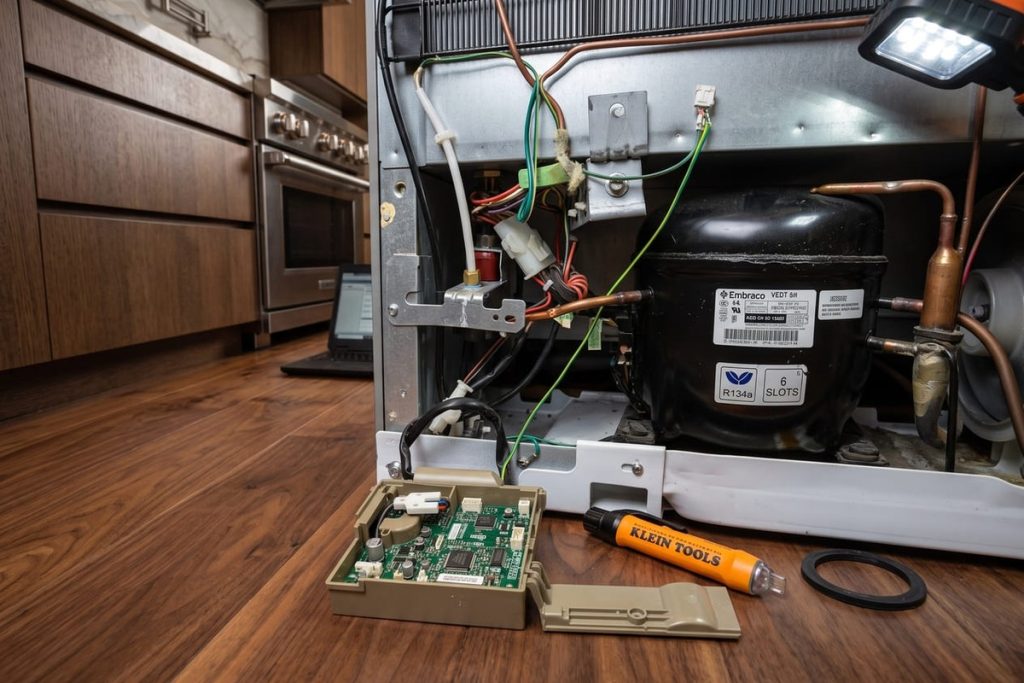
✓ Step 3: We test the compressor and its electronics. If the refrigerator is calling for cooling, we check whether the compressor circuit receives and responds to that call.
✓ Step 4: We decide whether sealed-system diagnosis is needed. If electrical checks pass but cooling stays weak, the sealed system moves into the conversation. Refrigerant movement, restrictions, leaks, and compressor performance need to be verified.
✓ Step 5: We explain repair versus replacement. A fan repair and a sealed-system repair are not the same decision. If your Bosch is worth saving, we explain why. If replacement makes more sense, we say so.
✓ Step 6: You choose the repair path. You get a clear explanation, a practical recommendation, and a real next step. No parts lottery.
Get the failure verified before major parts are approved. Book Bosch refrigerator repair with PRO Appliance Repair. We’re family-owned and insured, with same- or next-day service on most days across metro Atlanta. Our EPA 608 certified, background-checked technicians use genuine OEM parts, and our repairs carry a warranty of up to six months.
Bosch Compressor Problems We Diagnose
- Bosch refrigerator running but not cooling
- Compressor not running
- Warm refrigerator and warm freezer
- Weak cooling with fans running
- Clicking or humming near the compressor
- Hot compressor shell
- Electronics and part-compatibility concerns
- B26FT70SNS no-cool complaints
- Sealed-system repair
- Refrigerant leak and restriction concerns
- Repair-versus-replacement decisions
If your Bosch still powers on but doesn’t cool correctly, it’s time to book service. The failure is active enough to test, and the repair may still be easier to plan before more food is lost.
Conclusion
A Bosch refrigerator that isn’t cooling needs a careful diagnosis. Fan noise, a lit display, and a warm cabinet don’t prove the compressor is dead. They also don’t clear it. The problem may sit in a setting, the compressor, the electronics, the control circuit, the sealed system, refrigerant flow, or part compatibility.
That difference matters because Bosch compressor work can turn into a serious repair decision fast. If the quote is heading toward compressor replacement, make sure the failure has been proven first. A demo mode, blocked ventilation, bad electronics, a wrong replacement board, a sealed-system restriction, or a refrigerant leak can look like compressor failure from the kitchen.
Check the full cooling path before approving major parts. For a closer look at one of the most common Bosch French door lines, see our guide to Bosch 500 Series refrigerator problems.
FAQ
1. How do I know if my Bosch refrigerator compressor has failed?
A failed compressor often shows up as a refrigerator that has power, lights, and possibly fans, but does not cool properly in either section. Before suspecting it, rule out what Bosch lists first: a demo or showroom mode, covered ventilation openings, and a nearby heat source. Failed electronics or a sealed-system issue can look similar, so the compressor should be tested before it is condemned.
2. Can a Bosch refrigerator run with a bad compressor?
It may still power on, and fans or lights may work, but it will not cool correctly if the compressor isn’t doing its job. Homeowners often describe this as the refrigerator running but not cooling. The key is whether the compressor is actually starting, pumping refrigerant, and producing a temperature drop.
3. Why is my Bosch compressor not running?
It can come from a setting such as demo mode, a failed compressor, failed electronics, missing power, a wiring issue, a main control problem, thermal protection, or a compatibility problem after an incorrect replacement. If the display shows “E” or “d,” Bosch says the electronics have detected a fault. The compressor and its electronics should be tested together before either part is replaced.
4. My Bosch runs much longer than my old fridge — is the compressor failing?
Not necessarily. Bosch’s manuals say: “Not a fault. Modern refrigeration machines switch on more frequently and have different power levels to cool more efficiently.” Frequent door openings and covered ventilation openings also lengthen run time. Long runs only become a concern when the temperatures don’t come down.
5. Is Bosch compressor replacement a DIY job?
No. Compressor replacement is sealed-system work. It involves refrigerant handling, brazing, vacuum, charging to exact weight, pressure testing, and electrical diagnosis. Bosch notes these units use a flammable refrigerant, R600a, which is another reason the circuit should only be opened by an EPA 608 certified technician.
6. My Bosch was just moved and isn’t cooling — what should I do?
Bosch’s B26FT instructions say to wait at least 8 hours after installing the appliance before plugging it in, because compressor oil may have flowed into the refrigeration system during transport. If it was plugged in right away and still won’t cool after a day, mention the move when you call for service.
PRO Appliance Repair is an independent repair company and is not affiliated with, sponsored by, or endorsed by Bosch or BSH Home Appliances Corporation. Brand and model names are used only to identify the appliances this page is about and remain the trademarks of their respective owners.