
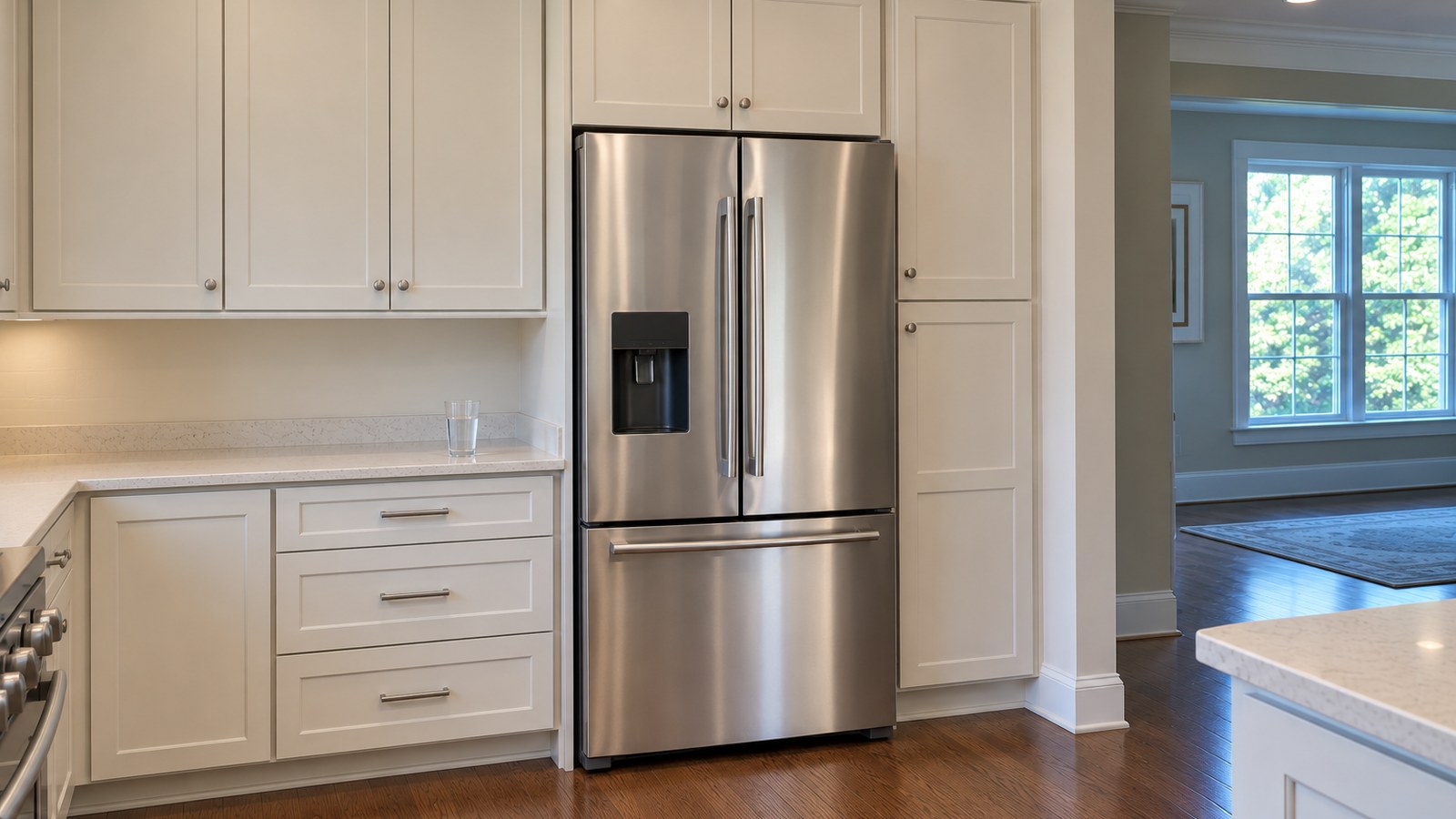
One morning the ice bin is a frozen brick, the water trickles into your glass, and the display shows a code you’ve never seen. Frustrating — on a refrigerator that still looks brand new.
Take a breath; most of this is fixable. Bosch gave the 500 Series an unusually strong sales pitch: counter-depth proportions, a built-in look, QuickIce Pro, an external water and ice dispenser, and app-connected controls. On Bosch’s product page, the B36CD50SNS sits exactly in that lane — a 36-inch Bosch 500 Series French door refrigerator with Total No Frost, MultiAirFlow, Home Connect, and an external dispenser. There are two details that matter once the honeymoon period is over: its spec sheet lists one evaporator, and Bosch notes that “the cutout depth of 25″ includes the required 1″ airflow” behind the unit.
That matters because the service story is less glamorous than the product one. Most Bosch 500 Series problems show up as narrower complaints:
- the ice bin starts clumping, or the dispenser loses pressure,
- the refrigerator section no longer feels as steady,
- or the same code comes back after a reset.
Bosch’s Use and Care Manual points owners toward the same places: the troubleshooting table, filter maintenance, and service when those symptoms persist. (Own an 800 Series? See our guide to Bosch 800 Series refrigerator problems.)
For a homeowner, the hard part is that these symptoms are easy to live around for a few weeks. For a service company, that is when the clock starts. A weak dispenser often travels with weak ice production. A recurring E02 or E03 points to the ice and water system — not to a temperature sensor, as many guides claim. A refrigerator that feels slightly off on temperature can keep working just long enough for the problem to spread. When it’s time for a technician, book Bosch refrigerator repair.
| What you notice | What it often points to |
|---|---|
| Ice bin clumps or the chute jams | Ice clumping, low water pressure, or a water filter that is no longer flowing properly |
| Water dispenser gets slow | A blocked filter, low water pressure, or a supply restriction |
| Fresh-food side feels less stable | Airflow, load, door openings, or installation clearance |
| E02 or E03 appears | Per Bosch: E02 — an ice maker fault or a communication issue in the ice and water controls; E03 — a dispenser user interface fault |
| The same issue keeps coming back | Time to stop resetting and book a Bosch 500 Series repair |
Safety first: These checks need no tools. Don’t remove panels, never reach into the ice dispenser opening — Bosch warns it “can cause cuts” — and leave the water valve and hose to a technician. If you smell burning, switch off the breaker if safe; if there’s smoke, call 911.
Still deciding whether this is a repair call? If the same symptom has outlasted a filter change, a reset, or a quick adjustment, book service — same- or next-day in Atlanta on most days.
Ice Maker Troubleshooting
This is where many owners first lose confidence in the appliance. Bosch bills the QuickIce Pro System as “the industry’s fastest refrigerator ice maker,” and the B36CD50SNS spec sheet rates it at “up to 12 lbs of ice per day.” That is great when everything is lined up. It also raises expectations high enough that even a modest drop in performance becomes noticeable fast.
Bosch’s manual says output drops when:
- water pressure is low,
- the water filter is blocked,
- the freezer has been opened often,
- or the appliance has only recently been connected.
Also the dispenser can stop functioning when:
- the ice storage container is not fully inserted,
- cubes are frozen together in the chute,
- the shut-off valve is closed,
- or the hose has a kink.
In other words, ice clumping problems on this platform are not a side issue. They are one of the main ways the refrigerator tells you the water-and-ice system is no longer running cleanly.
That changes how the symptom should be read. If the ice bin is clumping, the chute keeps jamming, or the cubes start arriving in smaller, slower batches, the safer assumption is that something in the chain has drifted: pressure, filtration, flow, alignment, or the dispenser side. Sometimes the fix is simple. Sometimes it is the beginning of a broader repair. Either way, the refrigerator has already stopped behaving normally.
What you can do: push the ice storage container fully into place and note your last filter change. Cubes frozen into the chute? Follow your manual exactly — never fingers or metal.
Slow or Dripping Water Dispenser
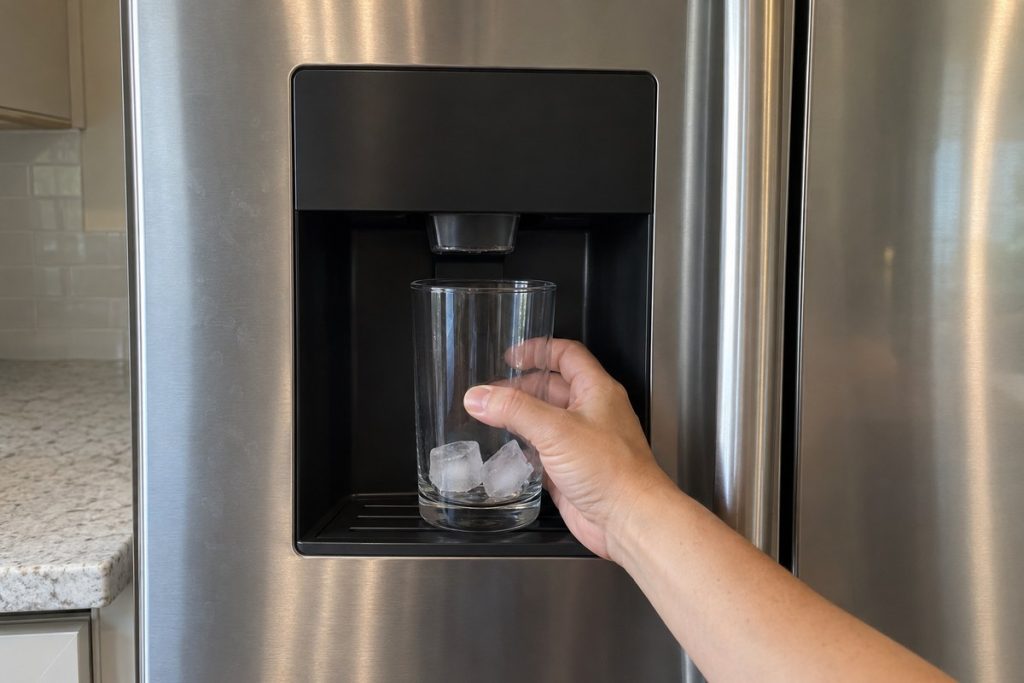
People occasionally search for “water dispenser design flaws,” and it is not hard to see why. The dispenser is one of the parts you interact with every day, so the moment it starts lagging, dripping, or losing pressure, the whole refrigerator becomes less refined. A product that looked premium on delivery becomes ordinary every time you fill a glass.
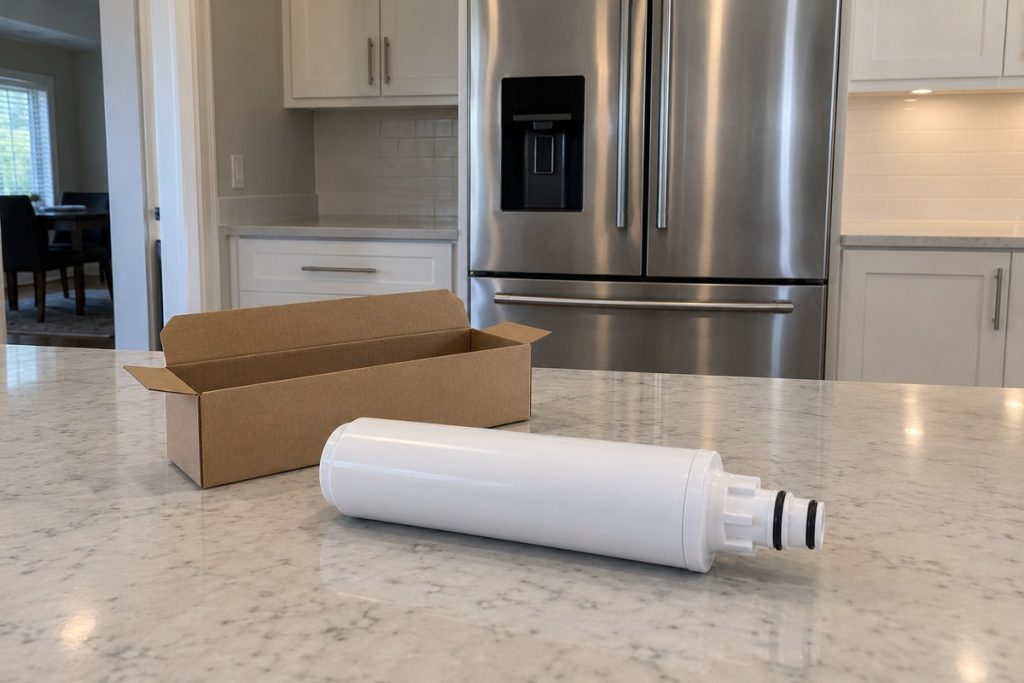
Let’s get practical. Bosch’s manual says to change the water filter “every 6 months,” when the reminder lights up, or sooner if water output or ice production has “visibly reduced.” Skipping replacement reduces water flow, affects taste, and lets sediment build up.
We must warn you that non-approved or universal filters may not seal properly and can cause leaks. Keep in mind that those are not cosmetic concerns. They go straight to the problems owners notice at the dispenser.
The B36CD50SNS manual makes the diagnosis even plainer: reduced water output can come from low water pressure or a blocked filter, and a non-functioning dispenser can be tied to the shut-off valve, supply interruptions, or kinks in the water hose. Dripping after a filter change? Bosch says “air is in the water system.”
So when a homeowner describes “design flaws,” the service conversation is usually about flow, filtration, fit, and supply — not about blaming the front panel because that is the part they can see.
Weak dispenser today, no-ice complaint tomorrow. If your Bosch 500 Series is giving you less water, less ice, or both, book Bosch refrigerator repair before the same issue starts showing up in two places at once.
One Evaporator, One Cooling System: What It Means Day to Day
Some owners search for “single compressor limitations.” Bosch doesn’t use that phrase, and its documents don’t describe the design as a weakness. What the B36CD50SNS spec sheet does list is one evaporator, MultiAirFlow, and a cutout depth that includes the required one inch of airflow behind the unit. That is enough to explain why some owners notice the refrigerator section becoming less steady than they expected.
In daily use, it shows up as a refrigerator that recovers more slowly after heavy use, a fresh-food section that feels a little softer on temperature than the owner wants, or a unit that seems more sensitive to loading, door openings, and kitchen heat than the brochure implied. Bosch’s manual says to keep the appliance “as far away as possible from heating elements, cookers and other heat sources” and out of direct sunlight — advice that earns its keep in a sunny Atlanta kitchen in July.
This is one reason cooling complaints on the 500 Series are easy to underestimate. The refrigerator can stay powered, lit, and outwardly normal while still drifting in performance. That is also why it is a mistake to answer every cooling complaint with either panic or denial. If the fresh-food side is slipping, the unit needs to be read carefully. On a counter-depth model with this kind of feature set, proper diagnosis matters more than broad guesses.
Error Codes E02 and E03 — What Bosch Says They Mean
Most homeowners are not opening the back of the refrigerator and diagnosing harnesses. When they search for “B36CD50SNS wiring issues,” they are usually describing something more practical: a dispenser that acts erratic, a fault that clears and comes back, or controls that stop behaving consistently.
Here’s where a lot of online advice gets the codes wrong. Bosch’s refrigeration error code page says E02 means the ice maker is faulty, or the ice and water system controls have a communication issue, and E03 means “there is a dispenser user interface fault/error.” Neither is a temperature sensor code — so E02 sends the technician to the ice maker and its controls, and E03 to the dispenser interface. Swapping a temperature sensor for either buys a part you don’t need.
Bosch’s first step for both: reset power at the breaker for 30 seconds. A short power reset may clear a temporary glitch, but if E02 or E03 returns, the refrigerator should be inspected by a qualified technician.
That matters because it separates a one-off display event from a repeating fault. A refrigerator that briefly shows a code after a power interruption is one thing. A refrigerator that keeps returning to E02 or E03 after resets needs a more careful diagnosis.
Other faults look different: the B36CD50SNS manual shows “E” or “d” on the temperature display when “the electronics have detected a fault.”
Before you book service, check these five things:
- Replace the water filter if it is overdue — Bosch says every 6 months, or when the reminder lights up.
- Check whether weak dispenser flow and weak ice production started around the same time.
- Make sure the ice storage container is fully inserted.
- Look — don’t touch — for simple supply issues: a kinked hose or a closed shut-off valve.
- Write down recurring codes exactly as they appear. E02 points to the ice maker or its controls; E03 to the dispenser interface.
That is enough to sharpen the service call. More than that, and most homeowners start losing time instead of gaining clarity.
When Bosch 500 Series Repair Is Truly Necessary
There is a clear point where monitoring becomes delay. It usually looks like this: the filter has already been changed, but water flow is still weak; the ice maker comes back for a day, then falls behind again; the same code returns; or the refrigerator side keeps slipping on temperature even though the unit still looks fine from the outside.
That is when Bosch 500 Series repair becomes the sensible move, not the last resort. We see the same pattern all the time: people wait because the refrigerator has not failed all the way yet. But the biggest refrigerator repairs rarely begin with a dead box. People usually notice a repeat symptom that was easy to live with until it was not.
Final Word
The most useful way to think about Bosch 500 Series problems is not as one big failure category. It is a smaller set of repeated complaints around the same systems: ice production, dispenser flow, cooling consistency, and fault codes that stop staying fixed.
If your refrigerator is already giving you one of those warnings, this is the time to act on it — early diagnosis usually means a smaller repair.
Ready to get it fixed? Schedule Bosch refrigerator repair with PRO Appliance Repair — call us or book online, and we’ll have a technician out same- or next-day across most of metro Atlanta. Our insured, background-checked, EPA 608 certified (a federal certification for handling refrigerant) technicians bring 15+ years of hands-on experience, use genuine OEM parts (made by the original manufacturer), and back the repair with our workmanship warranty — up to six months.
FAQ
How often should I change the water filter on a Bosch 500 Series refrigerator?
Every 6 months, according to Bosch’s manual, or when the refrigerator alerts you. Overdue filters can reduce water flow and affect taste and performance.
What does E02 mean on a Bosch refrigerator?
Bosch’s error code page says E02 means the ice maker is faulty or the ice and water system controls have a communication issue. Reset power at the breaker for 30 seconds; if the code returns, have a technician check the ice maker and its controls.
What does E03 mean on a Bosch refrigerator?
Bosch lists E03 as a dispenser user interface fault. If it returns after a 30-second breaker reset, diagnosis should focus on the dispenser interface — not on a temperature sensor.
Can a blocked filter really affect both water and ice?
Yes. The B36CD50SNS manual lists low water pressure and a blocked filter as causes of both low ice output and weak water output.
Is the B36CD50SNS a built-in refrigerator?
No. Bosch calls it a 36-inch counter-depth 3-door refrigerator, with “counter depth for built-in appearance” — a 500 Series French door bottom-mount, not a true integrated built-in unit.
My new Bosch 500 Series barely made any ice. Is the ice maker broken?
Probably not. Bosch’s manual says to “wait approximately 4 hours until the first batch of ice cubes is ready” after the appliance is connected. If ice is still scarce after a day of normal use, check the filter, then call us.
PRO Appliance Repair is an independent repair company and is not affiliated with, sponsored by, or endorsed by BSH Home Appliances Corporation or Robert Bosch GmbH. Bosch and the model and feature names on this page are used only to identify the appliances it is about and remain the trademarks of their respective owners.