

When a Bosch refrigerator starts warming up, the first suspect is not always the compressor. Often, the failure starts deeper inside the airflow system: a tired evaporator fan motor, fan blades trapped by ice, a defrost fault, or a control issue that stops cold air from moving where it should.
Already worried about the compressor? Start with our breakdown of Bosch refrigerator compressor problems.
That distinction matters. A Bosch fridge can still sound alive while the fresh-food section drifts upward, the freezer grows frost, or a rough grinding noise starts behind the rear interior panel. The appliance is running, but the cold air is no longer being distributed the way Bosch designed it to.
For homeowners in Atlanta, this is where guessing gets wasteful. Ordering a fan motor because a DIY guide said so may not solve anything if the real issue is ice buildup, failed defrost components, damaged wiring, a bad sensor, or a board that is not powering the fan correctly.
We handle Bosch evaporator fan replacement across Atlanta with the kind of diagnostic discipline these refrigerators need. With more than 15 years of hands-on experience, we service Bosch refrigerators across the lineup, test the fan motor, inspect the evaporator area, check airflow and frost patterns, and explain what we found before work begins.
Our guide covers what Bosch owners need to know: the warning signs, which fan sounds Bosch itself calls normal, the role of continuity testing, why “Bosch evaporator fan motor” is not one universal part, when ice buildup on fan blades changes the repair, and when calling a technician is smarter than wrestling with another generic DIY repair guide.
Need service now? Book Bosch refrigerator repair — we cover Atlanta and nearby Georgia communities and can usually be there same- or next-day.
Quick answer: A steady hum from a Bosch fan is normal — Bosch’s own troubleshooting tables list “A motor is running, e.g. refrigerating unit, fan.” under “Not a fault.” A warm fresh-food section, ice in the freezer, or a new scraping sound is different. The final repair depends on the model, part number, access, ice buildup, testing, and whether another cooling-system failure caused the fan problem.
Bosch fridge warming up or making noise? Let a Bosch refrigerator technician check the fan, airflow, frost pattern, and electrical side before the problem spreads.
> “A Bosch fan problem is rarely just a fan problem until the evaporator area has been inspected.”
How the Bosch evaporator fan works
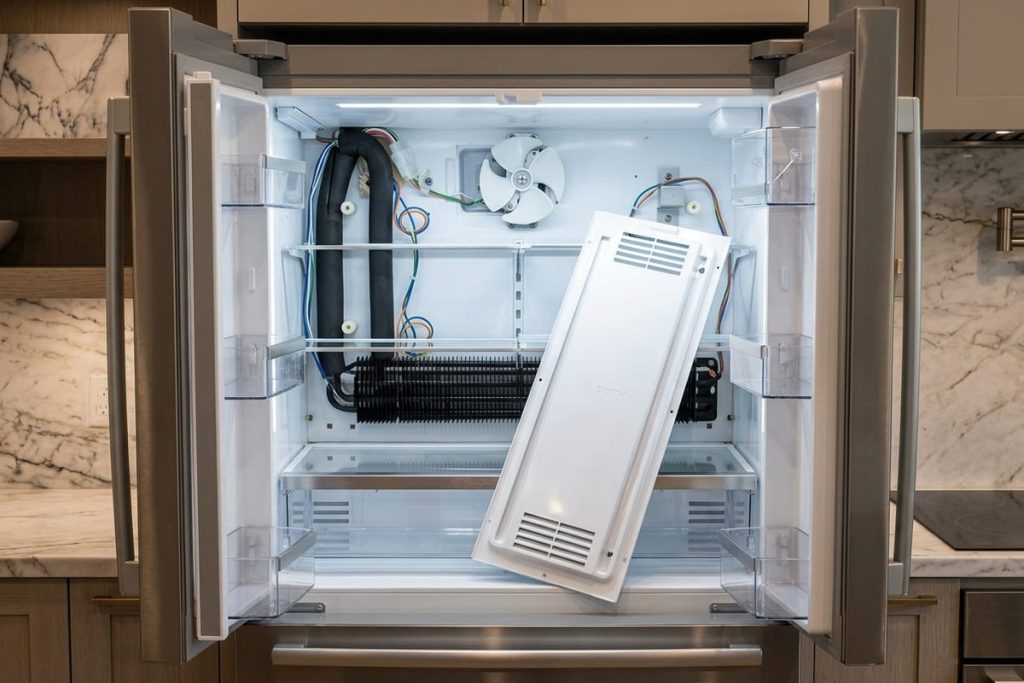
The evaporator fan typically sits behind the inner rear panel of the refrigerator or freezer compartment, depending on the Bosch model. Its job is to pull air across the evaporator coil and move that cold air where the refrigerator needs it.
In a healthy refrigerator, the compressor and sealed system create cold at the evaporator. The fan distributes that cold. Without the fan, cold air stays trapped near the coil instead of reaching the food compartments evenly. Bosch describes the goal in its Use and Care Manuals: “The air recirculation cooling system allows the air to circulate evenly in the refrigerator compartment and ensures a constant temperature at all shelves.”
That is why a failed evaporator fan can cause symptoms that feel contradictory:
- the freezer may be cold but the fresh-food section is warm;
- the refrigerator may cool unevenly;
- the fan area may become noisy;
- ice may build up in the freezer or around the rear interior panel;
- the unit may run longer than normal;
- temperature alarms may appear;
- food may freeze in one area and spoil in another.
One detail that saves service calls: a thin layer of frost on the back wall of the refrigerator compartment is “Not a fault” in the 100, 500, 800 Series and Benchmark manuals — that wall defrosts automatically. The freezer is different: Bosch says it “remains frost-free.” Ice building up there is worth a closer look.
Still with us? Good — because this part explains why a small fan can make a premium Bosch refrigerator act like the entire cooling system is failing.
That is one reason Bosch refrigerator troubleshooting requires model awareness. A freestanding French door model, a counter-depth unit, a built-in unit, and a dual-evaporator design may not behave the same way when the fan fails. Bosch’s own spec sheets show the split:
| Bosch models (examples) | Series | Evaporators / compressors on the spec sheet |
|---|---|---|
| B36CL80ENS, B36CL80SNS, B36CT81ENS | 800 Series | 2 / 2 |
| B36FD52SNS, B36CD52SNS | 500 Series | 1 / 1 |
| B36FD10ENS | 100 Series | 1 / 1 |
| B36BT130NS, B30IB100SP | Benchmark | 2 / 2 |
On a two-evaporator model, each section is cooled separately, so a problem can show up in one compartment while the other behaves normally. Either way, the model number comes first.
Signs you may need Bosch evaporator fan replacement
A failing Bosch fan motor doesn’t always stop all at once. Sometimes it gives warnings for days or weeks before the refrigerator becomes unusable.
Here are the signs we pay attention to on service calls.
Before you check anything: everything a homeowner does in this guide is look, listen, and move food — no tools. Don’t remove the rear interior panel or any cover, don’t chip or melt ice, and leave wiring and refrigerant tubing to a technician. Bosch warns that “Damage to the cooling circuit can create a risk of fire or explosion.” If you suspect the refrigerant tubes are damaged, Bosch says not to use the appliance, keep open flames and sparks away, and unplug it or switch off the breaker.
1. Warm refrigerator, cold freezer
This is one of the classic patterns. The freezer may still seem fine, but the refrigerator section is too warm. That can happen when cold air is being produced but not circulated properly.
Confusing, right? The freezer can still feel cold while the fresh-food section struggles, because the issue may be air circulation rather than total cooling failure.
Rule out the free causes first: a door that isn’t closing fully, frequent openings, or a big load of fresh food. For some older B36CL models, Bosch’s table names “Blocked air vents located on the back wall” — remove the food blocking them and, after a fresh load, wait at least 2 hours. Still warm? Now it’s a diagnosis.
2. Loud buzzing, rattling, grinding, or scraping
Bosch refrigerators are generally quiet, so new noise matters. A fan motor can become noisy as the bearings wear out. The blades can also hit ice if frost has built up around the fan housing.
Not every sound is a warning, though. Bosch’s table lists a refrigerator that “hums, bubbles, buzzes, gargles, clicks, crackles or rumbles” as “Not a fault” — a running motor, the fan included. What it does not describe is a blade scraping or grinding against something.
If you hear scraping or a rhythmic ticking from inside the freezer or refrigerator compartment, do not ignore it. A fan blade hitting ice may still run for a while, but the extra resistance can stress the motor.
3. Ice buildup on fan blades
Ice buildup on fan blades is one of the most frequent reasons a Bosch evaporator fan sounds worse than it really is. The fan may be functional, but ice around the evaporator cover blocks the blade path.
The important part is finding out why the ice formed.
Sometimes the issue is:
- a failed defrost heater;
- a bad defrost thermostat or sensor;
- a clogged drain;
- a door gasket leak;
- frequent door openings;
- poor airflow;
- an evaporator cover not seated correctly;
- a control issue that prevents proper defrost cycles.
If a technician only clears the ice and walks away, the refrigerator may sound normal for a few days, then start grinding again. That’s not a repair at all — you simply got a pause before a bigger repair.
This is where many homeowners get trapped. They see ice, melt it, hear the fan run again, and think the problem is solved. But if the cause of the frost is still there, the noise usually comes back.
> “Clearing ice can quiet the fan. Finding out why the ice formed is what prevents the comeback call.”
4. No airflow from the vents
If the refrigerator is running but there is little or no airflow from the internal vents, the evaporator fan may not be running. This can also happen if the airflow path is blocked by frost, food placement, or a failed damper.
Food placement is the free check. Bosch asks owners not to put food in front of the inner ventilation openings or against the back wall — “To avoid impeding the circulation of air and to prevent food from freezing.”

5. Temperature swings
If your Bosch refrigerator cools, warms, cools again, and never feels stable, the fan should be checked. Temperature instability can come from several components, but the evaporator fan is central to consistent air movement.
6. The fan does not spin freely
A technician may access the evaporator fan and manually check whether the blade spins freely after power is disconnected. If the fan blade is stuck, obstructed, warped, or dragging, the motor may need replacement.
If one of these sounds familiar, do not ignore it. Small airflow problems can turn into bigger cooling problems fast.
Hearing a scraping or buzzing noise from your Bosch refrigerator? That sound may be the evaporator fan hitting ice, wearing out, or struggling to circulate cold air. Let us check it before the refrigerator loses cooling completely.
What shapes a Bosch evaporator fan repair
Now let us talk about the question most homeowners really care about: what will this repair involve, and what affects the final scope?
For most Atlanta-area Bosch refrigerator repairs, the answer depends on the model, part number, access difficulty, frost condition, and whether the fan failure is the main problem or a symptom of a larger defrost or control issue.
As a practical planning guide:
| What affects the repair | Why it matters |
|---|---|
| Bosch fan motor part | Model-specific; the right part follows from the model and production numbers |
| Diagnostic visit | Confirms whether the fan, the defrost system, or the controls are at fault |
| Fan access and replacement | Depends on the model and how much ice has built up |
| Full evaporator fan repair | A simple motor swap on one unit, a more involved evaporator-area repair on another |
That may feel like a wide range, but Bosch parts are model-specific.
The most honest estimate starts with the Bosch model number, the symptom pattern, and whether there is frost or ice around the evaporator area. We explain what we found and what the repair involves before any work starts — so you’re not paying for parts you don’t need.
Want a real answer for your Bosch model? Have your Bosch model number and symptoms ready when you book. We will help you understand the likely repair path and schedule service in Atlanta or nearby Georgia areas.
Why one “Bosch fan motor” can mean many different parts
A homeowner may search for “Bosch evaporator fan motor” and wonder why the listings look so different. The answer is that “Bosch evaporator fan motor” is not one universal part.
For the wider picture on one popular line, see our guide to Bosch 800 Series refrigerator problems.
The right part depends on:
- the Bosch refrigerator model;
- the exact part number;
- whether the fan motor comes alone or with a housing;
- whether it is genuine or aftermarket;
- availability and shipping speed;
- whether the refrigerator has one evaporator or two;
- whether the fan is located in the freezer, the fresh-food compartment, or a dedicated evaporator assembly.
Bosch’s manuals are blunt here: “Only genuine spare parts may be used to repair the appliance.”
This is why a model number matters. Without it, nobody can give an honest Bosch fan motor answer: only a guess. The E-Nr. and FD numbers are on the rating label.
This is where DIY repair guides can become risky. A guide may show the general idea correctly, but if the part number is wrong or the refrigerator design differs from the example, the repair can turn into wasted time, broken tabs, damaged wiring, or a refrigerator that still does not cool.
Why the fan may fail in the first place
An evaporator fan motor can fail from age, moisture, bearing wear, ice obstruction, electrical faults, or stress from airflow problems. In Bosch refrigerators, we often look at the fan and the surrounding system together.
The fan may fail because of:
Worn motor bearings
The motor may run loudly before it fails. This usually sounds like grinding, whirring, squealing, or a rough vibration from behind the rear interior panel.
Ice buildup around the blade
Ice can physically block the blade or cause it to strike the fan shroud. This can be caused by a defrost issue, door gasket leak, drain problem, or temperature sensor problem.
Electrical failure
The fan may receive no proper voltage, have damaged wiring, or fail internal continuity testing. This is where a multimeter diagnosis matters.
Control board issue
Sometimes the fan is not the root failure. The refrigerator control system may not be sending power correctly, or another component may interrupt fan operation.
Door switch or sensor issue
Many refrigerators stop internal fans when the door is open. If a door switch or sensor behaves incorrectly, the fan may not run when it should.
Airflow restriction
Packed food, blocked vents, or ice around the evaporator cover can make the refrigerator behave like the fan has failed even when the motor still works.
> “If the fan failed because it was frozen in ice, replacing the motor without solving the frost source is only half the repair.”
Don’t replace the fan until you know why it failed. Ice buildup, failed defrost parts, wiring issues, sensors, and control problems can all affect the evaporator fan. We check the full cooling area before recommending replacement.
Continuity testing: when the fan motor needs real diagnosis
A serious Bosch fan diagnosis is not playing riddles. If the fan is accessible and safe to test, a technician may check:
- whether the fan blade spins freely;
- whether ice or debris is blocking the blade;
- whether the motor is receiving voltage;
- whether wiring or connectors are damaged;
- whether the fan motor windings have continuity;
- whether the door switch is interrupting fan operation;
- whether the control board is commanding the fan;
- whether the defrost system is causing repeat ice buildup.
Continuity testing helps determine whether the motor windings are electrically intact. If the motor does not run and the windings do not have continuity, the fan motor typically needs replacement.
That sounds simple on paper. In Bosch service, access matters. Some fan assemblies sit behind panels that must be removed carefully after frost is softened or cleared. Pulling hard on a frozen panel can crack plastic, damage wiring, or break mounting points. Technician work, not a homeowner step.
This is one reason Atlanta homeowners often call us after trying a DIY repair and realizing the problem is deeper than a visible fan blade.
Bosch fan not running? Let us test before guessing. A fan that doesn’t spin may have a bad motor, no voltage, damaged wiring, a faulty door switch, or a control issue. Our technicians use proper diagnosis so you do not pay for the wrong repair.
DIY repair guides vs. professional Bosch repair
Thinking about trying the repair yourself? We understand the impulse. But Bosch evaporator fan work is one of those repairs where the visible part is not always the full problem.
There is nothing wrong with DIY research. In fact, an informed homeowner usually makes better repair decisions.
But Bosch evaporator fan replacement is not a homeowner repair — and Bosch says so itself. The safety section of its Use and Care Manuals for the 100, 500, and 800 Series and the Benchmark line warns “To avoid risk of injury from improper repairs” and puts repairs in the hands of qualified technicians.
A generic DIY guide may suggest:
- unplugging the refrigerator;
- removing freezer shelves and drawers;
- taking off the rear panel;
- inspecting the fan blade;
- checking for ice buildup;
- replacing the fan motor;
- reinstalling the panel.
That may work in a video with no heavy frost and the correct part in hand. On a real Bosch, the risks include:
- ordering the wrong fan motor;
- damaging the evaporator cover;
- breaking fragile clips;
- pulling wires loose;
- melting plastic while defrosting ice;
- damaging the evaporator tubing;
- missing a defrost-system failure;
- misdiagnosing a control board issue as a fan issue;
- leaving the refrigerator warm too long and losing food.
DIY research still helps you describe the problem. The disassembly itself — panels, wiring, electrical testing, anything near the evaporator tubing — belongs to a technician.
Our position is simple: if the fix is basic, we will tell you. If the problem is inside the evaporator compartment, involves ice buildup, or requires electrical testing, it is worth having an experienced technician handle it.
Tried DIY and still not cooling? If the fan area is frozen, the panel will not come off safely, or the refrigerator is still warm after defrosting, call us. We repair Bosch refrigerators across Atlanta and nearby Georgia communities.
What we check before replacing the Bosch evaporator fan
Here is how we approach the problem in the field, based on the way Bosch refrigerators fail in Atlanta homes.
At PRO Appliance Repair, we do not like parts darts. That means we never guess and throw parts at the refrigerator until something works.
For Bosch evaporator fan complaints, our technician usually checks:
1. Model and serial information
Bosch has many refrigerator designs. The model number tells us which fan assembly, cooling layout, and access method we are dealing with.
2. Temperature pattern
We compare the refrigerator and freezer behavior. Is one compartment warm? Are both warm? Is the freezer over-freezing? Is the refrigerator cycling inconsistently?
3. Airflow
We check vent airflow and whether cold air is moving properly.
4. Noise location
A fan motor noise sounds different from a compressor noise, condenser fan noise, damper noise, or ice maker sound — and different again from the normal hums and clicks Bosch lists in its manuals.
5. Frost pattern
A thin, even layer of frost on the refrigerator compartment’s back wall is normal on Bosch models. Heavy frost or ice in the freezer can point toward a defrost issue. Clear ice around the fan may point toward moisture intrusion, gasket problems, or drain issues.
6. Fan blade movement
If the fan blade is blocked, warped, or stiff, that changes the diagnosis.
7. Electrical testing
If needed, we test voltage, continuity, connectors, and related circuits.
8. Defrost components
When ice buildup is present, we check the defrost path before calling the job complete.
9. Control behavior
If the fan motor tests well but still doesn’t run, we look at the control side of the system.
This diagnostic path matters because Bosch refrigerators are built with precision. They reward correct diagnosis and punish shortcuts.
> “We repair the cause, not just the part that happened to make noise first.”

Bosch models we service
We provide Bosch evaporator fan replacement and refrigerator cooling repair across the Bosch lineup, including many common configurations:
- Bosch French door refrigerators;
- Bosch counter-depth refrigerators;
- Bosch side-by-side refrigerators;
- Bosch built-in refrigerators;
- Bosch bottom-freezer refrigerators;
- Bosch 800 Series refrigerators;
- Bosch 500 Series refrigerators;
- Bosch Benchmark refrigeration;
- Bosch dual-evaporator designs;
- Bosch units with ice maker and water dispenser features.
Not sure which Bosch model you own? No problem. We will help you find the model tag before scheduling the repair.
Repair or replace the refrigerator
This is another question homeowners ask us all the time: is the repair worth it, or is the refrigerator too far gone?
A Bosch refrigerator is usually worth repairing when the cabinet is in good condition, the sealed system is healthy, and the problem is limited to a fan motor, defrost part, sensor, gasket, or control issue.
Replacement becomes a bigger conversation when:
- the refrigerator is very old;
- multiple major components have failed;
- the sealed system has a serious problem;
- the compressor has failed along with other parts;
- parts are discontinued;
- the cabinet or liner is damaged;
- the unit has repeated failures after previous repairs.
That is why a fan motor failure is often one of the more reasonable Bosch refrigerator repairs — provided the diagnosis is correct and the appliance is otherwise in good shape.
Not sure if your Bosch is worth repairing? We will inspect the cooling system, explain the repair, and help you decide whether fan replacement makes sense for your appliance.
How long does Bosch evaporator fan replacement take
In many cases, Bosch evaporator fan replacement can be completed during a single visit if the correct part is available and the evaporator compartment is accessible.
Typical timing depends on:
- how much ice buildup is present;
- whether the unit must be safely defrosted;
- how the rear panel is mounted;
- whether shelves, drawers, and covers must be removed;
- whether electrical testing is required;
- whether the fan motor is stocked or must be ordered.
A simple fan motor replacement may take less time. A frozen evaporator compartment with a hidden defrost fault can take longer because the technician must diagnose the cause, not just replace the visible part.
If you need Bosch refrigerator repair in Atlanta soon, book early — we can usually be there same- or next-day.
Why homeowners call PRO Appliance Repair for Bosch fan replacement
Bosch refrigerators require a different level of care than basic top-freezer units. The interior panels can be tight. The parts can be model-specific. The symptoms can overlap with defrost, sensor, damper, and control problems.
With more than 15 years of hands-on experience, PRO Appliance Repair brings the kind of practical Bosch knowledge that saves homeowners from repeat breakdowns.
Here is what we bring to the service call:
- Bosch refrigerator troubleshooting experience;
- evaporator fan motor diagnosis;
- continuity testing when appropriate;
- airflow and frost-pattern inspection;
- defrost-system awareness;
- same- or next-day service across Atlanta and nearby Georgia communities;
- a clear explanation of the repair before work begins;
- genuine OEM parts;
- honest guidance on repair vs. replacement.
We’re a family-owned, insured team. Our background-checked technicians are EPA 608 certified — the federal standard for handling refrigerant — and our repairs carry a warranty of up to six months. We know Bosch and we know Atlanta homes: when a refrigerator stops cooling properly, the repair needs to be handled quickly.
Bosch refrigerator not cooling correctly? Do not wait for the freezer to frost over or the fresh-food section to climb into unsafe temperatures. Book a Bosch evaporator fan diagnosis and let us find the real cause.
What to do before the technician arrives
While you are waiting for service, a few small decisions can protect your food and prevent accidental damage:
- Keep the doors closed as much as possible.
- Move sensitive food to a cooler if temperatures are rising.
- Do not chip ice with a knife or screwdriver.
- Do not use a heat gun inside the refrigerator.
- Listen for fan noise, scraping, or silence.
- Take a photo of any frost buildup.
- Locate the Bosch model number (E-Nr.) and production number (FD).
- Write down when the symptoms started.
- Describe the cooling pattern when you book.
Avoid aggressive DIY defrosting. Heat guns and sharp tools can damage plastic liners, wiring, and evaporator tubing — and Bosch warns against speeding up defrosting with mechanical devices or other means it doesn’t recommend. A punctured evaporator is a much bigger problem than a fan motor.
Need Bosch refrigerator repair soon? If your refrigerator is warming, frosting over, making noise, or not circulating cold air, book a visit. Same- or next-day service is usually available in Atlanta and surrounding Georgia areas.
Final word
A Bosch refrigerator with a failing evaporator fan can look like several different problems at once: warm fridge, cold freezer, frost buildup, weak airflow, grinding noise, or unstable temperatures. That is why the repair should start with diagnosis, not guessing — and with the free checks Bosch itself suggests.
The fan motor may be the failed component. Or it may be the part that suffered because ice, airflow, wiring, or controls created the real problem.
At PRO Appliance Repair, we handle Bosch evaporator fan replacement with the care these machines deserve. We check the cooling pattern, inspect the evaporator area, test the fan motor, look for ice buildup, and make sure the repair addresses the cause — not just the symptom.
Bosch refrigerator trouble? Let us fix it before it gets worse. A failed evaporator fan can start with a small noise and end with spoiled food, frost buildup, and unstable temperatures. Book Bosch refrigerator repair with PRO Appliance Repair for diagnosis, fan motor replacement, and airflow inspection — usually same- or next-day across Atlanta and nearby Georgia areas, with a repair warranty of up to six months.
Related guides
FAQ
What are the signs of a bad Bosch evaporator fan motor?
Common signs include a warm refrigerator compartment, cold freezer, weak airflow, a new grinding or scraping noise, ice building up in the freezer or on the fan blades, temperature swings, or a fan that does not spin freely.
My Bosch refrigerator hums and clicks. Is the fan going bad?
Probably not. Bosch’s troubleshooting table lists humming, buzzing, clicking, and similar sounds as “Not a fault” — a running motor such as the fan. A new scraping or grinding sound is the one to book a diagnosis for.
Can ice buildup stop the evaporator fan?
Yes, ice buildup can block the fan blades and make the fan scrape, click, or stop spinning. The bigger issue is why the ice formed — Bosch freezers are designed to stay frost-free. A defrost problem, gasket leak, clogged drain, or control issue may need repair. Don’t chip or heat the ice; leave it for the technician.
Can I replace a Bosch evaporator fan myself?
We don’t recommend it, and neither does Bosch: its manuals leave repairs to qualified technicians. The fan sits behind an interior panel, often with ice, wiring, and evaporator tubing around it. You can safely check the doors, food near the vents, and the sounds — then book a diagnosis.
Is it worth replacing a Bosch evaporator fan motor?
In many cases, yes. If the refrigerator is otherwise in good condition, fan motor replacement usually makes more sense than replacing the appliance. A technician should still check for defrost or control issues before replacing the fan.
Who repairs Bosch refrigerator fans in Atlanta, and how fast?
PRO Appliance Repair services Bosch refrigerators across Atlanta and nearby Georgia communities — French door, counter-depth, built-in, bottom-freezer, 500 and 800 Series, and Benchmark units — usually same- or next-day, with a repair warranty of up to six months.
PRO Appliance Repair is an independent repair company and is not affiliated with, sponsored by, or endorsed by BSH Home Appliances Corporation or Robert Bosch GmbH. Bosch, Benchmark, and the model names on this page are used only to identify the appliances it is about and remain the trademarks of their respective owners.