
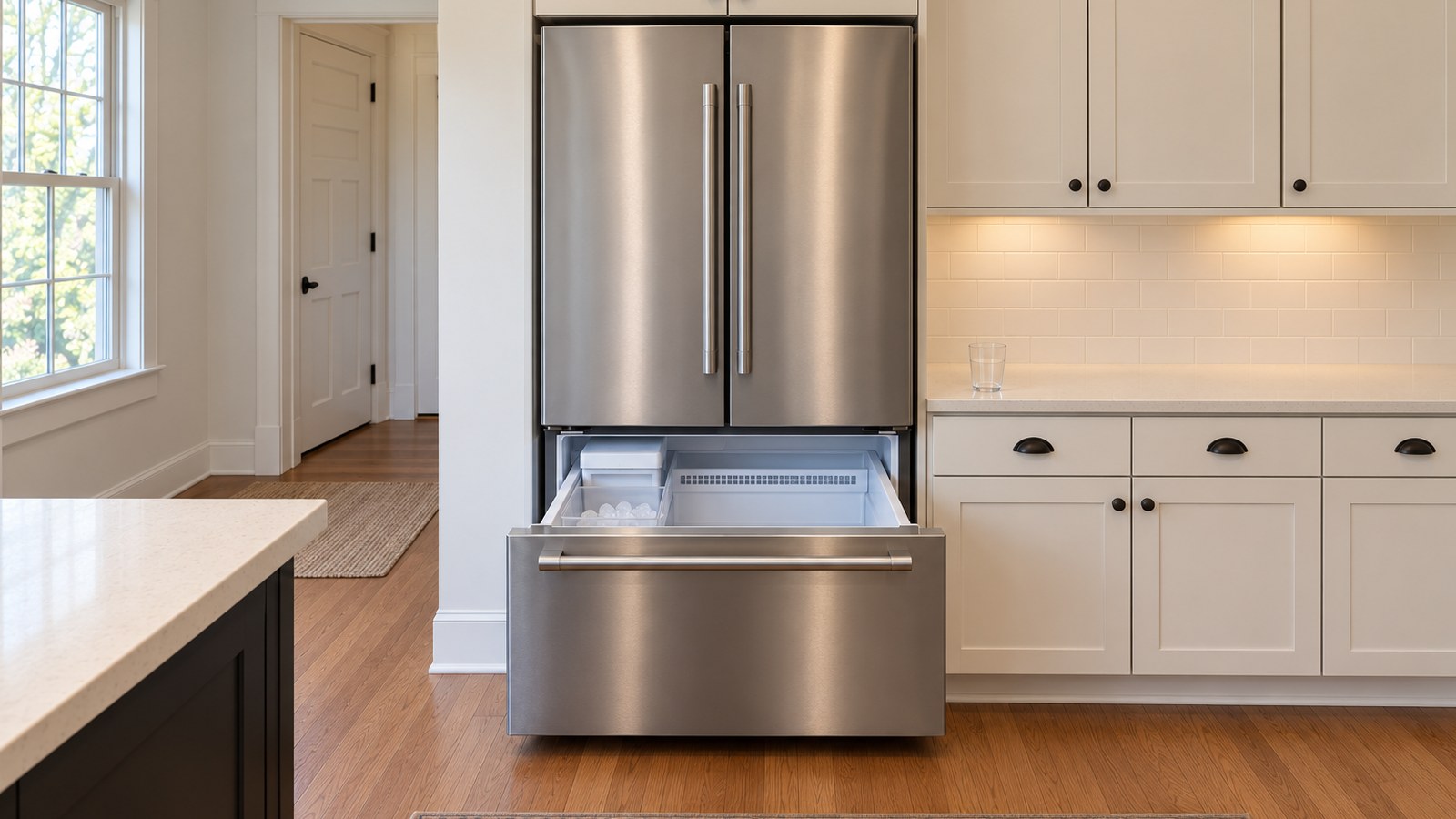
You fill a glass, reach for ice, and the bin is empty. Again. The freezer still feels cold, the display shows no warning, and the water dispenser runs fine — so what’s wrong? That combination is exactly why a Bosch ice maker is so hard to judge from the outside.
The good news: the ice tray itself — dry, half-filled, slushy or packed with cubes that won’t drop — points to the system that failed first. In this guide, we’ll walk you through what each tray condition means, the checks that are safe to do yourself, what Bosch’s own manuals say about resets, and when it’s time for a technician. Prefer to skip ahead? Our Bosch refrigerator repair team handles these ice makers across metro Atlanta.
Start Here: Match the Symptom You See
Pick the condition closest to yours; the sections below explain each one.
| What you see | Likely failure area | Where to look first |
|---|---|---|
| Dry tray | Water isn’t arriving | Filter (you); shutoff valve, supply line, fill tube, inlet valve (technician checks) |
| Small or hollow cubes | Weak or restricted fill | Filter seating (you); water pressure, valve screen, inlet valve (technician checks) |
| Slush or soft cubes | Freezer temperature | Setting, thermometer, door seal (you); airflow and frost pattern (technician checks) |
| Full tray, nothing drops | Harvest failure | Release mechanism, motor, tray surface, drop path (technician checks) |
| Ice clumped in the bin | Warm, humid air or temperature swings | Door seal, how often the drawer opens (you) |
| Bin full, door dispenser won’t release ice (500 Series) | Delivery | Bin seated, dispenser lock (you); chute, auger, dispenser motor (technician checks) |
What Your Symptom Points To
On Bosch 800 and 500 Series refrigerators, a no-ice problem can begin in one of four places: water delivery, freezer temperature, harvest movement, or the controls. The repair depends on which one failed first.
A clogged filter can starve the fill. A kinked line can cut the pressure. A weak water inlet valve (the electric valve that lets water in) can open unevenly. A warm freezer can keep the ice maker from ever reaching harvest. And a tray full of frozen cubes points to the harvest mechanism.
Replace the ice maker assembly without isolating the cause, and a simple repair turns into a parts chase. The first checks are free — so start there.
Ice Tray Condition Separates Water Problems From Harvest Failures
The empty bin confirms the symptom. The tray in the table above tells you which system to suspect: dry means water, slush means temperature, a full tray that won’t drop means harvest.
This distinction matters: a new ice maker won’t fix a weak valve, a pinched line or a warm freezer. Small, hollow cubes in particular are usually a water-supply story — our guide to small or hollow ice cubes goes deeper.
Booking service? Tell us whether the tray is dry, slushy, full or making small cubes. That one detail saves time on the visit.
How a Bosch Ice Maker Makes Ice
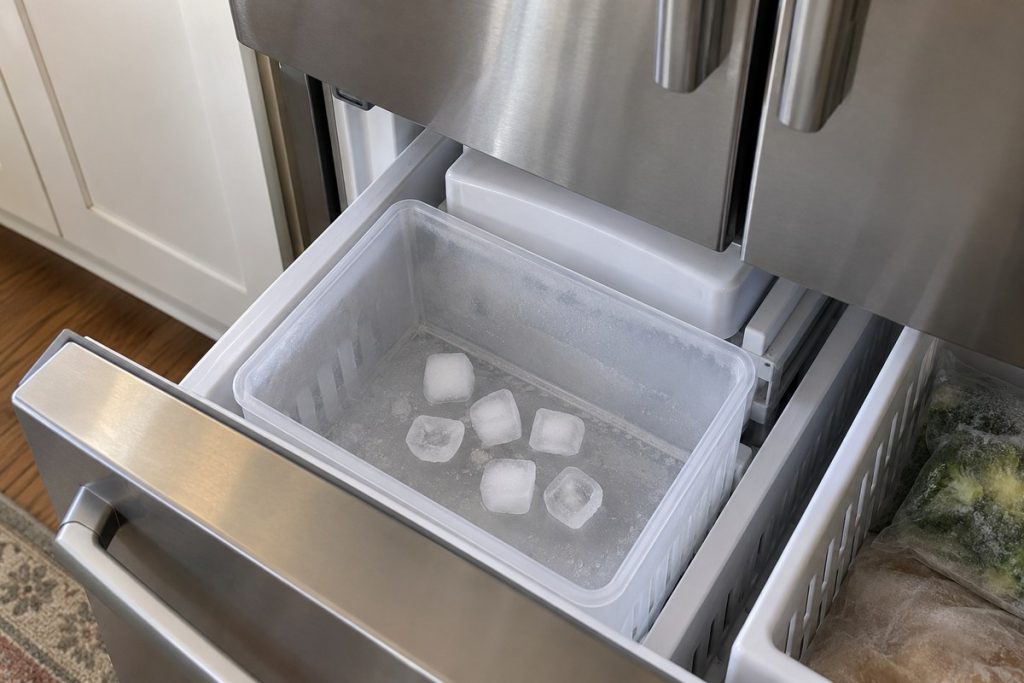
Ice production is a loop: a short, timed fill through the inlet valve and fill tube, freezing, harvest (depending on the design, the tray is gently warmed or twisted to release the cubes into the bin), then a reset for the next fill. If one step fails, production stops. The empty bin looks the same whichever step failed; the repair doesn’t.
Safety first: only attempt the checks in this guide. Don’t remove panels, touch wiring, or reach into or under the ice maker — Bosch warns that its rotating parts can cause injury. Don’t touch water fittings or the hose behind the refrigerator; the line stays under house pressure, and Bosch warns never to pull on it. Burning smell or water near the outlet? Skip the checks and call.
If the Tray Is Dry, Look at the Water Path First
A dry tray means water isn’t reaching the mold. That doesn’t condemn the ice maker — often it still works, and the water delivery is the problem.
Common causes of a dry tray: a clogged, overdue or poorly seated filter, air trapped after a filter change, a kinked line, a partly closed shutoff valve, low household water pressure (Bosch calls for at least 29 psi), a frozen fill tube, a weak inlet valve, or a control that never sends the fill command.
Clogged filter symptoms
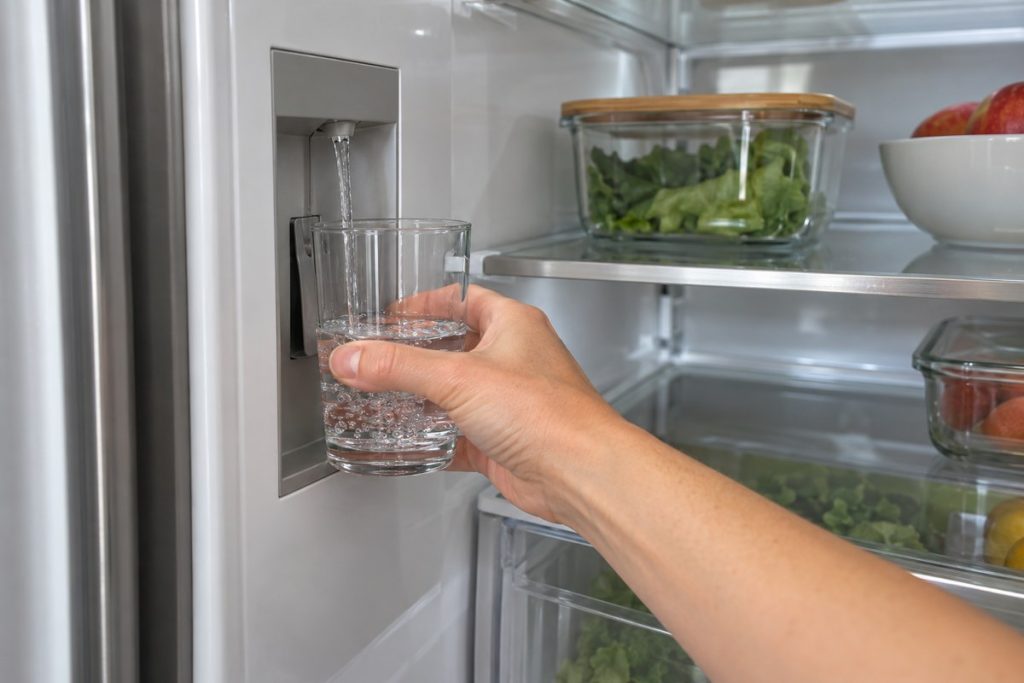
A restricted filter can hurt the ice maker before the dispenser looks blocked. The dispenser runs as long as you press the paddle; the ice maker gets only a brief timed fill. If the filter chokes flow during that short window, the tray underfills or stays dry.
Bosch’s rule: change the filter every 6 months, or sooner if ice production has visibly dropped, and remove it with care because it’s under pressure. After a change, dispense water for five minutes and discard it; air in the line can disrupt the first fills and imitate a mechanical failure.
Water line and shutoff valve problems
A supply line can bend or flatten when the refrigerator is moved for cleaning, new flooring or a remodel — and even a partial restriction can stop ice. Don’t pull the unit out to look; a loaded refrigerator is heavy and the hose is attached at the back. A crushed line should be replaced, not reshaped, and a shutoff valve that may be partly closed is a check for a technician or plumber.
Water Inlet Valve Issues Can Imitate Ice Maker Failure
The inlet valve controls the fill. When the ice maker calls for water, the valve has to open firmly enough to deliver the right volume. If it weakens, sticks, clogs or fails electrically, the tray gets too little water — or none.
Signs: a dry tray, small or hollow cubes, uneven production, a buzz during the fill with little water entering, and ice that returns briefly after a reset, then stops again.
A valve can pass a quick electrical check and still fail under real conditions, so a technician checks the water pressure, the valve’s response during a fill and the water that actually reaches the tray. Replacing the ice maker before testing the valve often misses the real failure.
For the wider picture on this brand, see our guide to Bosch 800 Series refrigerator problems.
Freezer Temperature Settings Can Stop Ice Production
A Bosch freezer can feel cold without being cold enough for steady ice. Bosch recommends 0°F (−18°C), and ice production only starts once the freezer has reached its set temperature. Run warmer, and the tray freezes slowly, the harvest is delayed, or the ice maker stops cycling.
Signs: slush in the tray, soft or cloudy cubes, ice cream softer than usual, ice clumped in the bin, frost around the vents, no ice after the drawer was left open.
Atlanta humidity makes small sealing problems worse. Warm, moist air sneaking past a tired gasket turns into frost, weakens airflow and slows freezing around the ice maker.
Checklist before you replace anything:
- Set the freezer to 0°F and check it with a separate thermometer — the display shows the setting, not the air around the ice maker.
- Keep the drawer closed for a few hours before judging; Bosch says frequent or long openings lower production.
- Keep food away from the inner ventilation openings, and look at the gasket all the way around.
- Need more ice for a party? Bosch says a colder setting or Super freezing speeds production up (Super freezing returns to normal after about 8 hours).
Full Tray, Empty Bin: Stuck Ice Tray or Harvest-Cycle Failure
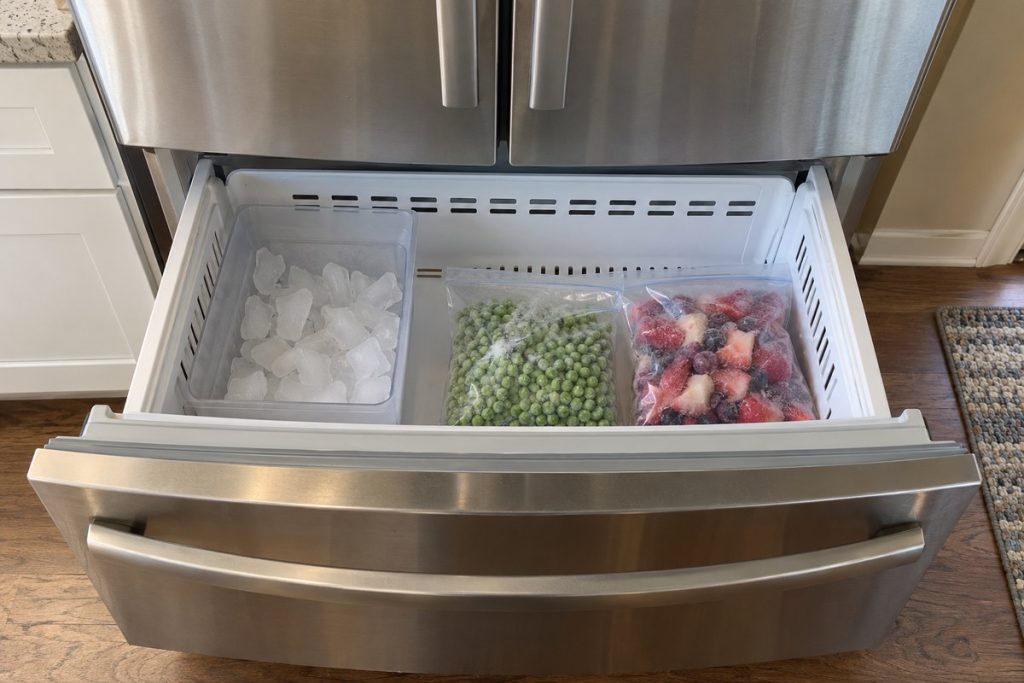
A full tray changes the direction completely. If the tray holds frozen cubes but the bin stays empty, the water already arrived — the problem has moved to the harvest system.
Signs of a stuck tray: full cubes left in the tray, cubes lifted halfway but not released, a mechanism that stops mid-cycle, ice jammed below the ice maker, oversized or fused cubes, the same batch sitting there for hours.
Common causes: a weak release mechanism or motor, stripped gears, a worn tray surface, overflowed or refrozen cubes, a misaligned bin, or a blocked drop path.
Don’t pry cubes out with a knife, a screwdriver or any tool. Bosch warns never to reach into or under the ice maker, and a scratched tray makes future cubes stick again and again. A full-but-stuck tray is a job for the technician, who checks the harvest side, not the water side.
Is There a Hidden Reset Button on a Bosch Ice Maker?
You’ll find advice online to remove the bin, find a hidden reset button near the ice maker and hold it for 5 to 15 seconds. Bosch’s manuals for its 800 and 500 Series refrigerators describe no such button. On 800 Series models, holding the ice maker button for 3 seconds resets the filter change reminder — not the ice maker.
What Bosch does describe is a power reset. For a fault in the ice maker (on the 500 Series, in the ice and water dispenser), Bosch’s manual says to unplug the refrigerator or switch off its breaker and reconnect after 5 minutes — or as your own manual says. Bosch’s error-code page also lists E02 for an ice maker fault or a communication problem in the ice and water controls, with the same advice: reset the power once, and call Bosch support if that doesn’t solve it.
A reset may help when: the power recently went out or the ice maker stopped mid-cycle with no jam or water problem in sight.
A reset won’t fix: a clogged filter, a weak valve, a frozen fill tube, a warm freezer, a damaged tray or a failed harvest motor.
One batch after the reset, then nothing? The reset only restarted the cycle; the cause is still there.
Bosch 800 and 500 Series Ice Maker Problems
Bosch builds its ice makers into two main layouts. Know yours — the model number (E-Nr.) and production number (FD) are on the rating label.
- 800 Series, for example B36CL80ENS (4-door) and B36CT81ENS (3-door): counter-depth French-door models with an internal water dispenser. The ice maker sits under a cover in the freezer drawer, with its own button that lights up when ice production is on. There’s no ice dispenser in the door — you take ice from the bin.
- 500 Series, for example B36FD52SNS (standard-depth) and B36CD52SNS (counter-depth): French-door models with an ice and water dispenser on the door. Bosch rates them at up to 12 lbs of ice in 24 hours — with the freezer at its coldest setting and the bin emptied every 3 hours — and 2.8 lbs of storage.
An empty bin is a production problem. A full bin with nothing coming out of the door — 500 Series only — is delivery: Bosch’s manual lists the keylock and a bin that isn’t fully inserted, and beyond that, the chute, auger or dispenser motor.
Free checks Bosch lists first: is ice production on? Vacation and Sabbath modes switch it off. Anything in the bin besides ice? It can block the fill level sensor, so the ice maker thinks the bin is full. Just installed? The first batch takes about 4 hours after the freezer reaches temperature; discard the first 24 hours of ice, and allow up to 48 hours for a full bin.
What Our Technician Checks During a Bosch Ice Maker Visit
Trouble often starts after an ordinary event: the refrigerator was moved, the filter was changed in a hurry, a summer storm cut the power. So tell us what changed. “It stopped after the filter change” and “the cubes got smaller first” point somewhere very different from “the tray is full, but nothing drops.”
On the visit, the technician follows the failure path — controls, real freezer temperature, tray, filter, line, inlet valve, fill tube, airflow, gasket — which prevents the most common repair mistake: replacing the ice maker when the failure begins upstream.
What You Can Check Before Calling
Some owner checks are worth doing. Repeating them for days isn’t.
- Ice production on; vacation and Sabbath modes off.
- Freezer at 0°F on a thermometer.
- An overdue filter replaced, then five minutes of dispensing.
- Nothing but ice in the bin. Old ice fused into a block? Empty the bin rather than chipping at it, and don’t spread cubes around by hand: Bosch says that can overfill the bin.
- A look for water behind and under the refrigerator, without moving it.
- One power reset, exactly as your manual describes.
Stop troubleshooting and schedule service if: the tray stays dry, the tray is full but won’t release, the reset works once and fails again, cubes keep coming out small or hollow, output keeps dropping, clumps keep returning, or you hear a buzz with no fill.
Why Guessing Gets Expensive
New filter, new ice maker, another part — and the real problem turns out to be a weak valve or a warm freezer. A measured diagnosis is usually easier on your wallet than swapping parts until something changes.
Repair or Replace the Refrigerator?
If your Bosch cools properly and the only problem is ice, repair usually makes sense — especially on an 800 or 500 Series in good overall shape.
Repair usually makes sense when: both compartments hold temperature and the fault sits in the filter, valve, line, tray or ice maker.
Replacement gets more reasonable when: neither compartment holds temperature, frost keeps returning, there are signs of a sealed-system failure, or several major repairs are needed at once on an older refrigerator.
Still within Bosch’s limited warranty — 365 days from the original delivery? Contact Bosch first.
Why Atlanta Homeowners Call Us for Bosch Ice Maker Repair
We look at the whole system that makes ice, not just the ice maker. What you get with us: a family-owned, insured team with 15+ years in appliance repair · EPA 608 certified, background-checked technicians · genuine OEM parts · our warranty covers parts and labor for up to six months · same- or next-day service across the Atlanta area, most days. And if a part doesn’t actually need replacing, we’ll tell you.
We service Bosch ice makers in Atlanta, Marietta, Sandy Springs, Roswell, Decatur, Alpharetta, Buckhead, Midtown, Brookhaven, Smyrna, Dunwoody and across the Atlanta area. Book a visit from our Bosch refrigerator repair page — and tell us what the tray looks like.
Frequently Asked Questions
1. Why is my Bosch ice maker not working if the water dispenser still works?
The dispenser runs as long as you press it; the ice maker gets a short, timed fill. So a clogged filter, a weak inlet valve, low pressure or a pinched line hits the ice maker first. Rule out the free causes too: ice production off, vacation or Sabbath mode, or something in the bin blocking the fill level sensor.
2. What does a dry Bosch ice tray mean?
Water isn’t reaching the ice maker: a clogged or poorly seated filter, a kinked line, a partly closed shutoff valve, a frozen fill tube or the inlet valve. Replace an overdue filter yourself; leave the line and valve to a technician.
3. Why are my Bosch ice cubes small or hollow?
Usually a weak fill: water arrives, but not enough of it. Bosch’s manuals list low water pressure and a blocked filter among the causes of low ice production. A restricted line or a weak inlet valve can do the same.
4. Why is my Bosch ice tray full but not dumping?
The water side has done its job; the harvest side hasn’t. The release mechanism, motor, gears, tray surface or drop path needs a look. Don’t pry the cubes out — Bosch warns never to reach into or under the ice maker.
5. Does a Bosch ice maker have a reset button?
Not according to Bosch’s manuals. Holding the ice maker button for 3 seconds on 800 Series models resets the filter reminder. For an ice maker fault, Bosch describes a power reset instead: unplug or switch off the breaker, reconnect after 5 minutes, and call if the fault persists.
6. How soon can you fix my Bosch ice maker in Atlanta?
Usually same- or next-day across the Atlanta area. Tell us what the tray looks like and have the E-Nr. and FD numbers handy, so our EPA 608 certified, background-checked technician arrives prepared.
Disclaimer: PRO Appliance Repair is an independent repair company and is not affiliated with or endorsed by BSH Home Appliances Corporation. All trademarks belong to their respective owners.