
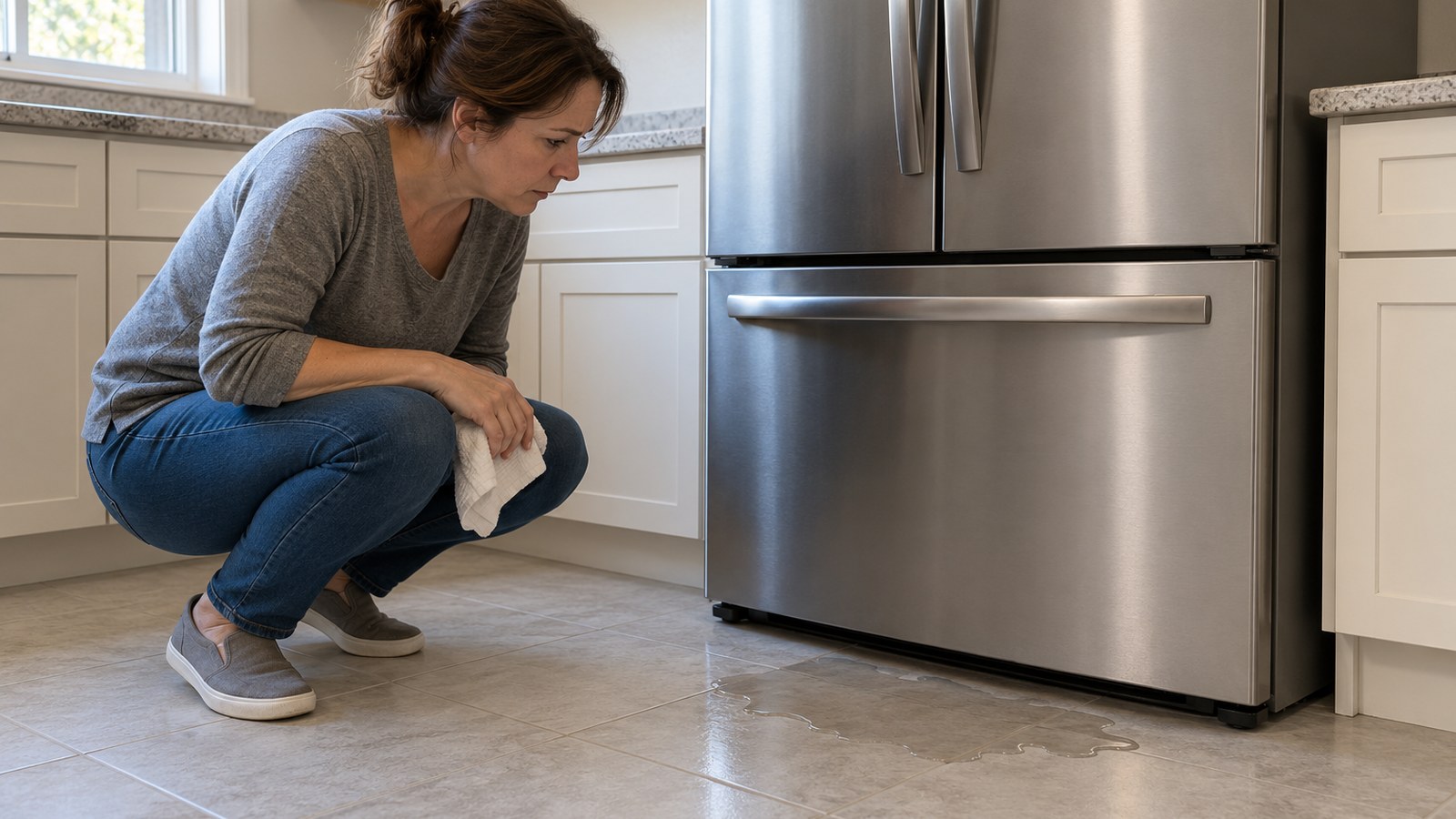
Finding a puddle under your GE freezer is one of those moments that stops you cold — literally. Take a breath: a leak can almost always be traced to one place, and some of the water may not be a leak at all.
GE freezers, including the bottom drawers of French-door refrigerators, are built solid, with automatic defrost. But humid summers and water lines bring trouble: drains clog, gaskets wear, connections loosen. In this guide, we’ll walk you through how leaks look, where the water usually comes from, what GE’s own manuals say is normal, what you can safely check yourself, and when it’s time to call in a pro. If you’d rather skip straight to help, our GE freezer repair team handles these leaks across metro Atlanta.
How Leaks Show Up in GE Freezers
Leaks in GE freezers rarely start with a flood. They begin as small clues. Here’s what they usually look like, grouped by their most likely source.
Problems with the Defrost Drain System
- A small, persistent puddle under the front of the unit, especially after the freezer goes through a defrost cycle. Meltwater from defrost is supposed to run down a drain into a pan underneath. If the drain is clogged or frozen, the water has to go somewhere else.
- Water or ice pooling inside the freezer, at the bottom or under the drawers.
Issues with the Water Supply (if you have an ice maker or dispenser)
- A steady drip or a trail of water from the back of the unit. This points to the water line, a connection, or the valve that feeds the ice maker.
- Water inside or around the ice maker compartment, or water on the floor below the dispenser. This comes from the ice maker, the ice chute, or the dispenser.
Moisture and Seal Issues
- Frost or moisture on food packages and shelves. A door that isn’t sealing lets warm, humid air in, where it condenses and freezes.
- Moisture on the outside of the cabinet. GE’s manuals call this “not unusual during periods of high humidity” — just wipe it dry. If it keeps forming, the door may not be seating properly.
The key insight: timing is your best diagnostic tool.
- Water only during or after a defrost cycle? Think drain.
- Water only after you use the dispenser? Think dispenser, chute, or water line.
- Water near the water filter? Think filter.
- Constant moisture or frost? Think door gasket or how often the door is opened.

What GE Says Is Normal
Before you assume the worst, it helps to know which drips GE describes as normal in its owner’s manuals:
- “After crushed ice is dispensed, some water may drip from the chute.” A few drops after crushed ice is expected.
- The spill shelf under the dispenser “is not self-draining.” Water that collects there needs to be wiped up; it’s not a leak.
- Water dripping after you fill a glass. GE’s bottom-freezer manual says to hold the glass under the dispenser for 2 to 3 seconds after releasing the button. Air in a newly connected water line can also make water drip after dispensing for a while.
- A dripping sound during defrost. “A water dripping noise may occur during the defrost cycle as ice melts from the evaporator and flows into the drain pan.” That’s the system working.
- A few drops when you change the filter, and ice droplets around the ice maker right after a new filter goes in.
- Moisture inside in humid weather when the doors are opened often or held open long.
If what you see fits one of these and dries up, relax.
Why GE Freezers Leak: The Common Culprits
1. Defrost Drainage Problems
- Clogged defrost drain: Food particles and debris block the narrow drain. Meltwater has nowhere to go but over the liner and onto your floor, or it freezes into a sheet of ice at the bottom of the freezer.
- Cracked or misplaced drain pan: The pan underneath the unit can crack or shift, or simply overflow if too much water arrives at once.
The drain and drain pan sit behind panels, and none of GE’s manuals treat them as an owner check. That’s a job for a technician.
2. Door Seal and Condensation Issues
- Worn door gasket: The rubber seal dries out, tears, or loses its shape. Humid air then seeps in all the time, condenses, and freezes inside. When that frost melts during defrost, you get extra water and sometimes puddles.
GE’s upright freezer manual puts it this way: if the door isn’t seating properly, cold air from inside meets warm, moist air from outside, and moisture forms. If your door is the real problem, our guide to a GE freezer door that won’t close walks through it.
3. Ice Maker, Dispenser, and Filter Leaks
- Water line problems: The supply line to the ice maker can crack, kink, or loosen over time. GE’s installation instructions warn that “overtightening may cause leaks,” so a connection that’s been cranked down too hard can leak, too.
- Water hammer: That banging in the pipes when a valve shuts off. GE’s manuals say water hammer in house plumbing “can cause damage to refrigerator parts and lead to water leakage or flooding,” and tell owners to call a qualified plumber to correct it.
- Filter leak: On many GE refrigerators the filter sits in the fresh food section. A filter that isn’t installed properly can leak. On models that detect it, “LEAK” appears on the display, water is disabled, the filter light flashes red, and a buzzer sounds. GE’s answer is to replace the filter.
- Jammed ice chute: In GE’s side-by-side manual, the one line in the troubleshooting tables that names “water on kitchen floor or on bottom of freezer” points to ice cubes jammed in the chute.
- Faulty ice maker or valve: a valve that doesn’t shut off fully sends water where it shouldn’t go.
4. Defrost System Failure
If the defrost heater or its controls fail, the evaporator coil can turn into a solid block of ice. When defrost finally works, the extra meltwater can overwhelm the drain all at once, and you get a sudden spill.
Notice a new puddle? For a fast, precise diagnosis, book GE freezer repair with us. We’ll find the source and stop the leak.
What You Can Check Yourself: A Safe, Step-by-Step Guide
Many GE freezer leaks start as small, fixable issues. Before you call, work through these steps in order.
Before you check anything: keep your hands and towels away from the power cord and outlet if there’s water near them — if water has reached the cord, outlet, or any wiring, stop and call. Unplug the unit before you look behind or underneath it. Don’t remove the kickplate, back panels, or covers, and don’t push wires, hangers, or other tools into drains or the ice chute. Never chip ice with a knife or melt it with a heat gun, hair dryer, or boiling water.
Step 1: The Detective Work (5 Minutes)
- Find the source: Dry the area completely with a towel. Lay dry paper towels on the floor along the front and sides. Check back in a few hours, or after a defrost cycle. The exact spot of the new wet patch is your best clue.
- Visual scan: Look for a gasket that’s pinched, torn, or full of crumbs, a door that doesn’t close all the way, a puddle starting at the back edge, or ice built up in the chute.
Step 2: Basic Care (15–20 Minutes)
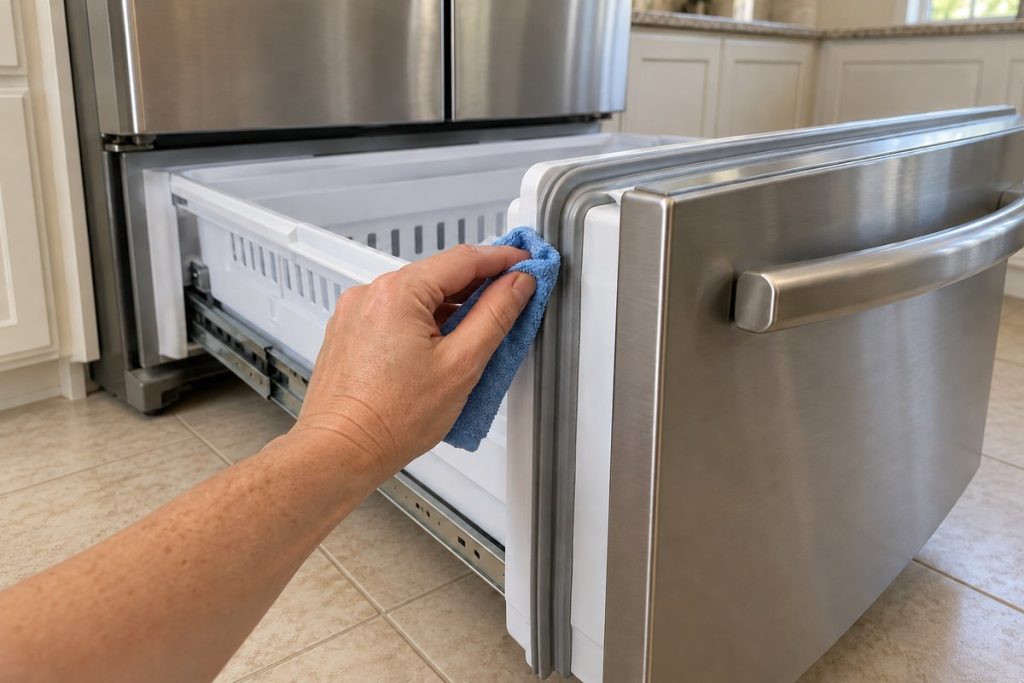
- Clean the door gasket: GE’s manual cleans the inside of the refrigerator with warm water and about a tablespoon of baking soda per quart. Wipe the whole gasket with a soft cloth, rinse, and dry. This removes debris that breaks the seal.
- Check the dispenser area: Wipe the spill shelf and the drip area. Hold your glass under the dispenser for 2 to 3 seconds after releasing the button and see if the dripping stops.
- Check the display: If you see “LEAK,” note it, along with the date the filter was last changed.
Step 3: Targeted Checks (Proceed with Caution)
- Look at the ice chute: If cubes are jammed in the chute, GE’s manuals describe poking the ice through with a wooden spoon. Nothing sharp or metal.
- Check the filter: Make sure it’s fully seated the way your manual shows. If “LEAK” is on the display, replace the filter as GE directs.
- Listen for water hammer: If your pipes bang when a valve closes, have a plumber look at it.
- Water line: Look for an obvious crack or a wet fitting at the back without pulling or tightening anything. If you see a cracked line, stop. It needs replacement.
When to Stop: Your Clear Red Flags
Stop DIY efforts and call a technician if:
- The leak is a steady stream, not a drip.
- Water is coming from behind the freezer’s back panel or from under the unit.
- There’s a sheet of ice on the bottom of the freezer.
- Water has reached any electrical part, the cord, or the outlet.
- The leak comes back within a day after the checks above.
These point to the drain, defrost system, valve, or ice maker.
Spent time troubleshooting, but the water’s still winning? You’ve done the hard part. Let us finish the job: our GE freezer repair team fixes the source, not just the symptom.

Why You Shouldn’t Ignore Leaking Water
A small drip rarely stays small. Left alone, a leak can lead to this:
- Water pools under the unit and can warp hardwood floors or damage cabinets.
- Standing water in the drain pan or inside the freezer can grow mold.
- A clogged defrost drain keeps overflowing, frost builds up, and cooling suffers.
- A leaking door gasket lets humid air in, which means more condensation and the compressor working harder.
- A cracked water line or ice maker leak gets worse over time.
Conclusion
A GE freezer leaking water starts as an annoyance and can turn into a real headache. The good news: most leaks come from a short list of places — the defrost drain and pan, the door gasket, the water line, the filter, the ice chute, or the ice maker.
Rule out what GE calls normal, then use timing and the paper towel test to find the source. Cleaning the gasket, clearing the chute, and checking the filter stop many drips right away.
When the leak is steady, comes from the back, or keeps coming back, it’s usually a part like the drain, the pan, the valve, or the gasket that needs replacement.
Don’t let a little water become a big problem. Book GE freezer repair with PRO Appliance Repair. We’re family-owned and insured, with same- or next-day service on most days across metro Atlanta. Our EPA 608 certified, background-checked technicians use genuine OEM parts, and our repairs carry a warranty of up to six months. If your GE freezer is also making strange sounds, see our guide to a GE freezer making loud noise.
FAQ
Why does my freezer only leak after a defrost cycle?
Meltwater from defrost is supposed to flow into a drain pan underneath. If the drain is clogged or frozen, it overflows inside or onto the floor. The drain sits behind panels, so this is a job for a technician.
Is it normal to have water under the freezer in summer?
GE says moisture on the outside of the cabinet is not unusual in high humidity — wipe it dry. A puddle that keeps coming back is different and usually points to the drain, the gasket, or the water supply.
Can a bad door gasket cause water inside the freezer drawer?
Yes. A worn gasket lets warm, humid air in, which condenses and freezes. When that frost melts, it can drip or pool inside the drawer.
My display says “LEAK.” What does that mean?
On GE models that detect it, “LEAK” means a filter leak was found. Water is turned off, the filter light flashes red, and a buzzer sounds. GE’s manuals say to replace the filter.
How do I know if the leak is from the ice maker?
Water near the ice maker, below the dispenser, or after the ice maker fills points that way. Check for jammed ice in the chute first. If water keeps appearing, the valve or ice maker needs a technician.
Should I tighten the water line connection myself?
Better not. GE warns that overtightening may cause leaks. If a fitting is wet or the line is cracked, shut off the water if the valve is easy to reach, and call.
PRO Appliance Repair is an independent repair company and is not affiliated with, sponsored by, or endorsed by GE Appliances. Brand and model names are used only to identify the appliances this page is about and remain the trademarks of their respective owners.