
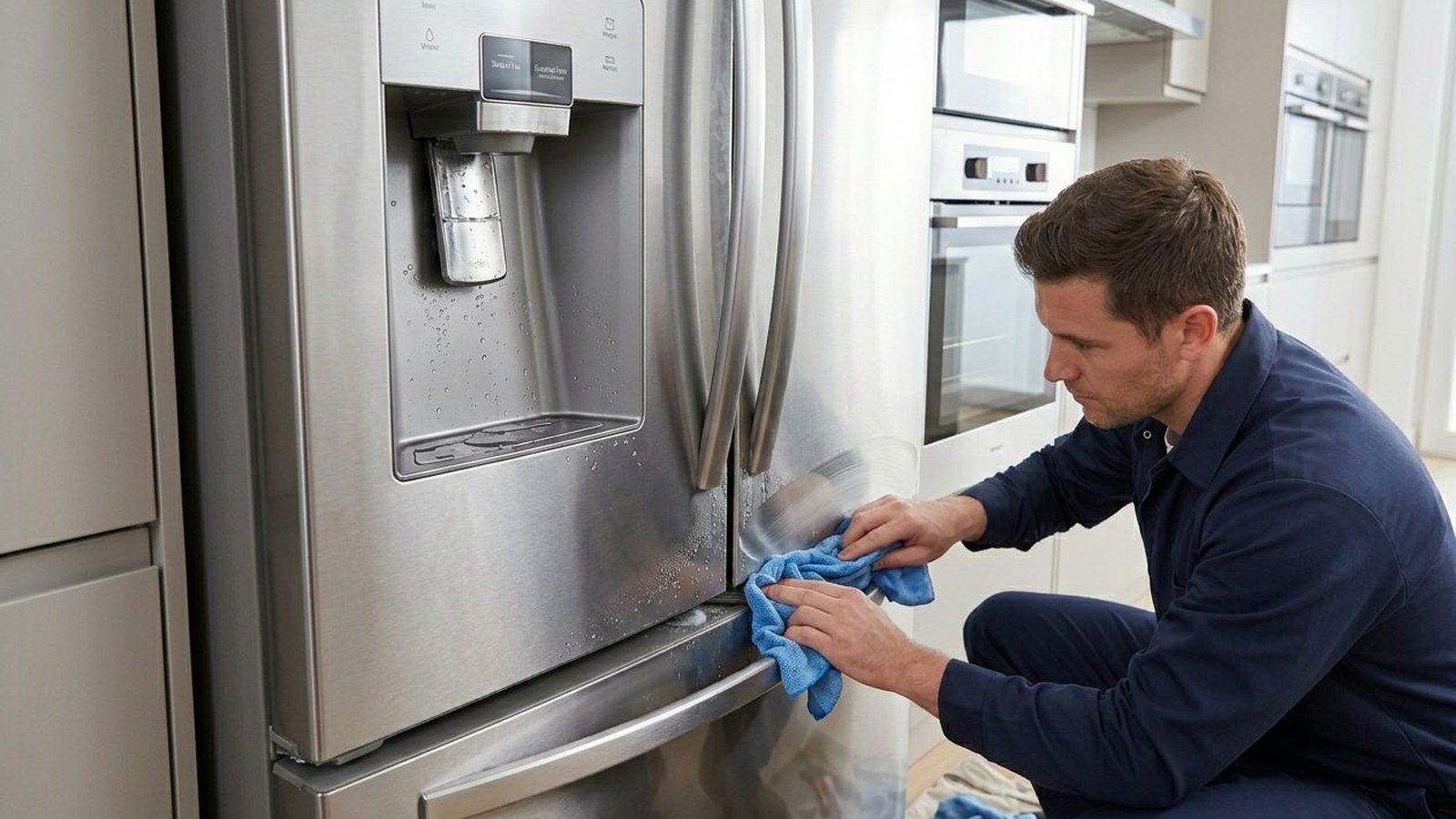
Samsung refrigerators can leak for several very different reasons, and the puddle itself usually shows you very little. What matters is:
- where the water shows up,
- when it shows up,
- and whether it returns in the same place.
Water under a drawer is not the same problem as a dispenser drip. Moisture along the door is not the same problem as a water filter leak. And a recurring pool under the cabinet can come from the defrost drain path, a frozen drain tube, or a water line that is no longer sealing the way it should.
This article is written to sort that out fast. It follows common Samsung leak patterns back to their likely source — using Samsung’s own manuals wherever they give an answer — including:
- leaks around the auto-fill water pitcher in the door,
- internal drain problems,
- and door condensation that keeps showing up in the same spot.
The goal is simple: give homeowners a clearer read on the leak, help them rule out the obvious, and make it easier to decide when repair is the next step. If you’d rather have someone find it, our Samsung refrigerator repair team works across metro Atlanta.
First, a safety rule from Samsung’s manual: “If large amounts of water enter the refrigerator, pull out the power plug and contact a Samsung service center.” If you can’t reach the plug, switch off its breaker and call for service.
Leak Pattern Map
This quick table is designed to shorten the first stage of diagnosis. Start with where the water shows up, then read the likely system behind it.
| Where you see water | Likely cause | What to look at first | Typical next step |
|---|---|---|---|
| Under crisper drawers | Defrost water not draining, or a frozen drain path | Ice or water on the floor of the compartment | Technician — the drain path is behind panels |
| At the dispenser recess | Dispenser drip or valve seepage | Whether the drip is brief or continuous | A brief drip can be normal; continuous drip needs service |
| Inside the door pitcher area (RF23M auto-fill models) | Water tank overflow or a leak | Blinking Auto Water Fill indicator | Drain through the rubber cap as the manual describes |
| Around the filter area | Water filter leak | Whether it started after a filter change | Reinstall per the manual; persistent leak needs service |
| Behind or under the cabinet | Water line or inlet connection | Dampness at the back, without touching the line | Technician — the line stays under house pressure |
| Along the door frame | Door condensation | Water drops on or around the doors | Samsung: turn Energy Saver mode off |
Pitcher, Dispenser, and Door Zone
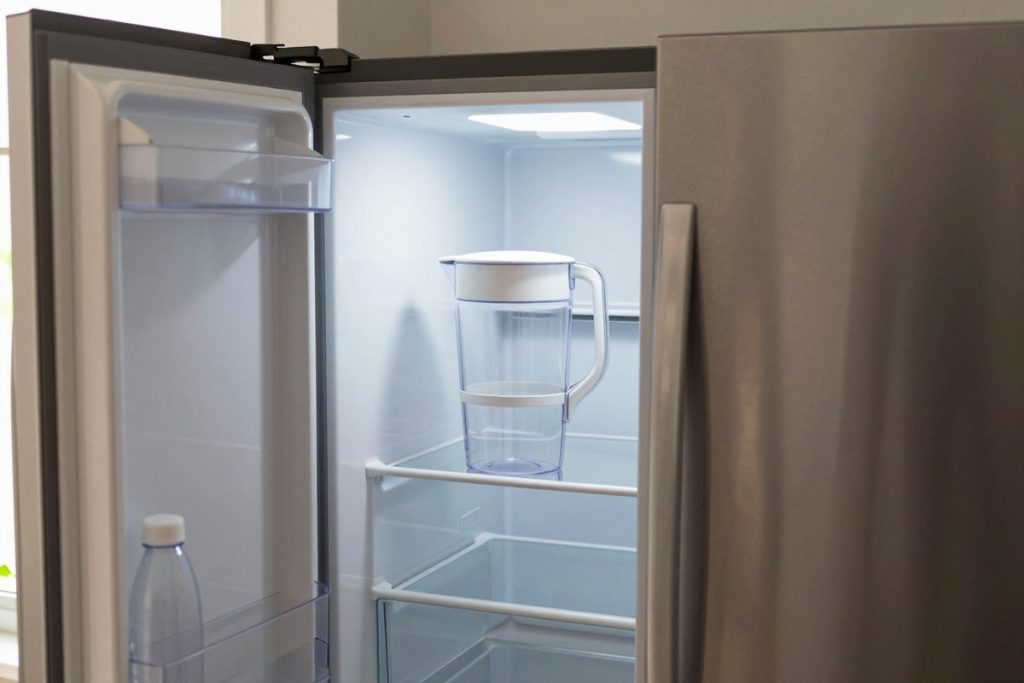
Front-of-cabinet leaks are easy to misread. Water near the dispenser does not always mean a dispenser fault. Moisture near the gasket does not automatically mean the door seal is bad. On Samsung models with a water pitcher in the door, the same front zone includes the dispenser, the pitcher holder, the gasket edge, and several surfaces where warm room air meets cold interior parts.
Start with one question: when does the water appear? After dispensing? After the pitcher refills? After the door has been opened several times? That timing usually tells you more than the puddle itself.
Auto-Fill Water Pitcher Leak
On the RF23M models with Auto Water Fill, the water tank sits inside the left fridge door, with an infuser holder. A leak there usually shows up in that area or along the shelf edge below it. The manual gives the warning signs and the fix in its own words: the indicators blink if “the water tank overflows, or the water-line or water-level sensor fails,” and “The Auto Water Fill indicator blinks if there is a leak.” Its steps:
- “Open the rubber cap and drain water.”
- When draining is complete, the indicators stop blinking and turn solid.
- “Close the rubber cap.”
The manual also notes: “Wipe around the infuser holder if the infuser overflows or leaks,” and “Water drops off if the rubber cap is opened” — so a few drops after draining are expected. If the indicators keep blinking, Samsung says this might be a system failure and to contact service. The key detail is the repeat pattern: if water appears during fill or right after the pitcher is handled, start there.
Dispenser Drip
A light dispenser drip right after dispensing can be normal. Holding the glass in place for a moment after you release the dispenser lets the last drops land in the glass. A drip that keeps returning, leaves standing water, or shows up long after use is a different issue. That usually points to a valve that is not closing cleanly, a nozzle assembly problem, or pressure changes after a recent filter change. Immediate after-drip and delayed seepage are not the same symptoms.
Door Condensation
Door condensation is often reported as a leak because it leaves water along the gasket line or at the lower edge of the door. In most cases, the cause is humid air reaching a cold surface — through a weak seal, frequent door openings, or slight door misalignment.
Samsung’s RF23M manual gives a specific step: “If condensation or water drops form on or around the doors, turn Energy Saver mode off.” It also explains that the refrigerator has heat-proof piping in the front corners to prevent condensation, and that “If the ambient temperature rises, this equipment may not work effectively. This is not a system failure.” Press the Energy Saver key exactly as your own manual describes — on some models the same panel keys do other things when held.
That repair path is different from a drain problem or a water line fault, so it helps to separate condensation from an active water leak early.
Quick Checks for the Front Zone
- Look at the Auto Water Fill indicator (RF23M models): blinking means the manual’s rubber-cap drain step applies.
- Check for moisture in the pitcher area before assuming the pitcher itself is defective.
- Dispense water, hold the glass for a moment, and watch whether the drip stops or continues.
- Look along the door edges for water drops with the doors closed; if you see them, try the Energy Saver step from your manual.
Water Under the Drawers: Usually a Drain Problem
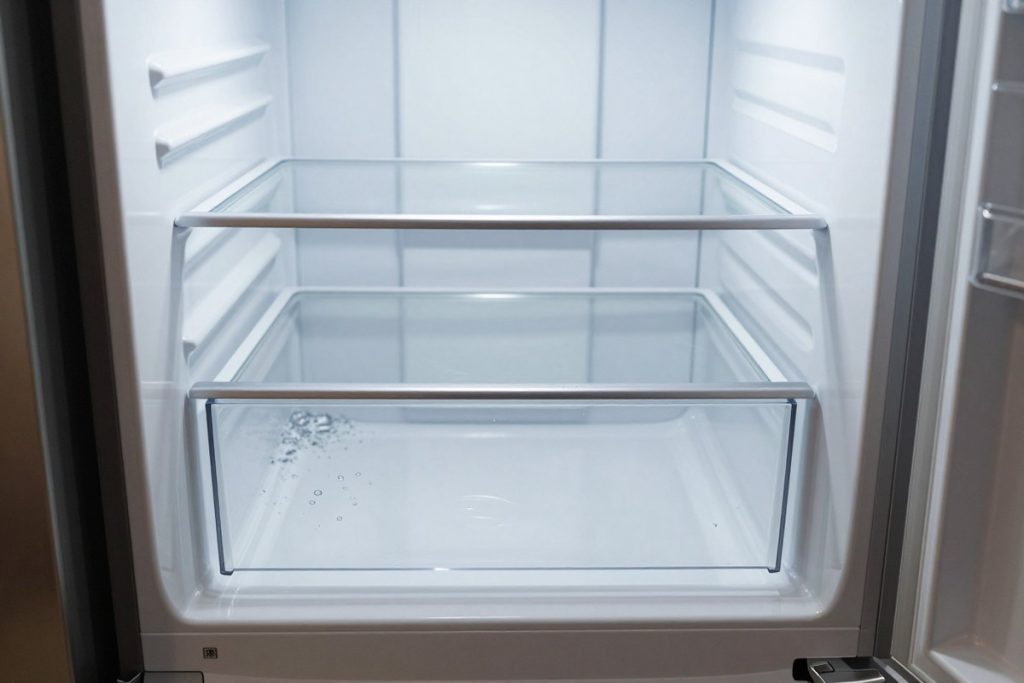
Water under the crisper drawers or on the refrigerator floor usually comes from the defrost side of the system, not the drinking-water side.
During a normal defrost cycle, meltwater should move out of the cabinet through the drain path. When that path is restricted, water stays inside the refrigerator instead of draining away. Once enough collects, it runs forward and shows up under the drawers.
A Slow or Blocked Drain
The drain opening can narrow from debris or buildup, which slows the flow during defrost. Early on, the leak may appear only once in a while. As the restriction gets worse, the water comes back more often. That is why this problem is easy to underestimate: one cleanup can make it look solved when it is not.
A Frozen Drain Path
A frozen drain path causes a similar leak, but the failure is different. In this case, the drain is blocked by ice. Water cannot move through, so it backs up inside the cabinet and often turns into sheet ice beneath the drawers. Owners may wipe it up, see the leak disappear, and assume the fix worked. If the leak returns, the issue was not the ice alone — it was the reason the drain froze in the first place.
What This Leak Pattern Usually Means
If water keeps returning under the crispers, the job is to find out which of these is happening:
- water is draining too slowly
- water is not draining at all
- the drain path is freezing again after thawing
That difference decides the repair. The drain and its parts sit behind interior panels, so a recurring leak means the drain system needs to be opened up, inspected, and corrected by a technician. Don’t chip at ice or remove panels yourself.
Water Around the Filter Area or Under the Machine: Pressurized Water Path Faults
Leaks from the pressurized water path do not behave like defrost leaks. They are usually cleaner, more direct, and more likely to show up near the filter area, at the back of the refrigerator, or under the cabinet.
Two causes are often mixed together: a water filter leak and a water line problem. They both involve the water supply, but they fail differently.
Water Filter Leak
A water filter leak often starts right after the filter is replaced. The filter may not be locked in place, the seal may be damaged, or the housing may be cracked. In some cases, the leak shows up only when water is dispensed. Samsung’s manual also notes that if water isn’t dispensing properly, “the water filter is most likely clogged,” and it gives one less obvious cause: if the vents are blocked and “a cooling period lasts too long, the water filter may break and cause water leakage.” Replace the filter exactly as your manual describes, starting with shutting off the water supply, and use only Samsung filters as the manual cautions.
Water Line Leak
A water line leak usually starts lower and farther back. A loose fitting, a worn section of line, or a slow valve seep can leave water under the refrigerator. Some leaks appear only when the ice maker fills. Others keep forming because the valve does not close fully.
Telling the Two Apart Safely
You don’t need to touch the line to narrow it down. Note whether the dampness is at the back and under the unit (more likely the supply side) or inside the cabinet under the drawers (more likely the drain side), and whether it appears only when the ice maker fills or the dispenser runs. The line stays under house pressure, so leave fittings, valves, and the line itself to a technician or installer.
Online Searches About Samsung Leaks
Many owners search online when they see repeat icing, water under the drawers, or moisture around the ice area, and they find long threads about other people’s refrigerators. Those threads don’t answer the real question: where is this refrigerator leaking from? A repeat water problem can come from very different faults — icing, drain restriction, valve seepage, filter-area leakage, or moisture caused by poor sealing.
That is why the repair has to stay specific. A technician needs to check the ice area, the drain path, the surrounding seals, and how the unit manages defrost and moisture. Online reading does not replace a hands-on diagnosis of the unit in your kitchen.
Homeowner Checks vs. Service Triggers
These checks are reasonable before booking service. The right-hand column marks the point where repeated moisture is no longer a setup issue.
| What to check | What a normal result looks like | When to book repair |
|---|---|---|
| Pitcher area (RF23M) | Indicators solid, no standing water | Indicators keep blinking after the rubber-cap drain step |
| Filter installation | Filter locked in place, no drip after installing per the manual | Leak starts after every filter install or comes from the filter housing |
| Drain behavior | No water under drawers after a full day of normal use | Water or ice returns under the drawers |
| Dispenser after-drip | A brief, light drip that stops quickly | Drip continues, pools, or reappears long after dispensing |
| Door edges | Dry, or dry after turning Energy Saver off | Water keeps forming with Energy Saver off |
| Rear of the unit | No dampness under the cabinet | Any persistent dampness at the back |
Stop the leak before it spreads. Book Samsung refrigerator repair with PRO Appliance Repair. We’re family-owned and insured, with same- or next-day service on most days across metro Atlanta. Our EPA 608 certified, background-checked technicians use genuine OEM parts, and our repairs carry a warranty of up to six months.

Why the Room Matters Too
Leak diagnosis is never only about the refrigerator. Room conditions matter too. Humid summers can make borderline sealing and moisture-management issues show up sooner. A weak gasket that might produce a small moisture trace in a dry season can become visible door condensation in a humid kitchen — and Samsung’s manual notes that when the room temperature rises, the anti-condensation equipment “may not work effectively.” A dispenser recess that already has minor after-drip can stay wet longer because evaporation is slower. A drain that is beginning to struggle can be exposed faster when the refrigerator works harder to manage repeated warm, moist air entry.
That does not mean humidity is the root cause of every water leak. It means room conditions can amplify the symptom and make timing more noticeable. Those details help tell an isolated spill from a leak pattern.
Conclusion
Samsung refrigerator leak complaints usually become easier to solve once the symptom is sorted by system. Water under the drawers points toward drainage. A blinking pitcher indicator points to the manual’s rubber-cap step. Water drops around the doors point to condensation and Energy Saver. A leak near the filter housing or behind the cabinet shifts attention to the pressurized water path. That turns one vague complaint — a Samsung refrigerator leaking water — into a smaller set of testable causes.
For homeowners, the best next step is not to keep wiping and watching indefinitely. It is to identify the pattern, perform the safe checks that fit that pattern, and act quickly when a leak repeats — especially when the refrigerator shows internal pooling, recurring ice under the drawers, persistent dispenser moisture, or dampness at the back. The earlier the fault is isolated, the easier it is to prevent cabinet damage, floor damage, and spoiled food. For other RF23 issues, see our guide to Samsung RF23 refrigerator problems.
FAQ
1. Why is my Samsung refrigerator leaking clear water under the crisper drawers?
That pattern usually comes from the defrost side: defrost water that isn’t leaving the compartment through the drain path, often because the drain is restricted or frozen. Water moves forward and collects under the drawers. The drain sits behind panels, so a repeat leak needs a technician.
2. Can a new filter cause a leak right away?
Yes. A filter that isn’t fully locked in, a damaged seal, or a cracked housing can leak right after replacement. Reinstall it exactly as your manual describes, starting with shutting off the water supply, and use only Samsung filters. If the leak continues, the filter housing needs a technician.
3. How much dispenser drip is normal?
A brief drip right after dispensing can be normal — hold the glass in place for a moment after releasing the dispenser so the last drops land in it. It becomes a service issue when the drip continues, pools in the recess, or returns long after the last use.
4. My Samsung’s Auto Water Fill indicator is blinking — is it leaking?
On the RF23M models, Samsung’s manual says the indicator blinks if the water tank overflows, a water-line or water-level sensor fails, or there is a leak. Open the rubber cap to drain the water, then close it; the indicators should turn solid. If they keep blinking, contact service.
5. Why is there water on the outside edges of my Samsung’s doors?
That’s usually condensation. Samsung’s manual says: “If condensation or water drops form on or around the doors, turn Energy Saver mode off.” The unit has heat-proof piping in the front corners, which may not keep up when the room gets warm. If water keeps forming with Energy Saver off, check the door seals or call for service.
6. What should I do if a lot of water gets inside the refrigerator?
Samsung’s manual says to pull out the power plug and contact a service center. If you can’t reach the plug, switch off its breaker instead.
PRO Appliance Repair is an independent repair company and is not affiliated with, sponsored by, or endorsed by Samsung. Brand and model names are used only to identify the appliances this page is about and remain the trademarks of their respective owners.