
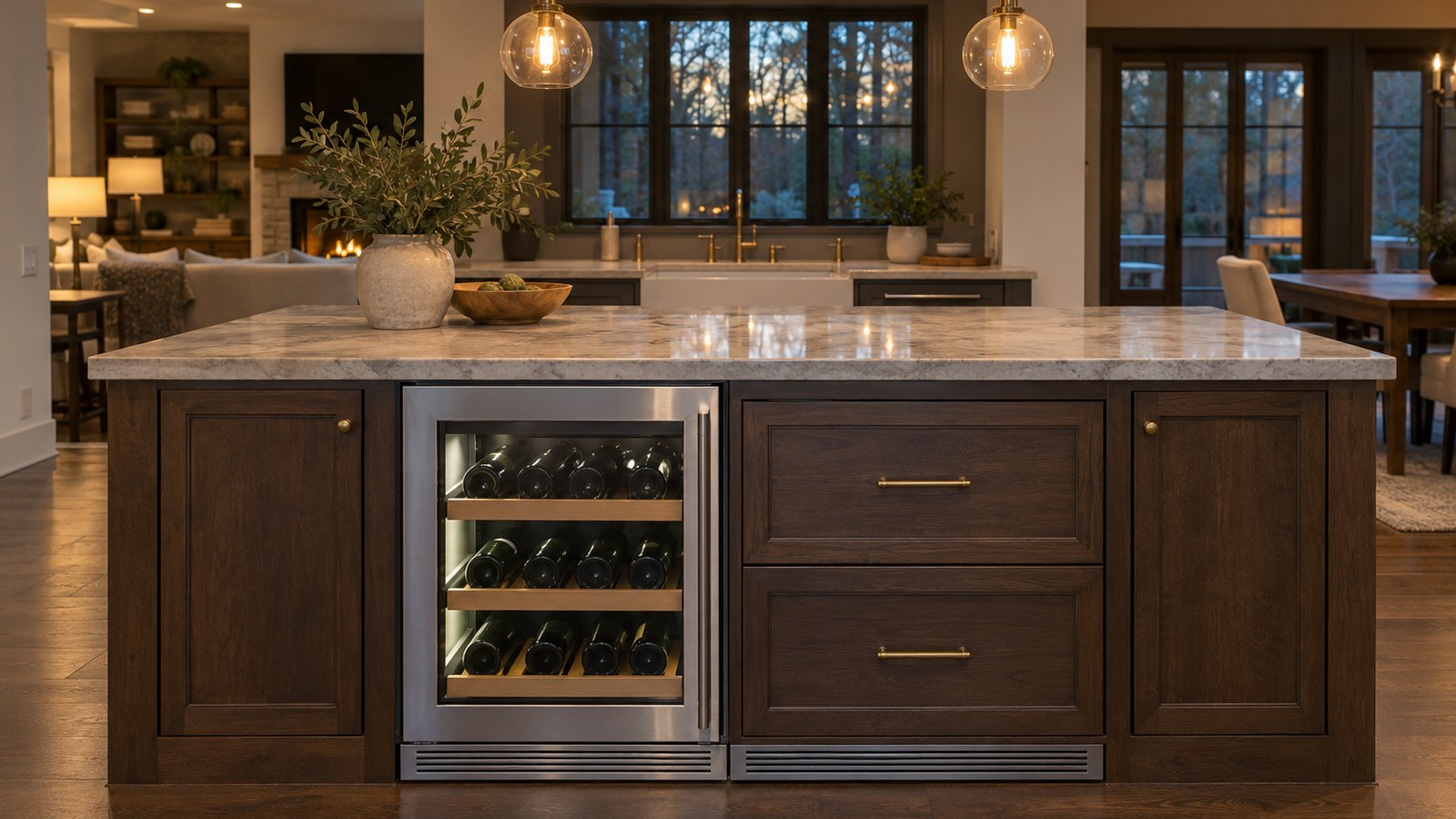
You reach into the beverage drawer for a cold drink and it’s… cool-ish. Or you open the wine unit before dinner guests arrive and the bottles feel warmer than they should. Annoying — and with a wine collection, a little nerve-racking. Before you assume the compressor has died, know this: compact units behave differently from full-size refrigerators, and a lot of “not cooling” calls turn out to be usage, setup, or a dusty condenser rather than a broken part.
Small refrigerators showcase big problems. A Sub-Zero undercounter refrigerator, refrigerator drawer, or undercounter wine unit holds a fraction of what a full-size refrigerator does. Less stored mass means less temperature stability: every door opening exposes a bigger share of what’s inside to warm kitchen air, and the unit has less cold “reserve” to fall back on while it recovers.
We see this pattern constantly in Atlanta: a homeowner calls about a drawer that isn’t cooling, assumes the compressor died, and the unit simply can’t catch up with being opened again and again while groceries are put away. Or a wine unit “not cooling” complaint turns out to be a unit fighting a kitchen corner that bakes in the afternoon sun.
Sub-Zero’s compact family is broad: UC-24 and UC-15I undercounter refrigerators, 700BR and 427R refrigerator drawers, Designer undercounter (DEU) models, and wine units like the UW-24, 315W, and 424. They’re engineered to fit tight spaces, and that design shapes how they behave.
This guide covers why compact units warm up so quickly, how door openings and the room around them affect temperature, which components actually fail, and how to tell normal behavior from a real repair. If you’d rather have it diagnosed now, our Sub-Zero wine cooler and undercounter repair team works on these units every week.
Why Small Refrigerators Warm Up Fast
Your compact unit might be working fine — the problem may be physics, not failure.
A full-size refrigerator has a lot of mass inside: food, shelves, containers, walls. All of it holds cold. Open the door for a minute and the items up front warm a little; the back of the cabinet stays cold, and the unit recovers quickly.
A drawer or undercounter unit has far less of that mass. Open it for the same minute and a much larger share of the contents meets room air at once. Pull out a drawer and nearly everything inside is exposed. Recovery takes longer, and the compressor works harder to get there.
This is not a malfunction. It’s geometry.
What Sub-Zero Considers Normal
Sub-Zero is clear that some movement is expected. Normal: temperatures fluctuating slightly — about ±5°F — depending on door openings, humidity, and room temperature. Also normal: new groceries or warm food raising the temperature for a while, with things returning to normal after several hours. In a wine unit, adding new bottles raises the temperature temporarily, and recovery depends on how much wine went in — Sub-Zero suggests allowing 24 hours.
So a reading that’s a few degrees high right after unloading isn’t a verdict. A reading that stays high the next morning is.
Wine Units Have Tighter Targets
Wine storage is about stability. Bottles also have air gaps between them, so a half-stocked wine unit has less thermal mass than a drawer packed with food — and one long browse with the door open exposes the whole collection.
Know your unit’s range. Sub-Zero lists 39°F–65°F (about 3°C–18°C) for Designer, Classic, and UW-24 wine storage, though it can vary by serial number, model, and age. The 315W is different: it uses a dial rather than an electronic control, its guide lists 45–55°F, and Sub-Zero notes the bottom racks run cooler and the top racks warmer — low-to-mid 40s at the bottom, low-to-mid 60s at the top at a mid setting. If your 315W feels “warm on top,” that may be exactly how it’s designed.
Beverage and Refrigerator Drawers Face Similar Problems
Half-empty drawers swing more per opening. Cans and bottles help because liquid holds temperature better than air — but a drawer stocked at a fraction of its capacity is fighting a losing battle. The 427R refrigerator drawers, for example, run between 34°F and 45°F, with both drawers set to the same temperature, so one busy drawer affects the reading for both.
Why is my drawer fridge warm? Often because someone opened it repeatedly during meal prep. Each opening warms the contents. The compressor runs constantly trying to recover but never fully catches up before the next one.
What Helps
Fill empty space — but not too much. Sub-Zero says refrigerators and freezers work best when they’re between a quarter and three-quarters full. Too little food makes the unit run more than normal; too much blocks airflow and causes poor temperatures. If a unit is on but barely used, Sub-Zero suggests bottles of water in the refrigerator to stabilize temperatures.
Group items together. Clustered cold items stabilize each other. Spread-out storage means more warm air pockets.
Don’t block the vents trying to add mass. Find the balance.
PRO TIP: If you can’t keep a compact unit reasonably stocked, a few sealed water bottles act as cold batteries between door openings. Takes two minutes. Costs nothing.
Kitchen Temperature Matters More Than You Think
Your wine unit might be struggling because of where it lives. Except for outdoor models, Sub-Zero designs its refrigeration to run in a 60°F to 90°F (15°C to 32°C) environment. Outside that range, performance suffers and damage is possible — and the warmer the room, the more the unit runs to stay cold. Sub-Zero also notes that units in humid spaces without climate control can see the drain pan fill quickly or excessive frost.
That’s directly relevant here. A Georgia kitchen in July, an unconditioned basement bar, a sunroom, a screened porch, or an under-counter spot next to the oven can all push a compact unit toward the edge of that range. And one rule worth knowing: Sub-Zero doesn’t suggest installing an indoor unit outdoors, and there’s no warranty for an indoor unit installed outside. Covered patio? It still counts as outdoors.
We’ve diagnosed plenty of units that worked perfectly in February. Come July, with the room running hot, the same unit can’t keep up. Different season, different performance, same refrigerator — and sometimes the fix is the room, not the unit.
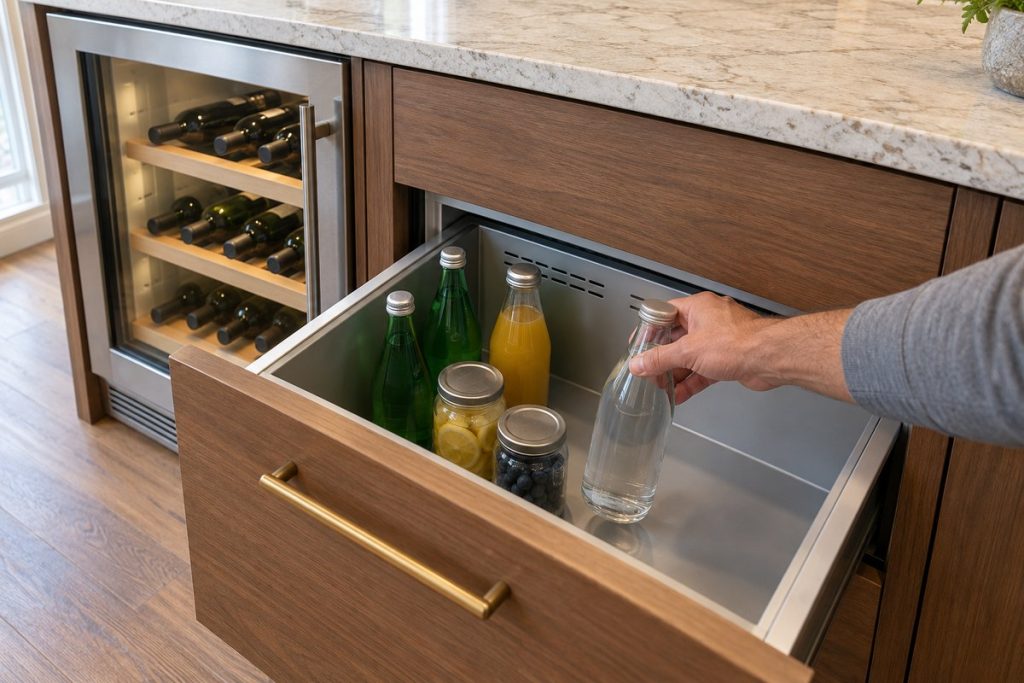
Door Openings Hit Compact Units Hardest
Surface area works against small refrigerators.
Open a full-size unit and the back shelves barely notice. Cold air settles at the bottom, and much of the interior stays protected.
Open a drawer and every item inside gets a blast of kitchen air. No protected zones. No cold pockets staying stable.
The Compounding Problem
Picture breakfast with a refrigerator drawer: open for milk, close; open again for butter a few minutes later; open once more to put the milk back. Each opening warms the drawer before it has finished recovering from the last one. The compressor runs almost continuously, and the drawer still reads warm. This is why people call saying their unit “doesn’t work right.” It never got a chance to recover.
Multiply that across a day — breakfast, lunch, after-school snacks, dinner prep, evening drinks — and temperature complaints make perfect sense once you track actual usage.
Wine Storage Gets Hit Harder
Wine units face precision demands that food drawers don’t. And people browse wine. You don’t grab a bottle in ten seconds — you look, consider, pull one out to check the vintage, put it back, grab another. Long door openings happen regularly, especially during a dinner party. A unit that holds steady when opened once a day may wander noticeably when it’s opened every few minutes all evening.
That’s not always fixable with a repair. Sometimes it’s simply how a compact unit behaves under heavy use.
Testing Usage vs. Failure
Need to know whether the problem is the unit or how it’s used? Run a simple closed-door test:
- Move perishables to another refrigerator.
- Set the unit to its normal setpoint — 38°F for refrigeration, or your usual wine setting.
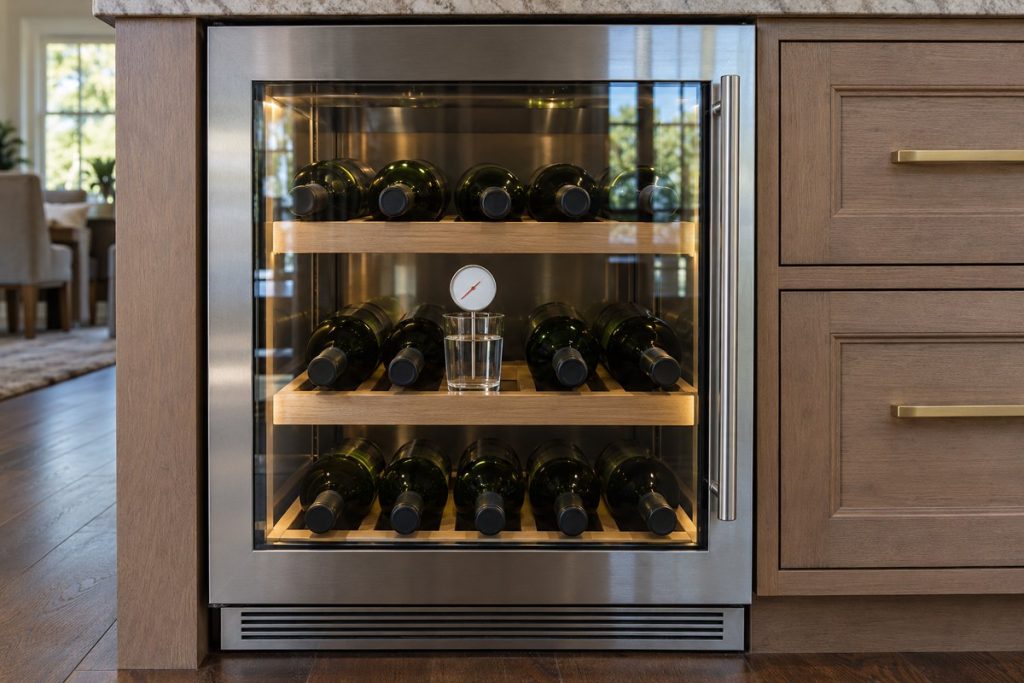
- Put a separate thermometer inside (a glass of water with a probe on a middle shelf works well).
- Close it and don’t open it for 24 hours. On glass-door units you can read the thermometer through the glass.
Results:
- Reaches and holds the setpoint? The unit works. Usage or the room needs adjustment.
- Never reaches the setpoint, or can’t hold it with the door closed? That points to a component problem — time for service.
This simple test separates physics from malfunction and saves an unnecessary service call.
Not sure what your results mean? We’ll run proper diagnostics and tell you straight whether it’s the unit, the usage, or the room.
Reducing Opening Impact
You can’t eliminate door openings, but you can minimize the damage:
- Plan ahead. Get everything you need in one opening instead of three.
- Organize by frequency. Daily-use items in front. Rarely-needed items in back.
- Space your openings when you can. Don’t open it three times in five minutes.
- For wine storage specifically: know which bottle you want before you open the door. Don’t browse with the door open.
- Use the door alarm if your unit has one. On many Sub-Zero units, a chime sounds if a door or drawer is left ajar. On WS-30 wine units, the alarm became a door alarm with a 2016 production change; earlier units have a temperature alarm instead.
- Track patterns if you’re skeptical. A logging thermometer shows exactly how openings affect your unit and whether it recovers.
When Patterns Reveal Real Problems
Normal behavior looks like this:
- Temperature rises during a reasonable opening.
- It returns toward the setpoint within a reasonable time.
- The compressor cycles off once it has recovered.
- The pattern repeats consistently, and overnight readings are steady.
Failure looks like this:
- Temperature takes far longer than usual to recover — or never quite does.
- The compressor runs constantly regardless of usage.
- Temperature drifts even when the door stays closed overnight.
- Frost builds on the back wall, or a service indicator appears.
The difference matters. Fixing temperature issues in compact units starts with separating normal behavior from broken components.
What Breaks in Compact Units
Real component failures do happen. Sub-Zero’s own list of causes for a warm wine unit is a good map for compact units in general: a fan not working properly, a temperature sensor or thermostat malfunction, a sealed system problem (the compressor, evaporator, and condenser), or a door seal or gasket problem. Here’s what that looks like in practice.
Evaporator Fan Motors
Compact units move air through tight spaces, and when an evaporator fan slows or stops, cold stays trapped at the evaporator coil instead of reaching the contents.
Signs:
- The compressor runs, but the compartment stays warm.
- One zone works and another doesn’t (dual-zone wine storage).
- Frost builds on the back wall inside.
- Silence where you’d normally hear gentle airflow.
How to check: with the door closed and the compressor running, listen near the unit for a soft fan hum. Many fans stop when the door opens, so listen with it shut.
Compressor Start Components
The start relay and overload help the compressor kick on. When they fail, you hear the compressor trying to start and not succeeding: a click, a pause, another click, repeating every few minutes. The cabinet gradually warms over hours as the remaining cold dissipates.
Don’t ignore this. Repeated failed starts stress the compressor, and a small start-component repair can turn into a sealed-system repair if it’s left running that way. Our guide to Sub-Zero compressor noise explains which sounds are normal and which aren’t.
Temperature Sensors and Thermostats
Drawer and wine units that won’t hold temperature sometimes have a sensor reporting false data. The control decides when to cool based on that reading — wrong information equals wrong cooling behavior.
| Symptom | What’s Likely Happening | Next Step |
|---|---|---|
| Display shows the setpoint, your thermometer reads much warmer | Sensor reading low, or an airflow problem | Run the closed-door test, then call |
| Wild swings up and down with no pattern | Intermittent sensor or connection | Technician diagnosis |
| Compressor never runs, display looks normal | Sensor stuck reading “cold enough” | Technician diagnosis |
| Runs constantly, never satisfied | Sensor reading high, or a cooling problem | Clean the condenser, then call |
The 315W is the exception: Sub-Zero says it has no electronic control or thermostat — just a dial — so its temperature moves with the amount of wine, the wine’s temperature, and the room.
Control Boards
Units with electronic controls manage everything through a control board: compressor operation, defrost, temperature regulation, and error detection. Heat trapped in tight installations, power surges, and age can all take a toll.
Warning signs:
- A “Service” or “Vacuum Condenser” message.
- The unit won’t respond to temperature changes.
- Random on/off behavior with no pattern.
- No power or display even though the circuit is fine.
If your unit shows “Service” or “Vacuum Condenser,” Sub-Zero’s first step is to clean the condenser — a dirty condenser is the most common trigger. Sub-Zero says it can take up to 24 hours for temperatures to return to normal after cleaning.
Compressor and Sealed System Failure
This is the expensive scenario. Complete cooling failure on an older compact unit can mean a compressor or other sealed-system repair. On a unit that’s 8+ years old, it’s worth weighing:
- The age of the other components.
- Efficiency improvements in newer models.
- Remaining useful life after the repair.
- Whether the unit was ever quite right for how you use it.
We give honest recommendations. Sometimes replacement makes more sense than repair, and we’d rather tell you the truth than fix a unit that isn’t worth it. If a part doesn’t need replacing, we won’t replace it.
Step-by-Step Diagnostics
Work through these in order. The first two steps take about ten minutes.
Important safety note: Only attempt the checks below. Do not remove any panel or cover beyond the kickplate your use and care guide tells you to remove, do not access any wiring, and never reach into the machinery area while the unit is running. Undercounter units are secured in the cabinetry — don’t pull one out of its opening. Work beyond the breaker and these checks should be done only by a qualified appliance technician.
First Five Minutes: Basic Checks
- Power and display. The display shows a temperature, not a blank screen. If it’s blank, check the home circuit breaker.
- Error codes. Address any message on the control panel first — Sub-Zero lists that as step one before anything else.
- Setpoint. It’s where you meant it to be, within your unit’s range. On a dial control, Sub-Zero suggests 4 to 6 (1 is warmest, 10 is coldest).
- Door and gasket. The door closes fully and the seal is tight all around. Remove anything keeping it from closing.
- Vents and kickplate. Nothing is blocking the interior vents or pushed against the kickplate grille at the front.
Next Five Minutes: Listen
- Fan: soft hum with the door closed? Good. Silence while the compressor runs? Possible fan failure.
- Clicking every few minutes without a steady run: likely a start component.
- Loud humming or buzzing: compressor stress — or simply a dirty condenser.
- Rattling: a loose part or debris near a fan.
Clean the Condenser
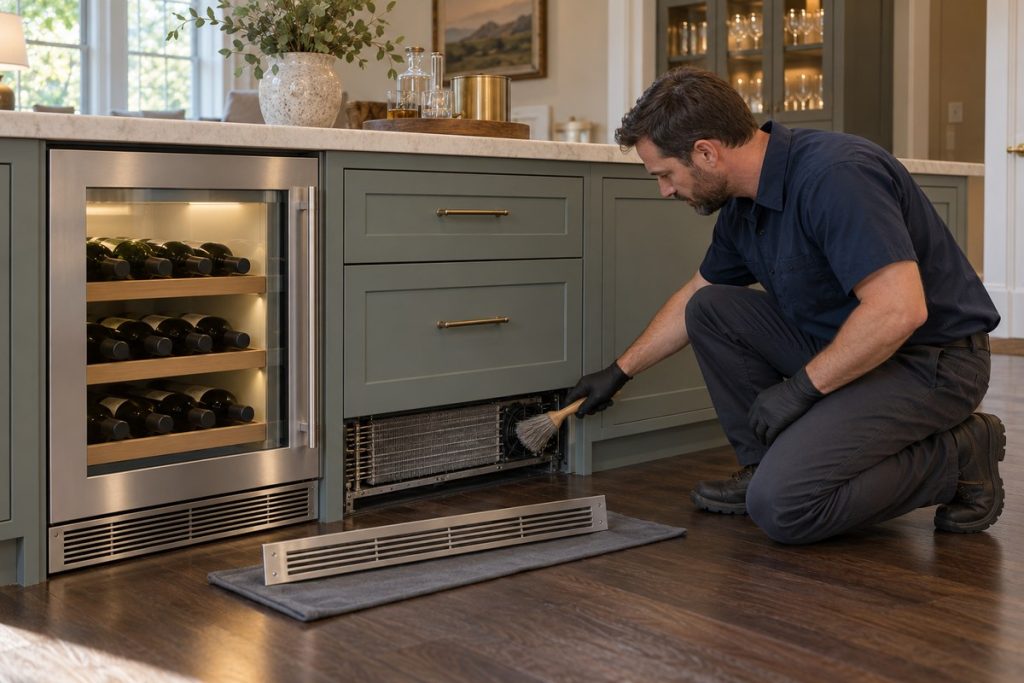
On UC Series, UC-15I, UW-24, 315W, 424, and similar undercounter models, the condenser sits behind the kickplate at the front. Sub-Zero’s routine: turn the unit off at the control panel (or turn the dial past 1 to OFF), remove the screws on both sides of the kickplate, clean the condenser without bending the fins, reinstall, turn the unit back on, and give it up to 24 hours. Sub-Zero recommends cleaning every six to twelve months — and, for a warm wine unit, cleaning first if it hasn’t been done in the last three months. Skip chemical cleaners; Sub-Zero doesn’t recommend them.
24-Hour Closed-Door Test
This is the definitive test — see “Testing Usage vs. Failure” above. Compare your thermometer with the display:
| Result | What It Suggests | Action |
|---|---|---|
| Reaches and holds the setpoint | Unit works correctly | Adjust usage or the room |
| Never reaches the setpoint | Component problem | Schedule service |
| Reaches the setpoint, but the display disagrees with your thermometer by several degrees | Possible sensor problem | Schedule service |
| Takes many hours to get there | Weak cooling — fan, condenser, or sealed system | Professional diagnosis |
Usage Pattern Test (48 Hours)
If the closed-door test showed the unit can reach temperature, test whether usage is the problem.
Day 1 — minimal use: open only twice, morning and evening, for a few seconds each. Track the temperature.
Day 2 — normal use: use it as you normally would and count the openings. Note how long it takes to recover each time.
Stable on Day 1 but struggling on Day 2? You’ve confirmed usage is overwhelming the unit’s capacity. Not failure — limitation.
Did the diagnostics point to a real component problem? You’ve done the hard part. We’ll confirm it with professional tools and give you honest repair-or-replace advice.
Repair or Replace? The Honest Math
Not every situation deserves a repair. Here’s how to think about it.
When Repair Makes Sense
- The unit is under about 7 years old. One failure doesn’t mean the whole system is tired.
- The failure is isolated — a fan motor, a sensor, a start component, or a control board. These are routine repairs that can buy a compact unit years of service.
- The unit has been maintained: regular condenser cleaning, a proper installation with adequate ventilation, no history of repeated repairs. A first-time failure on well-kept equipment usually means you fix it and move on.
When Replacement Makes More Sense
- The unit is 10+ years old with a sealed-system failure, and other components are aging too.
- Multiple problems keep appearing. Fixed the fan last year, now the compressor won’t start? A pattern of escalating repairs points to system-wide age.
- The unit was always undersized for how you use it. If your wine unit can’t handle the opening frequency, or a 24-inch drawer is overwhelmed by a big family, a repair won’t fix that.
- The location works against it. A spot that runs hotter than the 60°F–90°F design range, or an indoor unit installed outdoors, will keep causing problems.
Hot-Climate Considerations
- Hot, humid summers. June through September stresses compact units. A unit that struggled through last summer may struggle more this one — clean the condenser before the heat arrives.
- Older homes. Many have kitchens and basement bars where the air conditioning doesn’t reach the corner where the undercounter unit lives.
- Outdoor kitchens and porches. Popular across the metro — and the most common place we find indoor units that were never designed to be there.
All Things Considered
Troubleshooting starts with understanding what’s normal for a compact unit versus what signals a failure. Small refrigerators warm up faster, recover slower, and react to door openings in ways full-size units don’t. Some behavior that looks like failure is just physics.
But real component failures happen too. Fans wear out. Sensors misread. Control boards quit. Compressors fail. Knowing the difference saves money and keeps you from replacing parts that don’t need it.
What you can do now:
- Run the 24-hour closed-door test with a separate thermometer.
- Clean the condenser if it hasn’t been done in the last six months (three, for a warm wine unit).
- Track door openings for 48 hours.
- Check that the room stays within 60°F–90°F.
- Keep the unit about between a quarter and three-quarters full.
When to call us:
- The unit won’t reach its setpoint even when closed for 24 hours.
- The compressor clicks but won’t start.
- The display shows an error code or service indicator that doesn’t clear after condenser cleaning.
- Your thermometer and the display disagree by several degrees.
- You’ve done the basic checks and still have problems.
Ready to get it cold again? Schedule Sub-Zero wine cooler and undercounter repair with PRO Appliance Repair — same- or next-day service across most of metro Atlanta, from Buckhead and Brookhaven to Decatur, Sandy Springs, Roswell, Alpharetta, and Johns Creek. Our EPA 608 certified, background-checked technicians use genuine OEM parts and back the repair with our workmanship warranty — up to 12 months on Sub-Zero.
FAQ
Why won’t my wine unit hold temperature when my kitchen gets warm in summer?
Sub-Zero designs its indoor refrigeration to run in a 60°F–90°F room, and the warmer the room, the harder the unit works. Near the top of that range — or in a humid space without climate control — a compact wine unit can struggle. Clean the condenser, check the setpoint, and cool the room if you can. If it still drifts, have it checked.
How often should I clean the condenser on my undercounter refrigerator or wine unit?
Sub-Zero says every six to twelve months, and more often with pets. If a wine unit is running warm and the condenser hasn’t been cleaned in three months, Sub-Zero suggests cleaning it first. On most undercounter models, the condenser is behind the kickplate at the front. Turn the unit off first, don’t bend the fins, and skip chemical cleaners.
My 315W is warmer at the top than at the bottom. Is it broken?
Probably not. Sub-Zero says the 315W runs cooler at the bottom and back and warmer at the top and front. At a mid dial setting, that’s roughly low-to-mid 40s on the bottom racks and low-to-mid 60s on the top racks. Store bottles by the temperature you want. If the whole unit runs warm, clean the condenser and call.
What temperature range can I set on my Sub-Zero wine unit?
For Designer, Classic, and UW-24 wine storage, Sub-Zero lists 39°F–65°F (about 3°C–18°C), though it can vary by model, serial number, and age. The 315W uses a dial with a 45–55°F guide range. Red and white wines can be stored in whichever zone you prefer — the zones can be set for either.
Can I put my indoor Sub-Zero undercounter unit on a covered patio or in an outdoor kitchen?
Sub-Zero doesn’t suggest it. An indoor unit isn’t built for outdoor conditions, and there’s no warranty for an indoor unit installed outdoors. Sub-Zero makes dedicated outdoor models for that job. If your indoor unit is already outside and struggling, that location is likely part of the problem — and worth fixing before any repair.
Can temperature problems be fixed without pulling the unit out of the cabinet?
Often, yes. Condenser cleaning, many fan and sensor checks, and basic diagnostics are done from the front. Sealed-system repairs and some component replacements may require pulling the unit from its opening, which takes more time on a built-in installation. A good diagnosis tells you upfront which kind of repair you’re facing, before any work starts.
PRO Appliance Repair is an independent repair company and is not affiliated with, sponsored by, or endorsed by Sub-Zero Group, Inc. Brand and model names are used only to identify the appliances this page is about and remain the trademarks of their respective owners.