
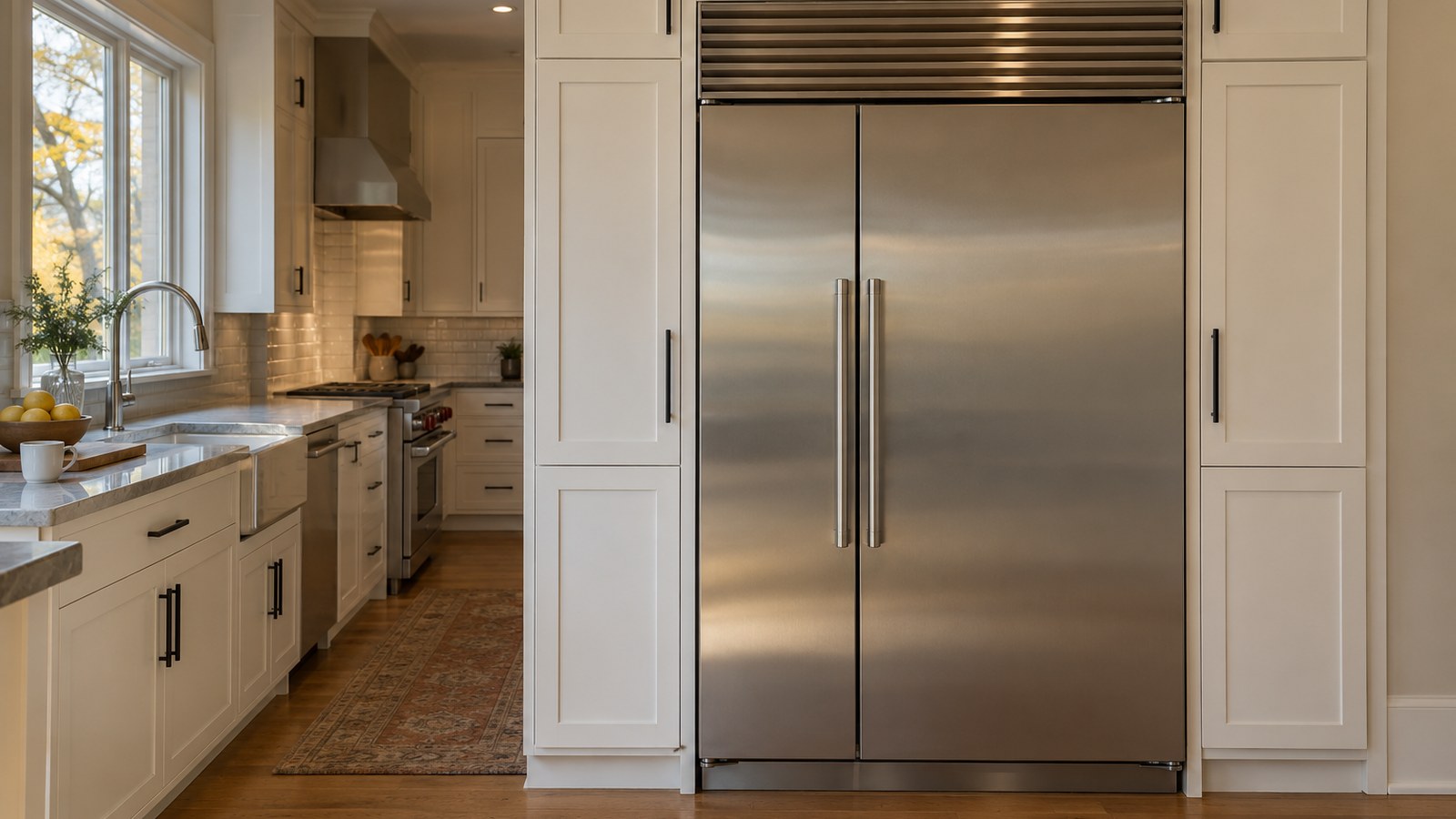
The house finally goes quiet, you’re halfway to bed — and the Sub-Zero you paid for because it’s supposed to be the quiet one is humming louder than the dishwasher ever did. Or it’s buzzing. Or clicking in short bursts you never noticed before. That’s unsettling, especially on an appliance you expect to run for twenty years. Take a breath: most of the sounds Sub-Zero owners call us about are the refrigerator doing exactly what it was built to do, and the ones that aren’t usually give you plenty of warning.
Sub-Zero refrigerators are engineered differently from almost every other brand on the market. Most full-size built-ins — the 500 and 600 Series, the 648PRO, the Classic (BI) combination units, and Designer combination units — use dual refrigeration: one dedicated compressor for the refrigerator section and a separate one for the freezer. The current PRO 36 and PRO 48 (PRO3650 and PRO4850) use variable-speed compressors that speed up and slow down instead of slamming on and off. The result? These units are among the quietest luxury refrigerators you can buy, and most of the time the only sign they’re running is a soft hum that disappears into everyday kitchen noise.
The compressor is the heart of the cooling system: it pressurizes and circulates refrigerant to carry heat out of the cabinet. One thing worth knowing up front: Sub-Zero does not publish decibel ratings for its products — so if you’ve read that a Sub-Zero “should” run at a specific number of decibels, that figure didn’t come from the manufacturer. What Sub-Zero does say is that sound is accentuated by placement and room acoustics — which is why an open-concept Atlanta kitchen with stone floors can make a healthy refrigerator sound louder at night.
We get calls every week asking “why is my fridge so loud all of a sudden?” Often it’s a normal startup, a defrost cycle, or both compressors running after a big grocery trip — healthy compressors doing their job. But when the sound changes — louder, sharper, or constant — it can point straight to the compressor, which sits inside the sealed system. Catching that early is how you avoid a breakdown and a fridge full of spoiled food.
In this guide, we’ll walk you through which sounds are normal, which ones are red flags, what happens when they’re ignored, the free checks you can do yourself, and when it’s time for a technician to take a look. If you’d rather skip straight to a diagnosis, our Sub-Zero refrigerator repair team handles exactly this every week.
Noises from Your Sub-Zero Compressor That Should Never Be Ignored
A properly running Sub-Zero compressor makes a steady, low hum that builds softly, runs for a while, then winds down quietly. Sub-Zero itself lists banging, buzzing, clicking, rattling, vibration, humming, and fan noise as sounds that can all be part of normal operation — so the sound alone isn’t the alarm. The alarm is change. A noise that’s new, louder than it used to be, getting worse over time, or showing up alongside warmer temperatures is the one to take seriously. Over the years, our technicians have heard every variation, and these are the seven that most often turn into a real repair.
#1 Humming noise that gets progressively louder or never fully quiets down
A healthy compressor hum is consistent and low. If the hum starts normal but builds to the point you can hear it in the next room — or the unit seems to run non-stop — the compressor is usually overworking. The most common reason is a dirty condenser; less often, the compressor itself is wearing. One caveat: on dual-compressor models both compressors can run at once, and Sub-Zero says there’s no set run time — it depends on room temperature, load, and door openings. Judge by the trend, not one evening.
#2 Buzzing sound from the back or base of the unit
A sharp, electrical-type buzz from the compressor area that wasn’t there before often means a start component — the relay or overload that helps the compressor kick on — is struggling, or there’s a loose connection making intermittent contact. Don’t confuse it with: the ice maker’s water valve filling (normal, roughly every 2–3 hours), or a lighted shelf on Classic and Designer models that isn’t seated properly. Reseat the shelf first.
#3 Compressor vibration that shakes the whole cabinet or nearby items
Some vibration is normal. Vibration that rattles bottles in the door or gets steadily worse is not. On older units the rubber compressor mounts can harden or crack, and the grille can work loose. Left alone, heavy vibration stresses the copper tubing — and a cracked line means a refrigerant leak.
#4 Fan noise that sounds like it’s coming from the compressor
Many owners mistake fan noise for compressor noise. Sub-Zero built-ins have multiple fans — evaporator fans inside and a condenser fan in the machinery compartment. A sudden whine, scrape, or tick usually means ice or food packaging hitting a blade. Not the compressor yet — but it makes the system work harder and shortens the compressor’s life.
#5 Grinding noise on startup or shutdown
A brief whoosh is normal. A metal-on-metal grind is not. It can mean the compressor’s internal parts are wearing — or, more hopefully, a fan dragging on ice. Either way, it’s worth a diagnosis rather than a wait-and-see.
#6 Compressor clicking every few minutes without the motor actually running
One soft click when the compressor starts or stops is just a relay doing its job. Rapid clicking — click, pause, click — that repeats while the motor never settles into a steady hum means the compressor is trying to start and failing. The usual suspects are the start relay or overload protector, often after power surges or outages.
#7 Rattling that seems to come from inside the back panel or top grille
Loose tubing, a displaced fan shroud, a loose grille, or broken mounting hardware all create rattling — and on a heavily insulated cabinet, any loose part vibrates loudly against the steel shell. Sub-Zero’s first check is the grille: springs and screw in place on 500 and 600 Series units, the grille assembly properly attached on the 648PRO and Classic (BI).
[IMAGE SLOT 1]
If you’re hearing any of these, don’t just turn up the TV. The compressor is trying to tell you something before it fails completely. The next sections will help you decide whether it’s safe to wait or time to act.

When You Can Safely Ignore the Noise
Sub-Zero builds some of the quietest refrigerators in the industry, but “quiet” doesn’t mean “silent.” It’s normal to hear the fans and motors. It’s normal for noises to seem more pronounced in an open-concept home or at night. And on models with a variable-speed compressor — including the PRO3650, PRO4850, and a number of Classic (BI) units within certain serial number ranges — Sub-Zero notes that the compressor always starts at high speed and slows down after about five minutes. On high speed it may give off a high-pitched whine. That’s normal, and swapping the compressor for another variable-speed compressor won’t make it go away.
Short whooshes, sizzling during defrost, light gurgling from refrigerant or drain water, and the occasional thump when the ice maker’s water valve shuts are all expected. If the temperature inside stays where you set it and the sound hasn’t changed in volume or pattern, you’re almost certainly fine. Sub-Zero recommends 38°F (3°C) in the refrigerator and 0°F (−18°C) in the freezer — a cheap thermometer in a glass of water on a middle shelf tells you more than any noise.
[IMAGE SLOT 2]

When to Worry About Noise
The red flags are simple: the sound is new, louder, or happening at the wrong time. A constant or escalating hum that wasn’t there last month. Repeated clicking without the motor ever running smoothly. A sudden loud hum that vibrates the floor. Any noise that shows up together with warmer temperatures, frost, condensation, or spoiled food. If the noise wakes you up at night or you can hear it clearly from the next room, treat it as a warning.
Burning smell, smoke, or a hot electrical odor with the noise? Skip everything else — switch the refrigerator off at the breaker and call.
Hearing any of these in the Atlanta area? Don’t wait for the unit to quit cooling — we’ll diagnose it before a worn part takes the compressor down with it.
What Happens If You Ignore Compressor Noise Issues
We’ve seen the same story many times: a strange noise starts, the owner hopes it “goes away on its own,” and a few months later the compressor has failed and there’s a fridge full of food to throw out.
A compressor doesn’t heal itself — a worn one keeps getting worse until it locks up, a cracked line leaks refrigerant, or the overload keeps cutting it out. Meanwhile the unit runs longer (hello, power bill) and secondary damage — burned relays, cracked tubing — piles up. A long humid Georgia summer already keeps compressors working hard, so that slide can happen faster.
Here’s what we typically see when the most common noise issues are left alone, by the Sub-Zero families we work on most:
| Model / Series | Typical Ignored Noise | What Usually Breaks First | Complications We See |
|---|---|---|---|
| 500 Series (511, 532, 550, 561, 590) | Escalating hum, unit “never shuts off” | Compressor overworking behind a dirty condenser | Warm sections, frost, spoiled food, eventual sealed-system repair |
| 500 Series after a surge or outage | Repeated clicking, no smooth start | Start relay or overload protector | No cooling in one section, emergency calls at night |
| 600 Series built-ins | Vibration + rattling from the top | Grille hardware or compressor mounts | Stressed tubing, slow refrigerant leak, uneven temperatures |
| 648PRO | Grinding + vibration | Fan dragging on ice, or compressor wear | Both zones drifting warm if both compressors are affected |
| PRO3650 / PRO4850 | Loud noise at startup | Usually normal high-speed start; sometimes a fan or mounting issue | Owner worry about a normal sound — or a missed fan problem |
| Classic (BI) and Designer combination units | Buzzing from the base or top + clicking | Start components or a fan | One section stops cooling while the other still runs |
Bottom line: most of these started with a noise the owner decided to “live with for now.” By the time the unit stops cooling, a small repair has often become a big one. The moment the noise changes from “background hum” to anything above, you’re on borrowed time.
How to Fix a Noisy Sub-Zero Compressor: Step-by-Step
Not every loud compressor means a major repair. Plenty of noise complaints turn out to be a dirty condenser, a loose grille, or ice on a fan. Here’s what you can safely check first — free, in the right order — and what to leave to a technician.
Important safety note: Only attempt the checks below. Do not remove any panel or cover beyond the condenser grille your use and care guide tells you to open, do not access any wiring, and never reach into a grille while the unit is running. Sub-Zero built-ins are heavy and anchored to the cabinetry — never try to pull one out of its opening. Work beyond the breaker and these checks should be done only by a qualified appliance technician. On units connected to a water line, do not open or close supply valves or touch fittings — the line stays under house pressure even when the refrigerator is off.
DIY Tips You Can Do This Weekend
- Find where the noise lives. Sub-Zero’s own test: open all doors and see if the noise stops. Then close only the refrigerator door — if the noise starts, it’s the refrigerator evaporator fan (or, on units with an air purification system, the filter fan, which runs whenever the door is closed). Close only the freezer door — if the noise starts there, it’s the freezer evaporator fan. If the noise keeps going with every door open, it’s in the machinery compartment. Takes five minutes and tells us a lot.
- Check what’s touching the fans. Make sure food packaging isn’t pushed into the refrigerator or freezer fan. Overfilled freezers are a classic cause of ticking and scraping.
- Check the grille. A single loose screw or spring on the grille can create a rattle that sounds exactly like compressor failure. Confirm the grille is properly attached, as described above.
- Clean the condenser. Dusty coils force the compressor to run longer and louder. Sub-Zero recommends cleaning every six to twelve months — more often with pets — per your use and care guide. Don’t bend the aluminum fins, and skip chemical coil cleaners. Temperatures not back at your set point within 24 hours? The condenser wasn’t the whole story.
- Look for frost. If you hear fan noise mixed with the compressor sound, open the freezer and look at the back wall around the fan cover. Heavy frost there usually means the defrost system isn’t keeping up. Unplugging overnight to melt it puts a full load of food at risk and hides the real fault — this one goes to a technician.
- Leave leveling to the pros. A tilted unit makes every sound louder, but Sub-Zero directs leveling to an installer or service technician. Rattle started after a floor project? Mention it when you call.
[IMAGE SLOT 3]
Spent the afternoon on this and it’s still humming? You’ve done the hard part — now let us finish the job.
When to Call a Professional
If the noise continues after the steps above — or if you hear grinding, repeated clicking without a smooth start, or the unit isn’t holding temperature — stop troubleshooting yourself. These usually mean:
- A failing start relay, overload, or related start component;
- Worn compressor mounts or internal compressor wear;
- A fan motor failing or dragging on ice;
- A defrost problem, a refrigerant restriction, or an electrical fault.
Going further than cleaning the condenser and checking the grille risks damaging the unit — and on a Sub-Zero still under its sealed-system coverage, it can complicate a claim (our guide to Sub-Zero warranty coverage explains what’s covered and for how long). A good diagnosis rules out the simple causes first, then tests the start components and the compressor’s electrical values under load. If it’s just a relay, the relay is what gets replaced — nothing more.
Older unit? Some of these sounds are part of a wider aging pattern; our article on Sub-Zero BI-30 and BI-36 problems covers what to expect from a 10–15-year-old Classic.
Ready to make your Sub-Zero quiet again? Schedule Sub-Zero refrigerator repair with PRO Appliance Repair — same- or next-day service across most of metro Atlanta. Our EPA 608 certified, background-checked technicians use genuine OEM parts, tell you upfront what the noise actually is, and back the repair with our workmanship warranty — up to 12 months on Sub-Zero. Don’t wait until it stops cooling completely.

FAQ
My Sub-Zero 648PRO makes a brief grinding sound only when it first starts up in the morning. Is this an emergency?
Not usually a same-hour emergency, but it’s a red flag. A true metal-on-metal grind at startup often means a fan is dragging on ice or the compressor is starting to wear — and both get worse with use. If temperatures are still holding, book a diagnostic visit within days, not months. If either section is warming up, call sooner.
What’s the difference between a normal compressor hum and a problematic one?
A normal hum is soft, steady, and cyclical — it builds, runs, and winds down. On variable-speed models it may whine for about five minutes after starting, then settle. A problem hum is louder than it used to be, changes pitch, or never stops even when the room is cool and the doors stay shut. The key is change: new, louder, or constant means the compressor is working too hard.
I cleaned the condenser, but my Sub-Zero 550 is still making a loud buzzing sound. What’s next?
Good first step — and it rules out the most common cause. If a sharp buzz from the compressor area persists, the issue is likely electrical: a failing start relay or overload protector near the compressor. Those need to be tested with a meter and replaced by a technician. Running the unit with a struggling start circuit can leave a section warm, so don’t wait long.
Are compressor clicking sounds ever normal?
Yes. A single soft click as the compressor starts or stops is just the relay, and clicking or chirping for a few minutes after a power outage is normal too. Abnormal clicking is rapid and repetitive while the motor never settles into a steady hum — the compressor is trying to start and failing. That overheats start components quickly, so switch off at the breaker and call.
My dual-compressor Sub-Zero is loud on one side but quiet on the other. What does this mean?
That’s actually helpful. Each section has its own compressor and fans, so the noisy side is where the problem lives — loose mounts, a worn fan motor, or a struggling start component. The quiet side running normally rules out whole-unit causes. Note which section is noisy and whether it holds temperature; that saves diagnosis time.
Can a really loud Sub-Zero compressor damage the rest of the refrigerator?
It can. Heavy vibration stresses the copper tubing and the fasteners around the machinery compartment, and over time it can loosen hardware and rattle shelves and trim. The vibration is a symptom — of failed mounts, a loose grille, or a struggling compressor — so fixing the root cause protects the whole appliance, including the cabinetry around a built-in.
PRO Appliance Repair is an independent repair company and is not affiliated with, sponsored by, or endorsed by Sub-Zero Group, Inc. Brand and model names are used only to identify the appliances this page is about and remain the trademarks of their respective owners.