
If you’ve started noticing that your Frigidaire isn’t cooling properly, you’re probably picking up on small changes first. The refrigerator section feels a little warmer. Drinks aren’t as cold as they used to be. You adjust the setting, wait a few hours, and hope it settles down.
Sometimes it does. Often, it doesn’t.
In Atlanta, refrigerators work harder than most homeowners realize. Between long summer heat, humidity, and kitchens that warm up quickly during the day, your refrigerator is constantly balancing the temperature inside against the conditions outside. When something in that system begins to drift, even slightly, you’ll see the temperature swinging before you see a total failure.
That’s the stage where most Frigidaire temperature problems begin.
In Frigidaire Gallery FGHB (French door) and FGSS (side-by-side) models, we regularly see problems tied to dirty condenser coils, a worn evaporator fan, a faulty thermostat or temperature sensor, and in more advanced cases, compressor failure or a developing refrigerant leak. The early signs often overlap, which is why guessing rarely solves the problem.
If your fridge feels “almost right” but not quite steady, this is the moment to understand what’s happening inside it. A refrigerator rarely stops without warning. It usually gives you time — if you know what to look for.
Fridge drifting warm and no time to chase it? Our Frigidaire refrigerator repair technicians can find the cause and get it holding temperature again.
How Your Frigidaire Holds Its Temperature
To understand why a fridge gets warm or the temperature starts swinging, it helps to know what it’s trying to do in the first place.
Your refrigerator is constantly moving heat out of the cabinet. That’s its only job. It pulls warmth from inside and releases it into the air around the unit. When everything works together, the process is quiet and automatic. You never think about it.
Inside your Frigidaire FGHB or FGSS model, several parts work together:
- The compressor pressurizes the refrigerant and keeps it moving.
- The condenser coils release heat outside the cabinet.
- The evaporator coils absorb heat from inside.
- The evaporator fan pushes cold air evenly through both compartments.
- The thermostat or temperature sensors report how cold it is inside.
- The control board acts as the traffic controller, deciding when each cycle starts and stops.
When one of these parts drifts out of rhythm, the refrigerator compensates. It may run longer. It may cycle more often. It may cool unevenly. That’s when you start noticing something feels off.
Maybe the freezer still seems fine, but the refrigerator section feels warm. Maybe you notice the temperature swinging during the hottest part of the day.
That’s not random. It’s the system working harder to get the same result.
One thing to know before you read too much into run time: Frigidaire notes that every compressor cycles on and off, and many of its French door models use variable-speed compressors designed to run almost continuously, except during defrost. A compressor that runs a lot isn’t a fault by itself. Long running plus a cabinet that won’t stay cold is the warning sign.
Here’s where Atlanta’s climate plays a role. When the air around the refrigerator is already warm, the condenser coils have a harder time releasing heat. If those coils are also dirty, heat stays trapped longer. The compressor then works overtime, and small inefficiencies start to stack up.
Over time, those inefficiencies show up as:
- A fridge that isn’t cooling properly
- Uneven temperatures inside
- Ice building up in certain areas
- Early signs of compressor strain
- Symptoms that look like a refrigerant leak
And this is where homeowners often get frustrated. The refrigerator is still running. It hasn’t stopped. But it isn’t performing the way it should.
That in-between stage matters. It’s usually when the problem is still manageable.
The key question becomes: which part of the system is struggling?
Below, we’ll go through the most common causes of Frigidaire temperature problems in Atlanta homes, starting with the simplest and working toward the more serious ones.
The Most Common Causes of Frigidaire Temperature Problems
Once you understand how your refrigerator holds its temperature, the next step is figuring out where the balance is slipping.
In our experience with Frigidaire FGHB and FGSS models across Atlanta, most cooling complaints fall into a handful of groups. Some are maintenance-related. Others involve controls or the sealed system. The challenge is that the symptoms can look alike at first.
You might notice the temperature swinging. You might feel a warm fridge compartment. You might hear the compressor running a lot and assume the worst.
Before jumping to conclusions, match what you’re seeing with what’s most likely happening inside the unit.
Frigidaire Temperature Problems: Symptoms and Likely Causes
| What you’re noticing | Most likely cause | How serious it is | DIY or professional? |
|---|---|---|---|
| Fridge slightly warm during hot afternoons | Dirty condenser coils | Mild to moderate | Cleaning per your manual is possible |
| Freezer cold, fridge warm | Blocked vents or an evaporator fan problem | Moderate | Clear vents first; the fan is usually a professional repair |
| Temperature swinging despite setting changes | Thermostat or temperature sensor problem | Moderate | Diagnostic testing required |
| Long running and still not cooling properly | Restricted airflow or developing compressor strain | Moderate to high | Professional evaluation recommended |
| Both compartments warm | Compressor or sealed system problem | Severe | Professional sealed-system repair |
| Gradual cooling loss over weeks | Refrigerant leak | Severe | Professional only |
Let’s walk through these one by one, starting with the most common and least intimidating.
Dirty Condenser Coils: The Simple Fix Many People Miss
If your refrigerator isn’t cooling properly, start with the easiest question: when was the condenser area last cleaned?
In Atlanta homes, dust buildup is not a small factor. Pet hair, debris from hardwood floors, and pollen collect quickly. When dirty condenser coils trap heat, the refrigerator can’t release warmth efficiently, and the compressor makes up for it by running longer. Frigidaire puts it plainly: a vent cover at the back clogged with dust chokes the airflow and makes the unit work harder.
At first, this shows up as a mild temperature swing. Over time, it becomes a warm fridge that won’t settle.
The good news is that this is often manageable with careful cleaning — unplug the refrigerator first and follow the steps in your owner’s manual. The important thing is not to ignore it. Long-term strain from clogged coils is one of the quiet contributors to compressor failure.
If you clean the condenser area and performance improves within a day, you’ve likely caught it early.
If not, the problem goes deeper.
Evaporator Fan Problems: When Cold Air Stops Moving
If your freezer feels normal but the refrigerator section is warmer, airflow is usually the issue.
The evaporator fan spreads cold air evenly. Without it, cooling becomes uneven. Food near the vents may freeze, while items on lower shelves feel warm.
In FGHB models especially, evaporator fan wear is common after years of daily use.
Unlike cleaning the condenser area, this repair usually means taking apart the inside of the freezer. Proper installation matters to avoid frost buildup or blocked airflow afterward.
Thermostat and Temperature Sensor Problems
When the temperature keeps swinging even after airflow is confirmed, the control system becomes the focus.
A faulty thermostat or a failing temperature sensor can send wrong readings to the control board. The refrigerator may think it has reached the target when it hasn’t, or it may keep cooling without ever settling.
These problems need diagnostic testing. Replacing parts without confirming the electrical readings often leads to repairs you didn’t need.
If you’ve changed the settings again and again and nothing holds steady, this is the stage where a professional diagnosis saves time.
Compressor Failure and Refrigerant Leaks: The Serious End
When both compartments get warm at the same time, the problem may involve the compressor.
In other cases, cooling may fade slowly over weeks, which suggests a refrigerant leak.
What about clicking? Clicking alone isn’t a sign of compressor failure. Frigidaire’s noise guide lists snapping or clicking from the electronic control and automatic defrost control as normal, and notes that modern high-efficiency compressors may hum or pulse. Clicking that repeats every few minutes while the refrigerator warms up is different — that pattern can point to a compressor that’s struggling to start.
Both compressor and refrigerant problems are sealed-system work. They require special tools, refrigerant handling certification, and careful measurements. Our technicians are EPA 608 certified for exactly this kind of work.
At this stage, guessing is expensive.
If your refrigerator has stopped cooling properly and the signs point toward the compressor or a refrigerant leak, it’s time to act quickly. We offer same- or next-day appointments most days across Atlanta.
Model Patterns: FGHB vs. FGSS
Not all Frigidaire refrigerators move air the same way. And that matters.
The FGHB (French door) and FGSS (side-by-side) models share the same basic cooling technology, but their airflow design and compartment layout change how temperature problems show up.
Understanding those differences helps you read the symptoms more accurately — and keeps you from assuming the worst too quickly.
Let’s look at how each one typically behaves when the cooling balance starts to shift.
What Frigidaire Says About Cooling Behavior
Frigidaire’s own guidance points to a few practical realities:
- A fridge won’t cool properly if vents are blocked by food or the airflow inside is restricted. Clearing space for air helps the system reach stable temperatures.
- Frigidaire’s suggested settings are 37°F for the refrigerator and 0°F for the freezer. The acceptable range is 33°F to 47°F for the refrigerator and −6°F to 6°F for the freezer. For food safety, the FDA recommends keeping the fresh food section at or below 40°F.
- A refrigerator needs up to 24 hours to stabilize after it’s installed, after a power interruption, or after a setting change.
- Frigidaire doesn’t recommend installing the unit where the temperature drops below 55°F — worth knowing for a garage fridge.
These basics apply to all Frigidaire models, but how the problems show up depends partly on the design differences between FGHB and FGSS units.
How FGHB (French Door) Airflow Usually Behaves
The FGHB layout puts the freezer at the bottom and the refrigerator compartment above it. Cold air is made in the freezer section and then moved up into the refrigerator compartment through internal vents and fans.
Because of that design, airflow is everything.
When an FGHB unit’s temperature starts to swing, the first signs often include:
- Middle shelves feeling warmer than top shelves
- Produce drawers losing crispness faster
- Cold spots near the vents but warmer air elsewhere
- The refrigerator section struggling while the freezer still seems stable
This doesn’t automatically mean compressor failure. In many cases, the problem starts with blocked airflow or a weak evaporator fan.
French door models are especially sensitive to:
- Interior vents blocked by overpacking
- Weak evaporator fan motors
- Ice buildup affecting airflow
- Temperature sensor misreadings across zones
When airflow weakens, the refrigerator section feels warm long before the freezer fails.
If you own an FGHB model, pay attention to uneven shelf temperatures. That’s often your early warning sign.
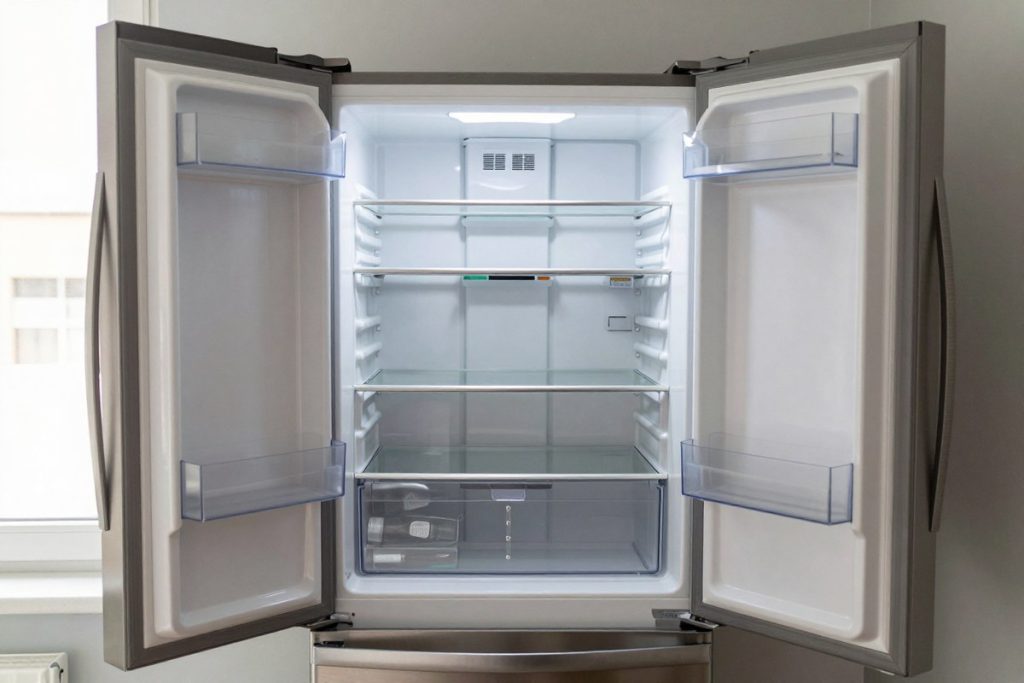
FGSS (Side-by-Side): Air Moves Across, Not Up
The FGSS layout puts the freezer and refrigerator compartments side by side. Cold air moves sideways from the freezer into the refrigerator through a damper.
That design changes how problems appear.
When FGSS units stop cooling properly, homeowners often report:
- The refrigerator side warming up first
- The freezer holding its temperature
- Sudden temperature swings after setting changes
- A change in the sound of air moving
In side-by-side designs, cold air reaches the refrigerator through a damper. If it doesn’t open or close correctly, cold air can’t move efficiently from the freezer to the refrigerator.
Unlike French door units, the air doesn’t have to travel up. But when the damper hesitates, the refrigerator side is usually the first to show it.
That’s why so many homeowners say, “The freezer is fine, but the fridge is warm.” The pattern is especially common in side-by-side models.
Practical Comparison for Homeowners
Here’s a short comparison to help you recognize the patterns:
| Cooling behavior | FGHB (French door) | FGSS (side-by-side) |
|---|---|---|
| First noticeable issue | Uneven fridge shelf temperatures | Refrigerator side warms first |
| How air moves | Up from the freezer below | Across from the freezer through a damper |
| Common early symptom | Warm spots on middle shelves | Fridge not cooling properly, freezer stable |
| Likely early suspects | Evaporator fan, blocked vents | Damper, airflow control |
| Sensor problem shows as | Uneven zones | An unstable fridge side |
This doesn’t replace a proper diagnosis, but it gives you a smarter starting point.
When you understand how your refrigerator is designed to move air, you can read the symptoms with more confidence instead of assuming the compressor is failing every time the fridge feels slightly warm.
Why This Matters
Georgia heat magnifies these model patterns.
In a French door unit, weak airflow plus summer humidity can make uneven cooling worse. In a side-by-side, longer compressor cycles on hot afternoons can expose small damper problems.
The climate doesn’t create the problem. It magnifies it.
That’s why temperature swings often show up seasonally in Atlanta homes, especially in older units that haven’t had their condenser area cleaned in a while.
A Quick Reality Check
If both compartments are warm at the same time, the problem has likely moved beyond the layout and into the sealed system: possibly the compressor or a refrigerant leak.
But if one section is stable while the other struggles, airflow or a control part is far more likely than a full system breakdown.
Knowing that difference prevents unnecessary panic.
And it lets you act earlier, when repairs are simpler and more affordable.
If your Frigidaire is showing early temperature swings or isn’t cooling properly, this is the moment to check airflow and the controls — not wait for a total shutdown.
A professional diagnosis isn’t about replacing parts blindly. It’s about confirming exactly which part of the cooling cycle is drifting and fixing it before it gets worse.
What You Can Safely Check Before Scheduling Frigidaire Repair
Before assuming the worst, there are several checks you can do safely. Many Frigidaire temperature problems start with blocked airflow or a simple setup issue. Taking ten minutes to check these basics can either solve the problem — or confirm that it needs professional attention.
Let’s start with the fundamentals.
1. Confirm the Temperature Settings
It sounds simple, but settings get changed more often than people realize — especially in homes with kids or after a power interruption.
Frigidaire’s suggested settings:
- Refrigerator: 37°F
- Freezer: 0°F
If your unit was recently adjusted, allow up to 24 hours for it to stabilize before judging its performance. Opening the doors often during that time slows recovery.
If the settings are right and the temperature still swings after a full day, it likely isn’t a simple setting problem.
2. Check for Blocked Air Vents Inside
Both FGHB and FGSS models rely on internal vents to spread cold air.
Take a moment and look:
- Are tall containers pressed against the back wall?
- Are vents covered by food packaging?
- Is the refrigerator packed so tightly there’s no room for air to move?
Cold air needs space to move. Blocked vents can easily make some shelves warm while others stay cold.
Rearranging items so air can flow can steady uneven cooling within hours.
3. Inspect the Door Seals Carefully
In Atlanta’s humidity, door gaskets wear faster than many homeowners expect.
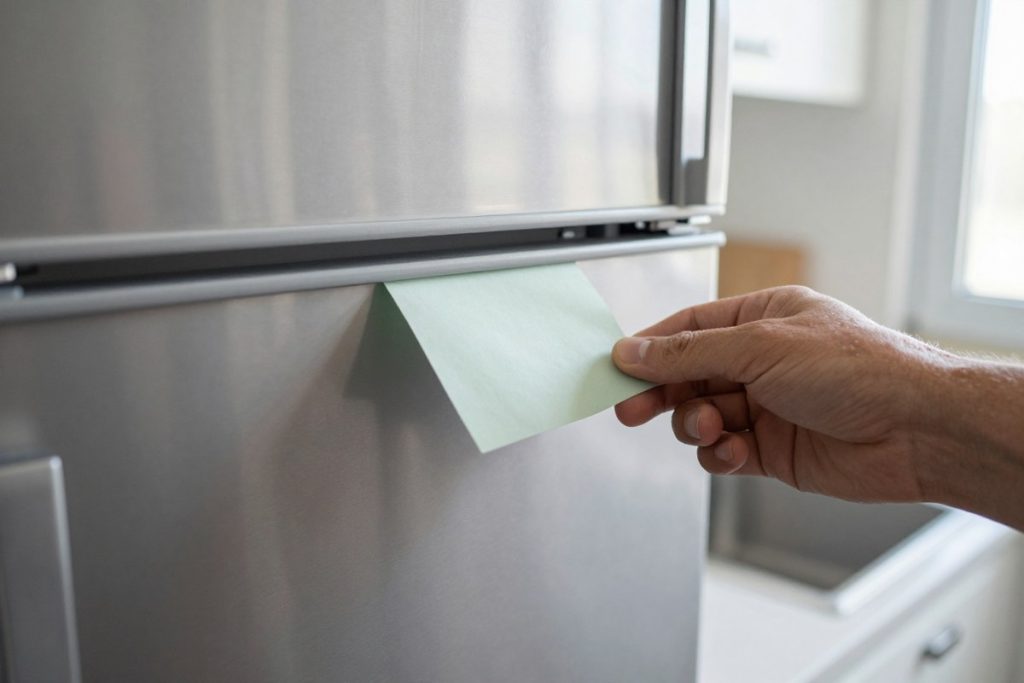
Try Frigidaire’s dollar bill test: close the door on a dollar bill and pull it out. You should feel a bit of resistance. If it slides out easily, that part of the seal isn’t holding. Then look along the gasket:
- Do you see cracks or gaps?
- Is condensation forming near the edges?
Frigidaire also recommends cleaning the gaskets with warm, soapy water, since dirt and residue can keep a seal from closing well.
A weak seal lets warm air in all the time. The refrigerator makes up for it with longer cycles, and the temperature starts to swing.
Replacing a door gasket is often straightforward — and catching it early prevents compressor strain.
4. Look at the Condenser Area
If the condenser area hasn’t been cleaned in a long time, this is one of the most useful steps you can take.
Unplug the refrigerator. Check the vent cover at the back for dust, and clean it the way your owner’s manual describes. Make sure there’s at least 1 inch of space between the refrigerator and the wall, as Frigidaire recommends.
In many Atlanta homes, a dusty condenser area is the quiet cause behind:
- A fridge that isn’t cooling properly
- Long running times
- A warm fridge on summer afternoons
Cleaning it may improve performance right away.
If performance doesn’t improve within a day, there may be a deeper mechanical problem.
5. Listen for the Evaporator Fan
Open the freezer and press the door switch. You should hear a steady sound of moving air.
If you hear:
- Grinding
- Weak airflow
- No airflow at all
the evaporator fan may be failing.
At this point, the repair usually means working inside the freezer.
When to Stop DIY Troubleshooting
There’s a point where more DIY adjustments stop helping.
If you notice:
- Both compartments warming
- Ongoing temperature swings even after cleaning and clearing the vents
- Clicking that repeats every few minutes while the fridge gets warmer
- Cooling that slowly fades and never settles (a possible refrigerant leak)
it’s time to stop experimenting.
A professional diagnosis prevents unnecessary part replacement and protects the sealed system.
Common Mistakes That Make Frigidaire Temperature Problems Worse
When a refrigerator isn’t cooling properly, it’s natural to start adjusting things. The problem isn’t effort — it’s direction. Some well-meant fixes quietly make the situation worse.
Here are the most common mistakes we see:
Quick Reference: What Not to Do
| Common mistake | Why it backfires | What to do instead |
|---|---|---|
| Lowering the temperature setting again and again | Forces longer compressor cycles without fixing airflow or a sensor | Keep 37°F (fridge) and 0°F (freezer) while diagnosing |
| Unplugging and resetting over and over | Interrupts stabilization and hides the real problem | Reset once; if it’s still unstable after 24 hours, look further |
| Chipping ice with sharp tools | Can puncture the coils and cause a refrigerant leak | Let it defrost, or call for help |
| Ignoring a dusty condenser area for years | Traps heat, overworks the compressor, speeds up wear | Clean it as your owner’s manual describes |
| Replacing parts without testing | Leads to a wrong diagnosis and wasted money | Confirm airflow, electrical readings, and system performance first |
Most Frigidaire temperature problems don’t start with compressor failure. They start with an imbalance:
- A blocked vent.
- A weak evaporator fan.
- A drifting temperature sensor.
- Restricted airflow from dirty condenser coils.
If you’ve already checked the settings, cleaned visible buildup, and confirmed airflow, but the temperature keeps swinging, that’s the moment to stop experimenting.
Still not cooling properly after the basic checks? The smartest move is a professional diagnosis, not another adjustment. We work on FGHB and FGSS refrigerators every day and test before replacing any part.
Why Cooling Problems Get Worse Faster in Hot Weather
Atlanta heat doesn’t cause refrigerator failure, but it exposes weakness.
When it’s hot, your refrigerator has to release heat into air that’s already warm. That means longer compressor cycles and higher pressure in the system.
If your unit already has:
- Dirty condenser coils
- Restricted airflow
- An early thermostat problem
- A drifting temperature sensor
summer speeds up the symptoms.
What Changes in High Heat
| Condition | What happens inside the refrigerator |
|---|---|
| Hot air around the unit | Condenser coils release heat more slowly |
| Longer run cycles | The compressor works harder |
| Restricted airflow | The temperature inside becomes unstable |
| Weak components | Temperature swings become noticeable |
That’s why many Atlanta homeowners report:
- A warm fridge in the late afternoon
- Poor cooling during heat waves
- A stable freezer but an inconsistent refrigerator
In mild weather, the system makes up the difference. In summer, that margin disappears.
What This Means for You
If your Frigidaire is showing temperature swings now, don’t assume they’ll settle down.
Fixing a small imbalance early protects the compressor and prevents sealed-system damage — and it’s best done before peak heat.
Repair or Replace? A Practical Guide
When your refrigerator isn’t cooling properly, the real question is whether repair makes sense for your unit.
Here’s a clear way to look at it.
| Situation | Repair is usually smart | Replacement may make sense |
|---|---|---|
| Age of the unit | Newer unit, first major repair | Older unit with repeated repairs |
| Problem type | Dirty condenser coils, evaporator fan, thermostat, temperature sensor | Confirmed compressor failure or a major refrigerant leak |
| Symptom pattern | Recent temperature swings, one compartment affected | Both compartments warm, repeated major repairs |
| Compressor condition | Running normally | Failed or heavily strained |
| Repair history | First or second repair | Several major part failures |
What Often Gets Misjudged
Many homeowners assume they need a new refrigerator when:
- The fridge has felt warm for several days
- The temperature swings become noticeable
- Cooling weakens during summer
In reality, airflow and control problems are far more common than compressor failure.
A professional diagnosis often reveals a manageable repair — not a full replacement.
Why Timing Matters
Waiting raises the risk:
- Restricted airflow leads to longer compressor cycles
- Longer cycles lead to overheating
- Overheating leads to possible compressor failure
In Georgia heat, that chain moves faster.
An accurate diagnosis protects your investment and often saves you from replacing a refrigerator that didn’t need it.
Final Thought
A refrigerator should hold its temperature without negotiation.
If your Frigidaire isn’t cooling properly or keeps swinging, it’s a mechanical signal that airflow, a control, or pressure inside the system has shifted.
The difference between a routine repair and a major failure is usually timing.
In Atlanta’s climate, small imbalances don’t stay small for long. Catching them early protects the compressor, prevents unnecessary replacement, and brings back the steady cooling your kitchen depends on.
When the free checks don’t fix it, our Frigidaire refrigerator repair team will find the exact cause. Our technicians are EPA 608 certified and background-checked, we use genuine OEM parts, and our repairs come with a warranty of up to six months on parts and labor. We’re an independent repair company, not affiliated with Frigidaire.
FAQ
Why is my Frigidaire not cooling properly?
Start with the free checks: the settings (37°F and 0°F), 24 hours to stabilize after any change, vents not blocked by food, and the door seal. If those are fine, the usual causes are dirty condenser coils, blocked airflow, an evaporator fan problem, or a faulty thermostat or temperature sensor. Compressor failure and refrigerant leaks are less common but more serious.
Why is the freezer cold but the fridge warm?
This usually points to airflow. Cold air is made in the freezer and moved into the refrigerator compartment. If the vents are blocked or the evaporator fan is weak — or, in side-by-side models, the damper isn’t opening — the fridge warms while the freezer stays cold.
What causes temperature swings in Frigidaire FGHB and FGSS models?
Most often an airflow imbalance, a weak door seal, or an inaccurate thermostat or temperature sensor. In Atlanta’s heat, small problems become more noticeable and last longer.
Is it normal for my Frigidaire to run most of the time?
It can be. Frigidaire notes that many of its French door models use variable-speed compressors designed to run almost continuously, except during defrost. Long running only becomes a concern when the refrigerator also isn’t reaching temperature.
Is clicking from my refrigerator a sign of a problem?
Not by itself. Frigidaire lists snapping or clicking from the electronic control and automatic defrost control as normal sounds. If clicking repeats every few minutes and the refrigerator is getting warmer, schedule a diagnostic check.
Should I repair or replace my Frigidaire refrigerator?
If the unit is under about 10 years old and the problem involves airflow, the thermostat, or a temperature sensor, repair is usually the smarter choice. Replacement is usually considered when compressor failure or a major refrigerant leak is confirmed in an older unit.
Frigidaire is a registered trademark of its owner. We are an independent appliance repair company and are not affiliated with or endorsed by Frigidaire.