
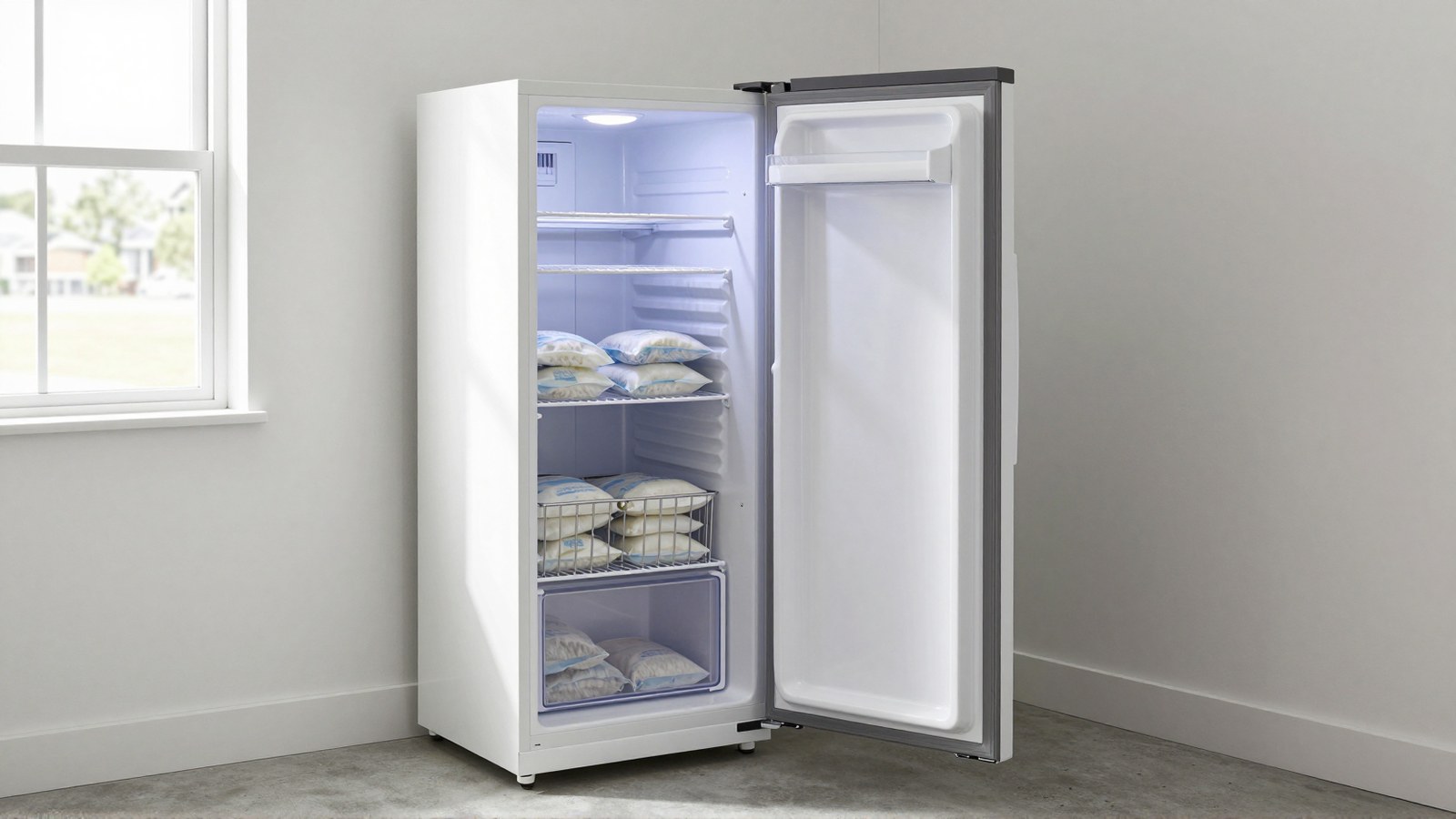
When the display on your GE freezer shows an error code like E2, it’s usually the freezer’s way of saying, “I don’t trust what I’m reading.” In most cases, codes like this point to the temperature sensing circuit — the small sensor that tells the control board how cold it is inside.
Here’s the first thing to know: E2 isn’t on GE’s published list of upright freezer codes. GE’s own support page lists three fault codes for its electronic upright freezers — E and 7, E and 8, and E and 9. Two of them are exactly the sensor faults people usually mean when they say “E2”: E and 8 means the thermistor is shorted, and E and 9 means the thermistor is open.
So before you buy a part, write down exactly what the display shows and find your model number. That alone can save you from replacing the wrong thing. This guide explains how the sensor works, what else can cause a code like this, what you can safely try, and when it’s time for a technician.
Seeing an error code and worried about your food? Our GE freezer repair technicians can test the sensor, the wiring, and the control, and get your freezer holding temperature again.
What a Sensor Error Code Actually Tells You
To understand a sensor code, it helps to know how your freezer senses temperature. A small part called a thermistor works like a precise electronic thermometer. Instead of sending a number, it changes its electrical resistance as the temperature changes. The control board reads that resistance to decide when to run the compressor and when to defrost.
When the board can’t get a believable reading, it shows a fault code. GE’s list names the two classic failures:
- An open circuit (GE code E and 9): The electrical path is broken. A wire may have come loose, a connector may have backed out, or the sensor may have failed inside. The board sends a signal and gets nothing back — like picking up a phone and hearing silence.
- A shorted circuit (GE code E and 8): The path is there, but it’s compromised. Damaged wire insulation, corrosion, or a failed sensor creates a connection that shouldn’t exist. The board gets a signal, but it makes no sense — like static on the line.
GE’s third code, E and 7, means a button has been stuck for more than 30 seconds — not a sensor problem at all.
Either way, the board can’t trust the reading, so it flags the fault instead of running the freezer blind.
Not Just a Bad Sensor: Problems That Can Trigger a Sensor Code
A failed thermistor is a common cause, but other problems can create the conditions that lead to a sensor fault. Here’s what technicians look at:
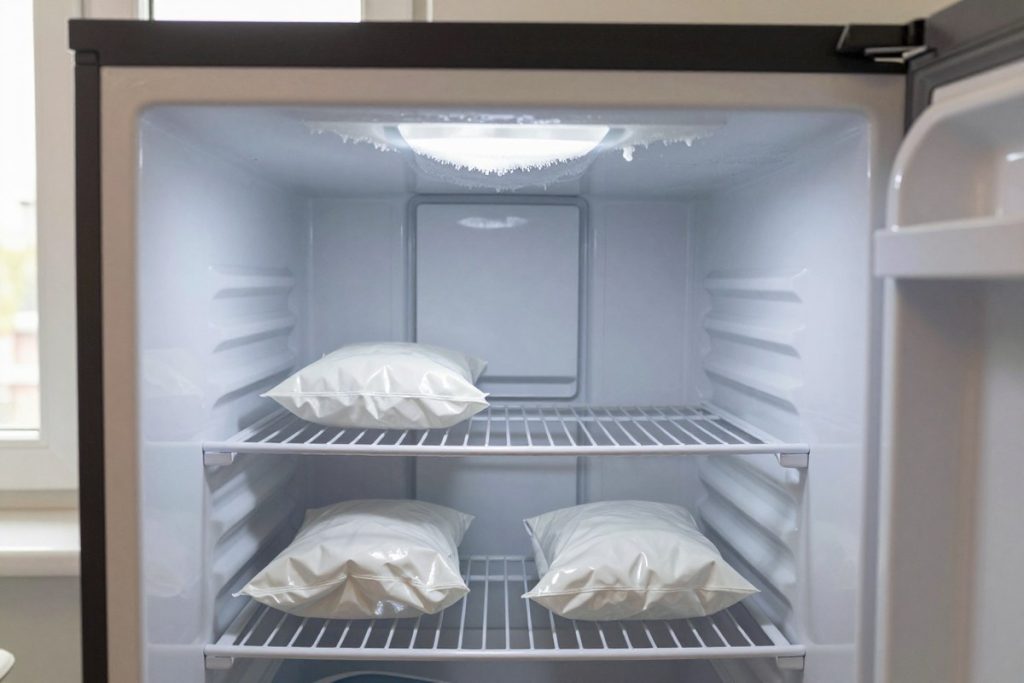
- A defrost system failure: If the defrost system stops working, ice doesn’t melt off the evaporator coils. That ice can grow around the sensor and let moisture into its wiring or connector, which can cause a short.
- A failed evaporator fan motor: When the fan stops, cold air stops moving. Frost builds up around the sensor and its wires and can damage them over time.
- A loose connector after a door was removed: On some GE Garage Ready upright freezers, the owner’s manual explains that removing the door means disconnecting a wiring connector and the ambient (room temperature) sensor in the top hinge cover. If that connector isn’t seated firmly when the door goes back on, the board can lose the sensor signal.
- A damper problem in refrigerator-freezers: In side-by-side models with a damper, a damper stuck in the wrong position can create unusual frost and humidity around the sensor.
- An ice maker leak: On models with an ice maker, a slow leak from the water line or fill valve can send water toward electrical parts and corrode the sensor wiring.
Dirty or blocked condenser coils won’t cause a sensor code by themselves, but they make the freezer run long and warm, which can confuse the picture during diagnosis. GE notes that most upright and chest freezers need about 3 inches of air clearance on the top and all sides — check your manual for your model.
Seeing a code and worried about your food? We can usually get a technician to you quickly, with same- or next-day appointments available most days.
GE Models Where Sensor Codes Show Up
Sensor faults aren’t tied to one generation. They show up in GE freezers of many types and ages. Here’s where we see them most:
Monogram built-in side-by-side refrigerators (freezer side)
- Monogram built-in side-by-side models. These are tight installations with limited airflow, and wiring stress and moisture can lead to sensor failures.
Standalone upright freezers
- FUF14DLRWW, FUF14SMRWW, FUF17SMRWW, FUF21SMRWW — GE Garage Ready upright freezers. Daily use and garage humidity wear out sensors and wiring faster, which is why sensor faults are among the most common problems here.
Whatever your model, the code and the model number together are what a technician needs to order the right part.
What You Can Check Yourself (and When to Stop)
Safety first: Unplug the freezer or switch off its breaker before you check anything near the back or bottom. Don’t open panels inside the freezer, and don’t use sharp tools on ice.
You can try a few safe steps before calling for service:
- Reset the control the way GE describes. Disconnect power to the freezer for 30 seconds, then restore power. If the code clears and doesn’t come back, keep an eye on the temperature over the next day.
- Check for heavy frost. Open the freezer. Is there thick ice on the back wall or the evaporator cover? If so, a manual defrost can help: unplug the freezer, move the food into a cooler, put towels down, and leave the door open until the ice melts. Heavy ice can take several hours. Don’t speed it up with a knife, a hair dryer, or an open flame. Dry everything well before you restart.
- Check the hinge connector on Garage Ready models. If the door was recently removed — for a move, for example — make sure the connector in the top hinge cover is fully seated, following your owner’s manual.
- Give the freezer room to breathe. Make sure there’s clearance on the top and sides, and clear away dust and pet hair from the vents.
If the code clears and the temperature holds, great — keep watching it. If the code comes back or the freezer still isn’t cold, it’s a hardware problem — the thermistor, the wiring, or the control board. GE’s own guidance at that point is clear: if the fault code doesn’t reset or appears again, service is required, and GE recommends unplugging the upright freezer until it’s serviced.

Why You Shouldn’t Ignore a Sensor Code
Letting a sensor code blink for days or weeks is risky. Here’s what can happen:
- Food thaws in spots, and you lose meat, seafood, or ice cream
- Ice builds up until the evaporator fan stops, and cooling is lost completely
- The compressor runs nonstop trying to make up for it and wears out early
- Moisture and mold build up behind the panels
GE’s manual for its upright freezers notes that a closed freezer will keep food frozen for about 24 hours, as long as warm air isn’t let in. That’s your window. Too many people lose a freezer full of holiday prep because they waited “to see if it goes away.”
When It’s Time to Call the Pros
If a reset and a defrost don’t clear the code, or the temperature stays uneven, it’s time for professional tools and parts. Here’s what we handle every week:
- The thermistor is open or shorted — we measure its resistance against the temperature chart for your model and replace it if it’s out of range.
- The wiring harness is corroded or broken — we trace it and repair it.
- The evaporator fan or the defrost heater has failed — we open the evaporator cover, test the parts, and replace what’s failed.
- The control board is misreading — we confirm it with testing before replacing it.
We bring common sensors and wiring parts for the models above, so many sensor-code repairs are finished in one visit. Our technicians are EPA 608 certified and background-checked, and we use genuine OEM parts.
Code still showing? Book a visit and we’ll get your freezer back to a solid freeze.
Conclusion
A sensor code is your GE freezer’s way of saying, “Check the temperature sensor before this gets worse.” In most cases, the cause is the thermistor or something around it — and the fix is straightforward when it’s caught early.
Start by writing down exactly what the display shows and your model number. On GE upright freezers, E and 8 and E and 9 are the sensor codes; E2 isn’t on GE’s list, so the exact code matters. A 30-second reset or a manual defrost sometimes helps, but a code that keeps coming back means hardware.
Don’t risk your frozen food and your energy bill. With 15+ years of fixing freezers in Atlanta, our GE freezer repair team can find the cause and fix it, and our repairs come with a warranty of up to six months on parts and labor. If your display shows E1 instead, see our guide to GE freezer error code E1.
FAQ
1. Is E2 a GE freezer code?
Not on GE’s published list for electronic upright freezers. That list has E and 7 (a button stuck for more than 30 seconds), E and 8 (thermistor shorted), and E and 9 (thermistor open). Write down exactly what your display shows and your model number — that’s what tells a technician which part to check.
2. How long can I run my GE freezer with a sensor code showing?
GE recommends unplugging the upright freezer until it’s serviced if the fault code comes back after a reset. GE’s manual says a closed freezer keeps food frozen for about 24 hours if warm air isn’t let in, so move food to another freezer or a cooler if the repair will take longer.
3. How do I reset my GE freezer?
GE’s steps are simple: disconnect power to the freezer for 30 seconds, then restore power. If the code doesn’t clear, or it comes back, the freezer needs service.
4. Does a sensor code always mean I need a new thermistor?
Not always. The sensor is the most common cause, but wiring, a loose connector, a defrost problem, or the control board can trigger a code too. A technician measures the thermistor’s resistance first to confirm before replacing anything.
5. Can I replace the thermistor myself on a built-in Monogram model?
We don’t recommend it. You’d need to remove the evaporator cover inside the freezer, and it’s easy to damage the wiring or the coils. Built-in Monogram models are best left to a technician.
6. Will cleaning the condenser area prevent a sensor code?
It helps the freezer run better overall and makes diagnosis clearer, but it won’t fix a failed thermistor. Keep the clearance your manual lists — GE notes most upright and chest freezers need about 3 inches on the top and sides.
GE and Monogram are trademarks of their respective owners. We are an independent appliance repair company and are not affiliated with or endorsed by GE Appliances.