
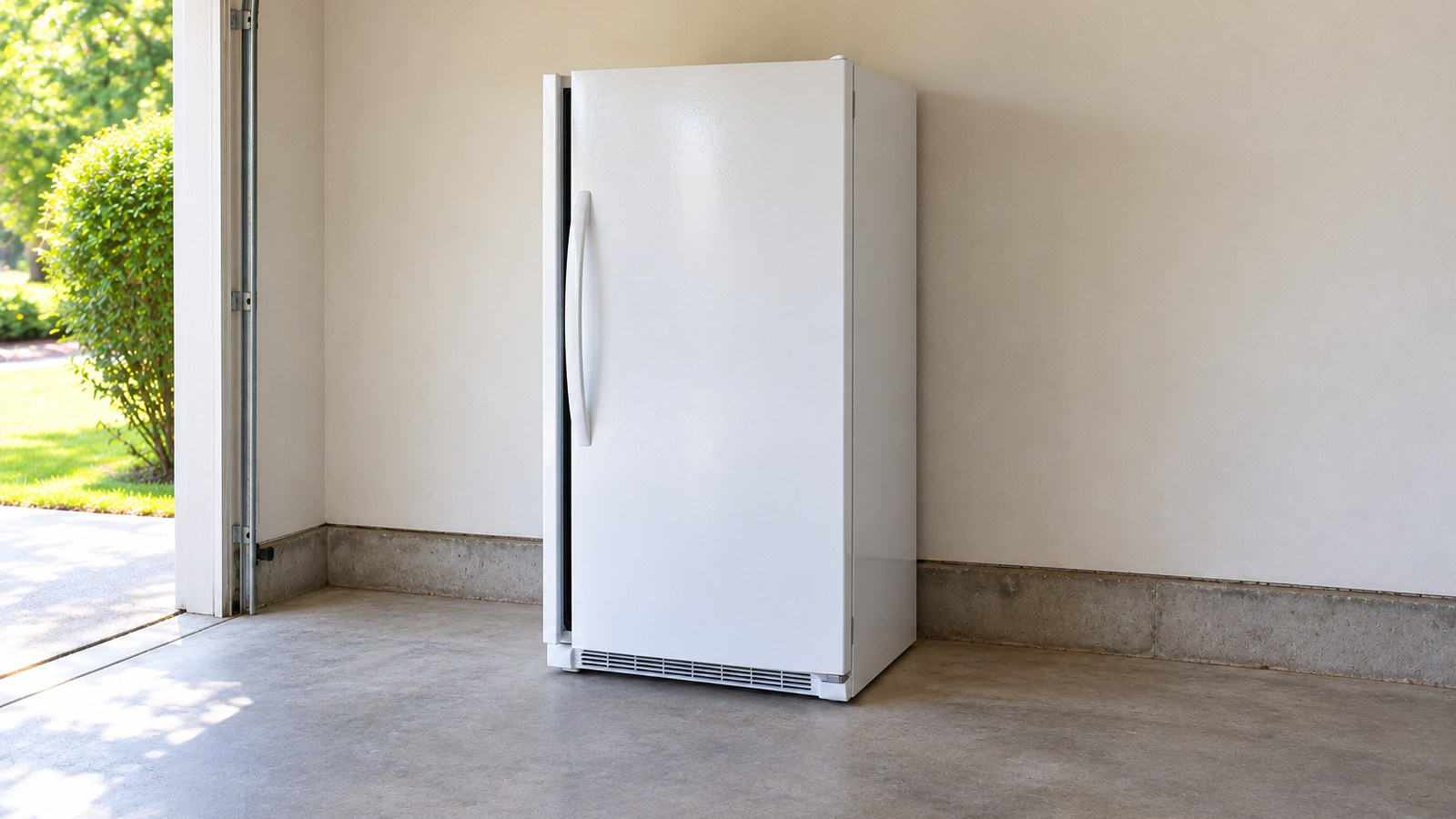
You push the freezer door shut, turn around — and it’s drifted open again, cold air spilling into the kitchen or the garage. Frustrating, and a little alarming with a freezer full of food. The reassuring part: a door that won’t close is almost always a mechanical problem, and the first fixes cost nothing.
Quick Door Drop Test — do this first: Close the freezer door and look at the gap between the door edge and the cabinet, at the top and at the bottom. If the bottom gap is noticeably wider than the top, the door is sagging — that’s your starting point. Gaps even, but the door still won’t stay shut? Think leveling first, then the closing hardware at the bottom hinge. Keep reading.
One important distinction: this guide is about the door that won’t physically close — it won’t shut all the way, or it swings back open on its own. A door that closes but doesn’t seal airtight is a related problem, and we cover it in a short section below. From the outside the two look alike, and Kenmore’s own guides send both to the same place: a door that “may not be seating properly.”
A door that won’t close is the more urgent one. Every hour it stays open, warm, moist air floods in, the freezer runs longer, frost builds, and food picks up ice crystals — Kenmore’s guides list every one of those. Rather hand it off now? Our freezer repair team comes out same- or next-day on most days across metro Atlanta.
Before you check anything: Unplug the freezer before you touch hinges, screws or the base panel, and before any defrost. Never chip ice with a knife or any sharp or metal tool — Kenmore warns it can damage the refrigerant tubing. Taking the door off is a two-person job: on many Kenmore uprights, the guide has you lay the freezer on its back and unplug a wire connector first. And don’t let kids hang on an open door.
Door Closes but Won’t Seal?
Try the dollar-bill test: close the door on a bill and pull it out slowly. It should drag all the way around the door. Slides out easily? That spot isn’t sealing. Kenmore’s guides name a gasket — the soft rubber seal around the door — that is “dirty, worn, cracked, or poorly fitted,” and the fix is to clean or change it; worn, cracked or poorly fitting gaskets should be replaced. On Kenmore refrigerators, a sticking gasket gets cleaned along with the surface it touches, then a thin coat of appliance polish or kitchen wax. Moisture forming on the outside of the freezer is another sign the door isn’t seating. A humid Georgia summer makes any gap obvious fast.
6 Causes Why Your Kenmore Freezer Door Won’t Close
Kenmore’s troubleshooting row for “Door will not close” names two causes: a freezer that isn’t level and a floor that’s uneven or weak. So that’s where we start. The rest is hardware that wears with years of use.
Freezer Not Level or Tilting Forward
A freezer that leans even slightly forward works against the door — gravity pulls it open instead of helping it swing shut. Kenmore describes an unlevel freezer as one that “rocks on the floor when it is moved slightly,” and warns that this “can force the cabinet out of square and misalign the door.” Out of square means the cabinet is twisted just enough that the door no longer meets the frame. Garage floors and basement slabs are frequent offenders, and a unit can settle over time. Kenmore also says the floor must be strong enough to support a fully loaded freezer.
Overloaded Door Shelves and Packages in the Way
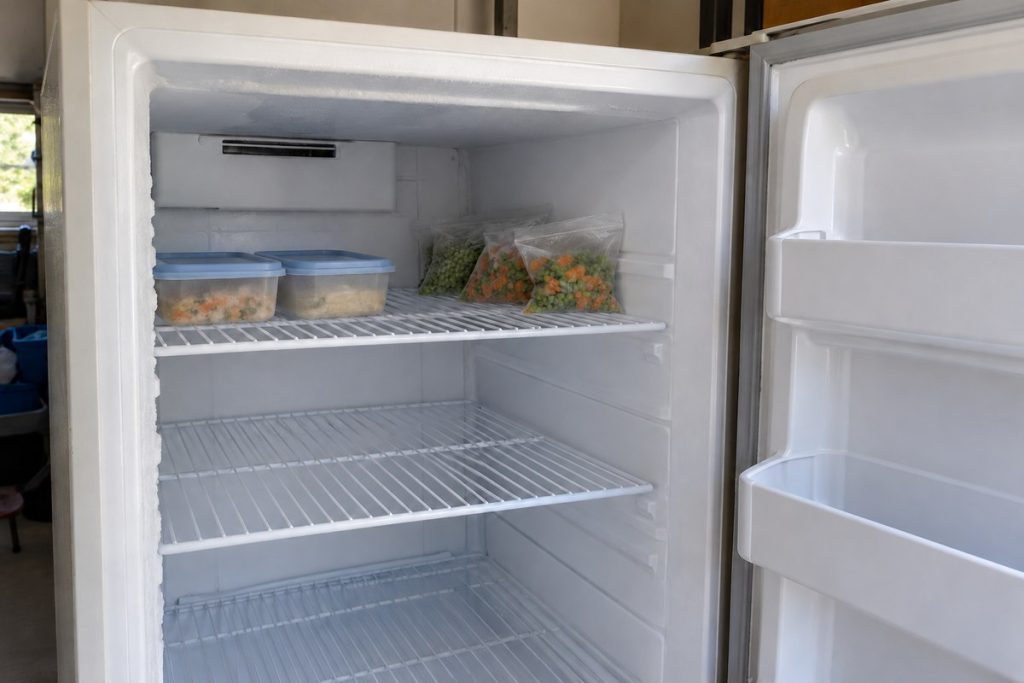
This one isn’t a parts failure — it’s weight and space. Heavy items on the door shelves put constant downward stress on the hinges and speed up wear. And Kenmore prints its caution in capitals: “DO NOT let food packages extend past the front of shelves.” One bag of frozen vegetables an inch too far forward, and the door bounces back. Heavy bulk storage belongs on the interior shelves.
Bent or Loose Door Hinges
Hinges take a beating: overloaded door shelves, kids hanging on the handle, years of daily use. Kenmore’s door-removal steps end with a telling line — “securely tighten all screws to prevent hinge slippage.” Screws that work loose let the door slip. The pattern differs by hinge position:
- Top hinge — tends to pull away from the cabinet, leaving a gap at the top corner
- Bottom hinge — more likely to bend downward, so the door sags toward the handle side
- Middle hinge (on Kenmore French door refrigerators) — can develop play, so the door wobbles instead of sitting flush
A bent hinge rarely snaps clean. It deforms gradually, so the problem creeps up on you: one day the door closes fine, a few months later you’re pushing it shut every time.
Worn Hinge Bushings
The hinge bushing is a small plastic sleeve at the pivot point of the hinge pin. Its job is to reduce friction and keep the door riding smoothly. When it wears out or cracks, the door drops slightly, and door alignment shifts just enough that the door no longer sits flush against the cabinet.
Broken Closing Cam
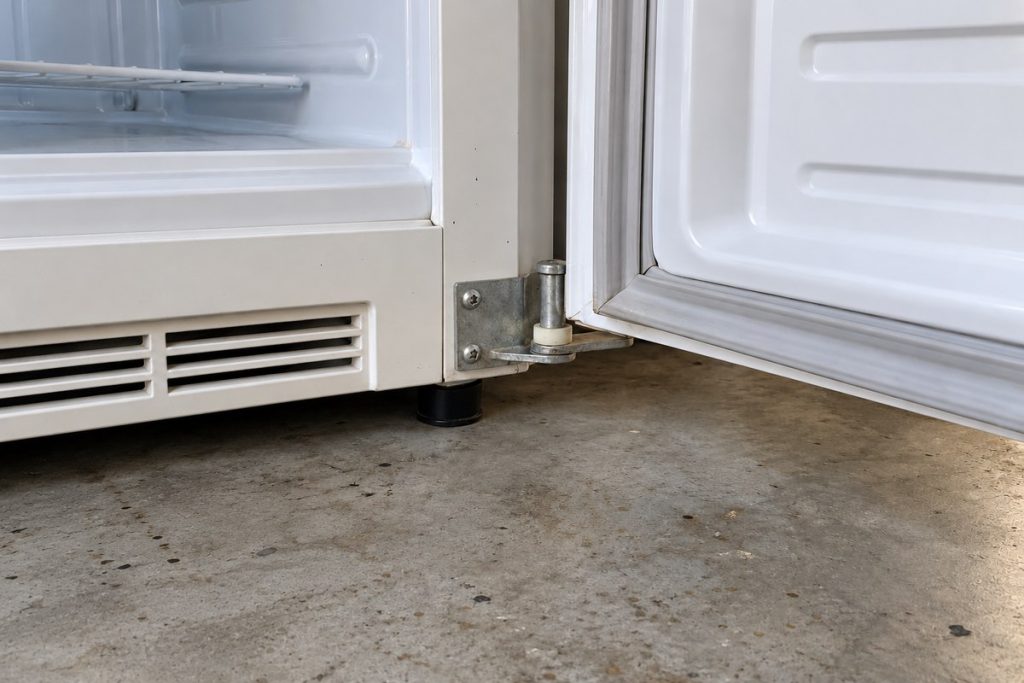
On many uprights, a small angled plastic piece at the bottom hinge — the closing cam — gives the door a slight inward push as it swings toward closed. When the cam breaks, that final push disappears. The door stops just short of closing, or drifts back open when you let go.
It’s easy to misdiagnose. Owners replace the gasket, adjust the hinges, and still can’t figure out why the door won’t stay shut — because nobody checked the cam.
Damaged or Missing Door Stop
The door stop is a small bracket that limits how far the door swings open. When it cracks or breaks off, the door can over-extend. On the return swing, it comes back at a slightly different angle and no longer lines up with the cabinet frame. Subtle — but enough to prevent a clean close.
How to Fix a Kenmore Freezer Door That Won’t Close
Work through these in order of difficulty, free fixes first. For any part, you’ll need the full model number from the model label — and Kenmore’s website lets you look up the Use & Care Guide by that number.
Fix 1 — Level the Freezer
Difficulty: Easy. It costs nothing, so do it first.
Steps:
- Make sure all bottom corners rest firmly on a solid floor — Kenmore’s first requirement.
- Place a carpenter’s level on top of the freezer, front to back.
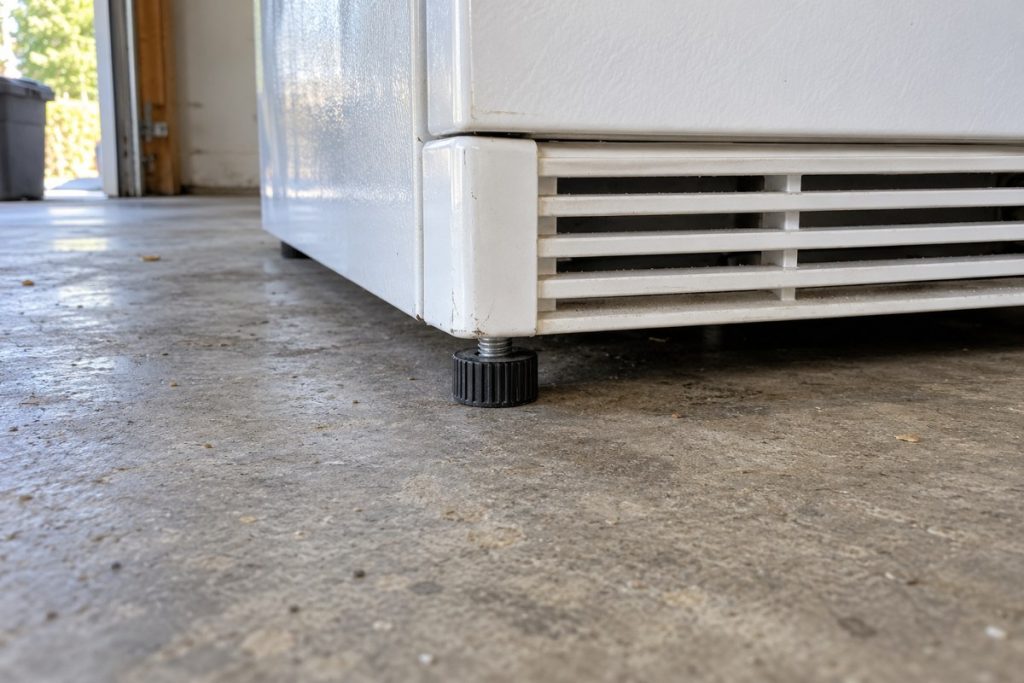
- Adjust the plastic leveling feet in front so the front sits half a bubble higher.
- Check side to side as well.
- Do the halfway-open test: open the door halfway and let go. Kenmore’s goal is a door that “closes easily when left halfway open.”
Floor uneven or weak? Kenmore says to level it with wood or metal shims under the freezer, or brace the floor that supports it. A chest freezer lid that won’t close follows the same rule — shims between the foot pads and the floor.
Fix 2 — Replace the Closing Cam
Difficulty: Easy to moderate.
If leveling didn’t solve it, check the cam before touching the hinges.
Steps:
- Unplug the freezer. Open the door fully and look at the bottom hinge assembly for the small angled plastic piece the door rides over as it closes.
- Inspect it for cracks or flat spots. A worn cam looks flattened where it should have a raised profile.
- Remove the old cam — snap-in or a single screw, depending on the model — and fit the new one ordered by your full model number.
- Close the door slowly. With a good cam, you should feel it pull itself shut in the last few inches.
Not sure your model even has a cam? The parts diagram for your model number shows it — or let a technician take a look.
Fix 3 — Replace the Door Stop
Difficulty: Easy.
If the stop is cracked or missing: unplug the freezer, remove its mounting screw, install the new stop from your model’s parts list, then open the door through its full range and confirm it stops without over-extending.
Fix 4 — Tighten the Hinges, Then Consider Shims
Difficulty: Easy to moderate.
Kenmore stresses tight hinge screws “to prevent hinge slippage,” so start there.
Steps:
- Unplug the freezer and empty the door shelves.
- Check and tighten the top and bottom hinge screws. On many uprights, the top hinge hides under a plastic cover.
- Close the door and repeat the Door Drop Test.
Still a slight sag with a straight hinge? A thin metal washer under the bottom hinge plate can lift the door a little. Kenmore’s guides don’t describe shimming, and those screws carry the door’s weight — if you’re unsure, leave it to a technician. A bent hinge won’t be fixed by shims.
Fix 5 — Replace the Hinge Bushings
Difficulty: Moderate to hard — the door comes off.
If the door drags when opening and sags at the handle end, a worn bushing is the likely cause. The bushing sits at the hinge pin, so replacing it means removing the door — and on many Kenmore uprights, that’s more than lifting it off a pin. Kenmore’s door-removal steps:
- Gently lay the freezer on its back, on a rug or blanket.
- Remove the two base screws and the base panel, and free the wire from the clips under the cabinet.
- Unplug the door connector — hold the cabinet connector in place and pull the door connector out.
- Remove the bottom hinge screws, the plastic top hinge cover, and the top hinge.
- Lift off the door together with the bottom hinge.
To put it back, reverse the order and securely tighten all screws. Before any of this: freezer emptied, power cord unplugged, and a helper on hand. This is the point where many owners call us.
Fix 6 — Replace the Door Hinges
Difficulty: Moderate to hard.
When a hinge is visibly bent or cracked, shimming won’t help — it needs to come out. It’s the same door removal as Fix 5: freezer empty and unplugged, a helper, the door set down on a blanket. Order the hinge by full model number; upright hinges aren’t universal. After reinstalling, close the door and check the gap around the perimeter. Uneven? Loosen the top hinge slightly, shift the door, and retighten securely.
Kenmore Freezer Repair in Atlanta & Across GA
Worked through these and the door still won’t cooperate — or you’d rather not lay a freezer on its back? PRO Appliance Repair handles Kenmore freezer door repairs across metro Atlanta, same- or next-day on most days, with genuine OEM parts and our workmanship warranty of up to six months.
Kenmore Freezer Door Problems by Model Type
Not every Kenmore freezer fails the same way. The model number tells you which guide applies.
Kenmore Elite Upright Freezers
Elite freezers such as the 253.27702 series share the same “Door will not close” troubleshooting as standard uprights: leveling and the floor first. What Elite adds is a Door Ajar indicator on the display with an audible alarm, and Kenmore’s answer is simply “Close door.” Alarm still going with the door shut? Then it isn’t seating — go back to leveling, packages and the gasket. The Elite guide also says worn, cracked or poorly fitting gaskets should be replaced.
Kenmore Standard Upright Freezers
Standard 253-series uprights — models like the 253.24452, 253.28262 and 253.22042 — are what most owners have. Two hinges, a plastic top hinge cover, front leveling feet, and door wiring that runs through a connector at the base, which is why door removal starts with the freezer on its back. Some, like the 253.28262, flash a “d” alternating with the temperature and beep every 5 seconds when the door is ajar.
The most frequent pattern on these models: the hinge screws work loose, and the door sags so slowly nobody notices until it’s visibly crooked. A quick seasonal check of hinge screw tightness can keep that from becoming a hinge replacement.
Kenmore Refrigerator Freezer Compartments
On Kenmore refrigerators with a bottom freezer — like the Elite 795.71033 French door — the refrigerator doors ride on a middle hinge pin, and play there can throw off door alignment. Kenmore’s guide for that model lists why doors won’t close completely: the refrigerator isn’t level (tilt it slightly more to the rear), food packages are blocking a door, bins, baskets or shelves are out of position, gaskets are sticking, or the doors weren’t put back properly after installation. Each refrigerator door has an adjustable alignment nut on the bottom hinge, turned with an 11/16″ wrench. And keep hands and feet clear of the bottom of the freezer drawer — Kenmore flags a pinch hazard there.
When to Call a Professional
DIY is the right move for leveling, moving packages, tightening screws, and a cam or stop swap. But there are situations where it’s not:
- The door frame or cabinet is physically bent or cracked — no hinge replacement will fix a warped frame.
- You’ve leveled the freezer and replaced the hinge, and the door still won’t align — Kenmore’s “out of square” warning applies, and the cabinet needs a professional look.
- Multiple components are failing at once — hinge, bushing and cam failing together suggest the door has been under unusual stress, from impact, overloading, or an earlier repair done incorrectly.
- The repair needs the door off and the freezer on its back, and you don’t have a helper.
- The freezer is under warranty. Kenmore’s warranty page lists a two-year limited warranty on freezers from the date of sale, with proof of sale; terms differ by model and date, so check your own document before picking up a screwdriver.
- Thick frost keeps coming back even though the door now closes — that’s beyond the door.
Conclusion
A Kenmore freezer door that won’t close is almost always a mechanical problem with a mechanical fix. Start where Kenmore starts: level the freezer, half a bubble higher in front, and keep packages behind the shelf edge. Then the hardware: hinge screws, closing cam, door stop, bushings, hinges.
Do the Door Drop Test before assuming a hinge needs replacing — tightening often handles minor sag without a full swap. And respect the door removal: on many uprights, it means laying the freezer on its back and unplugging a connector. Have a helper. A dropped door turns a small repair into a much bigger one.
We’re family-owned and insured; our EPA 608 certified, background-checked technicians use genuine OEM parts, and our workmanship is covered for up to six months. Door still fighting you? Book freezer repair with PRO Appliance Repair.
Related guides
FAQ
My Kenmore freezer door closes fine when I push it firmly, but swings back open if I just let it go. What’s the issue?
Start with leveling. Kenmore’s goal is a door that closes easily when left halfway open, with the front feet set half a bubble higher. Level and it still drifts open? Check for packages past the shelf fronts, then the closing cam at the bottom hinge, if your model has one.
I adjusted the leveling legs on my Kenmore upright freezer, but the door still won’t stay closed. What am I missing?
Check the floor next: if the freezer still rocks, Kenmore says to shim under it or brace the floor. Then look for packages past the shelf edge and tighten the hinge screws — Kenmore says all of them should be secure “to prevent hinge slippage.” After that, the cam.
The door on my Kenmore Elite freezer is harder to close than it used to be. It doesn’t sag, but it takes real effort to push it shut. What causes that?
Usually something pushing back: a sticking or swollen gasket, a bin or package in the way, or frost along the top. Clean the gasket and the surface it touches. On manual-defrost models, Kenmore says to defrost at 1/4 to 1/2 inch of frost — unplugged, plastic scraper only. If the hinge itself feels stiff or binds, call a technician.
My Kenmore freezer door was closing fine until I moved the unit to a new location. Now it won’t stay shut. What happened?
Moving almost always changes the level. Kenmore wants all bottom corners on a solid floor, the front half a bubble higher, and a door that closes from halfway open. New spot in a garage or on an old floor? Check for rocking and shim it.
How do I know if my Kenmore freezer door hinge needs replacing versus just tightening?
Tighten first, with the freezer unplugged and the door shelves empty. If the door sits flush and closes properly afterward, you’re done. If it still sags or gaps — or the hinge plate is visibly bent — it needs replacing. A bent hinge won’t straighten back from tightening.
Can I replace just one hinge on my Kenmore freezer, or do I need to replace both at the same time?
One is fine; there’s no requirement to replace both. But since the door comes off anyway — on many uprights, with the freezer on its back — inspect the other hinge, the bushing and the cam while it’s apart. Replacing a worn second part then saves a second disassembly.
PRO Appliance Repair is an independent repair company and is not affiliated with, sponsored by, or endorsed by Transform SR Brands LLC or the Kenmore brand. Brand and model names are used only to identify the appliances this page is about and remain the trademarks of their respective owners.