
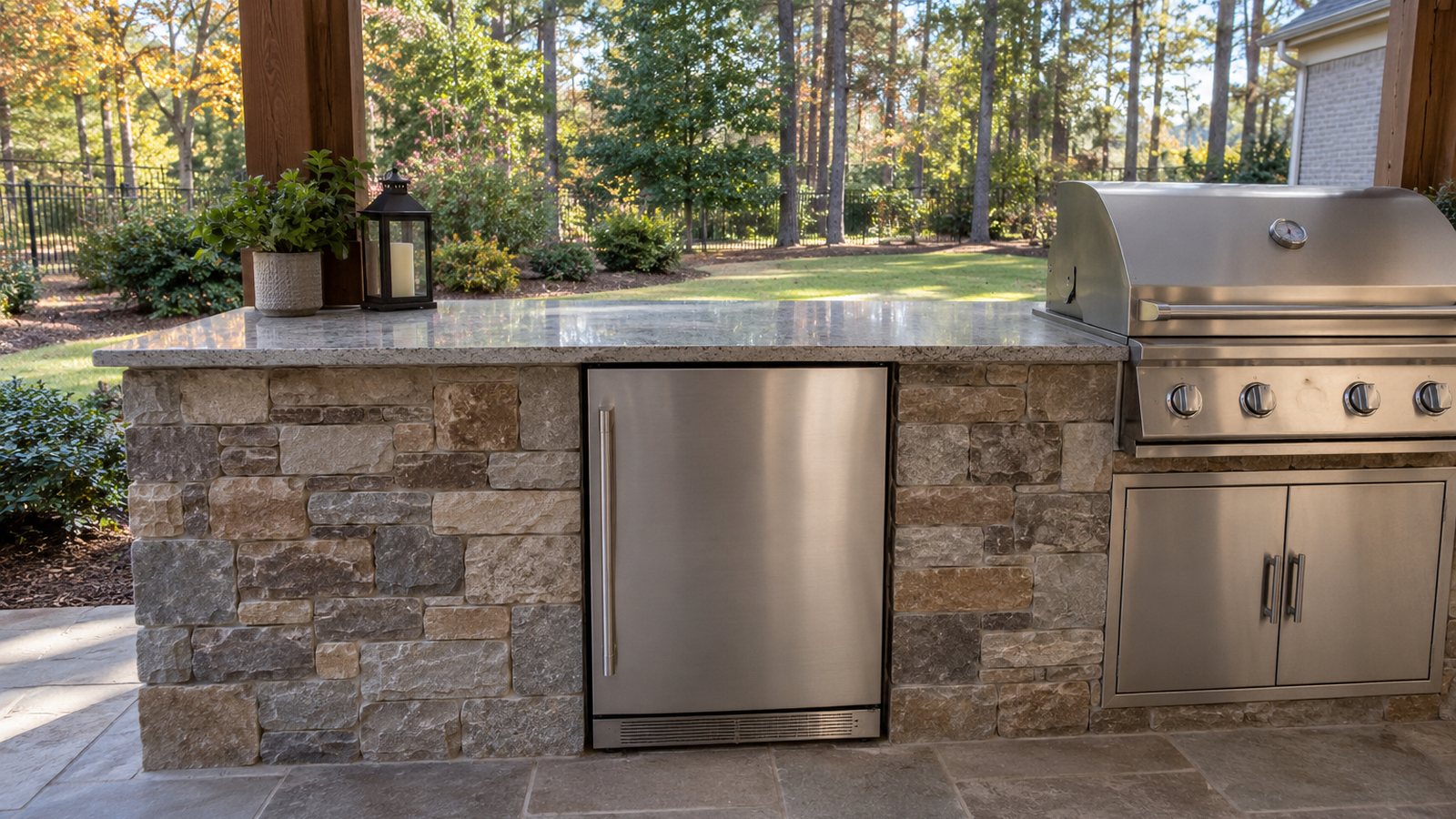
You grab a cold drink from the outdoor kitchen on a July afternoon — and it isn’t cold. Or you notice orange specks on the stainless handle that weren’t there last spring. An outdoor Sub-Zero is built for patios, pool bars, and grill stations, but it lives a much harder life than the refrigerator in your kitchen.
The reassuring part: most outdoor problems have a clear cause, several have a free fix, and a few are simply the weather — which no part can repair.
Sub-Zero’s outdoor-rated undercounter refrigerators — like the Designer Series DEU2450RO 24-inch model, and the older UC-24RO before it — are engineered for spaces where indoor room isn’t an option. The DEU2450RO packs 5.4 cubic feet of storage with one stationary and two adjustable glass shelves plus a clear storage drawer, run by an electronic control you set in one-degree steps. It’s built to coordinate with Wolf outdoor grills: the outdoor model takes Sub-Zero’s outdoor-rated stainless door panel and handle.
What sets them apart from their indoor Sub-Zero siblings?
- A wider temperature range. Sub-Zero approves its outdoor models for 50°F to 110°F (10°C to 43°C); indoor Sub-Zeros are designed for a 60°F to 90°F (15°C to 32°C) room.
- Outdoor-rated stainless. The outdoor model requires Sub-Zero’s outdoor stainless panel, not a custom wood panel.
- A GFCI-protected outlet. Sub-Zero requires a ground fault circuit interrupter for the outdoor model, on a dedicated 15-amp circuit, to reduce the risk of electrical shock.
But even a Sub-Zero can’t fully bulletproof against Mother Nature. Outdoor Sub-Zero problems reach us steadily across Atlanta — often from installs that skimped on shade, cover, or airflow. If yours is acting up now, our Sub-Zero refrigerator repair team works on outdoor units from Buckhead patios to Sandy Springs pool decks.
Hot, Humid Weather: The Silent Killer for Outdoor Sub-Zero Units
Atlanta’s climate is a perfect storm for these machines. Summer humidity feeds mildew around seals, long heat waves keep compressors running, and spring pollen coats everything that breathes air. A unit under a shaded, covered counter has a far easier life than one baking in afternoon sun on an open deck.
Humidity, Rain, and Rust
Stainless steel resists corrosion — it doesn’t ignore it. When water, pool chemicals, and grime sit on the surface day after day, rust spots and brownish staining start to show, usually first on handles, panel edges, and the kickplate. Sub-Zero’s guide for this Designer undercounter line, which includes the outdoor model, carries a plain warning: don’t expose the appliance to rain. That’s why a covered spot matters, and why standing water underneath is bad news.
One detail most owners don’t know: Sub-Zero covers stainless steel cosmetic defects for only 60 days. After that, keeping the finish clean is on you.
Heat and Cold Extremes
Sub-Zero rates the DEU2450RO, the UC-24RO, and the UC-15IO outdoor ice maker for 50°F to 110°F. On Atlanta’s hottest days, with direct sun on the cabinet, that upper limit isn’t far away — and Sub-Zero notes that higher room temperatures make the compressor run longer.
Sub-Zero is blunt about what happens outside the range: performance may suffer, and no repair can correct the problem until the temperature is back within range. Translation: on a record-heat afternoon, shade and airflow help more than a new part.
Cold matters too. Below 50°F the unit is outside its approved range — a mild cool spell is no cause for alarm, and once temperatures drop to freezing, Sub-Zero says to winterize, or the water line or water valve can be damaged on models connected to water. Atlanta gets freezing nights most winters, so plan for it before the first hard frost.
These issues stack up: pollen-dusted condenser coils in spring make the unit work harder, and that small strain can turn into an outdoor Sub-Zero not cooling by midsummer.

Faults That Hit Outdoor Sub-Zeros Hardest (and How We Tackle Them)
Outdoor exposure turns everyday glitches into showstoppers. Here’s what we fix most, straight from the field.
Safety first: Turn the unit off at its control panel and switch off the breaker before you remove the kickplate or clean the condenser, and wear gloves — the fins are sharp. Never chip ice with tools, never bypass the GFCI outlet, and leave the water line and valve alone. These units use a flammable refrigerant, so anything involving the sealed system (the compressor, the refrigerant, and the tubing between them), wiring, or compressor is a job for a qualified appliance technician.
Worn Door Seals
- Cause: Sun, heat, humidity, and constant opening wear the door gasket faster outdoors, especially in unshaded spots.
- Signs: Frost, condensation, or ice inside the unit, warm spots, or a door that doesn’t close firmly.
- DIY or Pro? Sub-Zero’s checklist for frost inside: make sure the condenser is clean, the door closes properly and wasn’t left ajar, and the gasket has no rips or tears. If the gasket is torn, Sub-Zero’s direction is service, not glue. Between checks, our technicians suggest wiping the gasket with mild soap and water.
- Repair vs. Replace: On a unit built this well, a new gasket is almost always worth it — cheap insurance against frost and warm drinks.
Surface Rust and Weathering
- Cause: Pool splash, standing water, and everyday grime left on the stainless.
- Signs: Orange specks or streaks on the handle, panel edges, or kickplate.
- DIY or Pro? Clean it the way Sub-Zero recommends: a nonabrasive stainless steel cleaner on a soft, lint-free cloth, then a damp microfiber cloth and a dry chamois — always with the grain. No scouring powders, steel wool, or abrasive pads; scratches give rust a place to start. If a panel or kickplate is deeply pitted, the fix is a replacement outdoor stainless panel or kickplate — not paint.
- Repair vs. Replace: Surface rust is cosmetic. It doesn’t mean the refrigerator is failing, so don’t let it talk you into a new unit.
When It Stops Cooling
- Cause: A clogged condenser, a blocked kickplate, temperatures outside the 50–110°F range, or a door that isn’t sealing.
- Signs: Drinks warmer than the 38°F (3°C) Sub-Zero recommends, a compressor that never seems to stop, or a service message on the control panel.
- DIY or Pro? Check the weather first. Then clear leaves from in front of the kickplate — Sub-Zero says to keep ventilation openings clear. The condenser sits behind the kickplate: power off and gloves on, remove the two kickplate screws, and clean it with a soft brush and a vacuum, moving with the fins. Sub-Zero says every 6–12 months; outdoors, check more often in pollen season. Fan and compressor diagnostics need a technician.
- Repair vs. Replace: Fans and electrical parts are almost always worth fixing. A failed compressor on an older unit is where we weigh repair against replacement — and give you a straight answer.
Spotting rust or warm drinks on a cool evening? Don’t let it snowball — call us or book online, and we’ll get your outdoor Sub-Zero back on track.
Compressor and Electrical Wear in the Elements
- Cause: Thunderstorms, power flickers, and moisture are hard on outdoor electrical parts. And because the outdoor model must be on a GFCI outlet, a storm can simply trip it.
- Signs: No lights and no cooling, clicking at startup, or no hum at all.
- DIY or Pro? First, the free check: make sure the breaker is on and press reset on the GFCI outlet. If it trips again, stop — that’s a job for a technician. Sub-Zero’s warranty doesn’t cover defects caused by improper service or repair, so leave electrical and compressor work to a pro.

When to Repair vs. When to Call Pros
Still inside Sub-Zero’s warranty? Use it — warranty repairs go through Sub-Zero’s own service network. Its outdoor warranty is shorter than its indoor coverage: Sub-Zero’s outdoor warranty lists one year of full coverage plus five years on the sealed system, so check the paperwork that came with your unit. Our guide to Sub-Zero warranty coverage explains what is and isn’t covered.
Out of warranty, most outdoor problems — seals, panels, fans, controls, electrical parts — are well worth repairing on a refrigerator built to last. On an older unit where rust has reached the inside of the cabinet, or the sealed system keeps failing, replacement can make more sense than piecemeal fixes. We’ll tell you honestly which side of that line you’re on.

Outdoor Care for the Worst Weather
The checklist our technicians share with outdoor Sub-Zero owners:
- Regularly: Wipe the stainless with a nonabrasive stainless cleaner, then a damp microfiber cloth and a dry chamois. Clean the gasket with mild soap and water. Skip the hose and the pressure washer — Sub-Zero warns against exposing the unit to rain.
- Every few months: Clear leaves and pollen from the kickplate, and test the GFCI outlet with its test and reset buttons.
- Every 6–12 months (more often outdoors): Clean the condenser behind the kickplate, power off and gloves on.
- Before freezing weather: Winterize the Sub-Zero way — turn the unit off, leave the door open until the interior warms up, then wipe it dry. On units with an ice maker, the water line must be disconnected and drained, so leave that to a technician. No antifreeze.
- For long trips: Turn the power off at the control panel, empty the unit, and block the door open slightly so the interior stays dry.
- Always: Install under cover and out of direct afternoon sun where you can, and keep the ventilation openings clear.
Wrapping Up
Outdoor Sub-Zeros turn backyards into an extension of your kitchen, but Georgia’s heat, rain, and pollen demand a little vigilance. Catch rust, a tired gasket, or a warming unit early, and a quick fix keeps it running for years. If yours is mainly struggling to hold temperature, our guide to a Sub-Zero undercounter unit that’s not cooling walks through more checks.
DEU2450RO or similar acting up under the elements? Schedule Sub-Zero refrigerator repair with PRO Appliance Repair — call us or book online, with same- or next-day service across most of metro Atlanta. Our insured, background-checked, EPA 608 certified (a federal certification for handling refrigerant) technicians bring 15+ years of experience with Sub-Zero, use genuine OEM parts (made by the original manufacturer), and back the repair with our workmanship warranty — up to 12 months on Sub-Zero.
FAQ
What causes rust fastest on an outdoor Sub-Zero?
Moisture and chemicals that stay on the stainless — pool splash, standing water, and grime. Regular cleaning with a nonabrasive stainless steel cleaner, then drying, is the best prevention. Keep the unit out of the rain and skip abrasive pads.
Can I fix an outdoor Sub-Zero that’s not cooling in Georgia heat?
Sometimes. Check the temperature first: Sub-Zero approves outdoor models up to 110°F (43°C) and says no repair fixes a performance problem while the temperature is outside the range. Then clear the kickplate, clean the condenser with the power off, and check the GFCI. Still warm on a normal day? Call a technician.
When should I repair vs. replace an outdoor Sub-Zero like the DEU2450RO?
Repair seals, panels, fans, and electrical parts — they’re well worth it on a unit like this. Consider replacement when an older unit has rust inside the cabinet or repeated sealed-system failures. We’ll give you an honest recommendation on-site.
Does Sub-Zero’s warranty cover rust on an outdoor unit?
Only briefly. Sub-Zero covers stainless cosmetic defects for 60 days, and its warranty doesn’t cover problems caused by improper use or maintenance — which is why the cleaning routine above matters so much outdoors.
Do I need to winterize my outdoor Sub-Zero in Atlanta?
Yes, when freezing weather is coming. Sub-Zero approves outdoor models down to 50°F and says to winterize once temperatures drop to freezing. Outdoor units can stay installed outside, as long as they’ve been winterized.
My outdoor Sub-Zero went dead after a storm. What should I check?
The GFCI outlet and the circuit breaker — Sub-Zero requires a GFCI for the outdoor model, and storms can trip it. Press reset once. If it trips again or the unit still won’t start, call a technician; never bypass the GFCI.
PRO Appliance Repair is an independent repair company and is not affiliated with, sponsored by, or endorsed by Sub-Zero Group, Inc. or Wolf Appliance, Inc. Brand and model names are used only to identify the appliances this page is about and remain the trademarks of their respective owners.