A loud noise from the freezer at 11 PM sets off a very specific kind of alarm. You’re not worried about the sound itself — you’re worried about everything inside. A month of groceries. The steaks you bought on sale. That worry makes sense, but here’s the thing: noise is actually useful. A freezer that clicks every few minutes is telling you something different from one that grinds when you open the door. A low rattle from the floor is a completely different message than a high-pitched squeal from the back.
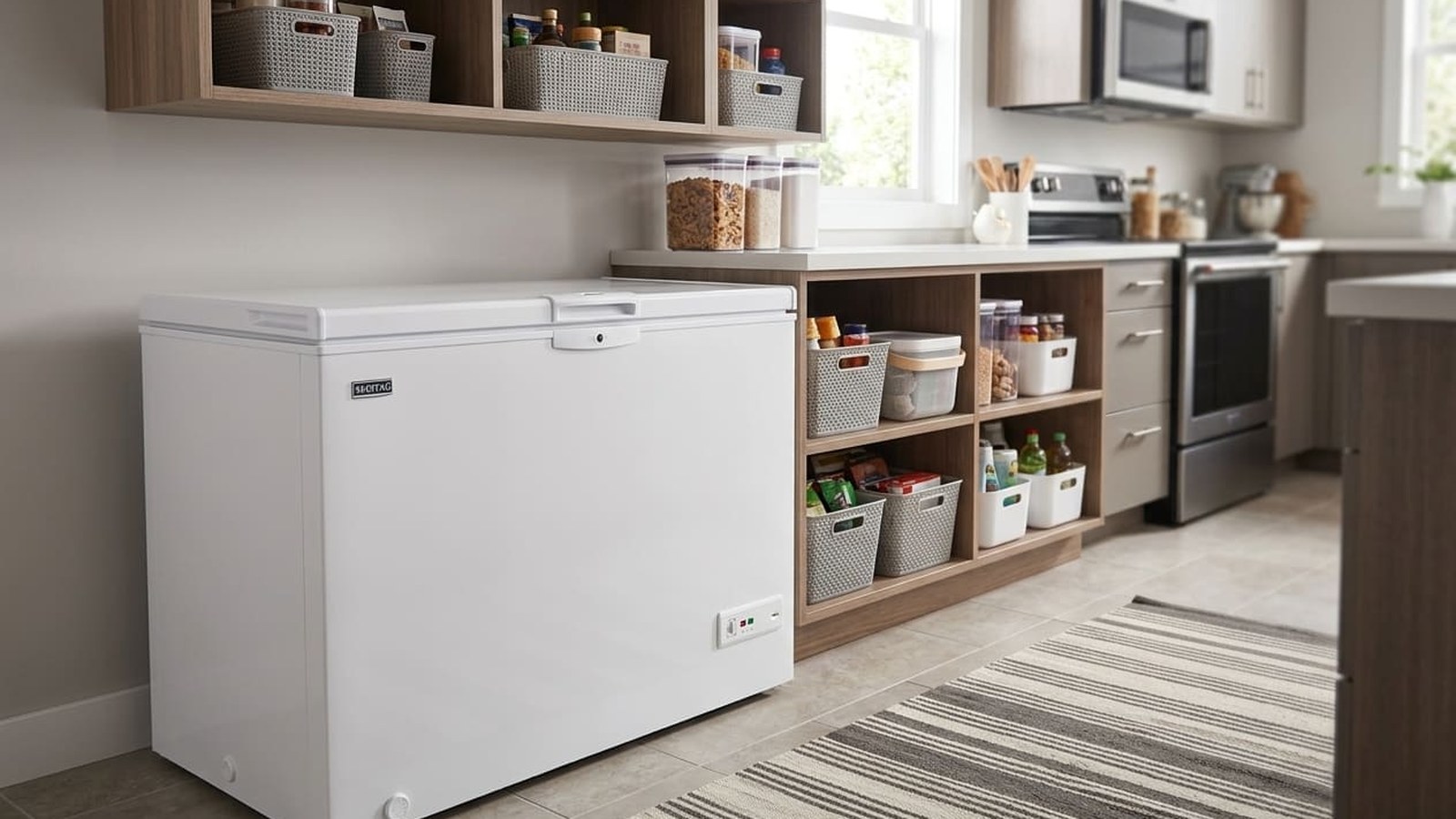
Maytag standalone freezers — both upright and chest models — can produce several types of sound, some entirely normal, some pointing to a part that needs attention before it fails entirely. The goal of this guide is to translate those sounds into causes. Grinding. Buzzing. Clicking. Humming. Rattling. Each one has a source, a mechanism behind it, and a logical next step — and the first few checks are free.
Where Maytag describes a sound, we quote Maytag — its upright freezer user guide (W10882915A) and its help pages for upright and chest freezers. Your own guide always comes first.
By the end of this guide, you’ll know what your Maytag freezer making loud noise most likely means — and whether it needs a technician or just a leveling adjustment.
First, Know What “Normal” Sounds Like for a Maytag Freezer
Before diagnosing a problem, it helps to know what you’re listening past. Maytag freezers are not silent appliances — they produce a consistent range of operating sounds, and confusing those with a fault leads to unnecessary service calls and unnecessary stress.
Here’s what Maytag describes as part of normal operation:
- A pulsating or high-pitched hum that “may come from the compressor or fans as they adjust to optimize performance.” A new freezer may run longer than your old one — the guide credits its “high-efficiency motor.”
- Long running after startup. A newly started freezer runs constantly until it’s cooled — up to 6 or 8 hours or longer, the guide says. A big load of unfrozen food does the same on a smaller scale.
- Gurgling — refrigerant flowing through the tubes as the freezer shuts off after a cooling cycle. On chest models, opening the lid can also gurgle as water equalizes in the drain tube, more often when humidity is high.
- Sizzling, hissing, or dripping on frost-free uprights — water “dripping on to the defrost heater during the defrost cycle.” The cooling coil periodically warms up to melt frost, which drains to a pan behind the base grille and evaporates. It sounds a bit like a pan cooling on a stovetop. Completely normal.
- Popping or cracking from the walls — the inside walls contracting and expanding, especially during the first cool-down or a defrost.
- A single soft click as a cooling cycle starts or stops — clean, with no follow-through noise.
On a muggy Georgia summer day, water in the defrost pan just takes longer to evaporate. Maytag calls that normal too.
What you should not hear:
- A grinding or scraping sound that stops when you open the door.
- A hum that has gradually gotten louder over weeks.
- A click every few minutes that is never followed by the compressor starting.
- A rattle that vibrates through the floor.
- A sudden new sound — any sudden new sound — that wasn’t there yesterday.
If your Maytag freezer noise matches anything in that second list, the following sections tell you where it’s coming from.
Before any check: don’t remove panels on a running freezer, and unplug it before touching anything near the base grille or the back. Keep fingers away from fan blades. Moving a loaded upright takes two people — Maytag’s guide warns of an excessive weight hazard.
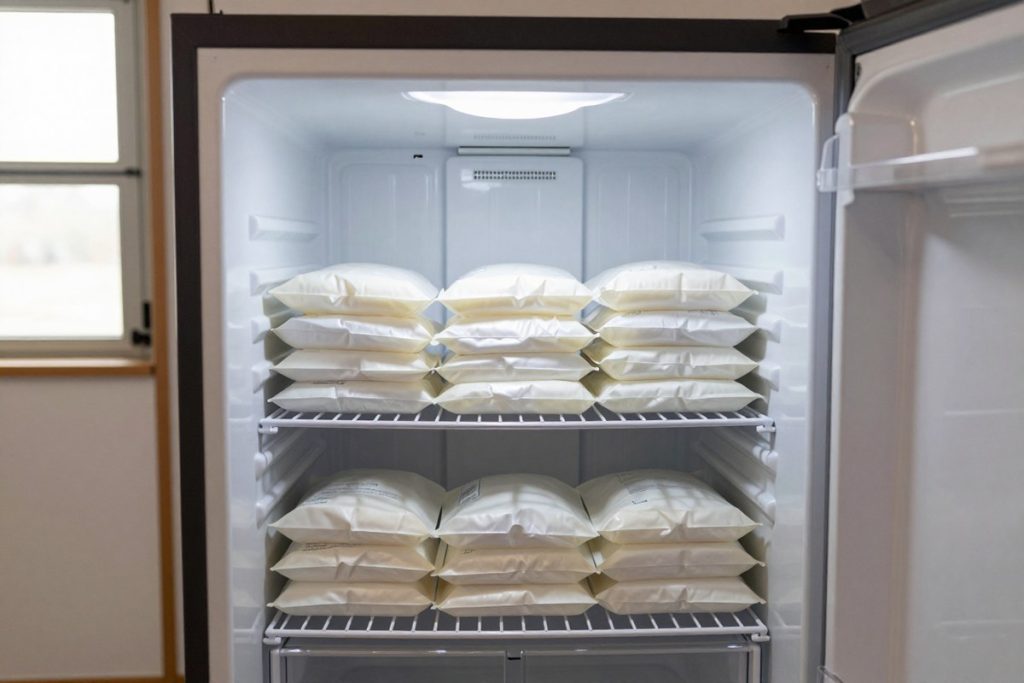
Grinding or Scraping — The Evaporator Fan Hitting Ice
This is the noise that gets people’s attention fastest. A grinding or scraping sound with a rhythmic, mechanical quality — sometimes intermittent, sometimes constant — coming from somewhere inside or behind the rear wall of the freezer.
How to check: open the freezer door while the sound is happening. On many frost-free uprights, opening the door stops the interior (evaporator) fan — the one that pushes cold air out of the freezer wall. If the grinding stops the moment the door opens — and comes back when it closes — the fan is the most likely source. If your fan keeps running with the door open, note where the sound is loudest instead.
What’s causing it? In a frost-free upright, the defrost system periodically warms the cooling coil to clear frost. When the defrost heater, defrost thermostat, or defrost control fails, that cycle stops happening. Frost accumulates on the coils unchecked over several days until it builds out far enough to contact the fan blades. The grinding sound is the blades hitting the ice on every rotation.
This matters for two reasons. First, it’s loud and alarming. Second, it’s also a cooling problem developing in parallel — as frost encases the coils, airflow drops and temperatures rise. The noise is the early warning. If your Maytag upright also isn’t freezing as well as it used to, the defrost system is likely behind both symptoms.
Maytag chest freezers typically have no interior fan to hit ice. Maytag’s help page for grinding or squeaking when you open the lid points somewhere simpler: a lid that wasn’t installed properly, a lid rubbing against cabinets, or a freezer that isn’t level. Grinding from the base while a chest model runs points to the machine compartment, covered next.
The repair path for an upright: a technician removes the rear interior panel, clears the ice, replaces the faulty defrost part, and checks the fan motor for damage. Do not attempt to defrost the coils with a heat gun or hair dryer — the refrigerant lines behind the coil assembly are thin tubing, and direct heat can damage them.
Loud Humming or Squealing — The Condenser Fan Motor
Different location, different sound, different repair path. On models that have one, the condenser fan sits at the lower back next to the compressor. Its job is to move room air across the condenser coils, releasing the heat the refrigerant carried out of the freezer — the reason Maytag says the outside of your freezer may feel warm. Not every freezer uses a condenser fan, and some chest designs don’t. When the fan motor’s bearings wear out, the unit develops a persistent hum or high-pitched squeal that builds gradually — often louder the longer the compressor runs.
The key distinction from evaporator fan noise: this sound does not stop when you open the freezer door. The door affects the interior fan, not the condenser fan at the back. If the hum or squeal continues with the door wide open, you’re listening to the machine compartment.
To confirm:
- Listen without moving it. From the side, listen at the back lower panel while it runs. If the sound clearly comes from there and intensifies as the unit works harder, the condenser area is the source.
- Check the clearances. Maytag asks for at least 3″ (7.5 cm) of air space at the top and both sides and 1″ (2.5 cm) at the back — and says not to cover the freezer with blankets or sheets.
- Look, don’t reach. Dust, pet hair, or a piece of packaging that found its way to the back can lodge near the fan and create noise. If you can see it without removing a cover, unplug the unit, pull it free, plug back in, and listen. Anything behind a screwed-on panel is technician work.
If the noise returns within a few minutes, the motor bearings have worn past the point where clearing debris helps — the motor itself needs replacement. Maytag’s troubleshooting chart also says to check that the condenser coils are clean when the motor seems to run too much.
On Maytag freezers that use one, condenser fan replacement is a standard repair. Matching the replacement motor to the exact model number matters — an off-spec motor can spin the wrong way or move too little air across the coils, creating a cooling problem even if the noise disappears. We match genuine OEM parts to your model number.
Clicking or Buzzing — Check the Alarm, Then the Compressor
Two distinct sounds live in this section — plus one Maytag lists first. They’re worth separating precisely because they sound similar at first and mean different things.
Check the alarm first. The only noise line in the troubleshooting chart of Maytag’s upright freezer guide is “Freezer Makes Loud Buzzing/Clicking Sound” — and Maytag’s answer is the temperature alarm, not the compressor. After a fresh start, a defrost, a move, a long power failure, or a large load of food, the guide says to turn the alarm off for the next 24 hours. Maytag’s help page adds that this alarm buzzes if the freezer reaches 10°F (−12°C) or more above normal for your setting; on models with it, a three-position switch below the temperature control tests it, turns it on, or turns it off. What’s at stake: an alarm is a message, not a broken part — but if it keeps sounding a day later with the door shut, call.
The rhythmic click: a click every few minutes, followed by several seconds of silence, followed by another click. No compressor hum in between. No sustained motor sound. Just: click — silence — click — silence. This often points to the start relay firing, the compressor attempting to engage, and the thermal overload protector cutting it off before the motor can run and overheat. The cycle repeats until the faulty part is replaced or the compressor stops trying.
The sustained buzz: a loud, constant buzzing from the compressor area that doesn’t cycle off — and isn’t the alarm. This can mean the motor is getting power but is mechanically stuck or has an internal electrical failure. Don’t let it run: unplug the freezer and call. Sustained locked-rotor current can burn out the motor windings, turning a repairable start problem into a compressor replacement.
Safety first: the start relay sits on the side of the compressor, next to live terminals and refrigerant tubing. Testing it is technician work: a technician unplugs the unit, removes the relay, checks it for a rattle inside the housing (a broken internal connection), and confirms with a meter across the terminals. If the start relay checks out, the compressor motor itself may be failing — a sealed system diagnosis that requires a technician’s equipment to confirm properly.
Clicking alongside a warm interior? The two issues are directly connected — a compressor that can’t start can’t cool.
Maytag freezer still noisy after these checks? You’ve done the free part. If your upright or chest freezer is still grinding, buzzing, or clicking, a part is failing — and noise is how appliances signal a problem before they stop working entirely. Our Maytag freezer repair team covers metro Atlanta, with same- or next-day service on most days.
Rattling or Vibrating — The Leveling Fix Nobody Does First
It sounds mechanical. It feels like something must be wrong inside. Very often, a Maytag freezer that rattles and vibrates on the floor just needs to be properly leveled.
A tall upright freezer with one leveling foot slightly off the floor transfers compressor vibration directly into whatever surface it’s sitting on — floor, cabinet panel, wall behind it. The compressor produces a pulse with every cycle, and without every contact point absorbing it evenly, that pulse turns into audible rattling. The freezer itself is fine. The contact geometry isn’t.
Maytag’s rattling page lists refrigerant flow, items stored on top, and a unit — or floor — that isn’t level. Clear the top first.
For Maytag upright models: the guide covers two styles. Without a base grille, two front leveling legs do the work: place a level on top, side to side and then front to back, turn a leg counterclockwise to raise a corner or clockwise to lower it, and recheck once the freezer is fully loaded. With a base grille (two Phillips screws), the back rests on fixed rollers and the front on two brake feet. Using a 1/4″ hex driver, turn both brake feet clockwise the same amount until they’re snug against the floor and the freezer doesn’t roll forward when the door opens. Check that the unit doesn’t touch the wall or any adjacent cabinet on the sides — even a few millimeters of contact transmits the compressor cycle into the surrounding structure.
For Maytag chest freezers: the unit should be fully level on a level floor, with nothing stored on the lid. Also check the internal storage baskets — a basket seated slightly off-center can shift with each compressor cycle, creating a rhythmic rattle from inside the cabinet that sounds convincingly mechanical. Lift, reseat, and close. Listen again.
If the unit is level, the contact points are clear, the internal baskets are seated correctly, and the rattle persists — the condenser fan or compressor mounts warrant a closer look by a technician.
When Noise Means the Freezer Is Running Out of Time
Some noises are warning signs, not just inconveniences. The gap between “weird sound” and “stopped working” is often shorter than people expect.
- A compressor clicking every few minutes without starting is a compressor at risk. Each failed start attempt loads the thermal overload protector with heat. Enough failed cycles, and the compressor may stop trying altogether. At that point, the freezer is simply warm.
- A condenser fan that has failed entirely removes the airflow from the condenser coils. The compressor keeps running but overheats on every cycle because the heat it’s supposed to release has nowhere to go. Cooling gets worse. The compressor ages faster than it should.
- An evaporator fan grinding against accumulated ice strains its motor bearings on every rotation. It may hold for days or weeks. It will not hold indefinitely.
- One more noise worth knowing: a hissing or irregular bubbling from the back of the unit — not the normal gurgle after a cooling cycle, but a persistent or irregular sound from the sealed system. This may indicate a refrigerant leak.
Our EPA 608 certified technicians diagnose refrigerant problems on-site. Refrigerant work is not a DIY repair — federal rules under Section 608 of the Clean Air Act require certification to handle refrigerant, and the diagnosis needs recovery-capable tools to open the sealed system safely.
Stop the noise before it stops the freezer. Book Maytag freezer repair with PRO Appliance Repair. We’re family-owned and insured, with same- or next-day service on most days across metro Atlanta. Our EPA 608 certified, background-checked technicians have 15+ years of experience and use genuine OEM parts, and our repairs carry a warranty of up to six months.
Conclusion
Once you know what each sound maps to, the alarm fades. A buzz or click after a move, an outage, or a big grocery run — check the temperature alarm first. Grinding that stops when the door opens — the evaporator fan hitting ice, defrost system likely involved. A hum or squeal from the lower back that keeps getting louder — a condenser fan motor wearing out. A rhythmic click with no motor following — the compressor isn’t completing its startup. Rattling through the floor — leveling. Sustained buzzing from the compressor that isn’t the alarm — a motor struggling under load.
Each of these has a logical next step, and none of them require guessing. For noises across brands, see our guide to a refrigerator making loud noise.
FAQ
Is a Maytag upright freezer fan noise different from chest freezer noise?
Yes. A Maytag frost-free upright moves cold air with an interior fan, and many also have a condenser fan near the compressor; either can grind, hum, or squeal. Chest freezers are simpler — typically no interior fan, so most chest noise comes from the compressor area, the lid, or the way the unit sits on the floor. That makes chest models somewhat faster to diagnose.
My Maytag freezer only seems louder at night. Why?
The freezer hasn’t changed — your home has gone quiet. Daytime background noise masks compressor and fan sounds that stand out after midnight. If the noise is genuinely louder at certain times rather than simply easier to hear, it may line up with the automatic defrost on frost-free uprights — Maytag calls the sizzling and dripping on the defrost heater normal. A sudden new loud noise is worth checking at any hour.
How do I know if my Maytag freezer compressor noise is serious or just normal operation?
Normal operation is a steady or gently pulsating hum, cycling on and off — Maytag says compressors and fans can sound high-pitched as they adjust, and a new freezer runs longer than an old one. Signs the noise is worth acting on: a volume increase over days or weeks; knocking from the compressor body itself (not the cabinet); a loud buzz that doesn’t cycle off and isn’t the temperature alarm; or the click-then-silence pattern described above. Any of these, especially with rising temperatures, needs a professional look.
Can I quiet a noisy Maytag chest freezer without a service call?
Possibly, if the source is leveling or vibration. Maytag’s help pages check that the freezer and the floor under it are level, that nothing is stored on top, and that the lid isn’t rubbing against cabinets. Reseat internal baskets. If the noise continues after those steps — especially grinding, a buzz that won’t stop, or a click that repeats without the motor starting — the next step is a technician visit.
Should I be worried if my Maytag freezer makes a loud pop occasionally?
Usually not. Maytag explains that the inside walls contracting and expanding can cause popping or cracking, especially during the first cool-down or a defrost. What sets a problem apart: a single loud bang from a specific internal spot (not the cabinet walls), or a repetitive metallic popping that’s new and localized. The first can be ice letting go in the evaporator area; the second may mean a part shifting or bearing wear in the fan area — worth a check by a technician.
Does a noisy Maytag freezer always mean it’s about to break down?
Not always — but noise is always worth understanding. Some sounds (leveling vibration, defrost sizzle, cabinet pops, a temperature alarm after an outage) are harmless or temporary. Others — a grinding fan, a clicking compressor, a worn condenser fan motor — are parts signaling they’re close to failure. Noise usually comes days to weeks before a complete failure. A grinding evaporator fan caught early is a smaller repair and less food lost than waiting until the freezer stops cooling and everything inside follows.
PRO Appliance Repair is an independent repair company and is not affiliated with, sponsored by, or endorsed by Maytag or Whirlpool Corporation. Brand names are used only to identify the appliances this page is about and remain the trademarks of their respective owners.