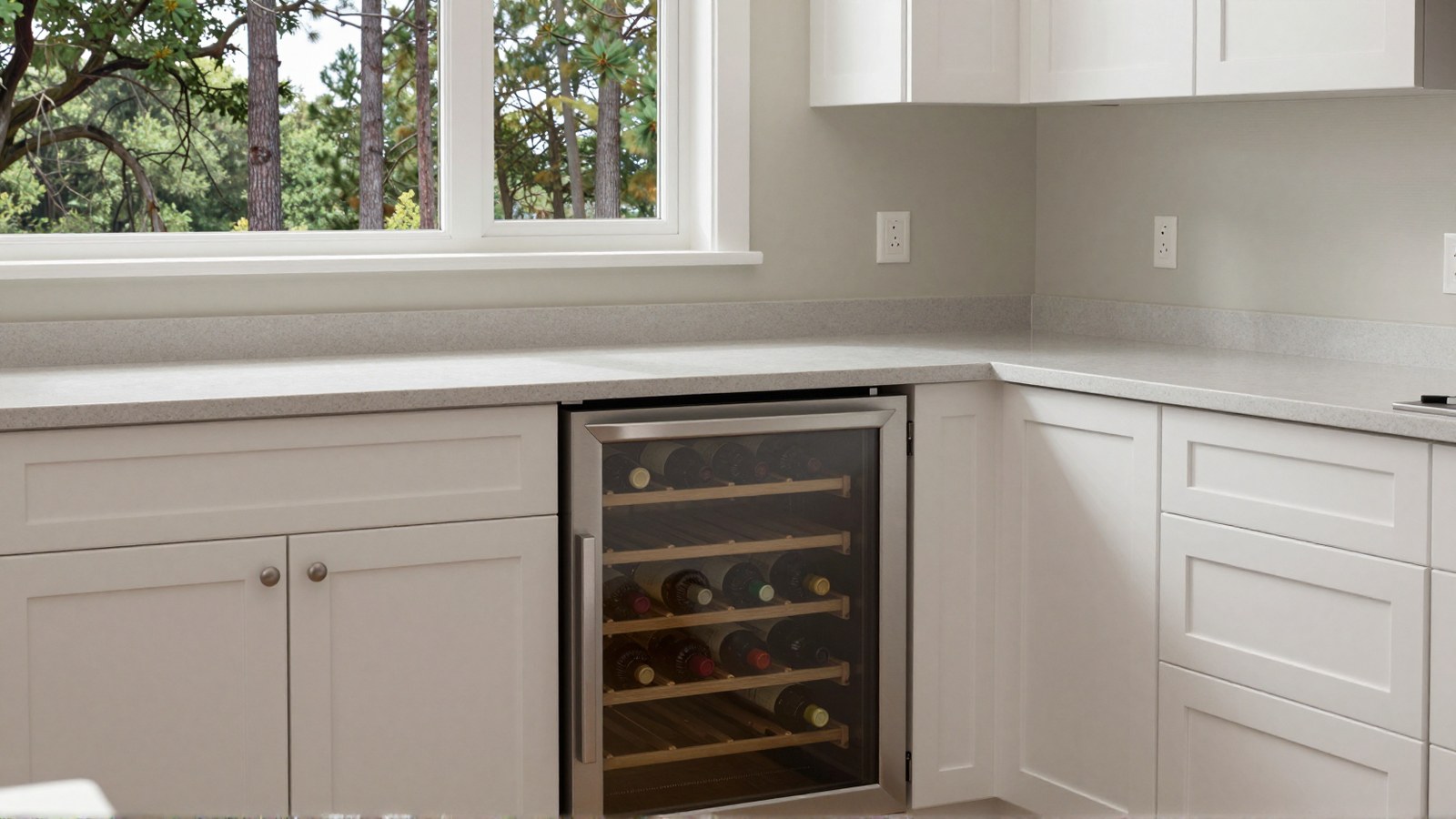
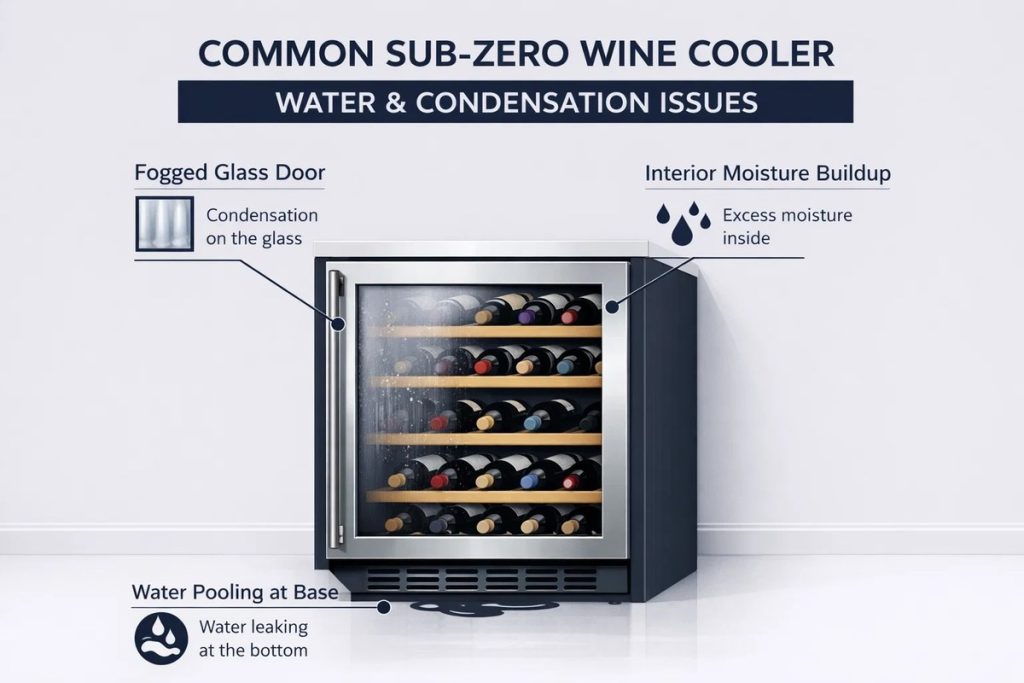
Water in a Sub-Zero wine cooler usually shows up in one of three ways: fog on the glass door, droplets inside the cabinet, or water where it shouldn’t be, on a shelf, the floor of the unit, or the kitchen floor. Some of it is normal. Some of it points to a door that isn’t sealing, a dirty condenser, or a drain problem that needs a technician.
This guide covers Sub-Zero wine storage across several generations: the 400 Series (424, 427, 427R, 430), the glass-door 424G, 427G, and 427RG, the UW-24 undercounter unit, and Designer Series wine columns. It explains what Sub-Zero considers normal, the checks it recommends, and the problems you shouldn’t try to fix yourself. It draws on Sub-Zero’s wine storage use and care guides and its owner support pages.
If the checks don’t solve it, our team handles Sub-Zero wine cooler repair across metro Atlanta.
A safety note before you start. Turn the unit off at the control panel before you clean it or the condenser, and wear gloves around the condenser fins, which are sharp. Leave the drain tube, the refrigeration system, and the wiring to a technician.
Why Wine Coolers Develop Water Issues
A wine cooler holds bottles cool and steady, not cold. That gap between a cool cabinet and a warm, humid room is where condensation comes from. Every time the door opens, room air comes in. When that air meets cooler glass or shelves, its moisture condenses.
How Wine Storage Humidity Works
Here’s what Sub-Zero says about humidity and wine:
- Too much humidity won’t hurt the wine itself, but it can make labels and cardboard boxes rot.
- Too little humidity can dry out corks. A shrunken cork lets air into the bottle.
- Humidity in a Sub-Zero wine unit isn’t adjustable, and Sub-Zero doesn’t publish an average humidity level for its units. Its 400 Series guide simply says proper humidity is maintained throughout the unit.
That last point matters. There’s no humidity control to turn and no humidity setting to fix. When there’s too much water inside, the cause is almost always air getting in, a condenser that needs cleaning, or a drain problem.
Temperature matters too. Sub-Zero explains that temperature swings make wine expand and contract, which can push the cork out and pull it back in, loosening it and letting in oxygen. Keeping the door closed and the temperature steady protects both the wine and the cabinet.
Temperature ranges by model. Sub-Zero gives these ranges:
- Designer (IW, DET, DEC), Classic (BW), and UW-24 wine storage: 39°F to 65°F
- Designer Undercounter (DEU) wine storage: 40°F to 65°F
- 400 Series wine storage: each zone from 38°F to 65°F
- 427R refrigerator drawers: 34°F to 45°F, with both drawers set to the same temperature
Sub-Zero adds that reds and whites can be stored in whichever zone you prefer.
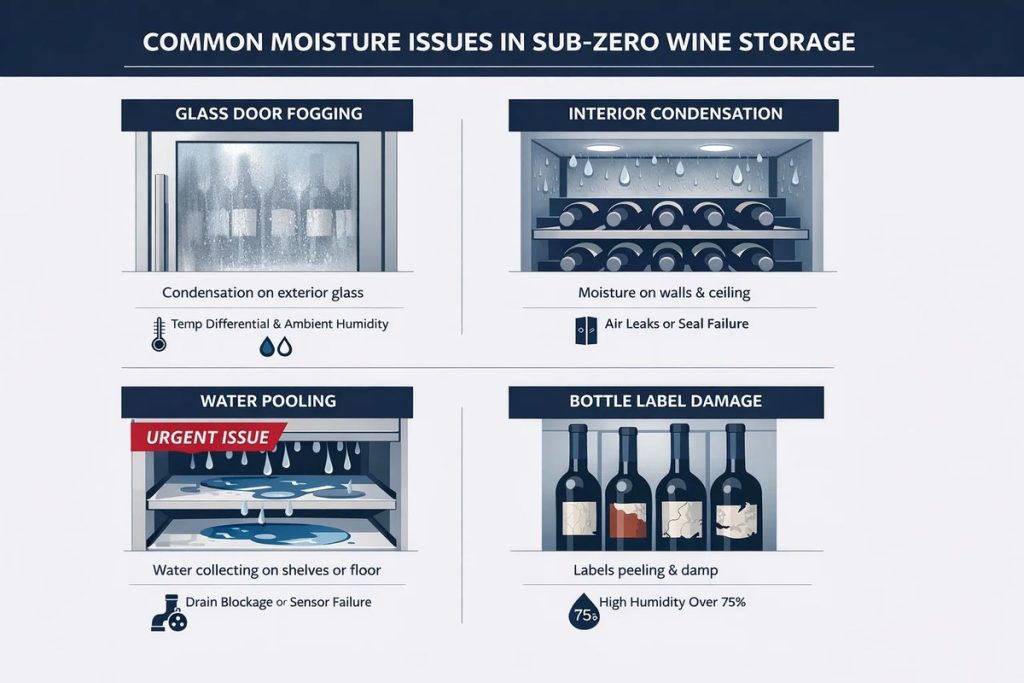
Common Moisture Presentations
| What you see | Where | Usual cause | What to do |
|---|---|---|---|
| Fog on the glass | Outside surface | Humid room | Usually normal; clears when humidity drops |
| Fog or droplets | Inside glass, walls, shelves | Door opened often or left open, humid season | Keep the door closed; check the seal |
| Heavy condensation | Inside, all the time | Gasket, door, or condenser | Run Sub-Zero’s checks |
| Water pooling | Bottom of the cabinet or floor | Drain or seal problem | Service on most models |
| Damp or moldy labels | On bottles | Long-term excess humidity | Find and fix the moisture source |
Exterior fog is often just the weather. Water collecting inside is the one to take seriously.
Glass Door Condensation
Fog on the glass door is the moisture complaint owners raise most often. It’s also the one that most often turns out to be normal.
Exterior vs. Interior Condensation
On the outside of the glass. Sub-Zero’s 400 Series guide says that during periods of high humidity, some condensation may appear on outside surfaces and will disappear when the humidity drops. Sub-Zero’s general guidance on sweating says it can happen in hot or humid climates, especially in homes without air conditioning, but there should be no dripping. Make sure the door is closing and sealing properly. If the condensation persists, Sub-Zero says to call for service.
On the inside. Sub-Zero’s 400 Series guide says condensation inside the unit is normal during humid periods, such as summer, and with frequent door openings. Its wine storage support page adds that some condensation inside, or on the shelves or drawers, is normal if the door has been open for a while. In warm climates you’ll notice it sooner. Keep the door closed, and the fog clears on its own.
Quick Test for Glass Door Issues
A simple check helps tell the two apart:
- Wipe the glass completely dry on both sides.
- Close the door and leave it closed for a while.
- Look again to see where the moisture came back.
What it means:
- Moisture on the outside only. That’s the room’s humidity meeting cool glass. It’s normal in humid weather, as long as nothing drips.
- Moisture on the inside that clears. Normal after the door has been opened often.
- Moisture on the inside that keeps coming back with the door closed. Run the checks in the next sections: door, gasket, and condenser.
Reducing Exterior Fogging
You can’t change the weather, but you can change the room:
- Keep the room conditioned. Air conditioning or a dehumidifier lowers the humidity that fogs the glass.
- Open the door less, and close it quickly. Every opening brings in humid air.
- Think about the location. Sub-Zero says its units, except outdoor models, are designed to run in a room between 60°F and 90°F. A warmer room makes the unit run more. Sub-Zero also notes that homes in humid areas without climate control can see a drain pan that fills quickly, or excess frost.
- Keep it out of direct sun. Sub-Zero advises keeping bottles away from direct sunlight, which can age wine early and affect its flavor. Sub-Zero’s 400 Series units have UV-resistant glass in the door that filters out harmful UV light, but a sunny spot still warms the glass and the cabinet.
Interior Moisture and Water Pooling
Water standing inside the cabinet, or leaking out of it, isn’t normal. It’s worth finding the cause.
Drainage System Failures
Compressor-cooled wine units make some water as they run, and it has to drain away. On 400 Series units, water drains through a drain tube at the back of the unit. If that tube clogs, water can collect inside.
Here’s the key point. Sub-Zero says that if the drain tube at the back of the unit is clogged on a 400 Series, Classic (BI), Designer (IT, IC, ID), 700, or 648PRO Series product, it requires service to clear it. This isn’t an owner job. Sub-Zero’s guidance doesn’t include flushing it with a turkey baster, vinegar, or bleach. Its 400 Series care guide also says not to use vinegar when cleaning the interior.
Sub-Zero says the drain tube can clog from too much moisture and cooling in the unit, and it lists the checks to do before you call:
- Check the temperature setting so the drain tube doesn’t freeze.
- Clean the condenser if it hasn’t been done in the past 6 to 12 months.
- Make sure the door closes properly, and remove anything keeping it from closing.
- Inspect the door gasket for rips or tears, and have it replaced if it’s cracked or torn.
Sub-Zero adds that the drain tube can clog, but it shouldn’t need frequent cleaning. If it clogs again and again, something else is letting in too much moisture.
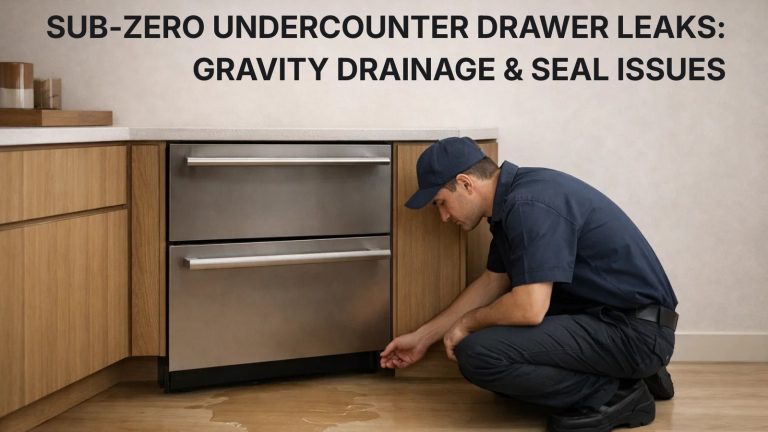
Water under the unit. Sub-Zero’s guidance for water on the floor starts with shutting off the water supply if the unit has one, then removing the kickplate to look for the source. On wine storage units, Sub-Zero notes that the drain pan isn’t accessible to owners. Water on the floor in front of or under a wine unit is a service call once you’ve ruled out spills and nearby plumbing.
Wine still wet inside? Book Sub-Zero wine cooler repair and we’ll find where the water is coming from.
Humidity Controls and Sensors
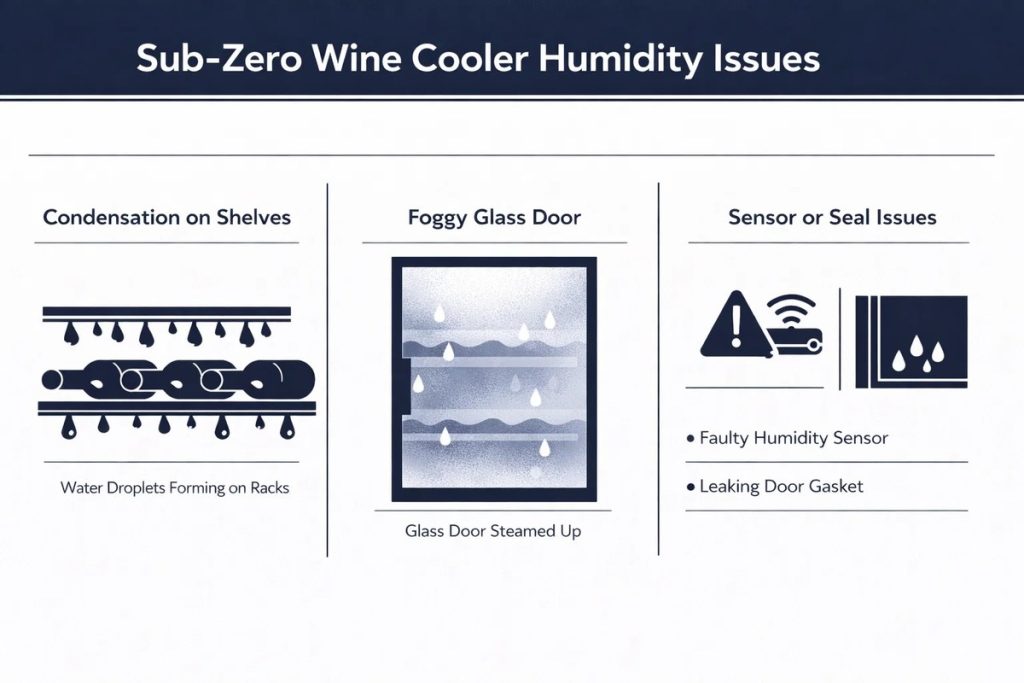
Some guides blame wine cooler moisture on a failing humidity sensor. Sub-Zero says the humidity level in its units isn’t adjustable, and its wine storage guides don’t list a humidity sensor or a humidity setting among owner controls or troubleshooting steps. So don’t go looking for one to reset.
What you can do is measure. A separate hygrometer placed inside the unit for a day tells you what the humidity actually is. Either way, the fix is to find out why moisture is getting in or not draining.
What Sub-Zero does list is a service indicator. On its glass-door wine storage models, “SERVICE” flashing on the display means to check that the condenser is clean, then turn the unit off at the control panel and back on. If the indicator keeps flashing, the unit needs service.
Door Seal Compromise
On a wine cooler, the door does most of the work of keeping room air out. A gasket that doesn’t seal lets in warm, humid air every minute, not just when the door opens.
Wine Cooler Seal Testing
Sub-Zero’s 400 Series guide says magnetic gaskets around the doors give extra-tight seals. When they don’t, you’ll usually see it. Check:
- The whole gasket, all the way around the door. Look for rips, tears, cracks, or a section pulling away.
- The bottom corners and the hinge side, where wear often shows first.
- Residue. Sub-Zero says sticky residue and spills left on a gasket lead to early wear or cracking. On a wine cooler, that means wine drips.
- Moisture at the gasket. If moisture is leaking or seeping from the gasket, Sub-Zero says to clean it thoroughly and dry it.
A paper test helps too. Close a piece of paper in the door, pull it out, and repeat around the door. You should feel even resistance all the way around. A spot where the paper slides out freely, compared with the rest, points to a gap.
On dual-zone units, also look at the divider gasket between the zones. Sub-Zero’s 400 Series guide shows a divider gasket at the stationary shelf.
Common Seal Failure Patterns
- A torn or cracked gasket. Sub-Zero says to replace it to avoid moisture problems and keep the unit cooling properly.
- A door that doesn’t close fully. Bottles that stick out, a shelf or rack not pushed all the way in, or something blocking the hinge can all hold the door open a little.
- Hinge or alignment problems. Sub-Zero says broken hinge parts should be replaced by a technician, and that leveling problems on a new installation should be checked against the installation guide.
Replacement Considerations
Sub-Zero recommends that a service technician replace any door or drawer gasket. Gaskets are model-specific. Genuine gaskets come from Sub-Zero’s parts distributors; Sub-Zero’s online store sells only filters and cleaners.
A technician can check the door’s alignment and hinge at the same visit.
Model-Specific Issues
400 Series: 424, 427, 427R, and 430
The 400 Series is Sub-Zero’s earlier built-in wine storage line. A few model details from its use and care guide:
- Each zone has a range of 38°F to 65°F.
- The glass is UV-resistant and filters out harmful UV light.
- Condenser location varies. On the 424, it’s behind the kickplate. On the 427 and 427R, it’s behind the kickplate or grille, held by screws. On the 430, it’s behind the grille at the top of the unit.
- The 427R has refrigerator drawers. Sub-Zero gives them a 34°F to 45°F range, and the 427R has an alarm that beeps if a drawer is left open. If the drawers are part of your moisture problem, check that they close and seal.
- Rating plate location. On the 424, the model and serial plate is on the underside of the top wall. On the 427 and 427R, it’s on the underside of the control panel. On the 430, it’s inside the door near the top hinge.
The 400 Series guide recommends cleaning the condenser every three to six months, more often than Sub-Zero’s newer guides. The right schedule depends on how much dust and lint builds up.
424G, 427G, and 427RG Glass-Door Models
Sub-Zero’s guide for these glass-door models lists a full-view glass door and a condenser behind the kickplate or grille. For condensation inside the unit, the guide’s checklist is to make sure the condenser is clean, the door closes properly and hasn’t been left ajar, and the gasket has no rips or tears. A torn gasket needs service.
The guide also says that if the display shows normal temperatures but the unit isn’t cooling, it may be in showroom mode. Contact Sub-Zero’s customer care line in that case.
UW-24 Undercounter Wine Storage
The UW-24 sits under the counter, close to the floor and often close to the dishwasher. Sub-Zero’s Wine Storage Use and Care Guide for the BW-30 and UW-24 says to clean the condenser every 6 to 12 months, and its troubleshooting for condensation inside is the same: condenser, door, gasket.
Undercounter units breathe through the front. Keep the kickplate area clear so the unit can move air, and don’t store things against it.
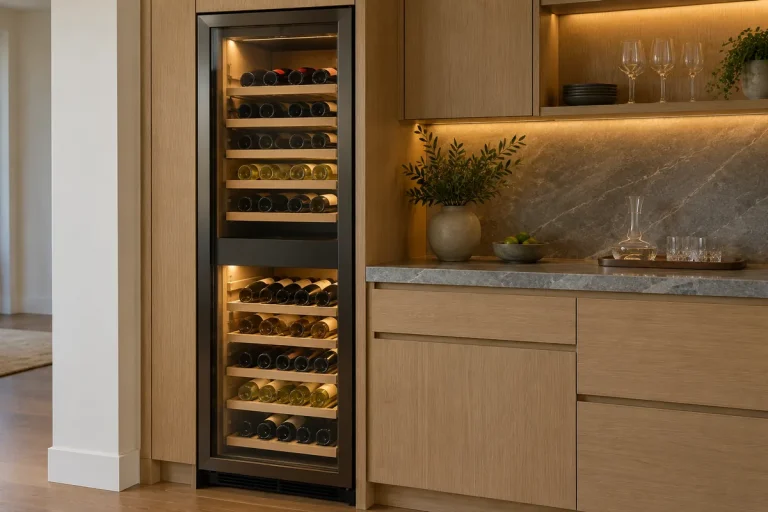
Designer Series Wine Columns
Designer Series wine columns are built into cabinetry, with a custom panel or stainless door. Sub-Zero’s condenser cleaning steps for Designer wine storage are:
- Deal with any error messages on the control panel first.
- Turn the unit off at the control panel.
- Remove the louvered kickplate. On column models, open the door to reach it.
- Vacuum the condenser area with a soft-bristle brush attachment.
- Turn the unit back on and watch the temperatures. They can take up to 24 hours to return to normal.
Sub-Zero says condenser cleaning chemicals and degreasers aren’t needed and aren’t recommended.
Because Designer units are built in, the drain tube and other internal parts aren’t owner access points. Sub-Zero’s drain tube guidance already sends its built-in Designer (IT, IC, ID) refrigeration and 400 Series wine storage to service for a clogged tube, so treat a drain problem in a built-in wine column as a service call too.
Dual Zone Complications
How Dual Zones Create Moisture Issues
A dual-zone wine unit keeps two areas at different temperatures. The colder zone tends to show condensation first when humid air gets in. A divider gasket helps keep the zones separate.
Diagnostic Approach for Dual Zones
- Check the settings for each zone. Make sure neither has been changed by mistake.
- Check that the door closes and seals along its full height, including near both zones.
- Look at the divider gasket for damage or a gap.
- Check the condenser. A dirty condenser makes both zones work harder.
- Note where the moisture is. Moisture in one zone only, with the door sealing well, is useful information for a technician.
Repair Priority for Dual Zones
Do the owner checks first. If one zone won’t hold its temperature, or condensation stays in one zone with the door closed, a technician needs to check the cooling system and controls.
Environmental Factors
Humid Climate Impact
Humid summers are hard on any wine cooler. Sub-Zero’s guidance on running in warm temperatures says products in humid areas that aren’t climate controlled may have a drain pan that fills quickly or excess frost. Its drain pan guidance adds that water in the drain pan is normal, and a pan can be half-full regularly, but it should never overflow.
Installation Location Effects
- Heat sources. A wine unit next to an oven or a dishwasher works harder. Sub-Zero’s indoor units are designed for a 60°F to 90°F room.
- Sunlight. Direct sun warms the glass and can harm the wine.
- Vibration. Sub-Zero says wine does best in a calm spot with little vibration.
- Airflow. Keep vents and the kickplate clear. Sub-Zero’s safety warnings say to keep ventilation openings in the unit and the surrounding cabinetry free of obstructions.
- Outdoors. Only units approved for outdoor use belong outside.
Troubleshooting Guide
Systematic Diagnosis
Work through these in order:
- Where is the water? Outside glass, inside glass, shelves, the bottom of the cabinet, or the floor.
- Is it normal? Fog that clears with the door closed, or light exterior fog in humid weather, is expected.
- Is the door closing fully? Check for bottles, racks, or drawers in the way.
- Is the gasket intact and clean? Look for tears and residue. Clean and dry it if moisture seeps from it.
- Is the condenser clean? Follow your model’s schedule.
- Is the setting right? Check each zone.
- Is the room very warm or humid? Use air conditioning or a dehumidifier.
- Is there water pooling or leaking? On most Sub-Zero wine units, that’s a service call.
When to Call Professionals
Call a technician when:
- water pools inside the cabinet or leaks onto the floor
- the drain tube may be clogged
- the gasket is torn, cracked, or won’t seal
- a hinge part is broken or the door won’t close squarely
- condensation inside keeps coming back with the door closed and the condenser clean
- “SERVICE” keeps flashing after you clean the condenser and restart the unit
- one zone won’t hold its temperature
Have the model and serial number ready.
Our EPA 608 certified, background-checked technicians bring 15+ years in the field and work on Sub-Zero wine storage, undercounter units, and full-size refrigerators. We use genuine OEM parts and back repairs with a warranty of up to 12 months. We’re a family-owned, insured, independent repair company, not affiliated with Sub-Zero, and we offer same- or next-day appointments when the schedule allows.
Maintenance Protocol
Regular Tasks
- Wipe up spills right away, especially on the gasket.
- Clean the glass door with a standard glass cleaner. Sub-Zero’s 400 Series guide says not to use abrasive cleaners or cloths on any surface, including the glass.
- Clean the interior with a mild solution of soap, lukewarm water, and a little baking soda. Rinse and dry. Sub-Zero says not to use vinegar, and to keep water off the lights, the control panel, and the wood facing on the racks.
- Keep the door closed as much as possible, and check that it seals after you take out a bottle.
Condenser Cleaning
Clean the condenser on the schedule in your model’s guide. The 400 Series guide says every three to six months. Sub-Zero’s newer wine storage guidance, and the BW-30 and UW-24 guide, say every 6 to 12 months. Shut the unit off at the control panel first, wear gloves, and vacuum in the direction of the fins so you don’t bend them.
Professional Service
Clearing a drain tube, replacing a gasket, adjusting a hinge, and diagnosing a zone that won’t hold temperature are technician jobs.
The Bottom Line
Most water in a Sub-Zero wine cooler comes from humid air getting in. Exterior fog in humid weather is normal. Interior fog that clears once the door is closed is normal. Water that pools, drips, or keeps coming back isn’t.
Start with Sub-Zero’s own checks: the door, the gasket, the condenser, the settings, and the room. Leave the drain tube to a technician. If the checks don’t solve it, schedule Sub-Zero wine cooler repair before moisture damages your labels or racks. If your undercounter wine unit is also running warm, see our guide to a Sub-Zero undercounter wine cooler not cooling. For a full-size Sub-Zero with water inside, see Sub-Zero refrigerator leaking water.
FAQ
Is condensation inside my Sub-Zero wine cooler normal?
Some is. Sub-Zero says condensation inside is normal during humid weather and with frequent door openings, and that it clears if you keep the door closed. If it keeps coming back with the door closed, check the door, the gasket, and the condenser.
Why is the outside of my wine cooler’s glass door foggy?
Sub-Zero says some condensation can appear on outside surfaces during high humidity and will disappear when the humidity drops. Make sure the door closes and seals. If it persists, or water drips, have it checked.
Can I adjust the humidity in my Sub-Zero wine storage?
No. Sub-Zero says the humidity level in its units isn’t adjustable. Too much humidity can rot labels; too little can dry out corks. If there’s too much moisture, look for air getting in or a drain problem.
Can I clear the drain tube myself?
Sub-Zero says a clogged drain tube at the back of the unit on 400 Series, Classic (BI), Designer (IT, IC, ID), 700, and 648PRO products requires service to clear. Before calling, check the temperature setting, clean the condenser, and make sure the door and gasket seal.
How often should I clean the condenser on my Sub-Zero wine cooler?
It depends on the model. The 400 Series guide says every three to six months. Sub-Zero’s guidance for the BW-30, UW-24, and Designer wine storage says every 6 to 12 months. Turn the unit off first and vacuum in the direction of the fins.
What should I use to clean the inside of my wine cooler?
A mild solution of soap, lukewarm water, and a little baking soda, then rinse and dry. Sub-Zero says not to use vinegar or abrasive cleaners, and to keep water off the lights, control panel, and wood facing. Clean the glass with a standard glass cleaner.