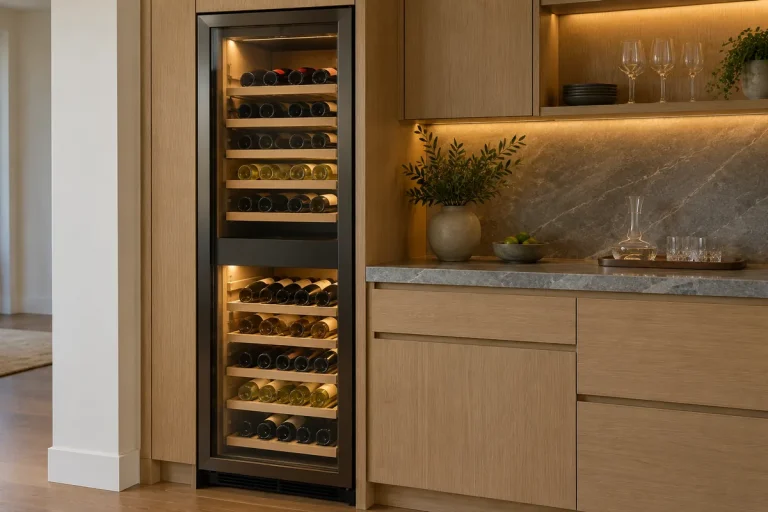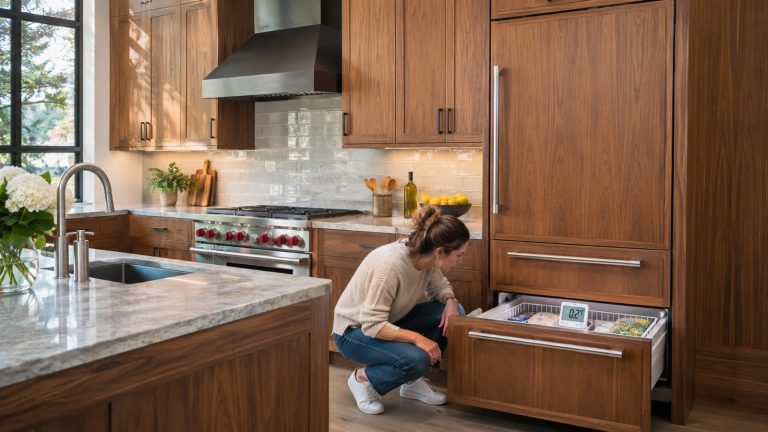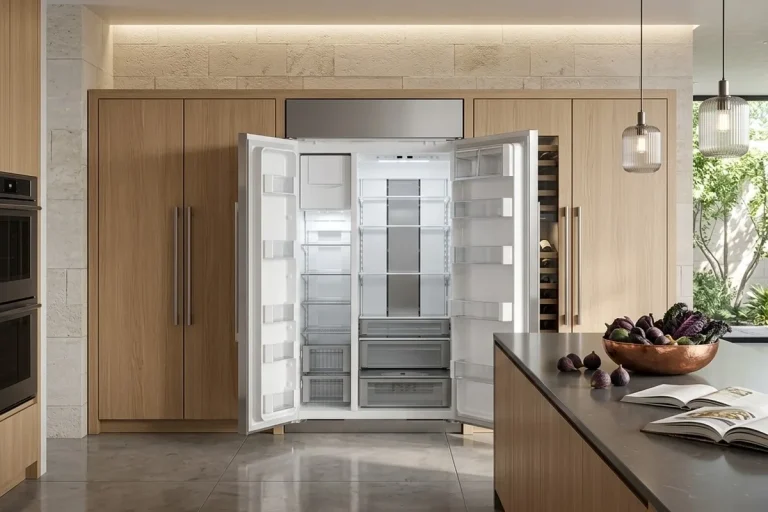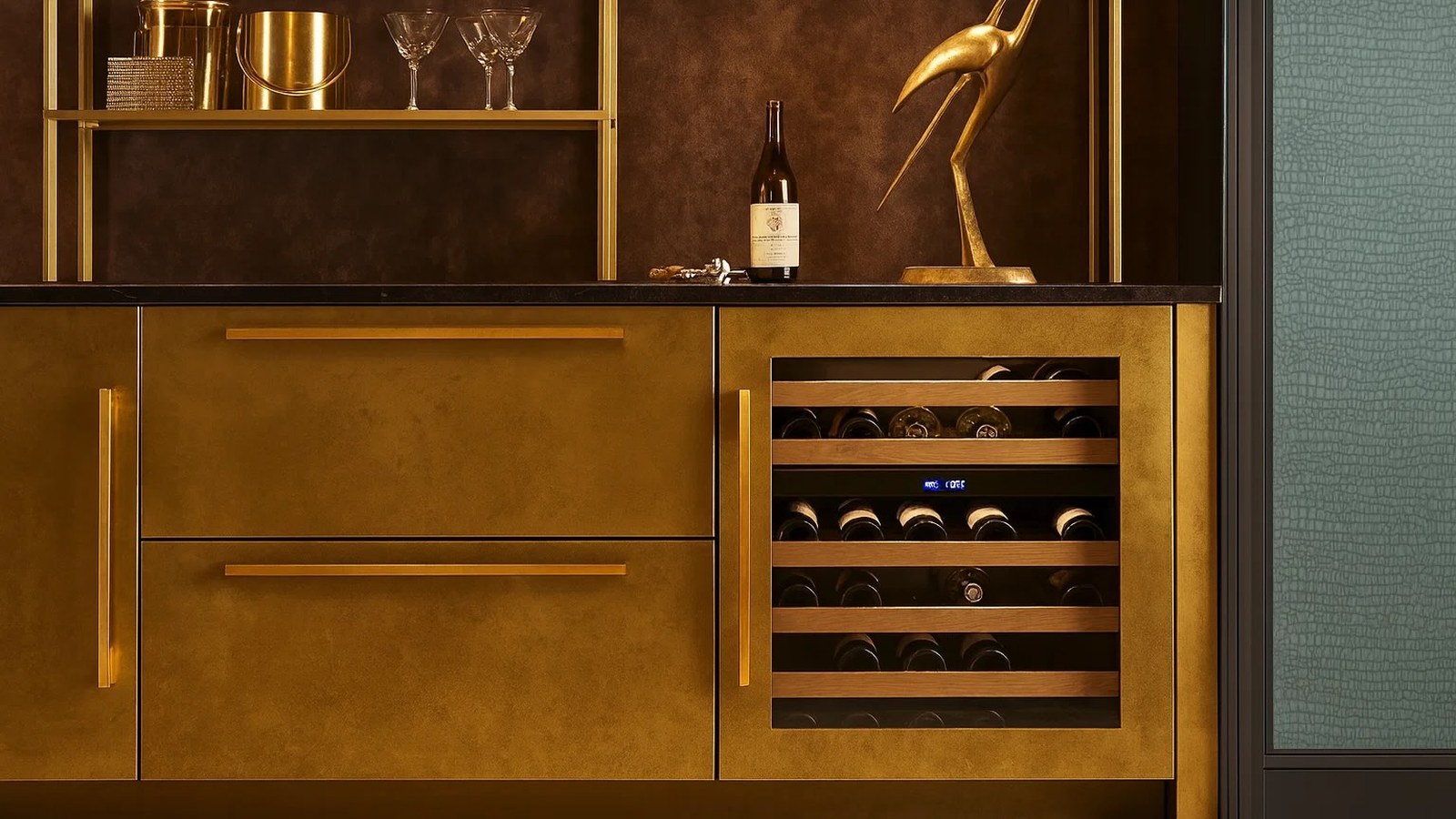
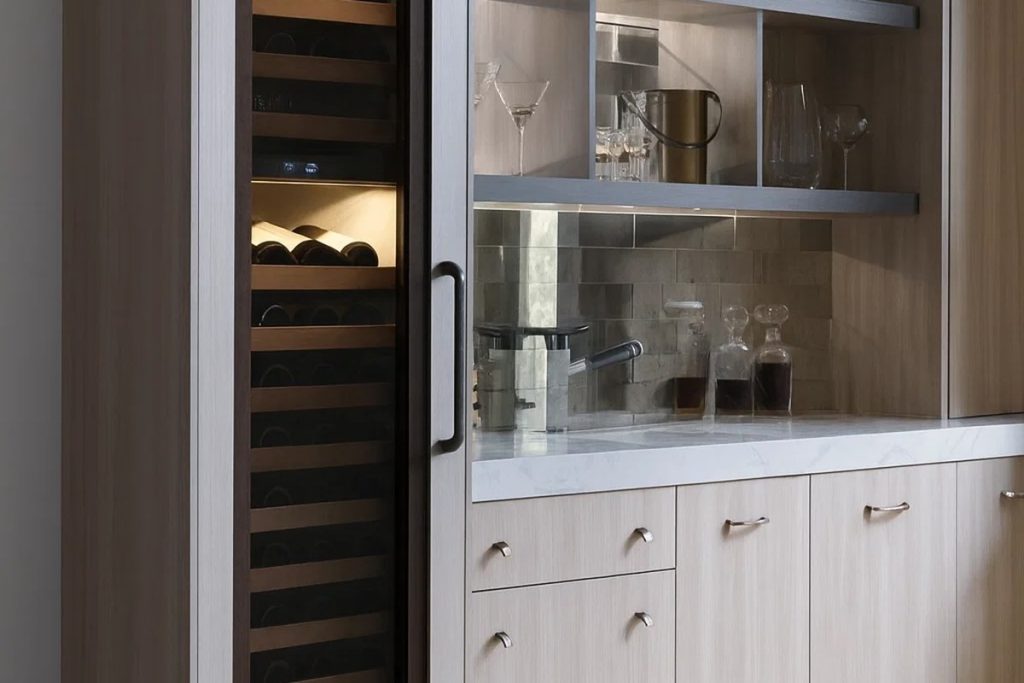
Sub-Zero wine storage comes in several forms: Designer columns that sit behind custom panels, Designer undercounter units like the DEU2450W, tall Designer units that combine wine storage with refrigerator drawers, Classic wine storage, and older undercounter and 400 Series models. They look different, but they’re built around the same idea. Sub-Zero describes the “enemies” of wine as heat, light, humidity, and vibration, and every part of a wine unit is there to control one of them.
Knowing how these features work makes it much easier to read what your unit is telling you. A lot of what owners worry about, like a small temperature swing or a zone that cools slowly after a restart, turns out to be normal. And some popular advice, like adjusting the humidity or pulling the unit out every few months, doesn’t apply to Sub-Zero at all.
This guide explains how Sub-Zero wine storage works: temperature zones, humidity, light, vibration, the cooling system, and the care each unit needs. It’s based on Sub-Zero’s wine storage use and care guides and its owner support pages. If your unit isn’t behaving the way it should, our team handles Sub-Zero wine cooler repair across metro Atlanta.
The Four Enemies of Wine
Sub-Zero lists four things that harm stored wine, in order of how much damage they can do:
- Temperature. Sub-Zero says temperature has the biggest effect. Warmer wine ages faster, peaks earlier, and declines sooner. Swings in temperature make the wine expand and contract, which can push and pull the cork and let in oxygen.
- Light. Ultraviolet light breaks down compounds in wine and produces off tastes and odors. Darkness is ideal.
- Humidity. Air that’s too dry can dry out corks and let air in. Air that’s too damp can let mold grow on corks and labels.
- Vibration. Vibration stirs up the sediment at the bottom of a bottle, which can produce off flavors.
How Sub-Zero Temperature Zones Work
Zones by model
Most current Sub-Zero wine units have two temperature zones, upper and lower, each with its own setting:
- Designer columns (DEC) have two zones. On the control panel, the temperature on the left is the lower zone and the one on the right is the upper zone.
- Tall Designer units with refrigerator drawers, such as the DET3050WR and the earlier IW-30R, add a third zone: the drawers, which run colder than the wine section.
- Designer undercounter wine storage comes in two widths. Sub-Zero says the 24-inch DEU2450W has two zones, upper and lower, and the 15-inch DEU1550W has one.
- Classic wine storage (BW-30) has two zones with separate controls, preset at 45°F and 55°F.
- The older 315W has no electronic control or thermostat, just a dial. Sub-Zero says it runs slightly warmer at the top and front and cooler at the bottom and back.
Sub-Zero is clear that red and white wine can go in whichever zone you prefer. There’s no fixed “red zone” or “white zone.” You set each zone to suit what you store there.
Temperature ranges
Sub-Zero gives these ranges:
| Model family | Wine section | Refrigerator drawers |
|---|---|---|
| Designer columns and tall units (DEC, DET, legacy IW) | 40°F to 65°F | 34°F to 45°F (DET3050WR, IW-30R) |
| Designer undercounter (DEU) | 40°F to 65°F | none |
| Classic (BW, CL) and undercounter UW-24 | 39°F to 65°F, may vary by serial number, model, and age | none |
| 400 Series 427R | wine section per the use and care guide | 34°F to 45°F, both drawers set together |
| 315W (dial control) | mid 40s to mid 60s | none |
What temperature to choose
Sub-Zero’s wine serving guide gives 55°F as the ideal long-term storage temperature for all wines. For serving, it suggests ranges such as 41°F to 46°F for sparkling and sweet whites, 46°F to 54°F for dry whites, 54°F to 61°F for light to medium-bodied reds, and 63°F to 66°F for full-bodied reds and vintage port.
A common approach is to keep one zone near 55°F for long-term storage and set the other closer to the serving temperature of what you drink most. The two zones are independent, so changing one doesn’t affect the other.
How steady the temperature should be
When Sub-Zero updated its Integrated (now Designer) wine storage in 2015, it said the controls hold each zone within one degree of its set point. At the same time, Sub-Zero’s general guidance says temperatures in its refrigeration products can drift about 5°F either way with door openings, humidity, and room temperature. Both are true: the control is precise, but opening the door and adding warm bottles still move the air temperature for a while.
Three things help you read the display correctly:
- The display shows the set point, not a live air reading.
- To check the real temperature, Sub-Zero suggests putting a thermometer in a glass of water in the middle of the compartment, halfway front to back and top to bottom, and waiting 12 hours.
- A new or restarted unit needs 24 hours to reach its settings, and during that time a new wine unit may cool only one zone at a time.
For zones that won’t hold their settings, see our guide to Sub-Zero wine cooler dual zone temperature.
How Humidity Works in a Sub-Zero Wine Unit
This is where a lot of advice online goes wrong. Sub-Zero says:
- The humidity level in its wine units isn’t adjustable.
- Sub-Zero doesn’t publish an average humidity level for its units, so there’s no published percentage to aim for.
- Too much humidity won’t damage the wine itself, but it can rot labels and cardboard boxes.
- Too little humidity may dry out corks and let them shrink, letting air into the bottle.
When Sub-Zero updated its Integrated (now Designer) wine storage in 2015, it said dual evaporators maintain the right humidity, so corks don’t dry out or get too moist. Some Designer models also have a humidor feature that can be turned on from the options screen.
Because the humidity isn’t something you set, the owner’s job is to keep the conditions that protect it: a door that closes and seals, a clean condenser, and a unit that isn’t opened more than it needs to be.
How Sub-Zero Protects Wine From Light
- UV-resistant glass. Sub-Zero’s Designer wine guide describes a full-view, UV-resistant glass door, cleaned with a standard glass cleaner.
- Soft LED lighting and a dark interior. Sub-Zero’s 2015 update to its Integrated (now Designer) wine storage added soft LED lighting and an even darker interior than before.
- Lights that shut off to limit heat. On Designer wine units, if the door is left open, the lights turn off to eliminate excess heat. Close the door for an hour and they should come back. If they don’t, the lighting needs service.
Sub-Zero still recommends keeping bottles out of direct sunlight, which can age wine too fast and hurt its flavor. Even with UV-resistant glass, it helps not to install a glass-door unit where the sun hits it directly.
How Sub-Zero Reduces Vibration
Sub-Zero says wine does best in a calm place with little vibration. Its wine units address that with the racks:
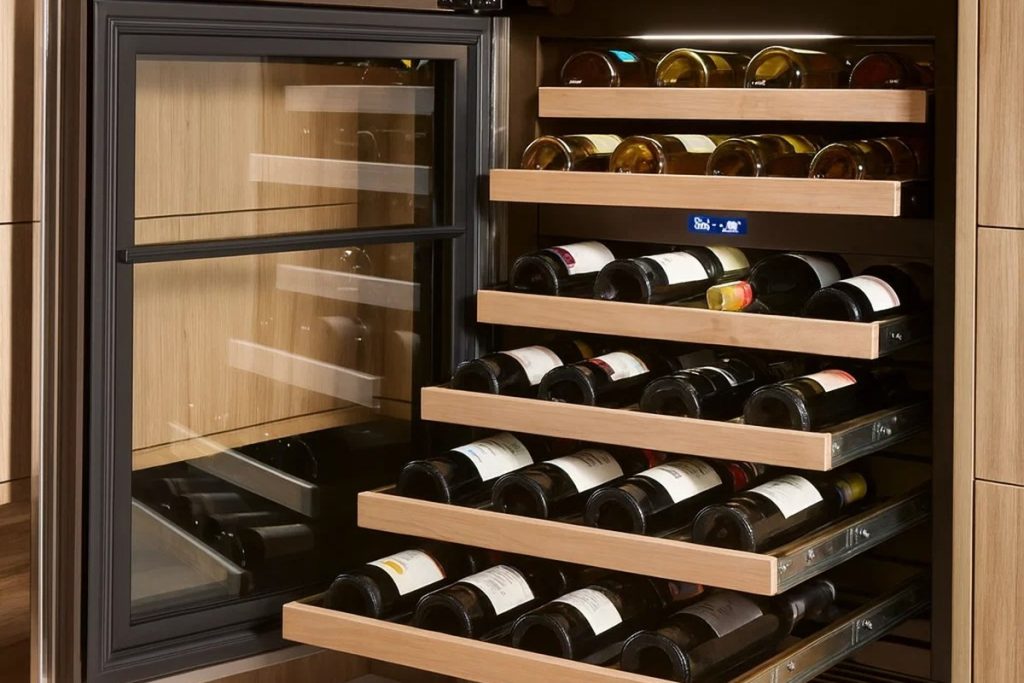
- Full-extension racks in Designer and Classic wine storage give access to every bottle without disturbing the rest. On the UW-24 undercounter unit, the racks are three-quarter extension.
- Coated racks. When Sub-Zero updated its Integrated (now Designer) wine storage in 2015, it said the racks are coated to cradle each bottle and prevent vibration.
- Racks sized for different bottles. Sub-Zero says the racks hold 750 ml bottles, half-bottles, and magnums. To store magnums, remove the rack above.
- A display rack on some models holds bottles so the wine stays in contact with the cork at any angle.
Like any refrigeration unit, a wine unit makes some sound while it runs. Sub-Zero lists humming, clicking, buzzing, and fan noise as normal. A noise that’s new or keeps getting louder is different. Clean the condenser, and if it continues, have the unit checked.
The Cooling System and Why Ventilation Matters
Each Sub-Zero wine unit has a compressor and a condenser, like a refrigerator. The condenser is behind the kickplate or grille, and it releases the heat removed from the cabinet.
Sub-Zero’s current guides note that its units use a flammable refrigerant and that only technicians trained to handle it should work on the refrigeration system. They also say to keep ventilation openings in the unit’s enclosure and the cabinetry clear. A built-in unit that can’t breathe has to work harder to hold its temperature.
Security and Alerts
Sub-Zero wine units include several features that protect a collection while you’re away:
- A door alarm on Designer wine units can be turned on and off, with adjustable volume, pitch, and delay.
- A temperature alarm on Classic wine storage chimes when a zone falls below 32°F or rises 15°F above its setting.
- A service indicator lights when the unit detects a temperature problem or the condenser needs cleaning.
- A home security connection on Designer and Classic wine units can link to a home security system. Sub-Zero says it can alert you to a power outage.
- An accessory lock, which Sub-Zero introduced with its 2015 Integrated (now Designer) wine storage update, keeps the door closed to anyone without the key.
Not sure your unit is working the way it should? Book a Sub-Zero wine storage check and we’ll take a look.
Care Sub-Zero Actually Recommends
Some maintenance checklists online come from other appliances. Here’s what Sub-Zero’s own guides say for its wine units:
- Clean the condenser every 6 to 12 months. On Designer wine units, it’s behind the louvered kickplate; on a column, open the door to reach it. Turn the unit off first, wear gloves for the sharp fins, and use a soft brush and a vacuum in the direction of the fins. Sub-Zero says condenser cleaning chemicals aren’t necessary and aren’t recommended. You don’t need to pull the unit out of its opening.
- Clean the inside with a mild solution of soap, water, and baking soda. Don’t use vinegar, rubbing alcohol, or other alcohol-based cleaners inside. Keep water off the lights, the control panel, and the wood facing on the racks.
- Clean the glass door with a standard glass cleaner.
- Remove all bottles before removing a rack.
- Give the unit 24 hours after a restart, a setting change, or a condenser cleaning before judging the temperature.
Sub-Zero’s Designer and Classic wine guides don’t list an air purification cartridge or a drain line among the owner’s tasks, so there’s nothing like that to replace or flush.
Conclusion
Sub-Zero wine storage controls the four enemies of wine with independent temperature zones, UV-resistant glass, dual evaporators, and racks that cradle each bottle. Red or white can go in either zone, the humidity isn’t adjustable, and small swings after the door opens are normal. The owner’s part is simple: choose the zone settings, keep the door closing and sealing, keep the ventilation clear, and clean the condenser on schedule.
If a zone won’t hold its temperature or the service indicator comes on, schedule Sub-Zero wine cooler repair. For an undercounter unit that’s running warm, see Sub-Zero undercounter wine cooler not cooling.
Our EPA 608 certified, background-checked technicians bring 15+ years in the field and work on Sub-Zero Designer, Classic, and undercounter wine storage. We use genuine OEM parts and back repairs with a warranty of up to 12 months. We’re a family-owned, insured, independent repair company, not affiliated with Sub-Zero, and we offer same- or next-day appointments when the schedule allows.
FAQ
Which zone should hold red wine in a Sub-Zero wine cooler?
Either one. Sub-Zero says red and white wine can be stored in whichever zone you prefer, and both zones can be set for either. Sub-Zero’s serving guide gives 55°F as the ideal long-term storage temperature for all wines.
What temperature range does Sub-Zero wine storage have?
Sub-Zero gives 40°F to 65°F for Designer wine storage (DEC, DET, IW) and Designer undercounter (DEU) units. Classic and UW-24 units range from 39°F to 65°F, depending on model and age. The refrigerator drawers in a DET3050WR run from 34°F to 45°F.
Can I adjust the humidity in my Sub-Zero wine unit?
No. Sub-Zero says the humidity level isn’t adjustable and doesn’t publish an average level. Its Integrated (now Designer) wine storage uses dual evaporators to keep humidity right, and some Designer models have a humidor feature.
Why does the temperature in my wine unit change a few degrees?
Sub-Zero says its refrigeration products can drift about 5°F either way with door openings, humidity, and room temperature. The display shows the set point, so to check the real temperature, put a thermometer in a glass of water in the middle of the unit for 12 hours.
Why did my new Sub-Zero wine unit cool one zone first?
That’s normal. Sub-Zero says that during the first 24 hours a new wine unit may cool only one zone at a time. Give it a full day before judging the temperatures.
How often should I clean the condenser on a Sub-Zero wine unit?
Every 6 to 12 months. On Designer wine units, the condenser is behind the kickplate. Turn the unit off, use a soft brush and a vacuum, and skip cleaning chemicals, which Sub-Zero doesn’t recommend.