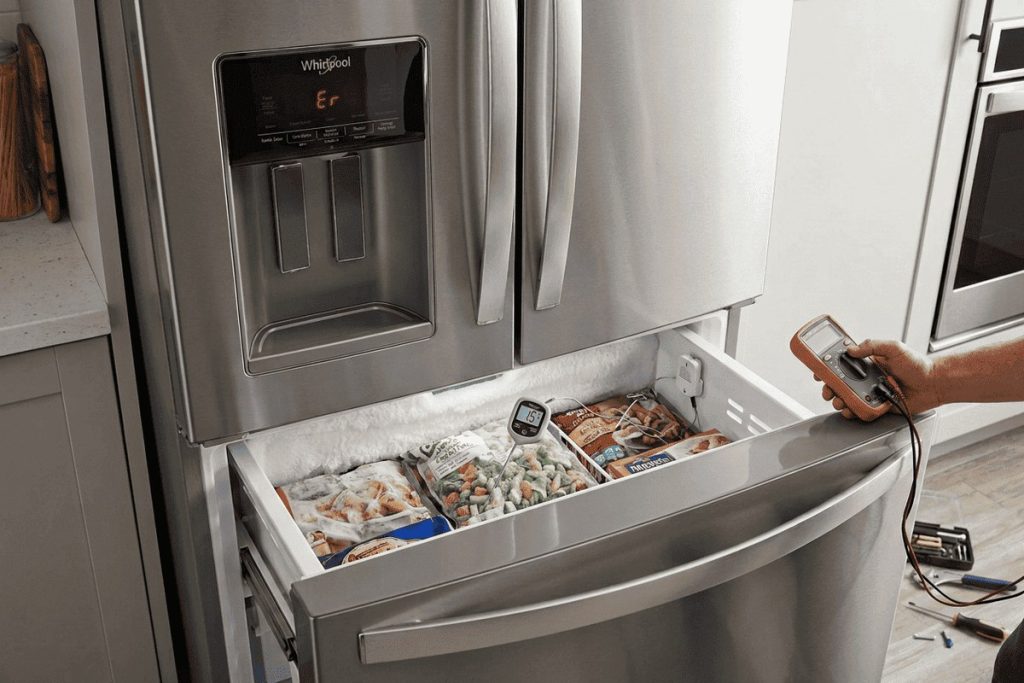
When a Whirlpool freezer displays Error Code ER, it feels like the appliance is telling you something important without saying what. The code often appears while the freezer is still running, which makes it difficult for homeowners to judge how serious the situation really is. The lights are on, the compressor hums, the ice cream still feels firm — and yet something isn’t right.
Let’s start with what Whirlpool itself publishes. Its product help site lists the codes and alerts its refrigerators and freezers use, and ER isn’t on any of those lists. So the useful first step isn’t guessing at a part — it’s reading the display, matching it to your model, and making a few free checks while you protect your food.
Below: what Whirlpool’s help pages actually say, the usual causes behind a freezer that drifts warm, what you can safely check, and when professional freezer repair is the most effective solution.
What Error Code ER Means on Whirlpool Freezers
Whirlpool’s help pages group their codes and alerts by appliance type:
- French door and bottom-freezer refrigerators — two-part codes that start with F, such as F3 E1 or FB E2, with the letter F flashing on the display;
- Side-by-side refrigerators — a flashing “F” on the display;
- French door and side-by-side refrigerators — PO after a power outage, plus a temperature alarm;
- Undercounter refrigerators, beverage centers and wine cellars — E1, E2, and HI or LO (beverage centers also list CL or LO);
- Chest and upright freezers — no error code list at all; instead, temperature alarms and indicator lights that vary by model.
ER doesn’t appear in any of these groups. And even for the codes it does list, Whirlpool doesn’t tell owners which part each one points to. Nearly every F-code page gives the same instruction: reset the refrigerator, and “If the problem persists, schedule service.”
So write down exactly what the display shows — every letter and number, whether it flashes, and which display it’s on — and compare it with the use and care guide for your exact model number.
Also check the badge. Some other refrigerator brands do use codes that begin with ER. LG, for example, lists ER FF and ER rF for a fan motor in the freezer or refrigerator compartment that may not be working properly. If your appliance isn’t a Whirlpool, follow its own manufacturer’s guide.
Many homeowners call us saying, “The freezer is still cold, but I’m getting this code.” In those cases, the appliance is telling the truth. It is still cooling, but it can no longer promise that temperatures will stay stable without intervention.
Standalone Freezers vs. Refrigerators With Freezers
Some Whirlpool upright freezers are frost-free and others are manual defrost — Whirlpool’s help pages point out that most freezers need to be defrosted by hand and don’t have an automatic defrost cycle. So a defrost-system failure only applies to frost-free models. In standalone freezers, temperature problems are more directly tied to a sensor or control failure, power-related electronic damage, blocked vents, or a door that isn’t sealing.
In refrigerators with freezer compartments, especially French door, side-by-side, and bottom-freezer models, the system is more complex. Whirlpool explains that most of these units use a shared cooling system: cold air is generated in the freezer and pushed into the fresh food section through vents. As a result, a problem in one area can indirectly affect the other.
What You Can Safely Check at Home
Safety first: every check here is a look-and-listen check. Don’t remove interior panels or covers, and don’t reach into any wiring. Whirlpool’s owner’s manuals warn that flammable refrigerant is used, that mechanical devices must not be used to defrost, and that refrigerant tubing must never be punctured. If you smell burning or see smoke, switch off the breaker and call for help.
There are a few basic observations homeowners can make without risking damage to the appliance:
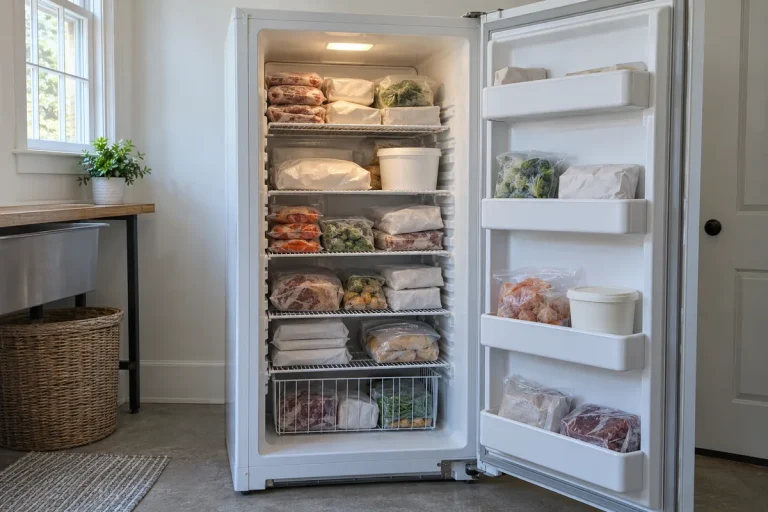
- Confirm that freezer vents are not blocked by food packages. In a Whirlpool upright freezer, cool air enters from the freezer wall, moves down, and returns through the vent near the bottom. Whirlpool says not to block any of these vents.
- Make sure the door is sealing properly. Whirlpool’s test: place a dollar bill or a piece of paper between the seal and the cabinet and pull it out. You should feel tension along the entire seal.
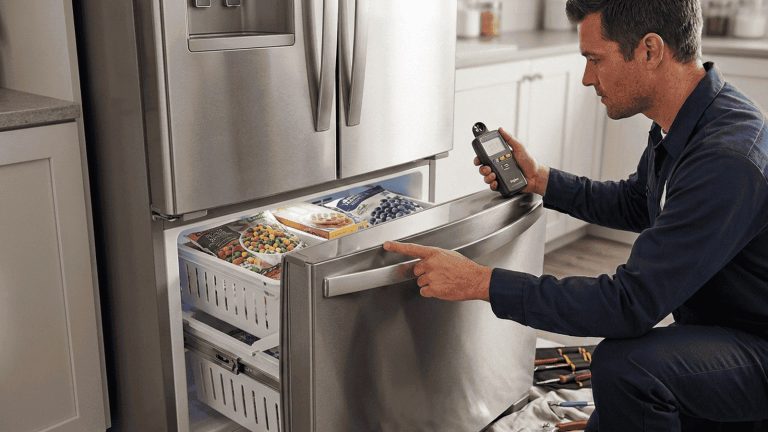
- Check the real temperature. Put an appliance thermometer in the freezer. The FDA says a freezer should be at 0°F (-18°C) and a refrigerator at or below 40°F (4°C).
- Confirm cooling is on. Some Whirlpool refrigerators and freezers have to be turned back on after a power outage or surge.
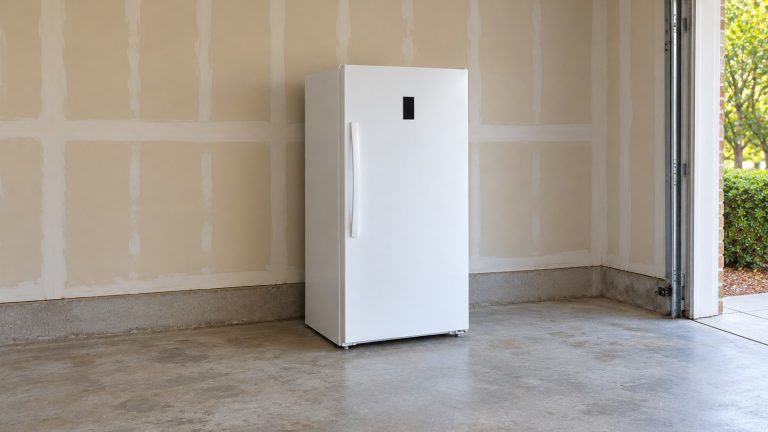
- Look at where it stands. Whirlpool’s French door, side-by-side and bottom-freezer refrigerators are designed for rooms between 55°F and 110°F (13°C to 43°C); its freezers, between 40°F and 110°F. A hot Georgia garage in August can push either past that.
Also rule out two display messages Whirlpool describes. COOLING OFF means cooling has been switched off, so neither section cools. Showroom or demo mode keeps the display and lights working while nothing cools; some models show “Demo,” “Showroom,” or “Shwrm.” Both are settings, not failures.
These checks help provide useful information, but they do not replace proper diagnosis. This is why we encourage homeowners only to observe, not to experiment, when a code appears.
Freezer Temperature Sensor and Thermistor Failure
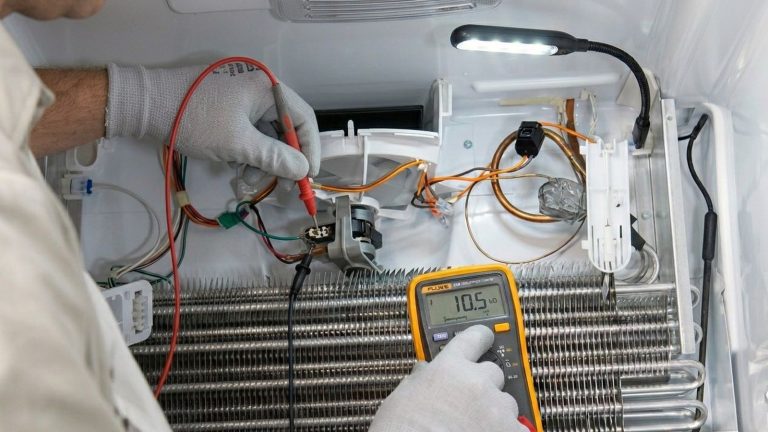
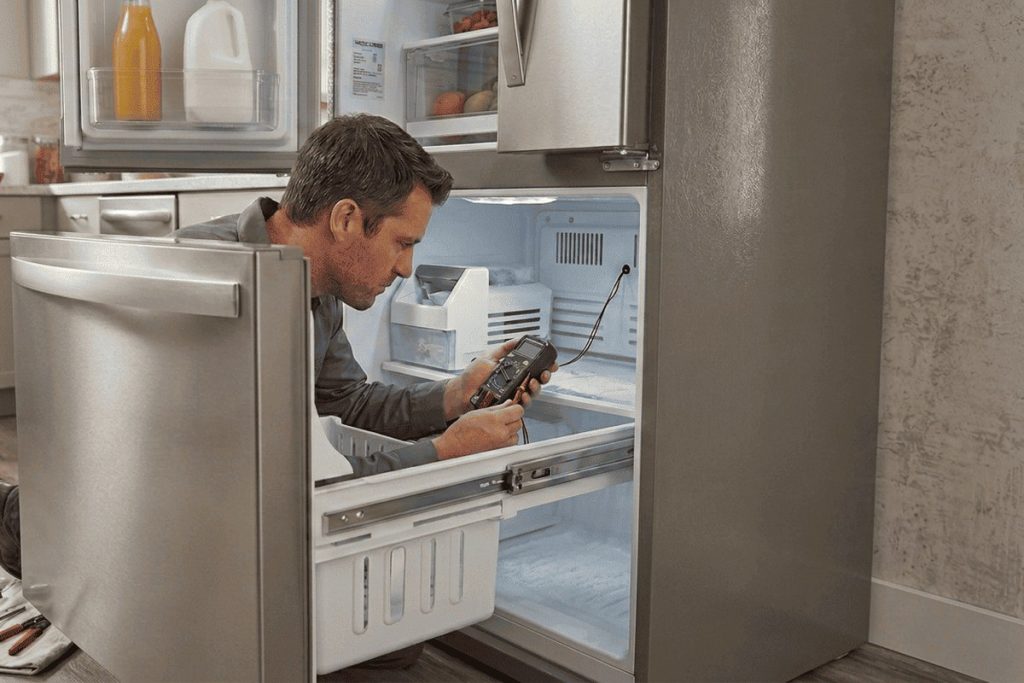
One of the most common reasons we are called out for a Whirlpool freezer that won’t hold temperature is a problem with the freezer temperature sensor, also known as the freezer thermistor. This issue rarely starts as a sudden breakdown. It usually develops gradually, which is why many homeowners do not connect early symptoms to a sensor problem until a code or an alarm appears.
What the Freezer Temperature Sensor Actually Does
On models with electronic controls, the freezer temperature sensor continuously measures the internal temperature of the freezer compartment. That information is sent to the control board, which then decides when to run the compressor and when to stop cooling. (Whirlpool notes many chest freezers use a mechanical dial instead.)
When the sensor begins to fail, the control board loses its reference point. In simple terms, the freezer no longer knows how cold it really is. A failing thermistor often keeps working but starts sending wrong readings. It reports temperature as electrical resistance, and when those values fall outside the expected ranges, the system recognizes that it can no longer trust the data.
Symptoms We Commonly See
- Frozen food becoming soft and then refreezing
- Ice cream that never fully hardens
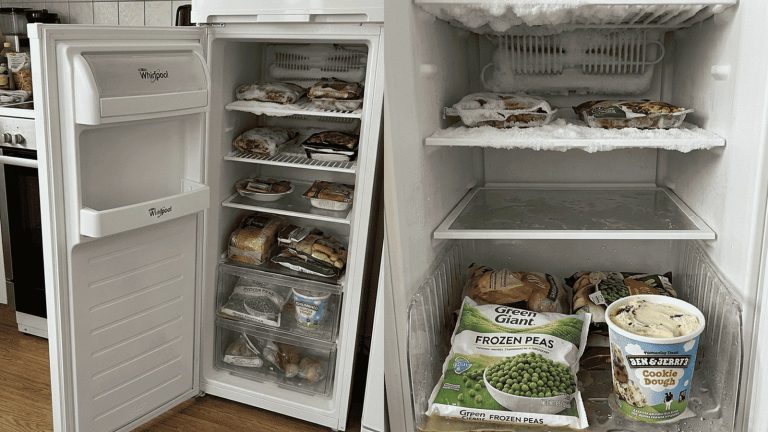
- Frost buildup on food packaging
- The freezer running longer than usual
A leaky door seal or blocked vents can create the same picture — which is why testing comes before buying parts.
Can This Be Safely Checked at Home?
There are limited, non-invasive checks homeowners can make:
- Make sure airflow inside the freezer is not blocked
- Avoid packing items tightly against the rear wall — Whirlpool warns that items pushed against the back and side walls can block the vents that distribute chilled air
- Note whether the freezer temperature changes after restocking. Whirlpool says a large load of food warms the freezer for several hours, and advises no more than 2 to 3 pounds of unfrozen food per cubic foot of freezer space
What we do not recommend is attempting to test or replace a sensor yourself. Checking a thermistor means opening panels and comparing readings against the specifications for your model — that’s technician work. Installing the wrong sensor or misreading values can lead to additional error codes or permanent damage.
Done the checks and the code is still there? Now it’s a job for someone who can test the sensor circuit.
Defrost Sensor and Defrost System Problems
Another major cause behind a Whirlpool freezer that slowly drifts warm is the defrost system — on frost-free models. Unlike temperature sensor problems, defrost failures often develop quietly. The freezer may appear to be cooling, but behind the panels, ice is slowly building where it should not.
How the Defrost System Is Supposed to Work
Whirlpool explains frost-free operation simply: moving air collects moisture and deposits it on the cooling coil. The coil periodically warms up enough to melt the frost, and the water flows down to a drain pan behind the base grille, where it evaporates. When everything works as designed, this process happens without the homeowner ever noticing.
On a manual-defrost model, there’s no defrost system to fail — managing frost is part of ownership. Whirlpool says to defrost and clean it when frost builds up to about 1/4 inch (6 mm), and at least once a year, more often in high-humidity areas. A humid Atlanta summer counts.
What Happens When a Defrost Part Fails
When a defrost part begins to fail, the defrost cycle may never complete, or never start at all. Frost stays on the cooling coil and continues to accumulate behind the interior panels, so the problem is often invisible until performance is affected. Homeowners usually notice:
- Freezer temperatures that slowly rise
- Uneven cooling inside the freezer
- Frost or snow forming on food packages
- Fan noise changing or becoming louder
Whirlpool puts the mechanism plainly: accumulated frost can block airflow, making it harder for the freezer to maintain the set temperature. Caught early, it’s usually a simpler repair.
What Homeowners Can Safely Do
- Check for visible frost buildup, especially on the back wall or around the vent cover
- Listen for changes in fan operation
- Rule out the door: Whirlpool notes that frequent door openings let in humid room air, and during humid months some frost on interior walls or food packages is normal
What we strongly advise against is manually chipping ice or using heat tools inside the freezer. Whirlpool’s warnings are blunt: don’t use mechanical devices to defrost, and don’t use an ice pick, knife, or other sharp-pointed tool, because damage can occur.
High Temperature Alarms and Freezer Overheating
Beeping or a flashing light may be one of Whirlpool’s temperature alarms. Unlike ER, these are documented:
- French door and side-by-side refrigerators with the over-temperature feature alert you when the refrigerator rises above 48°F (9°C) or the freezer rises above 15°F (-9°C) for more than 1½ hours. The sound stops once the temperature returns to normal, but the indicator keeps flashing until you press Alarm.
- Upright and chest freezers with a temperature alarm buzz if the freezer reaches 10°F (-12°C) or more above normal for your selected setting.
- Convertible chest freezers use lights: red means the temperature isn’t low enough, green means the compressor is running.
In our experience, these alarms are most commonly triggered by a failing sensor, ice buildup from a defrost failure, restricted airflow, a recent power outage, or a door left open. Even if the freezer cools again afterward, repeated alerts suggest the underlying cause has not been resolved.
Power Interruption Issues
The PO power outage code is real on Whirlpool refrigerators. It appears when the power supply has been off and the freezer temperature has risen to 18°F (-8°C) or higher. The display reads “PO,” an alert tone sounds three times, and “Confirm” blinks until you acknowledge it. After a power outage, this is one of the first things to rule out — and once the power comes back, check that cooling is on.
For its chest and upright freezers, Whirlpool’s advice is to keep the door closed during an outage of 24 hours or less, then unplug the freezer for 30 minutes after the power is restored to allow the refrigeration system to equalize. The FDA adds that a full freezer holds its temperature about 48 hours with the door shut, and food that still has ice crystals or is at 40°F or below can be refrozen.
Wiring, Connectors, and Control Boards
Behind any code, a technician also checks the wiring and control electronics for surge damage, loose connections, or a failing control board. Proper diagnosis is essential, as replacing the wrong board often leads to repeat failures.
Why Resetting Rarely Solves the Code
Whirlpool’s reset, as its code pages describe it:
- Power the unit down by turning off the circuit breaker or unplugging it for one minute.
- Power it back up.
- Make sure the cooling function is turned on.
- Watch it for one minute to be sure the code doesn’t display again.
If the code comes back, Whirlpool’s next step is to schedule service. A reset does not fix a sensor that is drifting out of range or a defrost component that is starting to fail — a code that returns needs testing, not another reset.
What to Do When Whirlpool Error Code ER Appears
- Write down exactly what the display shows, plus your complete model and serial number and the purchase date — Whirlpool’s guide asks for exactly that when you call.
- Check the badge, and rule out COOLING OFF, showroom mode, and PO.
- Do one reset exactly as Whirlpool describes.
- Make the free checks and protect your food if the freezer is above 0°F and climbing.
- If the code or alarm returns, schedule service.
From our experience, codes like this rarely resolve on their own. If your Whirlpool is fairly new, check its warranty document or contact Whirlpool before booking a repair.
When to Call for Repair
Book a visit if:
- the code returns after Whirlpool’s one-minute reset;
- the freezer reads above 0°F, or temperatures keep swinging;
- a temperature alarm keeps going off, or frost keeps building on the back wall;
- the refrigerator section is warming while the freezer seems only partly effective.
Frequently Asked Questions
What does Whirlpool Error Code ER mean?
Whirlpool’s help pages don’t list ER for its refrigerators or freezers. They list two-part F codes, a flashing F, PO, temperature alarms, and E1, E2, HI or LO on undercounter units. Write down exactly what you see, check the badge, and read the guide for your model.
Is it safe to keep food in the freezer with a code on the display?
Check the real temperature with an appliance thermometer. The FDA says a freezer should be at 0°F. If it holds there, the food is fine for now. If it’s climbing, move high-risk food to another freezer or a cooler with ice.
Can a power outage cause a code on a Whirlpool?
Yes — Whirlpool’s code for that is PO. It appears when power was off and the freezer warmed to 18°F or higher, with a tone that sounds three times. Acknowledge it, check that cooling is back on, and watch the temperature. If other codes or alarms follow, book a diagnosis.
Will unplugging the freezer fix the problem?
Whirlpool’s reset is one minute off, power back on, cooling on, then one minute of watching. It may clear a temporary glitch, but it won’t fix a failing sensor or defrost part. If the code returns, schedule service.
Which Whirlpool models show error codes?
On Whirlpool’s help pages, French door and bottom-freezer refrigerators use two-part F codes such as F3 E1, side-by-side models show a flashing F, and undercounter units use E1, E2, HI or LO. Chest and upright freezers rely on alarms and indicator lights instead of a code list.
Is this a repair or replacement situation?
A code alone doesn’t tell you that. Most temperature problems we trace come down to a sensor, a defrost part, airflow, a door seal or wiring — targeted repairs, not a new freezer. A diagnosis shows which part failed and whether fixing it makes sense at that age.
Why Homeowners Call Us
PRO Appliance Repair is a family-owned, insured company with more than 15 years of experience. Our technicians are EPA 608 certified and background-checked, and we repair with genuine OEM parts. Our warranty covers parts and labor for up to six months, and same- or next-day appointments are available across the Atlanta area.
Book a visit from our freezer repair page.
Disclaimer: PRO Appliance Repair is an independent repair company and is not affiliated with or endorsed by Whirlpool Corporation or LG Electronics. All trademarks belong to their respective owners.