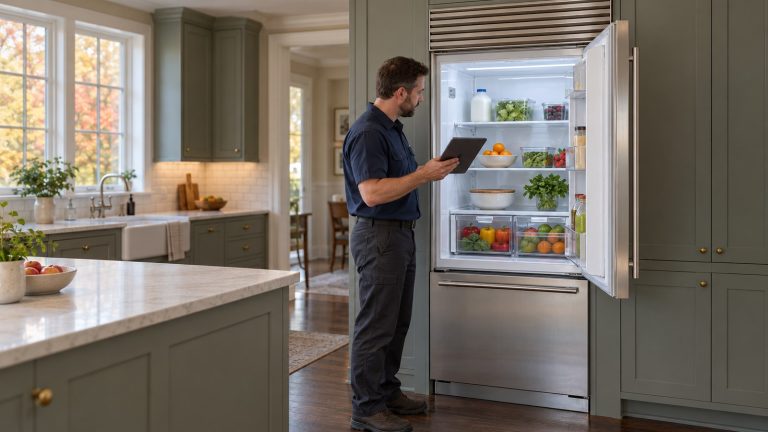
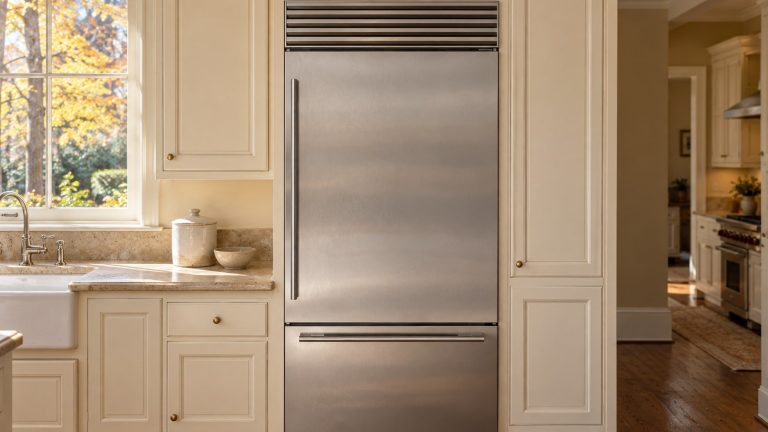
Your Sub-Zero is acting up. Maybe it runs louder than it used to, maybe there’s water under the crisper drawer, maybe the display is flashing something you’ve never seen before. When something goes wrong, it’s only natural to think, “I can probably fix this myself and skip the service call.” We get it. We hear that from homeowners across metro Atlanta all the time — often after they’ve already tried to handle things on their own.
The truth is, some problems are simple enough for DIY, while others can quickly turn into bigger, more expensive headaches if handled incorrectly. In this guide, we’ll walk you through how to know when to call service and when it’s smarter to step back. We’ll also compare professional vs. DIY repair so you can make an informed choice that protects your fridge, your wallet, and your safety. Rather have a technician look at it now? Our Sub-Zero refrigerator repair team can take it from here.
We’ve seen both sides: homeowners who clean a condenser and get their unit back on track, and others who lost part of their warranty coverage or caused more damage trying to open the sealed system. Our goal is to help you know the difference before you pick up a screwdriver.
Here are the facts from years of working on these units.
Safety first: Everything in the do-it-yourself part of this guide happens at the control panel, the circuit breaker, the grille or kickplate Sub-Zero designed to be opened for cleaning, or with a soft cloth. Sub-Zero built-ins are secured in their opening with anti-tip brackets — don’t pull one out, and don’t remove covers to reach wiring or tubing. Smell burning? Switch off the breaker and call for service.
Pros of DIY Repair
For the right kind of issue, tackling it yourself can be a smart move. Here are the main advantages we see homeowners enjoy when they handle simple tasks on their Sub-Zero:
- Saves money. No labor charges, no service call fees. Cleaning the condenser takes a vacuum with a soft brush attachment; swapping a water filter takes a new filter and a few minutes.
- Gets the problem fixed faster. You don’t have to wait for an appointment. If your Sub-Zero has gotten louder, Sub-Zero’s own first step is cleaning the condenser — something you can do that afternoon and be done.
- Gives you peace of mind. Knowing you’ve done the maintenance yourself can feel good — especially when temperatures settle back where they belong.
- Builds basic appliance knowledge. Simple fixes teach you how your Sub-Zero works — handy for spotting small issues early.
- No scheduling hassles. You control the timing. Free on a Saturday afternoon? Knock it out.
When the job is straightforward — like cleaning the condenser or replacing a filter — DIY is often the quickest, cheapest way to get back to normal.
Pros of Professional Repair
When the problem is beyond basic maintenance, bringing in an experienced technician is usually the safer, smarter choice. Here’s what you gain by calling a pro:
- Access to specialized tools and parts. We carry genuine OEM parts and diagnostic equipment you can’t buy at a hardware store — most repair parts aren’t sold to the public.
- Avoids voiding your warranty. Sub-Zero’s warranty doesn’t cover defects caused by improper service or repair, and repairs under that warranty are done by Sub-Zero’s own service network. Any alteration of sealed-system components voids the sealed-system warranty. That’s exactly why the order of your calls matters.
- Avoids safety risks. Handling refrigerant, live electrical components, or the sealed system can be dangerous without proper training and equipment.
- Saves time and prevents bigger problems. A quick, accurate diagnosis stops a small leak or an overworked compressor from turning into a much bigger repair. We’ve seen homeowners spend far more after a DIY attempt went wrong.
- Peace of mind from expertise. You’re not guessing — you’re getting a tech who works on Sub-Zero units regularly and knows the common failure points in a hot, humid Southern climate.
If any of these sound familiar, call sooner rather than later. Already worked through the basics and it’s still not right? You’ve done the hard part — let us finish the job.
Jobs You Can Do Yourself
There are several straightforward tasks that are safe and effective for most homeowners to handle themselves.
Not sure which model you have? The model number and the manufacture date are on the serial tag inside the unit — handy for both the owner’s manual and warranty questions.
Here’s what we recommend trying on your own, in this order:
- Clean the condenser. Sub-Zero says every six to twelve months — more often if you have pets. Turn the unit off at the control panel first. On Classic (BI) models, lift and rotate the grille at the top; on Designer (IT, IC, ID) models, remove the louvered kickplate at floor level; other lines have their own steps in the Use & Care Guide. Use a soft brush attachment on a vacuum, don’t bend the aluminum fins, and skip chemical cleaners — Sub-Zero doesn’t recommend them. A dirty condenser makes the unit work harder and can lead to temperature loss or mechanical damage.
- Replace the water filter. Change it when the filter indicator appears on the display, or after about a year — poor water quality can wear a filter out sooner. On Classic and PRO models, the filter sits behind the top grille; on Designer tall and column models, behind a small door at the top of the interior. Afterward, discard the first several glasses of water and the first two containers of ice. Not every Sub-Zero has a filter: undercounter units and Designer drawers don’t.
- Clean the door seals. Turn the unit off and wipe the gasket with mild detergent and water on a soft cloth; a baking soda paste handles tough stains, and a 1:10 bleach-to-water mix takes care of mildew — never mix bleach with other cleaners, and rinse and dry the seal afterward. Skip vinegar and rubbing alcohol, which can damage some plastic parts. Check for gaps by closing the door on a dollar bill at a few points along the seal — if it pulls out easily, that spot may not be sealing. A ripped, torn, or cracked gasket should be replaced, and Sub-Zero recommends a service technician for that job.
- Check that the doors close — but leave leveling to a pro. An uneven unit or a crooked door can cause noise or poor door closure. Remove anything blocking the door, like an overfilled bin or a jar against the gasket. Beyond that, door alignment and leveling on a built-in Sub-Zero are installation adjustments made at the hinges, and a misaligned freezer drawer needs service.
- Water pooling inside? Wipe it up — don’t flush the drain. Water under the crisper drawers often means a clogged drain tube along the back wall. On Classic (BI), Designer (IT, IC, ID), 700, 400, and 648PRO models, Sub-Zero says a technician has to clear it. What you can check: settings at 38°F (3°C) and 0°F (−18°C), a condenser cleaned within the last 6 to 12 months, a door that closes fully, and a gasket free of rips.
- Reset the controls. Built-ins are hard to unplug, so use the breaker: switch the refrigerator’s circuit off for 30 seconds, then back on, and make sure it isn’t on a tripped GFCI outlet (the kind with Test and Reset buttons). Write down any code on the display first. And check the simple things: double dashes (–) mean a zone is turned off, a dark interior can make the backlit display look dead, and Sabbath Mode changes how the panel behaves.
These are low-risk jobs with high payoff. If you start one and realize it’s more complicated than expected, or if you’re uncomfortable, that’s exactly when to call a repair professional — better to stop early than cause damage.
Jobs to Leave to a Technician
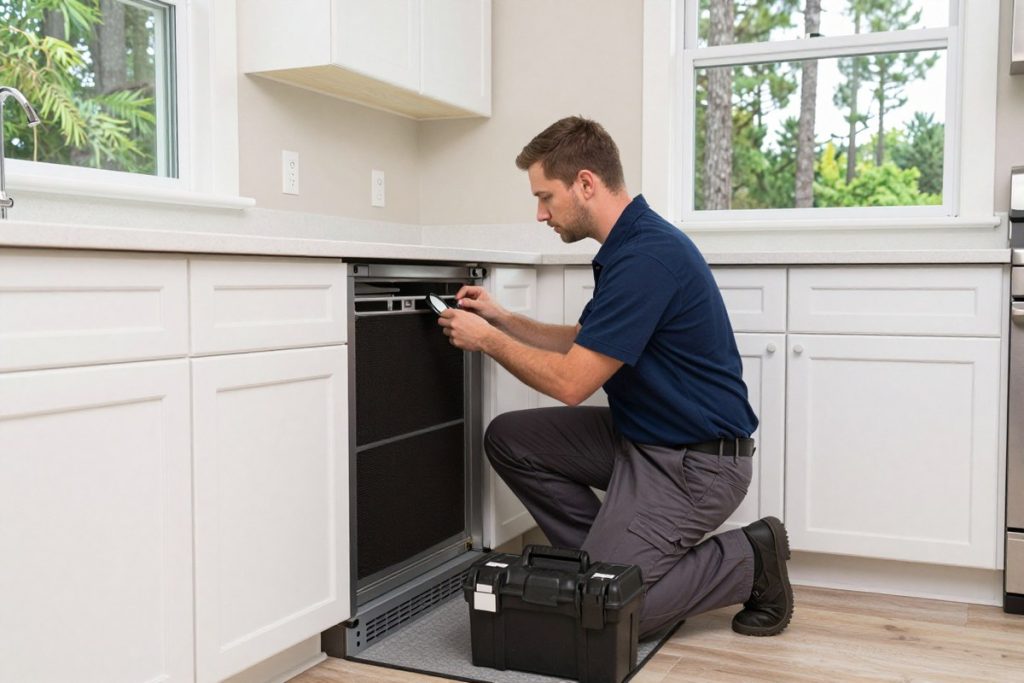
Some problems are too complex or risky for even experienced homeowners. Below are problems you shouldn’t fix yourself — the signs you need a technician that we see most often.
Refrigerant Leaks
Refrigerant is hazardous and tightly regulated. Under Section 608 of the Clean Air Act, the EPA requires EPA 608 certification for technicians who service equipment that could release ozone-depleting refrigerants. A leak leaves the system short of refrigerant, and the unit slowly loses its ability to cool. Check the installation date first: Sub-Zero’s sealed-system warranty covers parts and labor for five years and sealed-system parts for twelve — though not the refrigerant gas itself.
Sealed System Work
This includes the compressor, evaporator, condenser, drier (a small moisture filter in the refrigerant line), and the tubing that connects them. Opening the sealed system requires specialized tools and training. Mistakes can ruin the entire unit — and any alteration or relocation of sealed-system components voids the sealed-system warranty.
Electrical Problems
Control boards, wiring harnesses, fan motors, and lighting run on household current and carry real shock risk. Even a small misstep can cause injury or further damage.
Error Codes and Control Panel Failures
Modern Sub-Zero units have complex electronics. Designer (DET, DEC) models show three-number codes — 10 1 11, for example, points to a short in the Zone 1 evaporator thermistor (a temperature sensor). Classic (BI) and Designer (IT, IC, ID) models can flash “Service,” and Sub-Zero’s first response to that is a condenser cleaning. Misreading codes or replacing the wrong part often leads to bigger problems down the line. If the code comes back after a breaker reset and a condenser cleaning, call.
Compressor Replacement or Diagnosis
Compressors are expensive and delicate. A pro can tell if it’s truly failed or just overworking because of a dirty condenser, a door that isn’t sealing, or a hot room. Know what’s normal, too: Classic (BI) and Designer combination units have two compressors that can run at the same time, so the unit may seem to run non-stop. Variable-speed compressors always start at high speed — sometimes with a high-pitched whine — then slow down after about five minutes.
Noises: What’s Normal and What Isn’t
Here’s where Sub-Zero surprises people: it lists banging, buzzing, clicking, rattling, vibration, humming, and fan motor noise as normal. Gurgling or hissing usually comes from defrost water draining or from the evaporator. What’s worth a call is a noise that’s new, keeps getting louder, or won’t go away — especially alongside warmer temperatures. Clean the condenser first; if the sound still grows, it needs expert diagnosis.
The safety risks are real: electrical parts carry a shock risk, and a slip with a tool can cause a refrigerant leak.
That matters even more on a Sub-Zero, where parts and systems are built to very tight tolerances.
For these kinds of repairs, trust our team. We’ve been fixing Sub-Zero units for 15+ years, using genuine OEM parts only — we’ll get it back in shape safely and correctly.
Why Homeowners Call Us
We’ve been working on Sub-Zero refrigerators and freezers for 15+ years — and we’ve learned exactly what these units need to run right in a hot, humid climate.
Here’s what sets us apart:
- Genuine OEM parts (made by the original manufacturer) — no cheap generics that fail early.
- Our own warranty: our warranty covers parts and labor for up to 12 months.
- EPA 608 certified technicians, so refrigerant work is done safely and legally. Every technician is background-checked, too.
- Fast response: most days, same- or next-day across metro Atlanta.
- Family-owned and insured.
You might be wondering if it’s worth calling a specialist instead of a general handyman. The answer is yes — especially when it’s your Sub-Zero. And if your unit is still inside Sub-Zero’s two-year full warranty, we’ll tell you to call Sub-Zero first: there’s no reason to pay for a repair the warranty covers.
Conclusion
Deciding between professional vs. DIY repair comes down to understanding what’s at stake: your safety, your warranty, and the long-term health of your Sub-Zero refrigerator. Simple tasks like cleaning the condenser, changing the filter, or cleaning the door seals are safe and effective to handle yourself. But when you hit anything involving refrigerant, the sealed system, electrical components, a clogged drain tube, or complex diagnostics, the risks far outweigh the savings.
An experienced technician brings the right tools, training, and genuine parts to find the real fault and fix it properly — and protect everything you’ve invested in.
The bottom line? Know your limits. When in doubt, call a pro. Sub-Zero says its products are built and tested to handle at least 20 years of everyday use, and with the right care (and the right help when needed), yours can. Book Sub-Zero refrigerator repair and we’ll take it from there.
FAQ
When should I contact service for a suspected refrigerant leak?
If cooling keeps getting worse after you’ve cleaned the condenser and checked the door seals, or you notice oily stains near the unit, call a pro right away. Hissing alone isn’t proof — Sub-Zero says it’s usually a normal drain or evaporator sound. A leak in the first five years may fall under Sub-Zero’s sealed-system warranty.
Can I replace the compressor on my Sub-Zero myself?
No. Compressor replacement is sealed-system work that requires special tools, refrigerant recovery, and EPA 608 certification. Altering sealed-system components voids the sealed-system warranty — and within five years of installation, a defective compressor is covered for parts and labor anyway.
How do I know if a repair will void my warranty?
Sub-Zero’s warranty doesn’t cover defects caused by improper service or repair, and altering sealed-system components voids the sealed-system coverage. For the first two years — five for the sealed system — warranty repairs go through Sub-Zero’s own service network, so call Sub-Zero first. From year six through twelve, sealed-system parts are covered but labor isn’t; with an independent technician, you request those parts from Sub-Zero yourself.
What should I do if my Sub-Zero shows an error code I don’t understand?
Write it down, then switch the breaker off for 30 seconds and back on — Sub-Zero’s first step for Designer (DET, DEC) codes. If “Service” is flashing, clean the condenser and give temperatures up to 24 hours. If the code returns, don’t keep troubleshooting — call a technician.
How often should I clean the condenser on my Sub-Zero?
Every six to twelve months, per Sub-Zero, and more often if you have pets. Vacuum with a soft brush behind the top grille (Classic) or the kickplate (Designer), and don’t bend the fins. If temperatures haven’t recovered within 24 hours, schedule service.
My Sub-Zero is still under warranty. Should I call you or Sub-Zero?
Call Sub-Zero first. Its residential warranty covers the whole unit, parts and labor, for two years from installation, and the sealed system for five. We’re the team to call once that coverage has ended, or for problems the warranty doesn’t cover.
PRO Appliance Repair is an independent repair company and is not affiliated with, sponsored by, or endorsed by Sub-Zero Group, Inc. Brand and model names are used only to identify the appliances this page is about and remain the trademarks of their respective owners.