You open the freezer, glance at the control panel, and instead of a temperature you see E1. The freezer is still running. The food still feels frozen. But the code won’t go away, and you’re wondering whether this is a small glitch or the start of something expensive.
Here’s the reassuring part: a code on the display means the electronic control has noticed something it doesn’t like, and it’s telling you before the problem gets bigger. Caught early, most code-related repairs on an Electrolux freezer are contained jobs, not the end of the appliance. If you’d rather have someone look at it right away, our Electrolux freezer repair team works on upright freezers and bottom-freezer refrigerators.
Before we go further, one honest note. You’ll find plenty of websites that give E1 a single, confident meaning. We read the Electrolux owner’s guides for the models people most often ask about — the EI33AF80WS1 and EI32AF80QSA upright freezers and the EW28BS85KS8 bottom-freezer refrigerator — and none of them list E1. So this guide tells you what those guides do say about codes and alarms, what a code like E1 most often turns out to be on a service call, the safe things you can check yourself, and when it’s time for a technician.
What Triggers Error Code E1 in Electrolux Freezers?
Because Electrolux doesn’t publish a meaning for E1 in these guides, nobody can tell you exactly what it means from the code alone. Only a diagnosis can. What we can tell you is where a code like this usually leads when a technician opens the freezer up. On an electronic freezer control, it’s most often one of these.
A temperature sensor problem
Freezers use small sensors, called thermistors, to tell the control how cold it is inside the cabinet and around the cooling coils behind the back panel. A sensor that fails, or one that’s encased in ice, sends readings that don’t make sense, and the control flags it.
This is the one area where an Electrolux guide does speak directly. The IQ-Touch freezer guide (EI32AF80QSA) describes a “Temp Sensing Error Alarm”: when a temperature sensor has a problem, the alarm sounds after one hour, the display alternates between E8 or E9 and -10°F, and the control switches into a mode that keeps running the freezer at its preset temperature. So on that model, a sensor fault has its own codes, and they aren’t E1.
Frost buildup around the coils
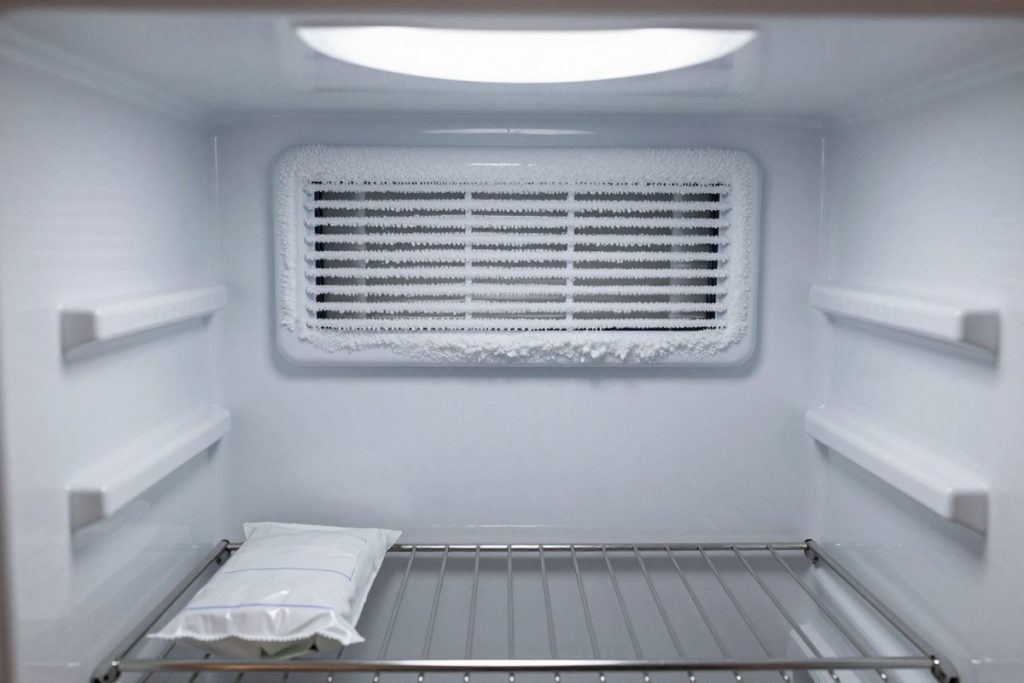
On a frost-free freezer, a defrost system regularly melts the frost off the coils. If any part of that system stops working, ice keeps building up. Heavy frost blocks airflow, and it can surround a sensor so its readings drift. A freezer in this state often shows other signs too: frost on the back wall, a fan that sounds muffled, or a cabinet that’s colder in some spots than others.
Humid summers make this worse. A door gasket that doesn’t seal well lets warm, moist air in, and that moisture freezes on the coils.
Damaged wiring or a loose connection
The wires between the sensors and the control can get pinched, corroded, or pulled loose — more likely after the freezer has been moved, or when it lives in a garage where moisture and pests are a factor.
A control board problem
The control board reads every sensor and runs the freezer. A failing board can misread signals or show a code even when temperatures are fine. It’s usually the last thing a technician concludes, after the sensors and wiring check out.
These causes rarely appear overnight. They build up gradually, and a code on the display is the freezer’s way of asking to be checked before food starts to thaw.
E1 on your display right now? Don’t wait for it to grow into a bigger problem. A quick diagnosis is the surest way to protect your food.
What the Electrolux Guides Do Say About Codes and Alarms
E1 isn’t in the guides, but several codes and alarms are, and you may see them alongside it. Here’s how the three guides describe them:
| What you see | Which guide | What it means there |
|---|---|---|
| HIGH TEMP light and alarm | IQ-Touch freezer (EI32AF80QSA) | The cabinet has gone above 23°F; the alarm sounds after one hour and stays on until the cabinet drops back below 23°F |
| HIGH TEMP light and alarm | 2020 upright freezer (EI33AF80WS1) | The temperature has risen above a safe range; you reset it by pressing HIGH TEMP |
| POWER OUTAGE / POWER FAIL light | Both freezer guides | Power was interrupted and the inside may have warmed up; check your food, then reset the light |
| DOOR AJAR / DOOR OPEN | Both freezer guides | The door has been open 5 minutes or more |
| E7 | IQ-Touch freezer | A key has been held or stuck for more than 30 seconds |
| E8 or E9 | IQ-Touch freezer | A temperature sensor problem |
| Flashing digital displays | Bottom-freezer refrigerator (EW28BS85KS8) | The control has detected a performance problem; an Electrolux service representative can interpret the codes |
The pattern is worth noticing. Whenever a guide ties a code to a sensor or a performance problem, the answer is a service visit, not a home fix. That’s the safest way to treat E1 too.
Which Models Show Error Codes?
Any Electrolux freezer or refrigerator with an electronic touch control can show codes on its display, on current models and older ones alike. The ones owners ask us about most:
- EI33AF80WS1 — an upright all-freezer. Its 2020 owner’s guide covers door open, power outage, and high-temperature alerts, but no numbered codes.
- EI32AF80QSA — an upright freezer with the IQ-Touch control. Its guide lists E7, E8, and E9.
- EW28BS85KS8 — a bottom-freezer refrigerator. Its guide sends flashing codes to an Electrolux service representative.
- EI28BS80KS — another bottom-freezer refrigerator. The guide we could find for it is a scan without a text layer, so we haven’t quoted it here.
If your model isn’t listed, the advice below still applies. You’ll find the exact model and serial number on the serial plate inside the unit — your owner’s guide shows where. Write both down before you call for service.
Handling Error Code E1: DIY or Call a Pro?
When E1 appears, most people ask the same thing first: can I clear this myself, or do I need a technician? The honest answer: a few basic checks are worth doing, but a code that keeps coming back needs a technician with the right tools.
Safe things to check at home:
- Write down exactly what the display shows. Note the code, any lights that are on (HIGH TEMP, POWER OUTAGE, DOOR OPEN), and whether the display alternates between the code and a temperature. Take a photo. This is the most useful thing you can give a technician.
- Make sure the door closes and seals. Look for something inside holding the door open, and run a hand along the gasket for gaps. Both freezer guides sound an alarm if the door stays open 5 minutes or more.
- Look at the back wall. A thick layer of frost or ice behind the panel points toward a defrost problem. Don’t chip at ice with anything sharp — the 2020 upright guide warns that the refrigerant is flammable, and says not to use mechanical devices to defrost or puncture the refrigerant tubing.
- Check the room. The 2020 upright guide warns against installing the freezer where the temperature drops below 0°F or rises above 110°F, because the compressor can’t hold proper temperatures there. It also says not to block the lower front of the appliance, since it needs air circulation.
- Check the temperature. If the display shows a real temperature between code flashes, note it. The IQ-Touch freezer can be set anywhere from -10°F to 10°F.
You’ll see advice online to unplug the freezer for 10–15 minutes to “reset” the code. None of the three guides offers that as a fix for codes. If the power was interrupted anyway and the code comes back, treat that as confirmation that something real is wrong, not as a reason to keep cycling the power.
If the code returns, stop there. Going further inside risks damaging wiring or parts.
What a technician does:
- Reads the code and the control’s behavior to see which part is involved
- Tests the sensors, wiring harness, and control board with a meter
- Checks the defrost system and clears any hidden ice
- Replaces the faulty part with a genuine OEM part matched to your model
- Runs the freezer and confirms it holds a steady temperature before leaving
In our experience, trying to swap sensors or boards yourself usually ends up costing more. A part that doesn’t match your model, or a connector damaged on the way out, turns one repair into two.
E1 got you stumped? Our Electrolux freezer repair technicians can diagnose it and get your freezer back on track.
Conclusion
An E1 on your Electrolux freezer isn’t something to lose sleep over. It’s the control telling you something needs a look before it turns into a bigger problem. Electrolux’s guides don’t give E1 a meaning, so the right first move is the same as for any unexplained code: write it down, rule out the simple things — the door, the room, the frost on the back wall — and keep an eye on the temperature.
If the code stays or comes back, a technician can find the actual cause, whether that’s a sensor, a defrost problem, wiring, or the control board. Our EPA 608 certified, background-checked technicians bring 15+ years in the field, use genuine OEM parts, and back repairs with a warranty of up to six months. We’re a family-owned, insured, independent repair company, not affiliated with Electrolux. We offer same- or next-day appointments when the schedule allows.
For other display codes, see our guide to Electrolux error code E2. For other Electrolux appliances, start at our Electrolux repair page.
FAQ
My Electrolux EI33AF80WS1 started showing E1 after a power outage. What should I do first?
Check whether the POWER OUTAGE light is on — the 2020 upright guide says it means the inside may have warmed beyond a safe range. Check your food, then reset the light. Note what the display shows. If E1 stays or comes back once power is steady, book service.
What does E1 mean on an Electrolux freezer?
The Electrolux owner’s guides we checked don’t list E1, so there’s no Electrolux meaning to quote. On a service call, codes like this most often trace back to a temperature sensor, frost on the coils, wiring, or the control board. A technician has to test the parts to know which.
Does E1 mean my food is thawing right now?
Not necessarily, but the freezer may not be holding a steady temperature. If the HIGH TEMP light is on too, the inside has warmed up — on the IQ-Touch model that means above 23°F. Move what you can to another freezer and book service soon.
Can humid weather cause an Electrolux freezer code?
It can contribute. Warm, moist air that gets past a worn door gasket freezes on the coils. If the defrost system can’t keep up, frost can surround a sensor and throw off its readings. Keep the door seal clean and the door fully closed.
How long can I run my freezer with E1 showing?
Only as long as it takes to arrange a repair, and only while it’s still holding temperature. Watch the display and the HIGH TEMP light. If the temperature climbs or food softens, move it to another freezer.
Will a new control board always fix E1?
No. A board is replaced only after the sensors and wiring test good. Replacing a board first is an expensive guess that often leaves the real problem in place.