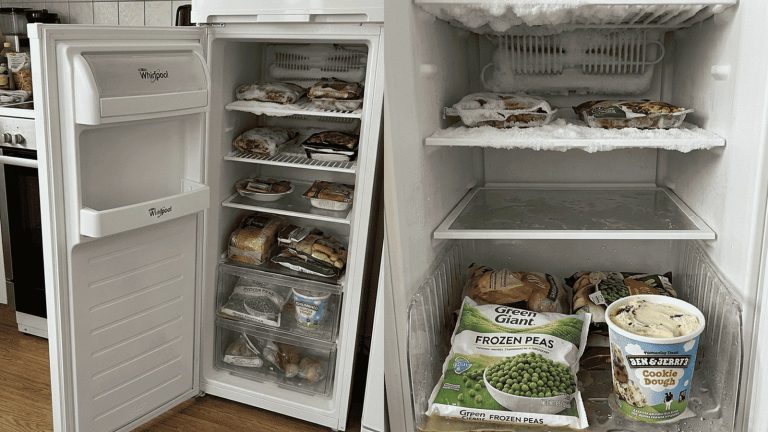
When a Whirlpool refrigerator can’t hold a steady temperature, the issue rarely announces itself loudly. It shows up in patterns. Food near the back wall freezes. Items near the door feel warmer than they should. The display still shows the right settings, yet something isn’t consistent.
What owners describe most often isn’t complete failure. It’s uncertainty, because the refrigerator is still running. The freezer works. But cooling doesn’t feel stable anymore. If you’d rather have it checked, our refrigerator repair team handles these calls across metro Atlanta.
Temperature instability isn’t just inconvenient. When the temperature keeps fluctuating, it affects food safety and puts the cooling system under more load. The difficulty is that the cause isn’t always obvious. It may involve airflow, the room, the settings, or internal sensor feedback.
In this article, we’ll explain why regulation drifts out of balance, what Whirlpool’s own help pages ask owners to check first, what signs tell you the issue is progressing, and when a professional diagnosis becomes necessary.
When Cooling Stops Being Predictable
Whirlpool’s help pages for French door refrigerators give 37°F for the refrigerator and 0°F for the freezer as the recommended settings. Other Whirlpool pages say the controls come preset to the “mid setting,” which “should be correct for normal household use,” and that “The controls are set correctly when beverages are as cold as you would like.” Scales differ by type, so your own guide decides the number for your model.
Minor shifts happen during normal use, after a door has been open or a load of groceries goes in. Recovery should be steady.
The difference between normal behavior and a developing issue is consistency.
When cooling becomes unreliable, owners report:
- Daily variations instead of occasional ones
- Frost forming unevenly in the freezer
- Food spoiling even though settings remain unchanged
- Items freezing in one part of the fresh food section while another stays warm
The system is still operating, but it’s no longer stabilizing well. That shift from predictable to unpredictable is where the real problem begins.
The Pattern Before Larger Failures
Temperature instability tends to follow a progression. It rarely jumps from minor inconvenience to complete breakdown overnight.
Here’s the pattern we commonly observe:
| Stage | What you notice | What it can suggest |
|---|---|---|
| Subtle | Slightly uneven cooling | Airflow imbalance or a door that isn’t sealing |
| Repeating | Cold pockets and warmer zones | Blocked vents, loading, or the room |
| Persistent | Daily temperature swings | A part of the regulation chain to be tested |
| Escalating | Long run times with warm food | A problem that needs a technician |
The earlier the issue is addressed, the more contained the repair typically remains.
Airflow: The Silent Disruptor
Cold air must move freely for a refrigerator to stay balanced. If circulation slows or becomes uneven, temperature begins shifting from one area to another.
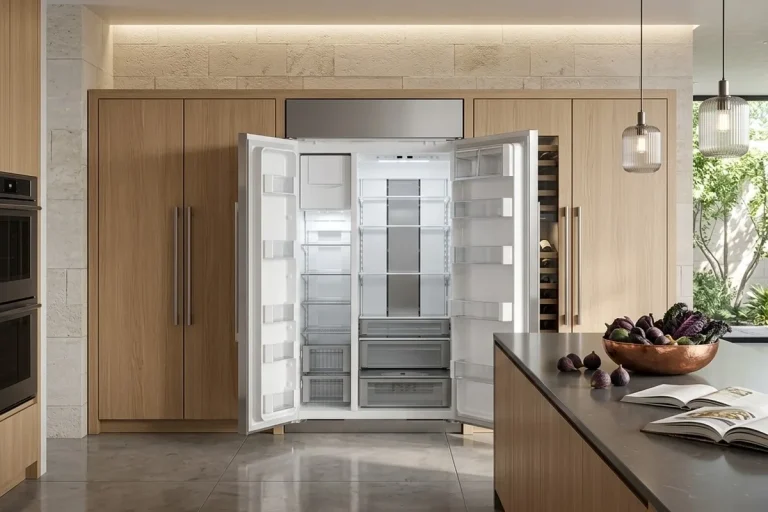
Whirlpool explains the path: “Most units use a shared cooling system in which cold air is generated in the freezer and pushed into the fresh food section through vents.” On its page for all refrigerator types, “cool air enters from the refrigerator wall and moves down,” then recirculates through a vent near the bottom.
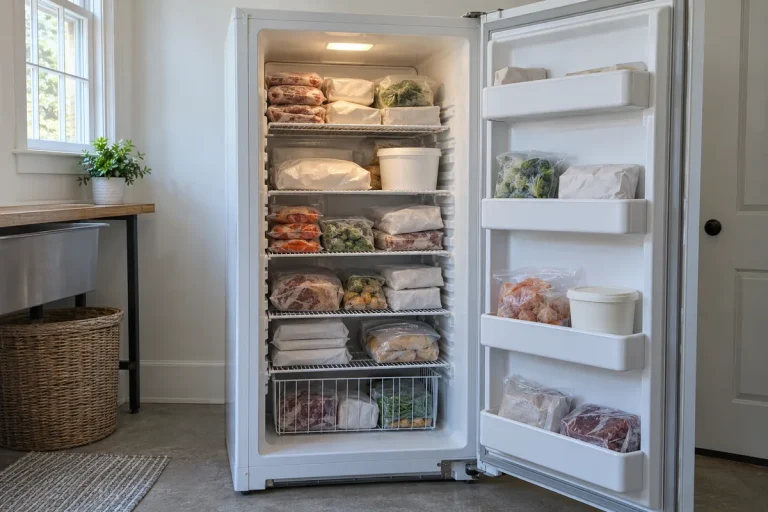
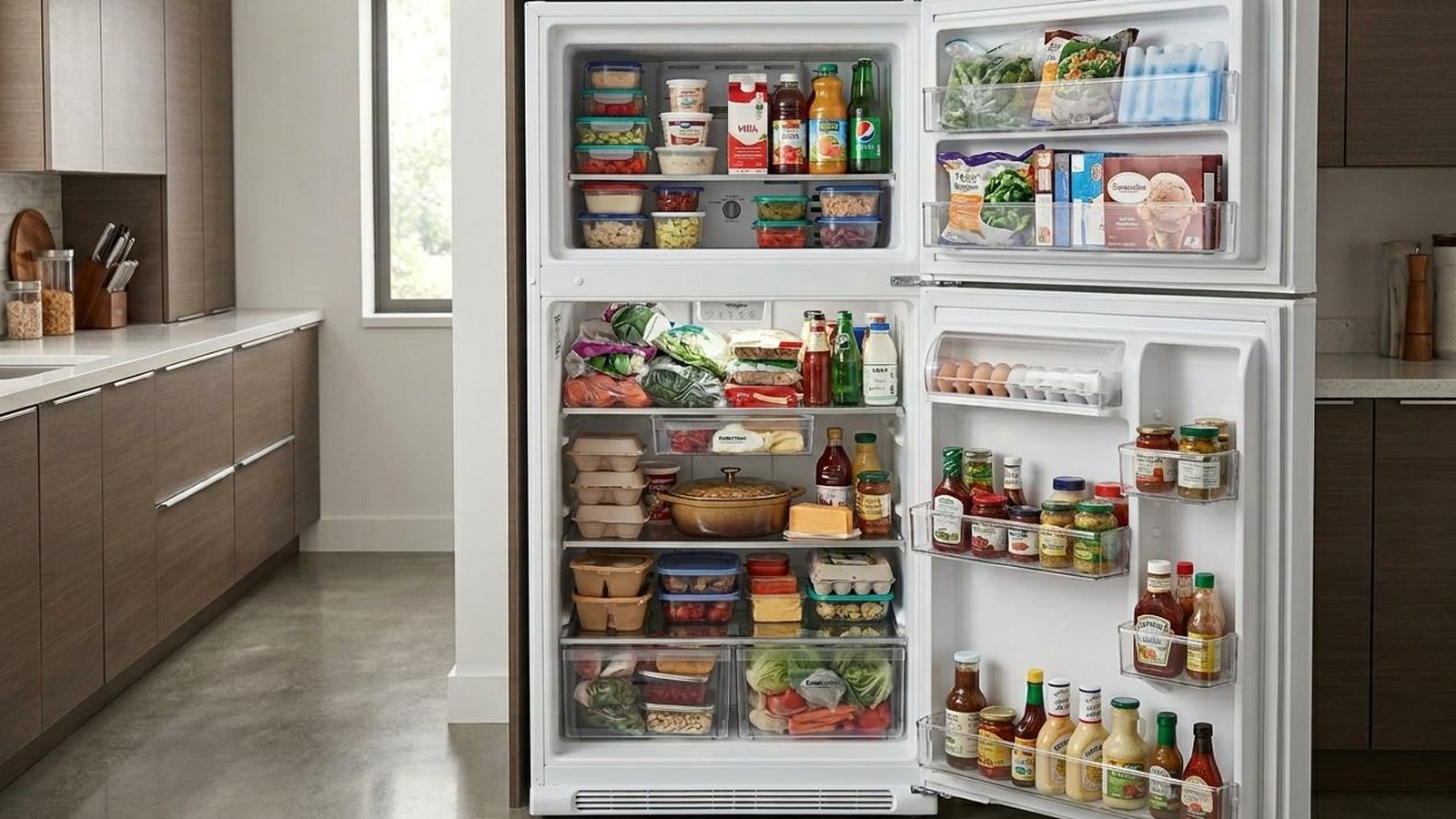
That’s why blocked air vents matter so much. Whirlpool says items crowded or pushed against the back and side walls “can obstruct the vents that distribute chilled air,” leading to warm spots or to food near the vents freezing. Its advice: “Do not block any of these vents with food packages,” leave small gaps between containers, and avoid stacking items too high. If the freezer vent is blocked, the help pages add, “cold air will be trapped,” and the freezer may get too cold.
Doors are the other half. A door that doesn’t close or seal lets warm air in continuously. The refrigerator compensates by running longer, but because warm air keeps entering, stability never fully returns. On top-freezer models, Whirlpool links a door swing that was reversed incorrectly to doors that can’t close or seal properly, frost or moisture, and “Temperature fluctuation.”
Airflow issues rarely cause dramatic shutdowns. They create gradual inconsistency.
When the Room Pushes the Limits
Temperature control depends not only on internal components but also on the room around the refrigerator.
Whirlpool’s help pages ask first whether the refrigerator is in a garage or a room that runs colder than 55°F or hotter than 110°F. Outside that window, regulation becomes harder to keep steady.
In garages and spaces exposed to seasonal swings, the freezer is often where owners notice it first. Some models come with a garage-ready setting, which Whirlpool’s top-freezer page ties to a room between 55°F and 38°F. Whether yours has it, and how it’s set, is in your own guide.
This isn’t a malfunction. It’s the refrigerator responding to its environment.
Settings and Modes That Look Like Mechanical Problems
Not all instability is caused by failing components.
Whirlpool’s help pages start with simple questions: is the cooling function turned on, and are the controls where they should be? A refrigerator left in a showroom or demo mode after delivery can keep the lights and display working while cooling stays off. That mode is switched off by the steps in your own guide.
The Power Outage indicator, on some models, is another clue. Whirlpool says it “lets you know if the power supply to the refrigerator has been off and the freezer temperature has risen,” and the display reads “Power Outage” with an alert tone that sounds three times. If you see it, check the food first.
You may read advice to unplug the refrigerator for a few minutes to “reset” the temperature controls. No Whirlpool help page we read gives that step for temperature controls, and unplugging switches the whole refrigerator off. If cooling keeps drifting, the cause lies deeper in the regulation system.
On a newly installed refrigerator, give it time. Whirlpool’s freezer page says to “Allow 24 hours for the freezer to reach proper temperatures.”
When Sensor Feedback Is No Longer Accurate
Temperature regulation relies on internal sensors giving the control board accurate information. When a sensor’s reading drifts, the control board reacts to the wrong data.
This can result in:
- Cooling cycles ending too early
- Long run times without proper stabilization
- Daily temperature swings without any visible obstruction
Sensor-related trouble doesn’t always produce an error code. Testing a sensor means reaching it behind interior panels and measuring it against the specification for your model, which is technician work. That’s why consistent instability needs a proper evaluation rather than repeated setting changes.
When Instability Turns Into System Stress
Temperature swings don’t stay isolated to food compartments. When cooling becomes inconsistent, the refrigerator keeps working to catch up. It runs longer. It starts more often. That’s more load on the parts that do the cooling.
Here’s how temperature instability can develop if left alone:
| Condition | Immediate impact | What to do |
|---|---|---|
| Minor daily variation | Food quality varies | Check vents, loading, and doors |
| Repeated uneven cooling | Frost in spots | Clear the vents; look at the door seal |
| Constant temperature swings | Long run times | Book a diagnosis |
| Ignored instability for months | Spoiled food, harder repair | Don’t wait any longer |
We don’t present this to alarm anyone. Temperature instability is rarely harmless once it becomes persistent.
When to Stop Adjusting Settings
One of the most common reactions to inconsistent cooling is adjusting the controls again and again. Lower the refrigerator setting. Raise the freezer setting. Change it back.
Whirlpool’s own pages recommend going back to the recommended setting first, and they explain why one compartment affects the other: “A freezer set too low can make the refrigerator section too cold, as air flows between the compartments.” Make changes only the way your guide describes, and give the refrigerator a day to settle. Constant adjustment usually means the system is compensating for something it can’t correct on its own.
If you notice:
- Daily temperature swings despite correct settings
- Stability that returns briefly, then drifts again
- Uneven cooling even after clearing the vents and checking the doors
It’s no longer a settings issue. It’s a regulation issue.
Repeated changes often mask the underlying cause rather than solving it.
How a Technician Diagnoses Whirlpool Temperature Problems
A good diagnosis doesn’t begin by replacing parts. It begins by confirming behavior.
The evaluation typically includes:
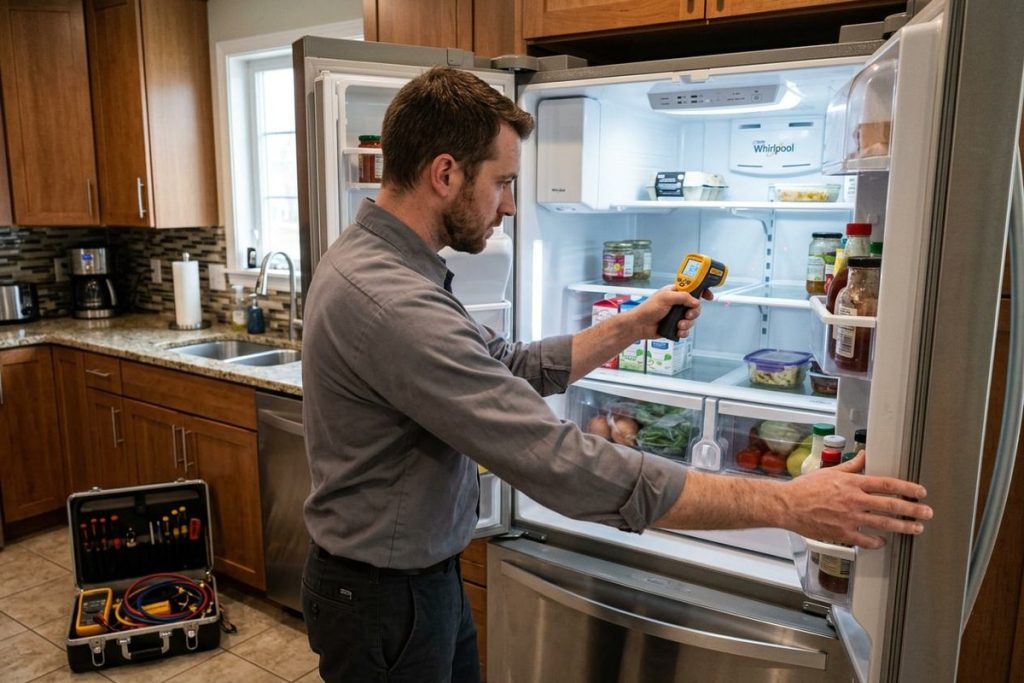
- Verifying actual internal temperatures with a thermometer against the display
- Inspecting airflow pathways, vents, and the damper
- Checking door alignment and seal condition
- Confirming the settings and modes, including showroom mode
- Testing the sensors, the defrost system, the fans, and the control
Identifying which category the issue belongs to — airflow, room, settings, or a failed part — prevents unnecessary part replacement. The point is to isolate the cause rather than react to the symptom. When the freezer is the side running warm, see our guide to a Whirlpool freezer that’s too warm.
Why Early Diagnosis Protects the Appliance
Temperature problems often grow gradually. That gradual progression makes them easy to tolerate for a while.
The risk lies in the system’s response. A refrigerator constantly compensating for instability works harder than one holding steady cycles. Over time, that narrows the gap between a manageable repair and a larger one.
Addressing instability early typically keeps the solution contained. Waiting increases the chance that more parts become involved, and that food gets lost along the way.
Final Thoughts
A Whirlpool refrigerator should feel dependable. When cooling becomes inconsistent, that dependability is what disappears first.
Temperature instability rarely corrects itself once it becomes a pattern. It reflects imbalance somewhere in the system: airflow, the room, the settings, or internal feedback. Check what Whirlpool asks owners to check, and let a technician take it from there.
Get the cause found, not guessed. Book Whirlpool refrigerator repair with PRO Appliance Repair. We’re family-owned and insured, with same- or next-day service on most days across metro Atlanta. Our EPA 608 certified, background-checked technicians use genuine OEM parts, and our repairs carry a warranty of up to six months.
FAQ
Why is my Whirlpool refrigerator temperature fluctuating even though the settings are correct?
If the display shows proper settings but the inside temperature shifts daily, the cause is usually airflow, the room, a door that doesn’t seal, or inaccurate sensor feedback rather than a simple setting error. Check the vents and doors first; persistent swings need a diagnosis.
Can blocked air vents really cause uneven cooling?
Yes. Whirlpool says crowded items can obstruct the vents that distribute chilled air, causing warm spots or freezing near the vents. Leave small gaps between containers and don’t block the vents with food packages.
Does room temperature affect refrigerator performance?
Yes. Whirlpool’s help pages ask whether the refrigerator sits in a garage or a room colder than 55°F or hotter than 110°F. Some models have a garage-ready setting; your own guide says whether yours does.
What temperature should a Whirlpool refrigerator be set to?
Whirlpool’s French door help pages recommend 37°F for the refrigerator and 0°F for the freezer. Other pages point to the “mid setting” and say the controls are right when beverages are as cold as you like. Your own guide decides for your model.
Should I just unplug the refrigerator to reset it?
No Whirlpool help page we read gives unplugging as a step for the temperature controls, and it switches the whole refrigerator off. If the temperature keeps drifting, book a diagnosis.
PRO Appliance Repair is an independent repair company and is not affiliated with, sponsored by, or endorsed by Whirlpool Corporation. Brand and model names are used only to identify the appliances this page is about and remain the trademarks of their respective owners.