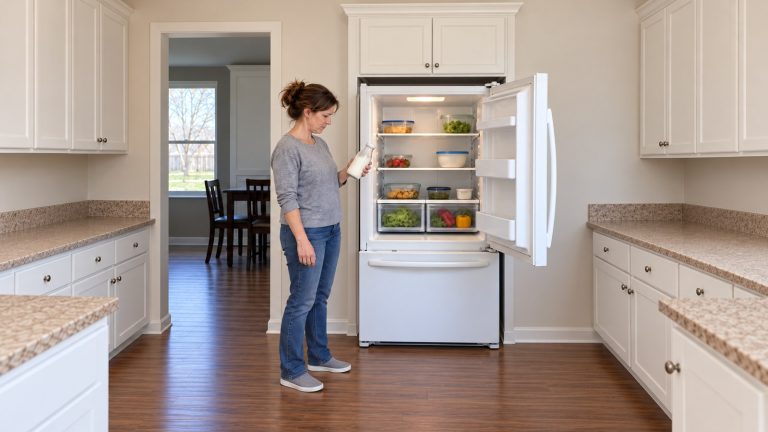
When a Whirlpool refrigerator stops cooling properly, most homeowners don’t think about the compressor right away. They notice food temperatures creeping up. The freezer doesn’t recover like it used to. The refrigerator seems to be running, but something feels off.
Same symptom turns up on other brands too – start with our guide to Bosch compressor problems.
That uncertainty is usually what brings people to us. If you’d rather skip the guesswork, our refrigerator repair team works on Whirlpool refrigerators across metro Atlanta.
In our work on Whirlpool French door (WRF) and side-by-side (WRS) refrigerators, compressor concerns often surface after other explanations have been ruled out. Settings haven’t changed. Power is stable. The refrigerator is on, but cooling no longer returns to normal. At that point, the compressor becomes the focus, and with it comes understandable worry.
This article explains how we approach a suspected Whirlpool compressor failure: what the compressor does, what Whirlpool itself calls normal, why it may stop running without being permanently damaged, and how we tell startup components, protection systems, and the compressor itself apart.
What the Compressor Does in Whirlpool WRF and WRS Refrigerators
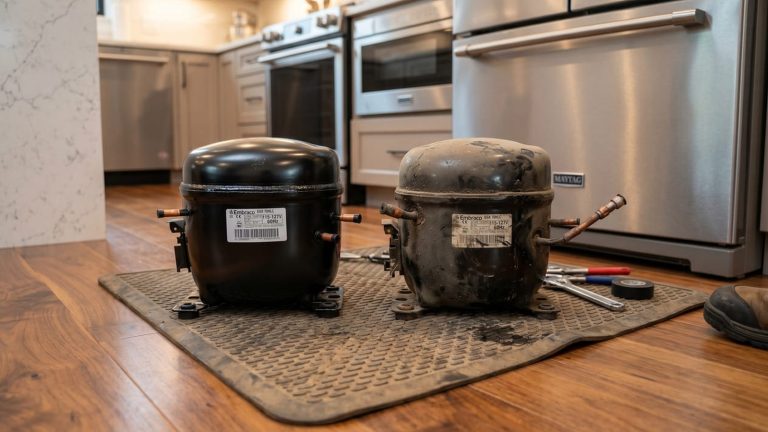
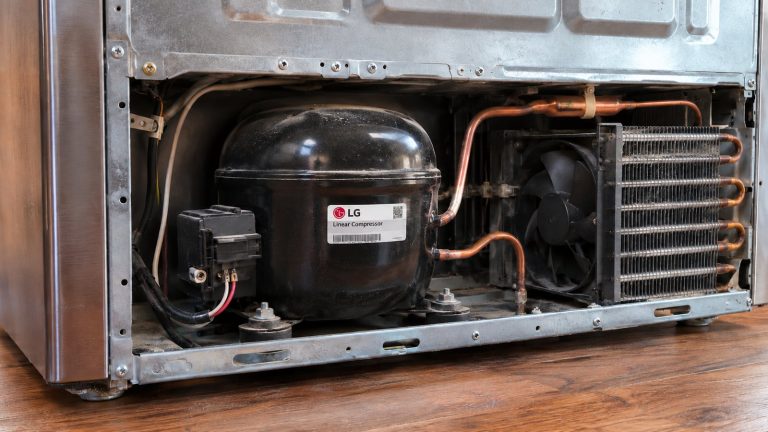
The compressor is the heart of the cooling system. Its job is to move refrigerant through the sealed system so heat can be removed from inside the refrigerator. When it runs properly, cooling happens quietly in the background and goes unnoticed.
A long run time is not automatically a bad sign. Whirlpool’s help page “Motor or Compressor Runs too Much” for French door refrigerators says: “It is normal for the high-efficiency compressor to run for extended periods at varying speeds.” If the food stays cold, a busy compressor is usually just doing its job.
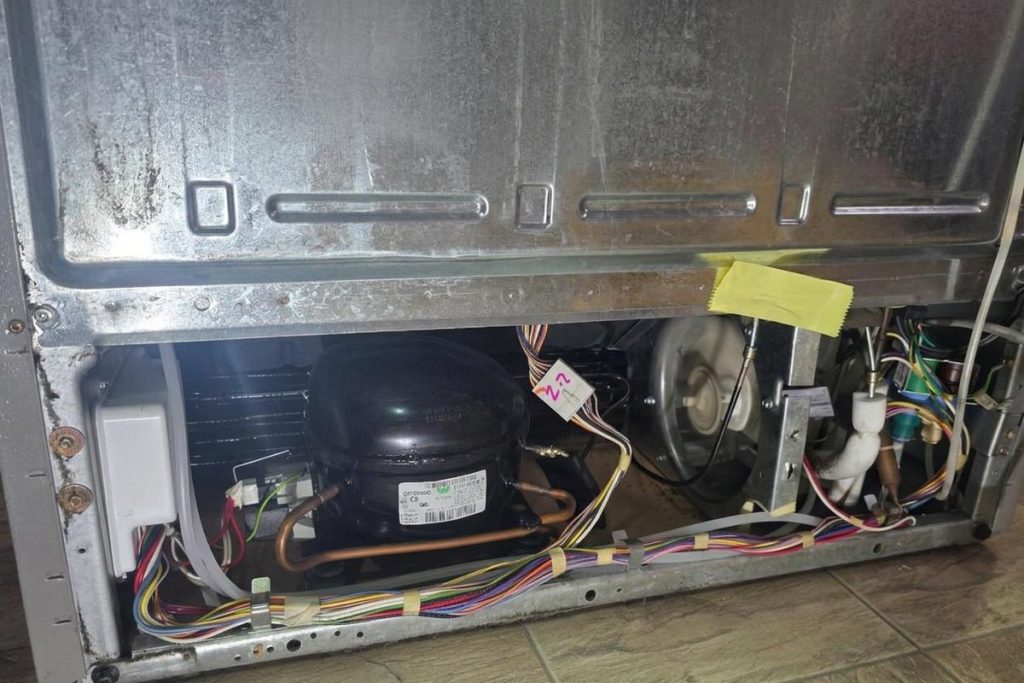
In Whirlpool WRF and WRS models, the compressor does not operate alone. It depends on several supporting components to start, run, and protect itself from damage. These include electrical startup devices, safety protections, and control signals.
When any one of these supporting parts fails, the compressor may stop running even though it is still mechanically sound. To you, the result looks the same: the refrigerator stops cooling.
That distinction matters. In our practice, many service calls labeled as compressor failure turn out to be startup or protection issues that prevented the compressor from operating.
What We Notice First When the Compressor Is Not Running
When a customer tells us the refrigerator is not cooling, one of the first questions we ask is whether the compressor is attempting to start.
A compressor not running can present itself in different ways depending on what caused the shutdown. Sometimes the unit is completely silent. Other times, customers report intermittent sounds or clicking.
These early observations help us narrow the problem before touching the appliance:
- Does the refrigerator attempt to start and stop repeatedly?
- Is there a click every few minutes, followed by silence?
- Does cooling stop suddenly after working normally?
We do not ask customers to open panels or test electrical parts. We ask them to notice behavior. That often tells us whether the compressor is being blocked by a safety system or whether a deeper failure is likely.
What Often Stops a Whirlpool Compressor From Starting
In our service work, a compressor that is not running is rarely dead on arrival. More often, it is being prevented from starting by one of its supporting components.
First, know which clicks are normal. Whirlpool’s “Refrigerator Normal Sounds and Noises” page says relays and control boards click as they switch components on and off, and “A single click can occur when the compressor starts or stops.” On models with a dual evaporator valve, Whirlpool’s “Clicking Noise” page calls rapid, repetitive clicking between compartments normal too.
The pattern that worries us is different: a faint click every few minutes, followed by silence, while the refrigerator keeps getting warmer. That is not the compressor failing randomly. In our experience, it is usually a protection device responding to a startup problem.
Another common situation is a tripped overload protector. When the compressor draws too much current or overheats, the overload shuts it down to prevent permanent damage. The refrigerator may attempt to restart later, only to shut down again.
From our perspective, these symptoms signal that the compressor is being protected, not ignored.
Simple Observations We Ask Customers to Make
Before we arrive, a few safe observations help us narrow the issue. They do not involve tools or disassembly, and never involve reaching behind the grille or touching the compressor, which can be hot and sits next to live wiring.
We may ask customers to:
- Listen for repeated clicking, and note roughly how far apart the clicks are
- Notice whether you ever hear the low, steady hum of the compressor running
- Observe whether cooling stops suddenly or fades gradually
You may read advice to unplug the refrigerator for 5 to 10 minutes as a compressor “reset.” None of the Whirlpool documents we read gives that step, so we don’t recommend it. Whirlpool’s “No Operation – Will Not Turn On” page lists simpler checks: the cord in a grounded 3-prong outlet, a tripped breaker or GFCI outlet, and controls turned on. It also notes the automatic defrost cycle: “Recheck in 45 minutes to see if it is operating.”
For the wider picture on this brand, see our guide to a Whirlpool freezer that’s too warm.
What we avoid is encouraging repeated restarts. If a protection system is shutting the compressor down, forcing restarts can increase stress on already-failing components.
Symptoms We See and What They Usually Mean
Certain symptoms consistently point to certain failure paths. The first row comes from Whirlpool’s help pages; the rest reflect what we see most often in Whirlpool WRF and WRS refrigerators.
| Symptom observed | What it usually indicates | Risk level |
|---|---|---|
| Long run times or a single click, food stays cold | Normal operation, per Whirlpool | Low |
| Repeated clicking, no cooling | Failed startup component or protection shutdown | Medium |
| Silence, no hum, food warming | Defrost cycle, electrical supply, or control issue | Medium |
| Starts, then shuts down within minutes | Tripped overload protector | High |
| Unit cools briefly, then stops | Startup failure escalating | High |
| No hum after power and control checks | Possible locked compressor | Very high |
This progression matters. Early-stage issues are often repairable without replacing the compressor. Later-stage issues reduce options.
Conditions That Make Problems Worse Over Time
Some conditions around the refrigerator increase stress on the compressor and accelerate failure.
Start with the room. Whirlpool’s help pages say its full-size refrigerators are meant for indoor use “from a minimum of 55°F (13°C) to a maximum of 110°F (43°C),” away from an oven, radiator, or other heat source, and not with the base grille blocked. A hot garage or a unit boxed in by cabinetry makes the compressor run longer and hotter.
Then there are dirty condenser coils. When heat cannot dissipate properly, the compressor runs hotter and longer than intended. Whirlpool’s under counter refrigerator guide says dirty coils obstruct air transfer, which “makes the motor work harder.” Its side-by-side “Not Cooling” page adds that routine cleaning is typically not needed in a normal home, only in greasy or dusty homes or with heavy pet traffic. Your own manual describes condenser cleaning for your model, if any; follow it exactly or have a technician do it.
Another contributor is a weak capacitor, on models that use one. The capacitor helps deliver the extra power needed to start the motor. When it weakens, startup attempts fail, current spikes, and protection systems activate more often.
When a Compressor Is Truly Locked
A locked compressor is one that can no longer start mechanically, even when electrical components are functioning correctly. It’s the scenario homeowners fear most.
In our practice, true compressor lockup is far less common than people assume. However, when it does occur, the symptoms are usually clear:
- The compressor draws power but cannot turn
- Protection devices activate immediately
- Repeated restarts worsen the condition
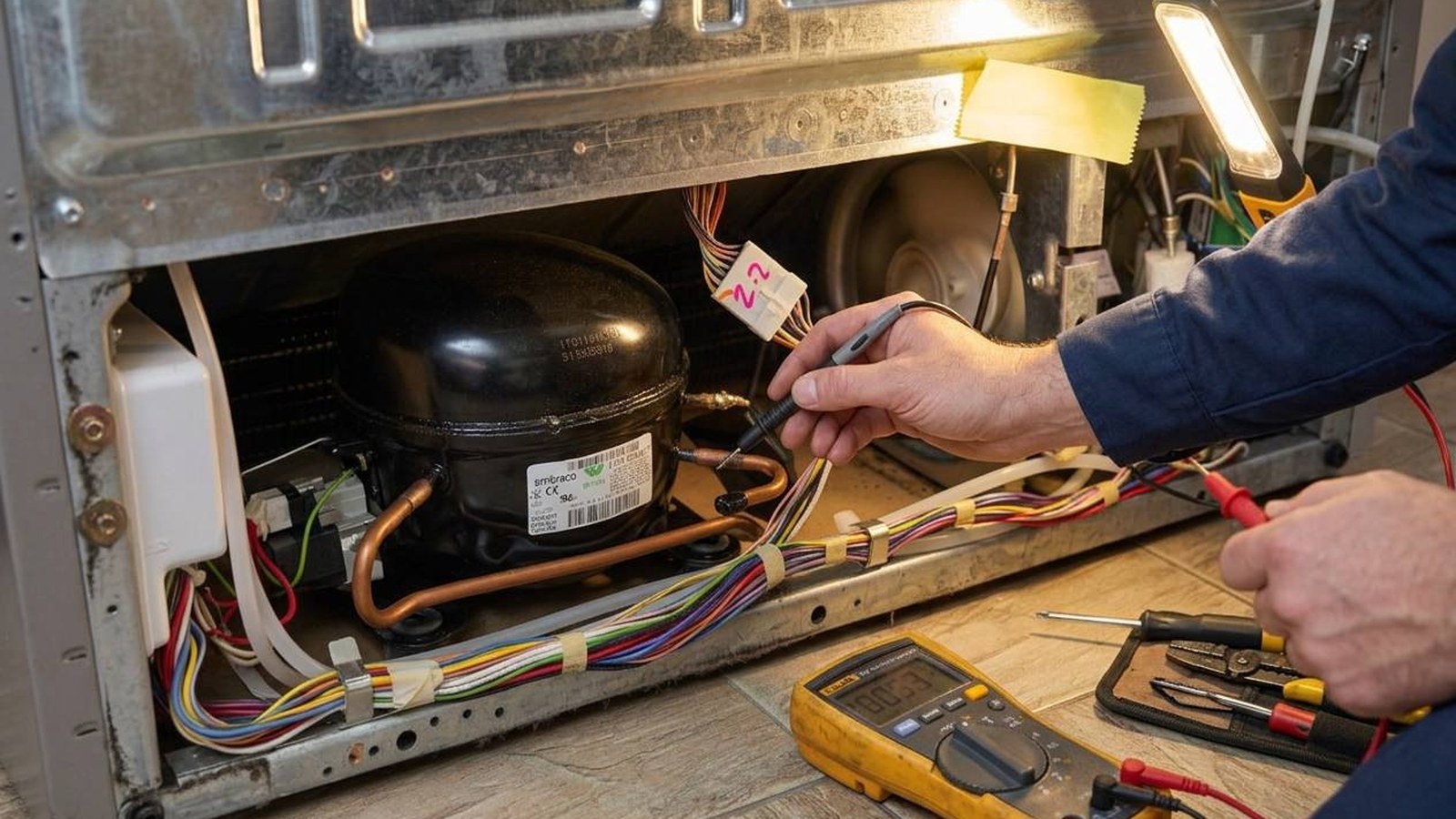
This is where professional diagnosis becomes essential. Locked compressors cannot be confirmed visually or through sound alone. They require electrical testing that goes beyond homeowner observation.
Understanding Whirlpool’s Compressor Warranty
You’ll often hear that Whirlpool covers compressors for 10 years, for the part only. That is not what the Whirlpool warranty we read says.
The “WHIRLPOOL® REFRIGERATION LIMITED WARRANTY” in Whirlpool’s Under Counter Refrigerator Use & Care Guide (W11515962B, pages 12–13) covers replacement parts and repair labor for one year from purchase. In the second through fifth years, it covers the “Sealed Refrigeration system (includes compressor, evaporator, condenser, dryer and connecting tubing),” again parts and repair labor. There is no separate 10-year term. It also says: “Service must be provided by a Whirlpool designated service company.” The side-by-side and French door manuals we read don’t print warranty text, so check the warranty for your own model.
Our role is to explain:
- Whether the compressor is truly the failed component
- Whether your Whirlpool warranty may still apply, so you can contact Whirlpool first
- What the repair realistically involves
Without proper diagnosis, warranty assumptions often lead to frustration.
When Professional Diagnosis Protects You
Compressor symptoms sit at the boundary between manageable repairs and major decisions. Here’s how we frame the level of professional involvement based on what we find:
| Issue identified | DIY observation only | Professional repair needed |
|---|---|---|
| Power checks: cord, breaker or GFCI, controls on | Yes | If the problem continues |
| Startup sounds and how often they repeat | Yes | No |
| Electrical testing | No | Yes |
| Sealed system diagnosis | No | Yes |
| Compressor replacement | No | Yes |
This isn’t about discouraging homeowners. It’s about preventing missteps that turn a repairable situation into a costly one.
How We Help Customers Decide What Makes Sense
When compressor-related problems come up, the real question our customers want answered is not “what failed?” but “what should I do next?”
In our experience with Whirlpool WRF and WRS refrigerators, compressor-related repairs fall into two very different categories. Some involve supporting components that failed first and prevented the compressor from running. Others involve damage to the compressor itself.
What matters most is not the name of the part, but the context around it:
- How the refrigerator has been behaving leading up to the failure
- Whether protection systems have been cycling repeatedly
- How long the unit has been operating under stress
- Whether Whirlpool’s sealed system warranty still applies
When we diagnose early-stage problems, repairs are often focused and contained. When symptoms have been present for a long time, the scope can widen quickly.
We explain the findings clearly, outline the realistic options, and let you decide.
Why Waiting Often Makes Compressor Problems Worse
A compressor that is struggling to start places extra load on startup components. Protection systems trip more often. Heat builds up. Each failed start increases stress on the system as a whole.
What we see far too often is a refrigerator that could have been repaired earlier with a limited fix, but wasn’t addressed until the compressor itself was damaged. At that point, options narrow.
It’s not about urgency for urgency’s sake. It’s about preventing a manageable situation from turning into a permanent one.
Final Thoughts
From our perspective, compressor problems are less about fear and more about clarity.
The word “compressor” carries weight, but the reality is more nuanced. Long run times and a single click at start or stop are normal by Whirlpool’s own description. Many issues that stop a compressor from running start outside the compressor itself. Others develop gradually and leave warning signs along the way.
Knowing when those signs cross the line from observation to action is what protects the refrigerator and the food inside it.
Related guide: Amana refrigerator compressor problems
Get the real cause found before parts get replaced. Book refrigerator repair for your Whirlpool with PRO Appliance Repair. We’re family-owned and insured, with same- or next-day service on most days across metro Atlanta. Our EPA 608 certified, background-checked technicians use genuine OEM parts, and our repairs carry a warranty of up to six months.
FAQ
Does start relay clicking always mean compressor failure?
No. Whirlpool says a single click can occur when the compressor starts or stops. A click every few minutes with silence in between, while the refrigerator warms, usually points to a startup part or protection response. Often the compressor itself still works.
What does it mean when the overload protector trips?
The compressor drew too much current or overheated, and the overload shut it off. Repeated trips signal a deeper problem.
Can dirty condenser coils really affect the compressor?
Yes. Whirlpool’s under counter guide says dirty coils make the motor work harder. Your manual says whether and how your model’s coils are cleaned.
How do you know if the compressor is locked?
It cannot start even when electrical parts work. Only professional testing confirms it, not sound or a visual check.
Is the compressor covered under warranty?
In the Whirlpool limited warranty we read (Under Counter Refrigerator Use & Care Guide), the compressor is part of the sealed system, covered for parts and repair labor through year five, with no 10-year term. Check your own model’s warranty.
PRO Appliance Repair is an independent repair company and is not affiliated with, sponsored by, or endorsed by Whirlpool Corporation. Brand and model names are used only to identify the appliances this page is about and remain the trademarks of their respective owners.