At a glance
| Read the timing | Separate normal from repair | Escalate early |
|---|---|---|
| Noise during fill, dispensing, cooling, or door movement points in different directions. | Light humming, brief clicks, bubbling, and cracking are on Samsung’s own list of normal sounds. Repeat grinding and fan scrape usually are not. | A sound that keeps coming back, gets louder, or shows up with weak cooling belongs on a service call. |
A Samsung refrigerator can make a lot of different sounds, and the sound itself is usually the first clue. A steady humming from the back of the cabinet, loud buzzing during a cycle, ice maker grinding at the dispenser, a door hinge squeak, a vibration noise, or those sharp snapping, cracking sounds people hear late at night don’t all point to the same thing. Some sounds belong to normal operation. Some show up when frost starts building around the fan, a panel starts rattling, or a moving part begins to wear harder than it should.
That’s why it pays to sort the sound before you start guessing at the repair. The sections below break down the noise patterns we see most often in the field, what Samsung’s manuals say about them, what you can safely check at home, and when the sound has crossed the line into a service issue. If the noise is getting louder, repeating daily, or showing up with cooling changes, our Samsung refrigerator repair team handles these calls across metro Atlanta.
Start with the sound
When a refrigerator gets noisy, most people jump to the wrong end of the problem. They start naming parts before they’ve named the sound.
A Samsung refrigerator can hum, buzz, click, grind, rattle, squeak, or pop. Those sounds don’t belong in one bucket. A loud buzzing sound from the rear of the cabinet points one way. Ice maker grinding at the dispenser points another. A door hinge squeak is usually simpler than either one. Snapping and cracking sounds often come from the cabinet warming and cooling as it runs through normal cycles.
So start with where the sound is strongest and whether cooling has changed along with it.
| Sound | Where it usually starts | What it often means |
|---|---|---|
| Loud buzzing | Lower rear cabinet | Water-fill side, cabinet resonance, or compressor noise |
| Steady humming | Rear or underside | Normal running sound or early compressor-side concern |
| Ice maker grinding | Ice maker or dispenser | Ice drive operation, jam, or icing around the ice path |
| Rough fan scrape that changes when the door opens | Freezer side | Ice building up around the evaporator fan |
| Door hinge squeak | Upper hinge area | Hinge friction, door setup, or leveling issue |
| Vibration noise | Cabinet, floor, or wall contact | Leveling, clearance, or something touching the fridge |
| Snapping, cracking sounds | Interior liner or rear cabinet | Expansion and contraction during cooling and defrost |
Start with five plain questions:
- Does the sound happen during water fill?
- Does it happen while ice is dispensing?
- Does it stop when the door opens?
- Does it show up after the compressor kicks on?
- Does it happen only when the door moves?
A quick tip
A useful description sounds like this: “Buzzing from the back when the ice maker fills,” or “Scraping from the freezer side until I open the drawer.” That gets you somewhere. “It’s making a weird noise” usually doesn’t.
The sounds you can usually live with
Not every refrigerator sound is a repair lead. Refrigerators fill with water, move refrigerant, cycle fans, and change temperature across plastic liners and interior panels. That work creates sound.
Samsung’s own user manual for the RF23M French door models gives these sounds a full troubleshooting entry, headed “These sounds are normal.” It lists:
- clicking, chirping, or buzzing when an operation starts or ends, “similar to a car engine ignition” — “As the operation stabilizes, the sounds will decrease.”
- fan sounds while the fan runs — “When the refrigerator reaches the set temperature, the fan sound will stop.”
- sizzling during defrost, when “water may drip on the defrost heater”
- bubbling as refrigerant gas moves through sealed pipes
- cracking or knocking as plastic parts contract and expand during defrost or while electronic parts are working
- buzzing on ice maker models when the water valve opens to fill the ice maker
- whooshing from pressure equalizing when you open and close the door
The same manual adds that “Noise from the ice maker as it produces ice during the ice making process is normal.”
| Sound | Usually normal? | Why |
|---|---|---|
| Soft humming or a start-up click | Usually yes | Compressor or fan starting and running |
| Bubbling / gurgling | Usually yes | Refrigerant moving through sealed pipes |
| Light snap / crack | Usually yes | Plastic parts expanding or contracting |
| Brief ice-drop clunk | Usually yes | Ice maker producing ice |
| Short sizzle | Usually yes | Defrost water meeting the defrost heater |
| Whoosh at the door | Usually yes | Pressure equalizing as the door opens and closes |
A normal sound becomes a service sound when one of three things happens: it gets much louder than it used to be, it keeps repeating outside the moment when it should happen, or cooling, frosting, or leaking changes along with it.
The freezer-side sounds
If the sound comes from behind the freezer panel, changes when the door opens, or comes back after a thaw, pay attention. That pattern often points toward ice building up around the evaporator fan. The fan is trying to turn, but ice is crowding the blade or the housing. A defrost can clear the ice and quiet the fan for a while, but a quiet fan after thawing doesn’t prove the problem is solved.
If the same sound returns, the job is no longer about quieting it down. It’s about finding the fault that keeps freezing the fan area up again. Samsung’s manuals don’t describe a scraping fan; that one is outside their list of normal sounds, and it belongs to a technician. A full manual defrost means switching the refrigerator off and emptying it, so leave that step to the technician too, and follow your own manual if you’re told to do it.
| What happens after the thaw | What it usually means |
|---|---|
| Noise disappears and stays gone | Ice may have been from a one-time event |
| Noise disappears, then returns in days or weeks | Repeat icing is still active |
| Noise disappears, cooling improves, then both slip again | Fan path is icing up again |
| Noise never really goes away | Fan motor or fan housing problem moves higher on the list |
Checklist: fan-side warning signs
- The sound changes when the freezer door opens
- Frost is building where it shouldn’t
- Cooling has started slipping too
- The same sound returned after a defrost
- The display is showing a code you don’t recognize (photograph it and look it up in your own manual)
Schedule service if the same freezer-side fan noise keeps coming back. For more on the fan side, see our guide to Samsung refrigerator temperature problems.
The ice maker sounds
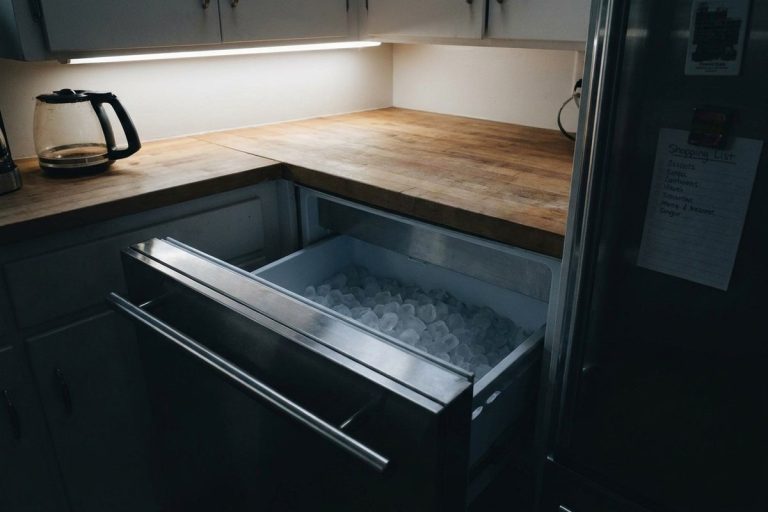
A little ice maker grinding during dispensing can be perfectly ordinary. Samsung’s manuals note that when you select crushed ice, “the ice maker grinds the ice cubes into crushed ice,” so crushed ice sounds rougher than cubed ice. The problem starts when the sound shows up outside that moment.
- the grinding starts when nobody is dispensing ice
- it keeps going after dispensing should have ended
- it comes with clumped or fused ice in the bucket
- it shows up with frost around the ice path
- it gets louder over time instead of staying roughly the same
| Sound pattern | Usually means | What to check |
|---|---|---|
| Short grind only during crushed ice use | Often normal | Does it stop cleanly? |
| Short grind during cubed ice | Often still normal | Is ice loose in the bucket? |
| Grinding with clumped ice | Ice path or bucket problem | Look for fused ice in the bucket |
| Grinding when nobody is dispensing | Not normal dispenser behavior | Ice maker, drive, controls |
| Grinding plus frost / weak ice output | Bigger ice-side problem | Frost pattern, ice maker area, airflow |
A quick tip
If the sound only happens while ice is moving and stops as soon as the job is over, the refrigerator may be acting exactly the way it’s supposed to. If the sound lingers after the job is over, the diagnosis changes fast. If the ice maker’s chime “rings repeatedly,” the RF23M manual says to contact the installer of the water line or a local Samsung service center.

The noises that come from the back or underneath
This is where owners often start worrying about the compressor, and sometimes they’re right. A low, steady humming from the back can be ordinary operation. So can a brief buzz during a water-fill event. What matters is the change in the sound.
- the hum turns into loud buzzing
- the sound carries through the cabinet or floor
- it starts showing up with weaker cooling or slower ice production
- the refrigerator sounds rough instead of steady
- a code appears on the display
One buzz has a simple cause in Samsung’s own table: “The ice maker function is activated, but the water supply to the refrigerator has not been connected.” The step the manual gives is “Press Ice Maker off.” The installation section warns the same way: “Leaving the water line disconnected may cause the water valve to produce a buzzing” sound over time. On some panels the same key does more when it’s held or pressed with other keys, so follow your own manual exactly.
| Pattern | More likely direction | What to check |
|---|---|---|
| Buzz during fill | Water valve opening | Normal per Samsung if it matches fill timing |
| Soft steady hum during cooling | Often normal | Monitor and compare with performance |
| Harsh buzz that grew louder | Compressor side or cabinet resonance | Cooling, code history, stance |
| Buzz with ice maker on but no water line | Water-fill side setup | Ice maker setting, per your manual |
Book a diagnosis if the refrigerator has moved from soft humming into loud buzzing or rough compressor noise.
The cabinet noises: stance, contact, and hinge trouble
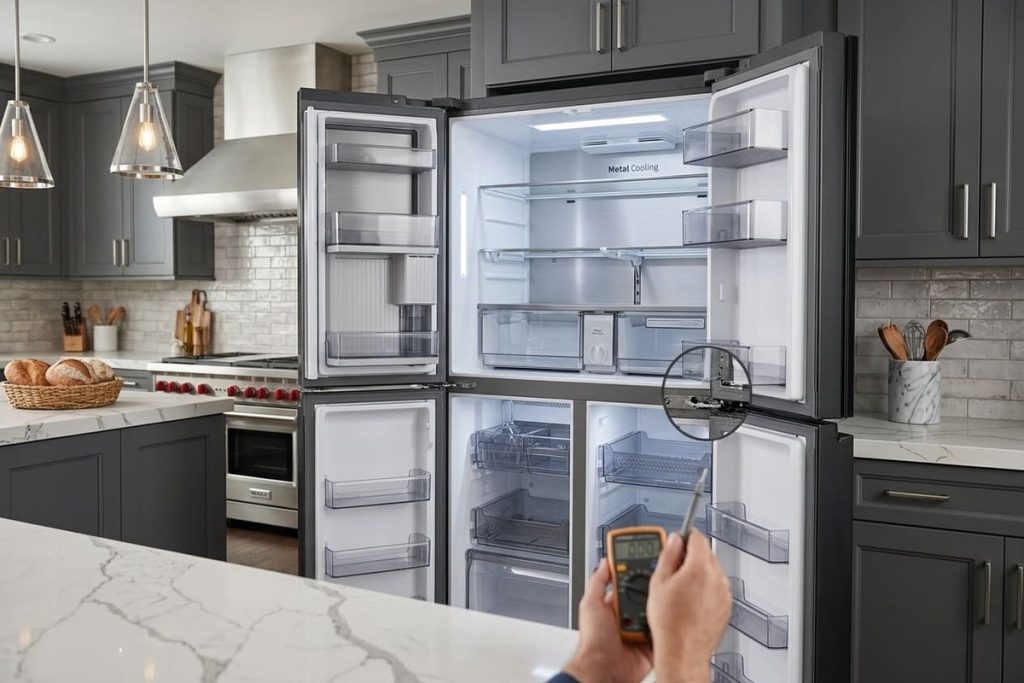
Some of the most irritating refrigerator noises have nothing to do with a failed internal part. A vibration noise can come from a cabinet that isn’t level, a refrigerator touching the wall or trim, or a line or panel rattling lightly against the frame. A door hinge squeak usually comes from friction, door stance, or hardware alignment, not from a serious cooling failure.
Older Samsung troubleshooting tables start their noise rows here: check that the refrigerator is level and stable, that nothing has fallen behind or under it, and that it isn’t against the wall; one says to try moving the back “at least 2 inches from the wall.” The RF23M manual sets the cabinet up so that “the front is a little higher than the rear,” and adjusts door height with snap rings at the hinge, warning that two or more rings “may slip out or make a rubbing noise.” Leveling and door height are installation steps for the installer or a technician.
| Sound | Often starts here | First move |
|---|---|---|
| Vibration noise | Leveling / cabinet contact | Look at stance and clearance |
| Rattle from behind | Loose contact | Look for wall or trim contact without moving the unit |
| Door hinge squeak | Hinge friction or alignment | Look at the hinge area and door swing |
| Rubbing at the door | Door height rings | Leave adjustment to the installer or a technician |
| Short cabinet shudder when compressor stops | Cabinet response | Monitor unless it gets much louder |
Quick home check
- See whether the refrigerator is sitting level and stable, not rocking
- Look for anything that has fallen behind or under it
- Check for trim, water line, or wall contact behind the cabinet
- If the squeak is at the hinge, inspect the hinge area before adding anything to it
A quick tip
A refrigerator that sits badly can sound worse than one with a real internal failure. Fix the stance first, then listen again.
Why an online search can’t diagnose the noise
Owners often widen the search after the same sound has shown up more than once. That’s when forum threads and complaint pages about the same model line start showing up in the results.
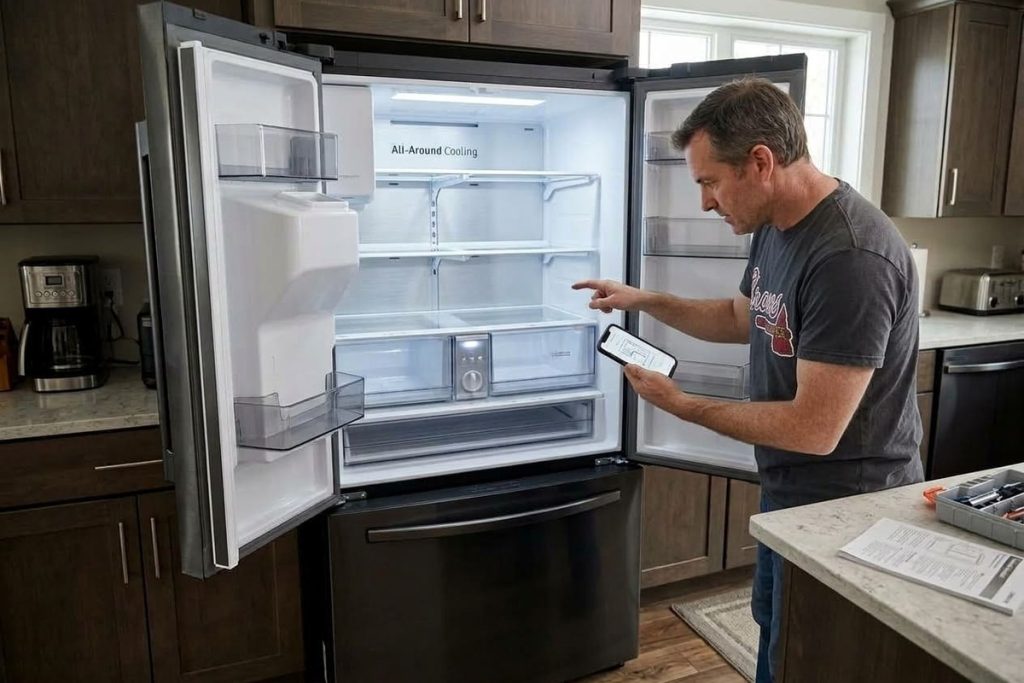
That history gives context. It doesn’t diagnose the refrigerator in front of you. One RF model may be dealing with ice maker trouble. Another may have ice around the evaporator fan. Another may just have a vibration noise from poor stance. Search results can tell you that you’re not alone. They can’t tell you which part failed.
| What the owner says | What it really tells us | What still has to be checked |
|---|---|---|
| “I found other owners with the same noise online” | They’ve seen public complaint history | Frost, fan behavior, ice maker, codes |
| “My fridge sounds like the same issue” | The symptom may overlap | The failed part still has to be identified |
| “This must be the same defect” | Maybe, maybe not | The machine still needs a real diagnosis |
Possible DIY checks at home
Noise complaints get more expensive when the same weak home fix keeps getting repeated. A few checks help. Random resets and rushed part orders don’t.
Start with useful checks
- Name the sound: humming, loud buzzing, grinding, squeak, rattle, or snap
- Note whether the sound changes when the door opens
- Look for frost around the fan area or vents
- See whether the refrigerator is level and not touching the wall
- Check whether the ice maker is on without a water line connected
- Photograph any display code before anything else is touched
- Pay attention to cooling changes along with the sound
Don’t do this
- unplugging the refrigerator every time it makes a sound
- forcing a quick thaw with external heat
- ordering a fan motor before you know whether ice buildup is the real cause
- ignoring a repeat loud noise because “it still cools”
- forcing the dispenser while ice maker grinding is already rough
- spraying random lubricants into hinges without checking alignment first
- opening panels: Samsung’s safety section says, “Do not attempt to repair, disassemble, or modify the refrigerator yourself.”
One more line from Samsung’s safety pages matters here: if the appliance makes a strange noise together with a burning smell or smoke, unplug it and contact the nearest service center.
| What you’re about to do | Useful or not? | Why |
|---|---|---|
| Check whether the sound stops when the door opens | Useful | Helps sort fan-side noise quickly |
| Look for wall or trim contact | Useful | Rules out the simplest rattle |
| Look for clumped ice in the bucket | Useful | Separates ice-path trouble from normal dispenser sound |
| Thaw it again without finding the cause | Not useful | Repeating the symptom isn’t the repair |
| Order a part because the sound is “probably” from there | Not useful | Too many noise complaints overlap early on |
| Reset the refrigerator before noting the pattern | Not useful | Erases useful clues |
Conclusion
Noise is one of the better early warnings a refrigerator gives you. It usually shows up before the bigger complaint does. That’s why it pays to read the sound correctly while it’s still only a sound.
A soft hum may stay harmless. A light pop may stay harmless. A short grind during dispensing may stay harmless — Samsung lists all of them as normal. A fan scrape that comes back after thawing, a repeat vibration noise, a stubborn door hinge squeak, or loud buzzing that keeps getting stronger belongs in a different class.
Get the noise traced, not guessed. Book Samsung refrigerator repair with PRO Appliance Repair. We’re family-owned and insured, with same- or next-day service on most days across metro Atlanta. Our EPA 608 certified, background-checked technicians use genuine OEM parts, and our repairs carry a warranty of up to six months.
FAQ
Why is my Samsung refrigerator making noise all of a sudden?
A new hum or buzz may come from the compressor or water-fill side; a scrape that changes when the door opens often points to ice around the evaporator fan; a rattle may be cabinet contact.
Is humming normal on a Samsung refrigerator?
Often, yes. Samsung says start-up sounds fade as operation stabilizes. It becomes more suspicious when it turns into loud buzzing, gets much louder than before, or shows up with weak cooling.
What does loud buzzing usually mean?
Usually the water-fill side or the compressor side. Buzzing while the valve fills the ice maker is on Samsung’s normal list; with no water line connected, the manual says to turn the ice maker off. If the buzz follows cooling cycles and sounds rougher than a normal hum, compressor noise moves higher on the list.
Why does the noise stop when I open the freezer or refrigerator door?
That’s a classic clue for ice around the evaporator fan: opening the door changes fan behavior enough to change the sound.
Is a manual defrost a real fix?
Not by itself. A defrost can clear ice and quiet the refrigerator for a while, but it doesn’t remove the reason the ice built up there. If the sound returns, the fault is still active.
Can ice maker grinding be normal?
Yes, during dispensing. Samsung calls ice maker noise during ice making normal. If the grinding becomes very loud or happens when nobody is dispensing, it moves out of the normal category.
Are snapping, cracking sounds normal?
Often, yes. Samsung puts them down to plastic parts contracting and expanding as the temperature changes, during defrost or while electronic parts are working.
What’s the difference between vibration noise and compressor noise?
Vibration usually comes from the cabinet shaking against the floor, wall, or trim; compressor noise comes from the cooling system. One can imitate the other, so check stance early.
When should I call for repair instead of waiting?
Call when the sound is repeatable, getting louder, paired with frost or cooling trouble, or tied to fan or compressor behavior. A strange noise with a burning smell or smoke means unplug it and call right away.
PRO Appliance Repair is an independent repair company and is not affiliated with, sponsored by, or endorsed by Samsung. Brand and model names are used only to identify the appliances this page is about and remain the trademarks of their respective owners.