Look, if your LG freezer stopped freezing, you’re on a short fuse before everything in there melts. We see this all the time in Atlanta, where long, humid summers put real load on a freezer. At PRO Appliance Repair, we know the quick diagnostic checks, the parts that tend to give out, and which repairs are worth your money.
Same symptom turns up on other brands too – start with our guide to a Kenmore freezer that’s too warm.
We’re going to get straight into the mechanical guts of the machine. We’ll show you how to tell if it’s a total system failure or just a simple airflow issue. We’ve also pulled what LG’s own Owner’s Manuals say about:
- the fan,
- the compressor,
- and those pesky sensors.
We used four LG guides: French door (LRFXS3106*, LRFLC2706* on the cover), side-by-side (LSC27925**), and two top freezer (LTCS20020*, LTCS24223*). Where your own guide differs, your guide comes first.
Whether you’re looking for a quick fix or just need to know if it’s time to buy a new fridge, here is the technical reality of why your LG isn’t staying cold. If the food can’t wait, book repair for your LG freezer.
Save your steak. Don’t wait for the groceries to hit the curb — book a visit and we’ll set an appointment.
Is Your LG Freezer Really Failing?
Look, before you start tearing into anything, you need to confirm if the unit is broken or just struggling with a setting. We get plenty of calls where the broken freezer is just set wrong or the air isn’t moving. Don’t guess, here you only have to measure.
What to eyeball right now:
Grab a freezer thermometer and don’t trust the display on the door. LG’s French door manual says the displayed temperature is the target temperature, not the actual temperature; its default freezer setting is 0°F (−18°C), and ice cream should be firm. After a setting change, a big grocery load, or a fresh install, LG’s guides allow up to 24 hours. If the thermometer still sits in the upper teens or 20s after a full day, your cooling system is losing the battle.
Sometimes the freezer is running but there’s zero air movement inside. If it feels dead quiet when you open the door, listen for the evaporator fan — LG calls its normal sound a whoosh. No whoosh and no airflow at the vents usually means the fan is shot or blocked by ice.
The Atlanta Factor: Don’t ignore the door seals. In our humid summers, every door opening lets moist air in, and LG’s guides list humid weather and frequent door openings among the causes of frost. A gasket that’s torn, stiff, or caked with grime won’t close tight. If that seal isn’t tight, you’re basically trying to freeze the whole kitchen. Check for gaps or sweating around the edges. If you see frost buildup on the walls along with a warm interior, suspect the defrost system or vents choked with ice.
Technical Diagnostic Reference Table
What a technician tests — and why we don’t print meter values
Resistance specs vary by model and part number, and every one of these tests means opening the cabinet on a live household circuit. LG’s guides give owners none of these readings and say not to remove the panel covering the condenser coil area.
| Component | What the technician checks | Symptoms of Failure |
|---|---|---|
| Linear or inverter compressor | Windings and current draw against its spec | Short hum, click, silence; freezer keeps warming |
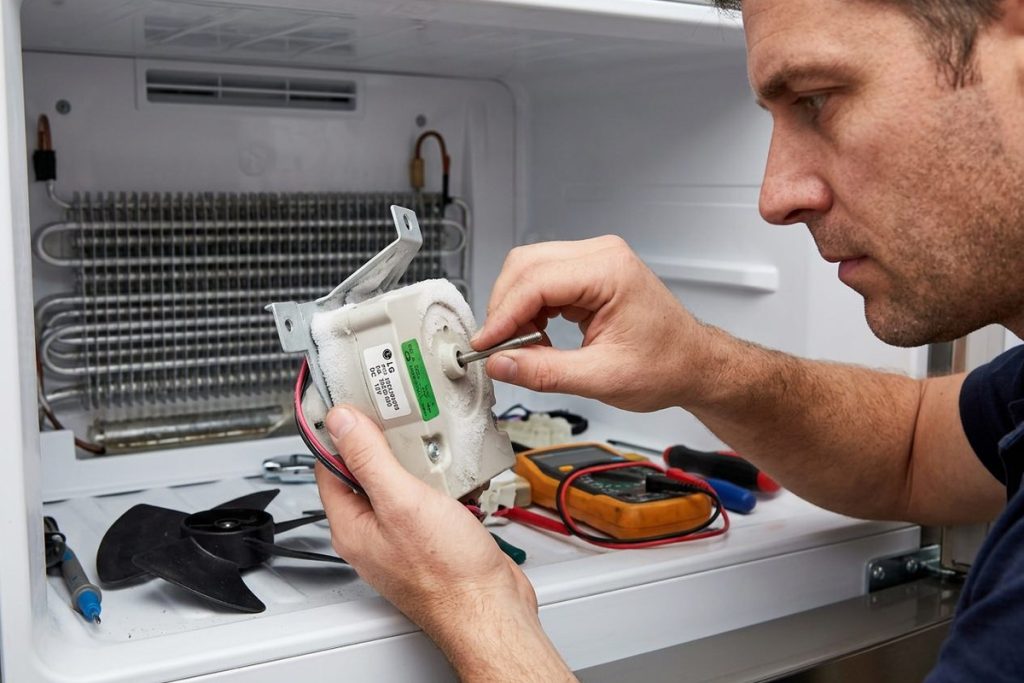
| Evaporator fan | Motor, blades, ice around them | No whoosh; no airflow |
| Defrost heater | Heater, its sensor, defrost control | Heavy ice buildup on back panel |
| Thermistor | Reading against the sensor’s spec | Thermistor defect; erratic temps |
| Control board | Outputs to fan and compressor | Lights on, no power to fan/compressor |
Inside the LG Cooling Chain — What’s Happening
If you want to find the fault, you have to understand how the cold gets there. It’s a sequence: if one part of the chain snaps, the whole freezer goes warm.
- The Heart: The Compressor
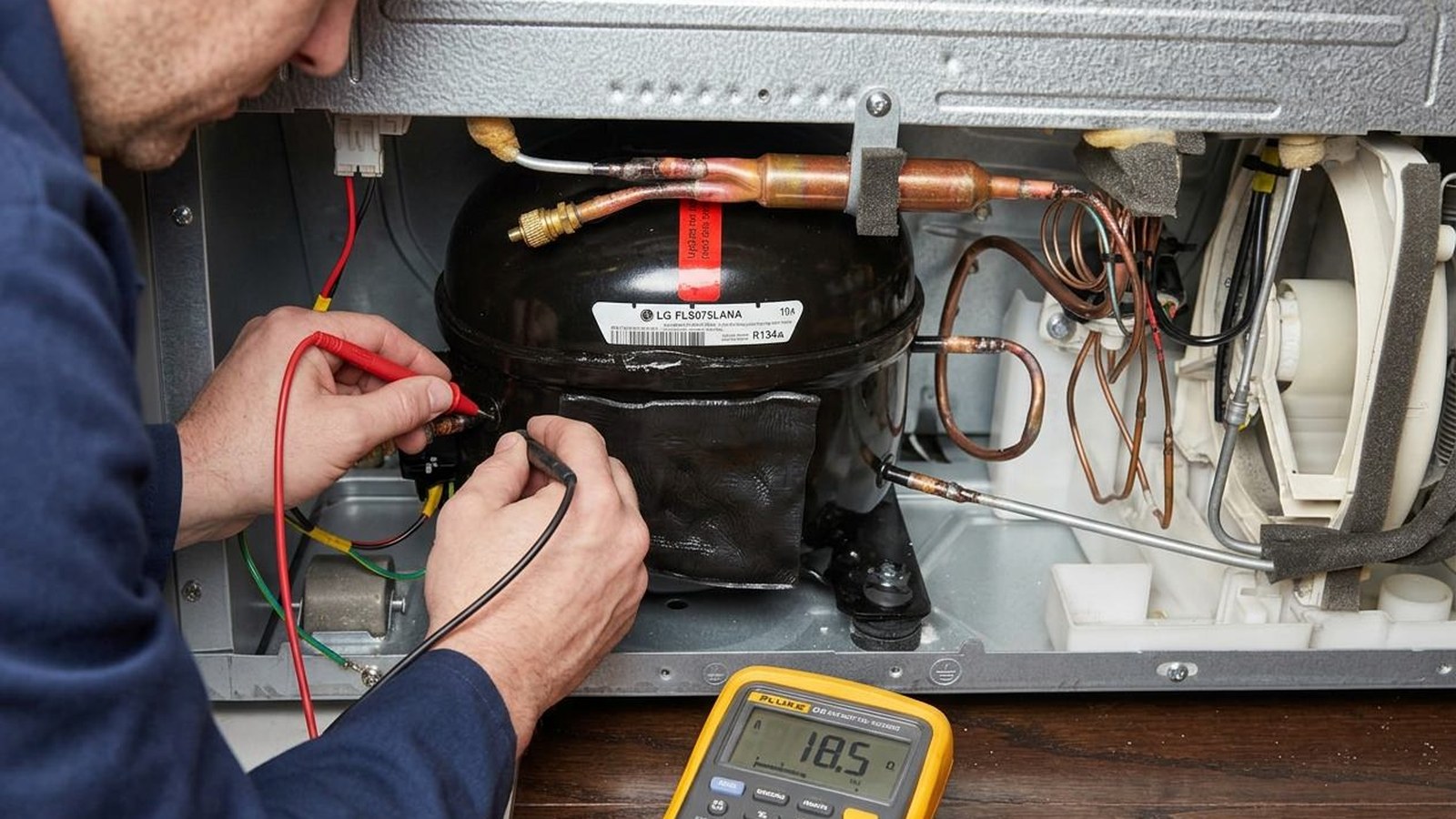
Many modern LG units use a linear or inverter compressor — LG’s warranty names both. It’s efficient, and LG lists a pulsating or high-pitched sound as normal for it. What isn’t normal: a short hum, a click, then silence, again and again, while the freezer warms.
- The Check: Your part is to listen, not to open anything. A technician confirms it with winding and current readings.
- The Air Mover: The Evaporator Fan
You can have a perfectly working compressor, but if this fan isn’t spinning, that cold air is just going to sit in the coils and freeze solid instead of cooling your food.
- The Check: Listen for that faint whoosh inside the freezer. No noise? Note it for the technician — the fan sits behind the freezer’s rear panel.
- The Rest of the System:
The refrigerant moves from the compressor through the condenser coils (which dump the heat outside), passes through the expansion device to drop the pressure, and finally hits the evaporator inside the freezer to soak up the heat. All of this is babysat by the control board and its sensors. If that board fails after a power surge, it won’t tell the fans or compressor to kick on at all. LG’s warranty excludes damage during power failures and from incorrect voltage.
Don’t let a struggling freezer wear out its compressor. Book a tech.
The Main Culprits: Why Your LG Isn’t Freezing
In our experience, most no-freeze calls boil down to the same handful of components. You don’t need a lab; you just need to know what a failing part sounds and looks like.
The Compressor
If you hear your fridge humming for a few seconds followed by a distinct click and then silence, over and over, the compressor is trying to start, but it can’t. Don’t confuse it with normal clicks: LG says the defrost control clicks when defrost begins and ends.
For the wider picture on this brand, see our guide to LG refrigerator temperature problems.
- The Tech Check: Winding and current readings tell a technician if the heart of the machine is dead. This isn’t a DIY fix, trust this issue to professionals.
The Fan and the Vents
We see this all the time: the compressor is humming along perfectly, but the freezer is warm. That usually means an evaporator fan failure. If you don’t feel air moving at the vents, the fan motor is likely shot or the blades are blocked by ice.
- The Check: Keep packages off the vents — LG asks owners not to block them with food. Don’t reach in or spin the blades: LG’s safety sections warn against putting hands or objects into air vents.
The Defrost System
If you see a layer of frost thicker than about a quarter inch on the back panel or blocking the ducts, suspect the defrost heater, its sensor, or the defrost control. Instead of melting the frost away, the system is letting it turn into a solid ice dam that chokes off the airflow. A door that doesn’t seal can frost things up too.
- The Check: A technician measures the heater. Don’t chip at the ice — LG warns against mechanical devices or other means to speed up defrosting.
What to check before you spend money on a service call
Safety first: these checks need no tools. Don’t remove any panel or cover, don’t move the fridge, and never reach behind or into a grille while it’s running. If you smell burning, switch off the breaker if it’s safe to reach, and call for service.
Look, before you pick up the phone, do these five things. It might save you a service call just to find out your door was ajar or a bag of peas was blocking a vent.
- Don’t trust the temperature display on the door. On LG French door models, it shows the setting, not a reading. Put a real thermometer inside, and give any setting change 24 hours.
- Open the door and listen. You should hear a faint whoosh from the evaporator fan. If it’s dead quiet or making a grinding sound, that’s your clue right there.
- Check the back wall. Look at the back wall inside the freezer. If you see ice or thick frost building up around the vents, your defrost system may be failing.
- Listen to the compressor. A steady hum or LG’s normal pulsating sound is good; a hum-click-silence cycle that keeps repeating is a warning sign.
- The Dollar Bill Hack. This is an old technician’s trick. Close the door on a dollar bill at the gasket and tug gently. If the bill slides out without any resistance, the seal isn’t tight there. In Atlanta’s humidity, a bad seal will make a freezer struggle until it just gives up. If you find thick frost or a silent fan, you’ve confirmed it’s a mechanical issue, and that’s when you call us.
When to stop DIY and call a pro
Look, we’re all for saving a buck, but some LG freezer issues just aren’t safe or practical to fix with a basic toolbox. If you’re dealing with the sealed system or the main brain of the unit, you can easily turn a repairable problem into a scrap metal project.
What You’ll Notice When the Cold Starts Giving Out
When an LG freezer begins to fail, it usually leaves a trail of clues before it dies completely. You just have to know what you’re looking at.
The Soft Ice Maker: This is often the first red flag. LG’s ice maker won’t begin to operate until it reaches 15°F (−9°C) or below, and LG says ice production suffers when the freezer is warmer than 0°F. If your ice cubes are coming out soft or hollow, or the tray just stops moving, don’t blame the ice maker itself yet. Usually, it just means the freezer isn’t cold enough or the airflow to that corner is blocked.
Warm Air and Ghost Frost: If the compartment feels cool but not freezing — basically anything above 32°F (0°C) — your cooling chain is broken. We see a lot of ghost frost, where ice builds up around the vents but the rest of the freezer is warm. That’s a classic sign of a defrost failure or a fan that’s stopped moving the air.
The Sweating Gasket: You have to keep an eye on the door seals. If you see condensation (sweating) around the edges or dirt gunked up in the folds, the seal is compromised. Try the dollar bill test: if it slides out without a fight, you’re letting Atlanta’s moist air inside every single second. That moisture turns into frost and chokes the system.
Common Symptoms and Your Next Steps
| Symptom | Probable Cause | Next Step |
|---|---|---|
| Cool but not freezing | Airflow blockage, a setting, or weak compressor | Clear the vents; give a setting change 24 hours; listen for the compressor |
| Ice maker failure | Freezer too warm | Confirm the freezer is near 0°F before blaming the ice maker |
| Frost or ice buildup | Defrost system or door seal | Check the door closes fully; a technician tests the defrost |
| Condensation on exterior | Failed gasket | Inspect the seal; clean it per your guide; replacement is a tech job |
How We Run a Diagnostic
When we walk into a kitchen in Atlanta, we never play riddles. We follow a specific sequence to rule out the cheap fixes before condemning an expensive part.
- Check Condenser Coils: Inspect for pet hair or dust; LG lists a clogged condenser cover among the reasons a cooling system runs too much.
- Visual Inspection: Pull the rear panel inside the freezer to eyeball the evaporator fan and look for frost dams.
- Sensor Test: Test the thermistor against its room-temperature spec.
- Compressor Check: Move to the back of the unit to check the compressor windings and current draw.
- Control Board Output: Test board outputs to make sure the “brain” is sending power correctly.
Step-by-Step: How Our Technicians Test the Components
1. Testing the Compressor
We listen closely when the unit starts. You want to hear a steady hum once it’s running.
- The Check: We put a meter on the terminals and compare the readings with that compressor’s spec. A current spike on start or constant clicking means it’s likely seized or failing internally.
2. Checking the Evaporator Fan
If the compressor is running but you don’t feel a breeze, the fan is our prime suspect.
- The Check: We pull the panel and check whether the blades are stuck or “crunchy” from ice, then test the motor.
3. Airflow and Ventilation
Frost is the enemy of airflow. If ice is blocking the air vents, a full manual defrost means emptying the freezer and switching it off for hours — make that call with a technician. Never chip the ice or speed it up with heat.
- Warning: If that frost comes back within a few days, your defrost system is broken.
4. The Demo Mode Trap
Before you panic, check the display. If the lights are on but nothing is cold, look for OFF. LG’s French door guide calls it Display Mode, a store setting that disables all cooling; the top freezer guides call it Demo Mode. In this mode, the compressor will never kick in. The way out isn’t one long button press — it differs by panel and is printed in your Owner’s Manual.
The Seized Compressor: Why This Is a Serious Hit
A locked compressor is a major mechanical failure. In our experience, this is usually caused by:
- an internal mechanical failure,
- power surges that damage the electronics driving it,
- overheating because the condenser was clogged with dust and never cleaned.
Technical Diagnostics: We compare winding and current readings with that model’s spec. A current spike on start means a locked compressor; clicking, or a few seconds of running before cutting out, means seized or overloaded. Long run times alone aren’t a fault: LG’s newer top freezer guide expects about 40 to 80 percent run time at 70°F (21°C).
LG Warranty, Recalls, and What You Should Know
Before you pull out your wallet, check your paperwork. The limited warranty in LG’s French door and top freezer guides covers internal and functional parts — fans, boards, heaters — for one year, parts and labor. The sealed system (condenser, dryer, connecting tube, evaporator) and the compressor get five years. A linear or inverter compressor adds parts only for years 6–10; labor is charged. The older side-by-side guide prints different terms.
It applies to the original buyer, in the U.S., with proof of purchase showing model and date, and excludes power failures, non-household use, and parts like shelves and filters. Other terms apply.
Model Alerts: You may have read about lawsuits over LG compressors. Rather than repeat claims, check two things: your receipt date against the terms above, and your model number on the Consumer Product Safety Commission’s recall list at cpsc.gov.
Repair or Replace: Is It Worth Your Money?
This is the question we get on almost every call. Here is the technical reality:
- The Compressor: Replacing a compressor is the biggest job on a refrigerator — sealed-system work for EPA 608 certified technicians. Check the date first: on the guides above, a linear or inverter compressor has parts coverage through year 10. If the rest of the fridge is solid, that changes the math.
- The Control Board: If the brain is fried, swapping the board is a mid-size repair. If the rest of the fridge is solid, this is a no-brainer fix.
- Fans and Heaters: These are the smaller fixes, and essential maintenance items that can keep your compressor from burning out early.
The Rule of Half: If the repair runs more than half the cost of a new refrigerator, and your unit is old and out of coverage, replacement deserves a serious look.
Why Homeowners Call Us First
As we said above, we never play riddles. We work across the Atlanta area, from Buckhead and Midtown to Sandy Springs, and we use genuine OEM parts. We use clamp meters and multimeters to give you a real diagnosis without a hunch.
If your LG freezer is struggling, don’t wait for a total meltdown. We explain what we find before any work starts, with same- or next-day service in most cases.
Need help fast? Book a visit before the weekend hits.
The Bottom Line
The reality is that this part of the country is tough on refrigeration. Between the sticky humidity and long, hot summers, your LG is basically sprinting a marathon in a sauna every single day. When the cooling stops, it’s usually because a part finally gives out under that load.
At this point, you have two choices: keep guessing and hope for the best, or get a pro out there who understands how these freezers fail. At PRO Appliance Repair, we look at the electrical and thermal data to make sure the fix actually holds up when the next heatwave hits.
If you’re seeing ghost frost on the panels or hearing that repeating hum-click-silence from the back of the unit, your clock is running out. Don’t wait until you’re hauling spoiled groceries to the curb. Book repair for your LG freezer with PRO Appliance Repair. We’re a family-owned, insured team with more than 15 years of experience; our background-checked technicians are EPA 608 certified and back every repair with a warranty of up to six months. We’ll get your kitchen back to a rock-solid 0°F.
Related guides
FAQ
How do I know if the compressor is seized?
Listen for a low hum that cuts out after a few seconds with a click, over and over — the compressor is trying to start but can’t. Normal LG clicks come when defrost begins and ends. Confirming it takes meter readings on a live unit, a technician’s job.
Is it possible the fridge is just in “Demo Mode”?
It happens more often than you’d think. If the lights are on but nothing is cold, check the display for “OFF.” LG calls it Display Mode on French door models and Demo Mode on top freezer models; both disable cooling. The steps to turn it off differ by panel, so keep your manual close.
How often do I really need to clean those coils?
LG’s guides say to vacuum the condenser cover and vents, not to remove the panel over the coils, and to unplug before cleaning. With Atlanta’s pollen and pets, dust builds fast. If reaching the back means moving a heavy fridge, add it to a service visit.
Can I DIY these repairs myself?
Checking settings, vents, and the door seal? Absolutely. But once you start talking about swapping a control board, testing a thermistor, or messing with the sealed system, you’re in dangerous territory. One wrong move with the wiring or the refrigerant and you’ve got a very expensive piece of kitchen decor.
Why isn’t my LG ice maker making ice if the freezer feels cold?
Cold to the touch isn’t cold enough. LG says its ice maker won’t start until it reaches 15°F (−9°C) or below, and ice production suffers above 0°F. A new install can take 12 to 24 hours for first ice.
Does LG’s warranty cover a compressor that stopped?
On the French door and top freezer guides, the compressor and sealed system get five years of parts and labor; a linear or inverter compressor gets parts only in years 6–10. Keep proof of purchase with model and date. The side-by-side guide prints different terms.
Our own repair warranty (up to six months) covers the work we perform. It is separate from any warranty on your LG appliance, which it neither replaces nor extends.
PRO Appliance Repair is an independent repair company and is not affiliated with, sponsored by, or endorsed by LG Electronics U.S.A., Inc. or the LG brand. Brand and model names are used only to identify the appliances this page is about and remain the trademarks of their respective owners.